
The best donor incentive is one that costs little, fits your mission and is tied to the action you want, whether that is a first gift, a monthly pledge or a bigger check. This guide gives you 15 ideas sorted by what you are trying to achieve, shows where incentives can backfire, and covers the IRS disclosure rule that catches many small nonprofits off guard.
TL;DR
- Match the incentive to the goal: low-cost premiums and matches for one-time gifts, recognition and access for monthly donors, experiences for major and mid-level donors.
- Incentives are not free money. Research shows that thank-you gifts can reduce giving from your most committed donors, so test before you roll out.
- If a donor pays more than $75 and receives something in return, the IRS requires a written disclosure of the deductible amount.
- Experience-based rewards, such as a hotel stay or cruise certificate, carry high perceived value without warehouse, inventory or shipping work.
- Survey a handful of donors first. What they value beats what other nonprofits happen to use.
Table of Contents
- What donor incentives are and when they help
- Quick comparison: which incentive for which goal
- Incentive ideas for one-time gifts and campaigns
- Incentive ideas for monthly donors
- Incentive ideas for mid-level and major donors
- Incentives for peer-to-peer fundraisers
- The IRS rules you cannot skip
- How to choose incentives that fit your budget and audience
- Our perspective: reward the relationship, not the transaction
- Using travel certificates as donor rewards and auction items
- FAQ
- Sources
What donor incentives are and when they help
A donor incentive is anything you offer to encourage, reward or thank a gift. It can be a physical item (a mug, a tote), recognition (a name on a donor wall), access (a behind-the-scenes tour) or a mechanic (a matching challenge). Some are given after a gift as a thank-you. Others are announced up front to drive the gift itself.
The evidence is mixed, and that matters before you spend a dollar. A 2017 study by Matthew Chao found that thank-you gifts can lower donation rates. The drop came from donors who had given more the previous year and were probably the most intrinsically motivated. Offering them a reward pushed them toward a cost-benefit mindset.
A 2020 Journal of Marketing study on acquisition mailings found that monetary pregiving incentives raised response rates but lowered direct-mail return on investment and average gift compared with nonmonetary or no incentives. A 2022 meta-review of what works to increase donations found that highlighting individual beneficiaries, making giving more visible and stressing tax deductibility can lift giving, though the average effect was small (r = 0.08).
The takeaway is not “skip incentives.” It is to use them where they fit: to bring in new or lapsed donors, to reward behavior you want repeated, and to thank people in a way that deepens the relationship rather than turning it into a transaction. For a broader look, see our guide to the role of incentives in charity fundraising.
Quick comparison: which incentive for which goal
| Goal | Best-fit incentives | Typical effort | Watch out for |
|---|---|---|---|
| First-time gift | Matching challenge, branded premium, raffle entry | Low to medium | Attracting one-off donors who never return |
| Monthly giving | Exclusive content, impact reports, member badge, postcards | Low | Perks that cost more than a month of giving |
| Mid-level donors | Events, leaderboards, milestone shout-outs, small experiences | Medium | Making the gesture feel generic |
| Major donors | Leadership access, tours, naming, travel experiences | High | Quid pro quo disclosure rules |
| Peer-to-peer fundraisers | Early-action rewards, team challenges, referral rewards | Medium | Unfair leaderboards that discourage small teams |
Incentive ideas for one-time gifts and campaigns
These work best when the goal is to bring in new donors or create a burst of giving during a defined campaign.
1. Matching challenges
A lead donor or sponsor agrees to match gifts up to a set amount. Matching-gift challenges are among the campaign mechanics that fundraising offer guidance lists alongside urgency countdowns, milestone celebrations and donor-as-hero narratives. The incentive costs the organization nothing extra, and it gives the donor a reason to give now.
2. Time-limited milestones and progress bars
Show how close you are to a goal and unlock a surprise (a video message, a bonus match) when you hit it. WhyDonate points to time-limited milestones, progress bars and donor competitions as ways to add urgency and visible momentum.
3. Low-cost branded premiums
T-shirts, mugs, pens, keychains and gift baskets are the classic option. CallHub lists these as practical premiums for one-time gifts, and notes that personalized items cost more and take more labor, so they suit major or recurring donors better. Keep premiums useful and tied to the mission, not generic swag.
4. Raffles
In-person or virtual raffles create excitement at modest cost, and Donorbox describes them as a cost-effective way to drive participation. Check your state’s rules on raffles and gaming before you sell a single ticket.
5. Mystery-box perks
A surprise mix of digital perks or items for different gift tiers can build curiosity. Treat this as an experiment on a small segment, since the evidence behind it is thin.
6. A prize drawing for a travel experience
A donor who gives during the campaign is entered to win a hotel stay, resort getaway or cruise. The prize is easy to describe, easy to picture and requires no shipping. Our guide to travel rewards for fundraising walks through how to structure that kind of prize. Because the donor is paying for a chance to win, confirm with your accountant how it affects the deductible amount.
Incentive ideas for monthly donors
Recurring donors give small amounts, so the incentive must cost almost nothing per month. Recognition and belonging beat physical goods here.
7. Exclusive online content and groups
Wired Impact suggests non-physical perks for monthly donors, such as password-protected content, digital screensavers and handwritten notes from beneficiaries. A private page with early program updates costs you an afternoon to build and nothing to ship.
8. Annual impact report and handwritten postcards
The same source lists annual impact reports and handwritten postcards. Have staff or board members write ten postcards a week. It is personal, it scales slowly, and it is hard for a big organization to fake.
9. Membership cards and donor identity
Membership cards, exclusive newsletters and a named donor group (a “sustainers circle,” for example) build a sense of belonging. If the benefits are limited and the annual payment is $75 or less, the IRS has a special rule for certain membership benefits, covered below.
10. Anniversary and cumulative milestones
Mark the first year of giving, or a cumulative total, with a note or small recognition. Ecuadane recommends recurring-giving milestones tied to the first anniversary or a total reached. Making it easy to continue also matters: the UK Behavioural Insights Team found that default enrollment and prompted choices are core ways to encourage giving, so pair any perk with a frictionless sign-up.
Incentive ideas for mid-level and major donors
These donors rarely need a mug. They want to see their gift at work and be treated as partners.
11. Donor appreciation events
The Association of Fundraising Professionals advises that appreciation events work best when they are about gratitude and impact rather than a disguised ask. Build them around mission-related tours, stories from beneficiaries or leadership, and interactive stations. Personalize invitations and follow up with a thank-you or small token.
12. Exclusive access
OmniAlly lists donor lunches or dinners, behind-the-scenes tours, priority event seating and access to leadership meetings as ways to recognize committed donors. Invite a small group twice a year to see programs in person.
13. Gamification and milestone shout-outs
The Dormie Network Foundation’s mid-level donor stewardship plan includes leaderboards and milestone shout-outs to encourage increased giving. It also stresses knowing why donors give before you design tiers, so ask first.
14. Public recognition
Donor names on a website, in a publication or on a wall are among the oldest incentives and still work, particularly because the 2022 meta-review points to giving visibility as a driver. Always offer an anonymous option.
15. Travel experiences as a thank-you
A resort weekend, golf-and-spa stay or cruise certificate is a gift most donors would never buy for themselves, and it says “you matter” far louder than a tote bag. It also solves the logistics problem: a digital certificate is delivered by email, with no inventory to store. For ideas on why this works, read why travel experiences inspire donor loyalty and the role of travel in donor engagement.

Incentives for peer-to-peer fundraisers
If your supporters raise money from their own networks, the incentive goes to the fundraiser, not the donor. Ecuadane’s guidance suggests rewarding the steps that lead to results: launching a page, sharing a personal story, receiving a first donation, reaching a donor-count target or meeting a goal. It also recommends setting milestone thresholds from your prior campaign totals and averages, and offering several ways for teams to win, such as total dollars, participation rate, improvement or hitting a shared goal, so smaller groups can compete fairly. For people who dislike public ranking, offer private recognition instead of a leaderboard.
A travel reward works well at the top of this ladder. A fundraiser who brings in the most new donors earns a getaway, and a volunteer who gives a season of hours earns a weekend away. Our overview of travel incentives for volunteers shows how to structure that without overcomplicating it.
The IRS rules you cannot skip
Incentives that give something of value back to the donor change the tax picture. According to the IRS page on quid pro quo contributions, when a donor pays more than $75 partly as a contribution and partly for goods or services, the charity must give a written disclosure. The disclosure must say the deductible amount is limited to the payment above the fair-market value of what the donor received, and give a good-faith estimate of that value. The IRS example: a $100 payment for a $40 concert ticket.
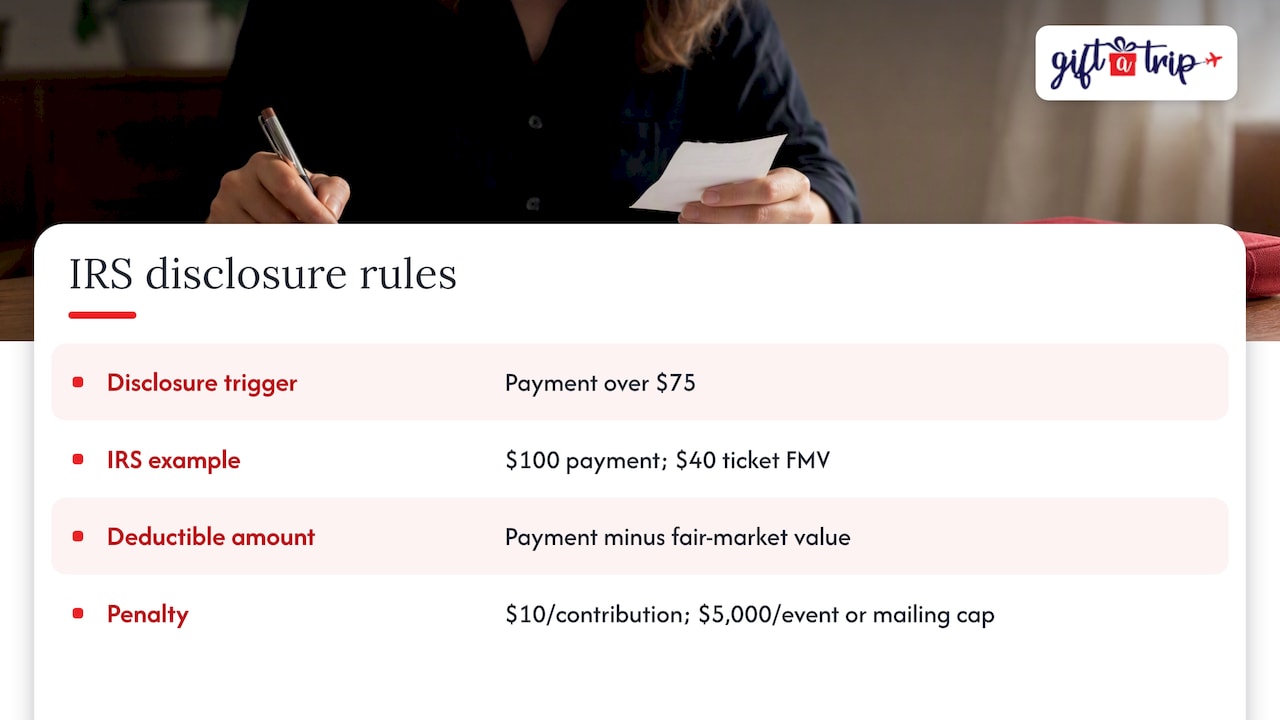
The same page lists exceptions. No disclosure is required for benefits that meet the insubstantial-value rules, for certain qualifying annual-membership benefits when payments are $75 or less per year, or for solely intangible religious benefits. If you miss a required disclosure, the penalty is $10 per contribution, capped at $5,000 per fundraising event or mailing, unless you have reasonable cause.
In practice: a thank-you mug sent after a $50 gift is a different situation from a resort stay offered to anyone who gives $1,000. Before you launch a tier that includes a high-value reward, talk to your accountant or tax counsel about how to value the item and word the receipt.
How to choose incentives that fit your budget and audience
Start with these five steps.
- Name one behavior. Early gifts, monthly sign-ups, referrals or upgrades. Incentives work best when tied to the specific action you want, as Ecuadane puts it.
- Ask your donors. A five-question survey or ten phone calls will tell you whether they care about recognition, access, merchandise or nothing at all. Wired Impact advises learning what supporters value and keeping incentives mission-focused.
- Count the full cost. Include production, storage, shipping, staff time and the tax paperwork. Personalized items cost more and take more labor.
- Test on a segment. Send the incentive to half of a list and compare gift rate and average gift. Given the crowding-out result, keep your most loyal donors out of the first test, or run them as a separate control.
- Plan fulfillment before you announce. A promise you cannot deliver on time costs more in trust than the incentive earned.
The 2022 meta-review adds a useful caution: evidence on many fundraising tactics is uneven, so combine expert judgment with what you know about your own audience instead of applying incentives blindly.
Our perspective: reward the relationship, not the transaction
We work with organizations that give travel certificates to employees, customers and supporters, and the pattern is consistent. People remember an experience far longer than an object. A donor who spends a weekend at a resort they were gifted tells people about it, and it comes back to your organization as goodwill.
But we are equally clear about the limits. Do not use a trip to buy a gift that would have been given anyway. Use it where it marks something real: a multi-year donor, a top fundraiser, an auction winner, a volunteer who gave a season of weekends. Keep it simple for your team too. Digital delivery means no stock to manage, no minimum order means you can start with a handful of thank-yous, and certificates that include taxes and fees avoid awkward surprises for the recipient.
If you want to see how others structure this, our pieces on the benefits of travel rewards for nonprofits and a travel gift fundraising guide go step by step.
— Donovan
Using travel certificates as donor rewards and auction items
Travel is also one of the strongest items you can put in front of a room. If your gala or online auction needs a headline lot, read what makes a good auction item and these creative auction item ideas, then see how the charitable auction travel workflow runs from donation to delivery.
Gift A Trip offers travel certificates for cruises, resorts and hotels, and golf and spa getaways, with digital delivery and an option for presentation in a Red Box at $69 when you want a physical moment at an event. If you are rewarding many people at once, the corporate gifting page covers custom trip selection sites, branded gift boxes and airfare vouchers.
FAQ
What is the best incentive to get people to donate?
There is no single best one. A matching challenge is the lowest-cost way to encourage a gift today, while recognition and personal notes tend to suit recurring donors. Pick the one that matches the behavior you want, then test it on a small group first.
Do donation incentives actually work?
Sometimes. Research has found that thank-you gifts can reduce giving among your most committed donors, and that monetary incentives in acquisition mailings can raise response while lowering average gift and return. They tend to work best for new or lapsed donors and for rewarding specific actions, not as a blanket offer to everyone.
Are donor incentives tax-deductible?
Only the part of a payment that exceeds the fair-market value of what the donor receives is deductible. If a donor pays more than $75 and gets goods or services in return, the IRS requires you to give a written disclosure with a good-faith estimate of that value. Check your specific situation with a tax professional.
What incentives work for monthly donors?
Low-cost, relationship-based ones: exclusive online content, an annual impact report, handwritten postcards, a member badge or card, and a note on the first anniversary of giving. Avoid perks whose cost is close to the monthly gift.
How do I give incentives without managing inventory?
Choose digital or experience-based rewards: private online content, event invitations, or travel certificates delivered by email. They carry high perceived value and need no storage, packing or shipping.
Sources
- Demotivating incentives and motivation crowding out in charitable giving (Chao, 2017)
- What Works to Increase Charitable Donations? A Meta-Review (2022)
- Coins Are Cold and Cards Are Caring, Journal of Marketing (2020)
- IRS: Charitable contributions, quid pro quo contributions
- Applying behavioural insights to charitable giving
- AFP: Why donor appreciation events matter
- Mid-Level Donor Stewardship Plan, Dormie Network Foundation
- Using Donor Incentives to Attract or Retain Supporters, Wired Impact
- Nonprofit Fundraising Incentives, Donorbox
- 7 Donation Incentives, CallHub
- 10 Fundraising Incentive Ideas, Ecuadane
- Donor Recognition Ideas, OmniAlly
- Fundraising Offer Toolkit, Nonprofit Storytelling Conference
- 15 Donation Incentive Ideas, WhyDonate