Jump to Section:
TL;DR:
- Proper management of travel auction items, especially using no-risk consignment, significantly increases fundraising revenue.
- Effective platform integration, emotional storytelling, and prompt fulfillment are essential for maximizing donor engagement and satisfaction.
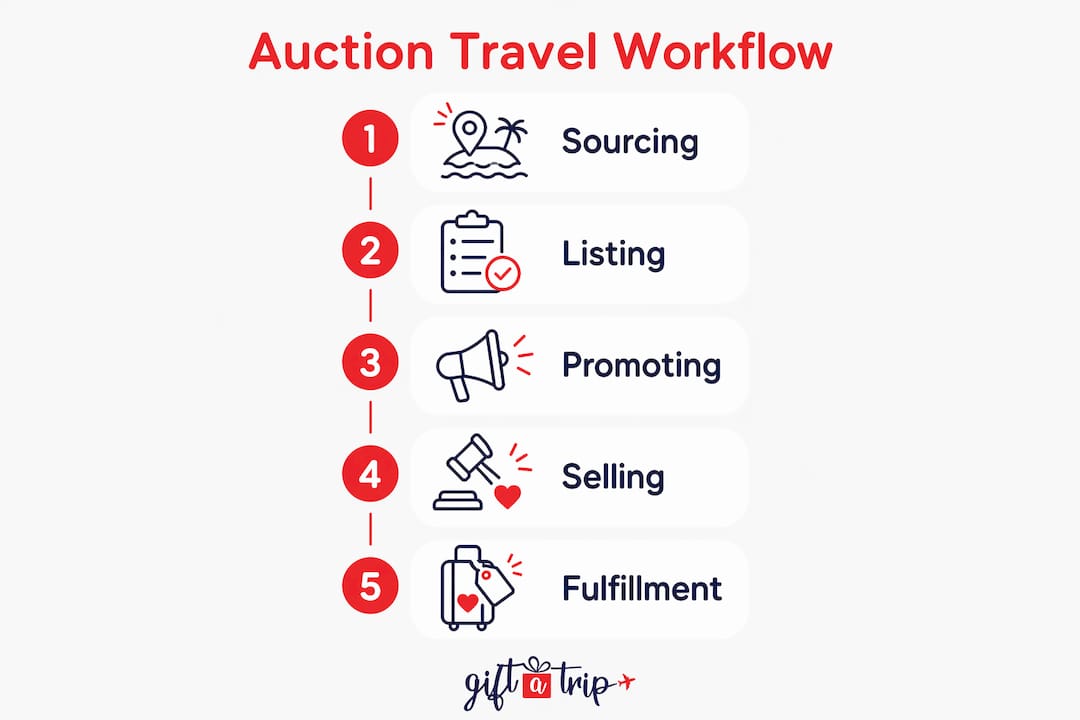
A charitable auction travel workflow is a systematic process that covers sourcing, managing, promoting, and fulfilling travel-related auction items to maximize fundraising revenue and protect donor satisfaction. Nonprofits that treat this as a structured process rather than an ad hoc task consistently raise more money and avoid costly post-event headaches. The no-risk consignment model, championed by platforms like GalaBid, has become the industry standard for reducing financial exposure. Travel packages are the highest-performing auction category in nonprofit events, generating stronger donor competition than almost any other item type. Getting the workflow right from the start is what separates a record-breaking gala from a frustrating one.
What is the charitable auction travel workflow?
The charitable auction travel workflow is the end-to-end process that event organizers use to source, list, promote, sell, and fulfill travel items in a fundraising auction. The industry term for this broader practice is “auction item management,” and the travel category sits at the top of that process because of its revenue potential and emotional pull. A well-built workflow covers four distinct phases: procurement, platform integration, live auction promotion, and post-event fulfillment. Each phase has its own decisions, deadlines, and risks. Skipping or rushing any one phase creates problems that surface at the worst possible time, usually in front of donors.
How to source travel packages for a charity auction
Procurement is where most nonprofits either protect themselves or expose themselves to real financial risk. The two main sourcing paths are donated packages and consignment packages, and each has a distinct risk profile.
Donated packages come from sponsors, board members, or community partners at no cost to the organization. They carry zero financial risk, but they are unpredictable in quality, redemption terms, and availability. A donated beach house week sounds appealing until winners discover a two-week blackout window covering every school holiday.
Consignment packages are supplied by third-party providers under a sale-or-return agreement. Consignment travel packages allow nonprofits to avoid upfront costs entirely, paying the provider only when the item sells. If the package goes unsold, it returns with no cost incurred. That model has made consignment the preferred approach for organizations that want a predictable, professional item catalog without tying up budget.
When evaluating any consignment provider, check these factors before signing:
- Pricing transparency: Confirm the provider’s cost to you and the minimum bid required to generate a net positive for your organization.
- Redemption window: Longer redemption periods, typically 12–18 months, give winners flexibility and reduce complaints.
- Blackout dates: Ask for a full list in writing. Vague language like “subject to availability” is a red flag.
- Transferability: Confirm whether winners can gift the package to someone else, since that question will come up.
- Fulfillment support: The best providers handle booking directly with winners, removing that burden from your volunteer team.
Aim for roughly one prize per 10 guests in a silent auction format. That ratio keeps bidder interest high without diluting competition across too many items.
Pro Tip: Call the provider’s customer support line before committing. If it takes more than two business days to get a clear answer on redemption terms, that delay will multiply after your event when winners need help booking.
How do you integrate travel items into your auction platform?
Platform integration is the step most organizers underestimate, and it is where manual errors pile up fastest. Auction items integrated directly into fundraising platforms increase operational efficiency and improve bidder experience by automating tracking and payment. Real-time bidding updates and automated notifications remove the need for volunteers to chase down winning bids by hand.
A clean integration workflow follows this sequence:
- Upload item details early. Enter package descriptions, retail values, starting bids, and images at least two weeks before the event. Last-minute uploads produce typos and missing information that confuse bidders.
- Set starting bids deliberately. Starting bids often range from 5–20% of retail value for consignment items. A starting bid that is too high kills early momentum; one that is too low risks selling below your cost threshold.
- Enable automated outbid notifications. Bidders who receive a text or email when they are outbid return to the auction and bid again. This single feature drives a measurable increase in final sale prices.
- Connect payment processing directly. Platforms that handle payment within the same system reduce checkout friction and eliminate the risk of winners walking out without paying.
- Assign each item a fulfillment contact. Before the event opens, designate one person responsible for each travel package’s post-auction handoff. Ambiguity here causes delays that damage donor relationships.
On the promotional side, selling the emotional experience rather than the logistics consistently drives higher bids. Your item description should paint a picture of the vacation, not list the fine print. “Five nights at a beachfront resort in Cancún, with breakfast included and a sunset sail on arrival evening” outperforms “Resort stay, 5 nights, Mexico, some restrictions apply” every time.
Pro Tip: Create a one-page “experience preview” for each headline travel package. Include a photo, three bullet points describing the experience, and the starting bid. Display it on screens during the reception hour before bidding opens. Donors who visualize the trip before they bid always bid higher.
For more ideas on framing travel items as emotional centerpieces, the top fundraising travel ideas resource from Giftatrip covers high-performing package formats used in 2026 events.
Managing booking, fulfillment, and winner support
Post-auction fulfillment is where donor goodwill is either cemented or lost. The auction closes, the winner is excited, and then nothing happens for two weeks. That gap is where organizations lose repeat donors.
A reliable fulfillment workflow covers these areas:
- Send winner instructions within 24 hours. Include the provider’s booking contact, the redemption deadline, and a clear list of what is and is not included. Do not make winners hunt for this information.
- Disclose all restrictions upfront. Clear disclosure of blackout dates, restrictions, and hidden costs prevents donor dissatisfaction and protects your organization’s reputation. Surprises after payment destroy trust.
- Confirm the provider offers concierge support. Effective consignment providers offer comprehensive booking and concierge support for winners, handling the redemption process directly. That support reduces the volume of questions your team fields in the weeks after the event.
- Track redemption status. Build a simple spreadsheet or use your platform’s reporting tools to monitor which packages have been booked and which are approaching their expiration window. Follow up with winners who have not yet booked at the 60-day and 90-day marks.
- Document everything. Keep records of all winner communications, booking confirmations, and provider correspondence. If a dispute arises, documentation resolves it quickly.
Transparency is not just good ethics. It is a retention strategy. Donors who have a smooth redemption experience return to your next event and bring friends. Donors who feel misled do not come back and often say so publicly.
What are the most common challenges in travel auction workflows?
Even well-planned events run into friction. Knowing the common failure points in advance lets you build workarounds before they become problems.
- Unsold items: Set a realistic starting bid and promote the package actively before bidding opens. An item that receives zero bids usually suffered from poor visibility, not poor quality.
- Late bookings: Winners sometimes delay redemption until the package is weeks from expiring. A proactive follow-up schedule at 60 and 90 days post-event prevents last-minute scrambles.
- Confusing redemption rules: Simplify. If your winner instructions require more than one page to explain, the provider’s terms are too complex. Choose providers whose redemption process a first-time traveler can follow without calling for help.
- Volunteer overload: Assign one person per travel item for post-event support. Spreading fulfillment responsibility across the whole team means no one owns it.
- Provider reliability: Vet providers by asking for references from other nonprofits. A provider that has fulfilled packages for organizations similar to yours is a lower-risk choice than one with no track record in the sector.
An integrated auction workflow that consolidates item management, bidding, payment, and fulfillment in one system reduces errors and manual workload for event teams. Unified platforms improve data accuracy and make it far easier to spot problems before they reach donors.
Pro Tip: Run a final workflow audit 48 hours before your event opens. Check that every travel item has a complete description, a confirmed starting bid, a designated fulfillment contact, and a printed winner instruction sheet ready to hand out. Catching a missing detail at that stage costs minutes. Catching it after the auction closes costs hours and goodwill.
For a full walkthrough of the procurement and listing process, the charity auction gift certificates guide from Giftatrip covers each step in practical detail.
Key Takeaways
A successful charitable auction travel workflow depends on no-risk consignment sourcing, platform integration, experience-driven promotion, and proactive post-event fulfillment working together as a single system.
| Point | Details |
|---|---|
| Use consignment sourcing | Consignment packages eliminate upfront costs and return unsold with no financial loss to your organization. |
| Set starting bids at 5–20% of retail | This range attracts early bidders while protecting your minimum net proceeds from each travel item. |
| Sell the experience, not the logistics | Descriptions focused on emotional value consistently produce higher final bids than fine-print-heavy listings. |
| Disclose all restrictions before bidding | Upfront transparency on blackout dates and transferability prevents post-auction disputes and donor attrition. |
| Send winner instructions within 24 hours | Fast, clear fulfillment communication cements donor goodwill and increases the likelihood of repeat attendance. |
What I’ve learned from watching travel auctions succeed and fail
The single biggest mistake I see event organizers make is treating travel packages as passive items. They list the package, open bidding, and assume the item will sell itself because travel is universally appealing. It does not work that way.
The events that generate the most revenue from travel items are the ones where the organizer actively tells a story about the package. A volunteer stands up during the live portion and describes the resort at sunset. A short video plays on the screen. The item description uses language that makes the bidder feel like they are already there. That storytelling is not fluff. It is the mechanism that converts a curious glance into a competitive bid.
The second lesson is about partner selection. I have watched organizations choose a consignment provider based on price alone, only to spend the three months after the event managing angry winner calls because the booking process was a mess. The provider’s cost matters, but their fulfillment quality matters more. A provider that handles winner support well is worth a slightly higher cost per package because they protect your relationship with your donors.
Technology integration is the third lever that most organizations are still underusing. When your auction platform, payment processor, and fulfillment tracking all live in the same system, your volunteer team spends less time on data entry and more time on donor engagement. That shift alone can meaningfully improve the energy in the room on event night.
For organizers who want to understand the full range of what travel auction certificates can do for a fundraising program, the category is broader and more flexible than most people realize.
— Donovan
Travel certificates that work for your next charity auction
Giftatrip provides digital travel certificates that fit directly into a charitable auction workflow, with no upfront cost required and flexible redemption options that winners actually use.
The catalog includes Virgin Voyages cruise certificates, resort stays, and golf getaway packages that consistently perform as headline auction items. Taxes and resort fees are covered, blackout dates are minimal, and secure digital delivery means your team can procure and distribute certificates without managing physical inventory. Giftatrip also supports bulk orders with customizable presentation options, making it straightforward to prepare multiple travel items for a single event. For organizers who want a reliable, professionally managed travel item catalog, Giftatrip is built for exactly that use case.
FAQ
What is a charitable auction travel workflow?
A charitable auction travel workflow is the structured process nonprofits use to source, list, promote, sell, and fulfill travel-related items in a fundraising auction. It covers every stage from procurement through winner redemption.
How do consignment travel packages work for nonprofits?
Consignment packages are supplied by third-party providers at no upfront cost. The nonprofit pays the provider only when the item sells, and unsold packages are returned with no financial obligation.
What starting bid should I set for a travel auction item?
Starting bids for consignment travel items typically range from 5–20% of retail value. This range attracts early bidders while protecting the organization’s minimum net proceeds.
How soon should winners receive their redemption instructions?
Send winner instructions within 24 hours of the auction closing. Fast communication reduces confusion, prevents booking delays, and protects donor goodwill after the event.
Why do travel packages outperform other auction items?
Travel packages generate higher bids because of their universal appeal and emotional value. Donors compete more aggressively for experiences than for physical goods, making travel the top-performing category in nonprofit auctions.