
Jump to Section:
TL;DR:
- Travel rewards help nonprofits reduce travel costs and serve as valuable donor incentives and auction items.
- Implementing a formal compliance framework and strategy maximizes benefits and minimizes audit risks.
The benefits of travel rewards for nonprofits include measurable cost savings on mission-critical travel and powerful tools to deepen donor engagement and fundraising results. Nonprofits that treat travel rewards as a strategic asset, rather than a side perk, unlock a second revenue channel that costs nothing extra to activate. Programs like the Aeroplan Member Donation Program and specialized nonprofit airfare contracts prove that points, miles, and travel certificates translate directly into budget relief and donor motivation. This guide covers how to capture those benefits, avoid the compliance traps, and build a rewards strategy that holds up to IRS scrutiny.
What are the real benefits of travel rewards for nonprofits?
Travel rewards reduce the cost of every flight, hotel stay, and conference your organization attends, and they do it without requiring a separate fundraising campaign. For nonprofits where travel is woven into program delivery, that reduction compounds quickly across a fiscal year.

The Aeroplan Member Donation Program has facilitated over 1.8 billion points donated to 1,554 nonprofits since 2006. That volume represents real flights, real auction items, and real budget relief for organizations that would otherwise pay full price. The scale of that program alone confirms that travel rewards are not a novelty. They are a recognized funding mechanism.
Beyond cost savings, travel rewards serve as donor incentives that money cannot easily replicate. A weekend resort stay or a cruise certificate offered at a gala auction generates excitement that a gift card rarely matches. Nonprofits that align travel perks for charities with donor interests consistently report stronger auction performance and higher donor retention.
The financial case is equally direct. Nonprofits that allocate 60% or more of their budget to travel benefit more from travel rewards cards than from cash back, because the rewards act as ongoing mini-fundraisers by reducing operating costs. That framing matters. It repositions travel rewards from a convenience into a financial strategy.
How do travel rewards reduce nonprofit operating costs?
Cost reduction is the most immediate and measurable benefit, and it operates through three distinct channels: discounted rates, earned points, and redeemed miles.
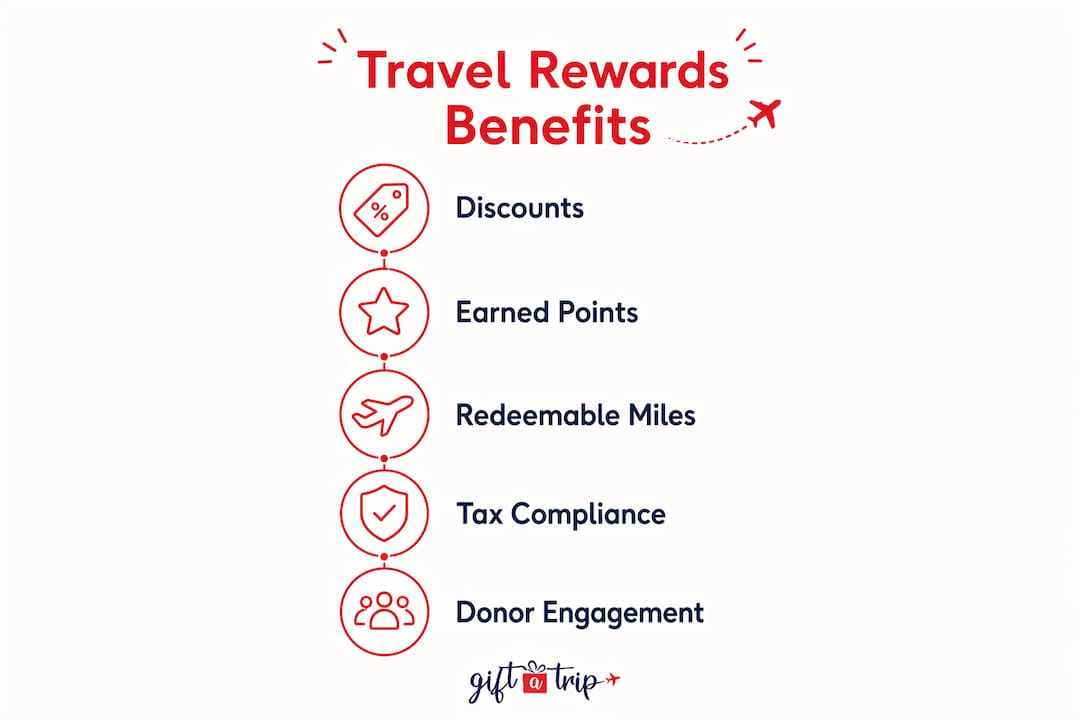
Specialized nonprofit airfare contracts offer over 33% savings on international travel, plus perks like extra checked bags and flexible ticketing. For an organization sending staff to international conferences or field programs, that discount on a single trip can exceed the annual fee of any rewards card. The savings are not theoretical. They appear on the invoice.
Earning points on routine expenditures adds another layer. Every hotel booking, rental car, and catered event charged to a travel rewards card generates miles or points that reduce the cost of the next trip. The key is consolidating spend onto one card rather than spreading it across multiple accounts, which dilutes point accumulation.
Redeemed points can cover staff travel, volunteer transportation, and in some cases beneficiary travel. That last use case is often overlooked. When a nonprofit can fly a program participant to a medical appointment or training event using accumulated miles, the mission impact is direct and the cost is zero.
- Discounted airfare through nonprofit-specific contracts cuts international travel costs by more than a third
- Points earned on hotel, catering, and event spend reduce the cost of future travel
- Miles redeemed for volunteer or beneficiary travel extend program reach without additional budget
- Auction items sourced from donated points generate fundraising revenue that offsets operating expenses
Pro Tip: Consolidate all travel-related purchases onto a single rewards card tied to your highest-volume travel program. Splitting spend across cards fragments your points and delays redemption milestones.
How travel rewards enhance donor engagement and fundraising
Travel rewards become fundraising tools the moment you convert points into experiences that donors want to bid on or earn. The psychology is straightforward: a tangible travel experience creates anticipation and memory in a way that a check cannot.
Converting points or miles into auction items is the most direct application. A donated travel package, whether a resort stay, a cruise certificate, or a flight upgrade, commands higher bids at charity galas than most physical items. Donors perceive travel as aspirational, which drives competitive bidding and increases total auction revenue. The role of travel in donor engagement is well documented, and organizations that build travel experiences into their fundraising calendar consistently outperform those that rely solely on cash appeals.
Offering travel experiences as incentives to top donors or major gift prospects strengthens loyalty in a different way. When a donor who gives above a certain threshold receives a travel certificate as a thank-you, the gesture signals that the organization values the relationship beyond the transaction. That signal is worth more than its face value.
- Convert accumulated miles into resort stays or cruise packages for live auction items
- Use travel certificates as recognition gifts for donors who reach giving milestones
- Offer travel experiences as matching gift incentives during year-end campaigns
- Partner with travel reward programs to source donated packages at no cost to the organization
Pro Tip: When sourcing travel packages for auctions, choose certificates with minimal blackout dates and covered resort fees. Donors who win a package and then face hidden costs associate that frustration with your organization, not the travel provider.
Aligning rewards with donor interests requires knowing your audience. A donor base that skews toward families responds differently to a beach resort certificate than one that skews toward adventure travelers. Survey your top donors before your annual gala and match the travel package to the room.
What pitfalls should nonprofits avoid with travel rewards?
The compliance landscape for nonprofit travel is specific, and ignoring it turns a financial asset into an audit liability. Three areas require consistent attention: IRS accountable plans, grant budget alignment, and reward program caps.
IRS accountable plans allow nonprofits to reimburse employee travel expenses tax-free, lowering payroll tax burdens and keeping reimbursements off taxable income. Without a formal accountable plan in place, reimbursements become taxable wages. That outcome erases any savings the rewards program generated. Establishing the plan is a one-time administrative task with permanent financial benefit.
Grant compliance is the second pressure point. Travel expenses charged to federal awards must be strictly allocable within approved grant budget periods. Booking airfare outside those periods, even for a mission-critical trip, triggers compliance issues that can jeopardize the entire award. The fix is procedural: require staff to confirm grant period dates before booking any travel charged to a federal account.
Reward program caps create a third, less obvious trap. Some credit cards cap rewards annually at thresholds as low as $500, which diminishes returns for nonprofits with high travel volumes. A card that earns 3x points on travel but caps at $500 per year is the wrong card for an organization that spends $80,000 annually on flights.
- Establish a written IRS accountable plan before issuing any travel reimbursements
- Confirm grant budget period dates before booking any federally funded travel
- Map your annual travel spend against each card’s reward cap before selecting a program
- Document all travel with receipts for lodging and per diem records for meals
- Assign grant or project codes at the time of booking, not during reconciliation
“A clean audit trail from booking to reimbursement is not just a compliance requirement. It is the foundation of organizational credibility with funders and donors alike.”
Assigning grant codes at booking avoids costly audit reconstructions and keeps every dollar of travel spend aligned with its approved budget. Finance teams that require this step at the point of purchase, rather than after the fact, report significantly fewer reconciliation errors.
How should nonprofits choose travel rewards programs and credit cards?
Selecting the right program requires mapping your organization’s actual spending patterns against the reward structures on offer. The comparison is not complicated, but it requires honest data.
| Criteria | Travel rewards cards | Cash back cards |
|---|---|---|
| Best for | Nonprofits spending 60%+ of budget on travel | Nonprofits with mixed or low travel spend |
| Reward type | Miles, points, travel certificates | Flat percentage cash return |
| Redemption flexibility | Flights, hotels, auction items, beneficiary travel | Unrestricted cash or statement credit |
| Annual fee consideration | Justified when travel volume is high | Lower fees matter more at low spend volumes |
| Reward caps | Watch for low annual caps that limit high-volume earners | Caps less common but still present |
The cash back versus travel points decision comes down to volume and intent. If your organization spends heavily on travel and wants to convert rewards into donor-facing experiences, travel points win. If your travel spend is modest and you need unrestricted budget flexibility, cash back is simpler and safer.
Redemption flexibility matters as much as earn rate. A program that locks points into a single airline or hotel chain limits your ability to source auction items or cover volunteer travel. Programs with transferable points, like those that move to multiple airline and hotel partners, give you more options at redemption time.
Pro Tip: Before applying for any rewards card, pull 12 months of travel expense reports and categorize spend by type: airfare, hotel, ground transport, meals. Match those categories to the bonus earn rates on each card you are evaluating. The math takes 20 minutes and prevents years of suboptimal earning.
For 2026, nonprofits with significant international travel should prioritize programs that waive foreign transaction fees and offer flexible ticketing, since those features directly reduce the cost of mission travel without requiring any additional administrative effort.
Practical tips for implementing travel rewards in nonprofit workflows
Implementation is where most nonprofits lose the value they worked to earn. The rewards exist in the account, but no one has a clear process for redeeming them, documenting them, or aligning them with program budgets.
- Establish a formal written accountable plan that specifies reimbursable travel categories, required documentation, and submission timelines
- Require grant or project code assignment at the time of booking, not during monthly reconciliation
- Designate one staff member as the rewards account manager responsible for tracking balances, expiration dates, and redemption opportunities
- Coordinate between finance and program teams quarterly to align upcoming travel with available reward balances
- Use IRS per diem rates for meals and incidentals to waive receipt requirements and reduce administrative burden without sacrificing compliance
- Document all reward redemptions with the same rigor as cash expenditures, including purpose, amount, and grant allocation
The coordination between finance and program teams is the step most organizations skip. Program staff book travel based on mission needs. Finance staff track spend against budgets. When those two functions operate independently, reward balances go unused and compliance gaps appear. A quarterly alignment meeting closes that gap in under an hour.
Travel reward partners and platforms work best when your team treats them as vendors, not perks. Negotiate directly with program representatives, ask about nonprofit-specific tiers, and request documentation of any donated points or certificates for your audit file.
Key takeaways
Travel rewards for nonprofits deliver the greatest return when organizations combine high travel volume with formal compliance procedures and a clear strategy for converting rewards into donor-facing value.
| Point | Details |
|---|---|
| Cost savings are immediate | Nonprofit airfare contracts and earned points reduce travel costs by over 33% on international routes. |
| Rewards double as fundraising tools | Donated points and travel certificates generate competitive auction bids and strengthen donor loyalty. |
| Compliance is non-negotiable | IRS accountable plans and grant period alignment protect tax-free reimbursements and federal award eligibility. |
| Card selection requires spend mapping | Match your annual travel categories to reward earn rates and caps before committing to any program. |
| Implementation needs ownership | Assign a rewards account manager and require grant codes at booking to prevent value leakage. |
Why most nonprofits underuse travel rewards, and what I’d do differently
I have worked with enough nonprofit finance teams to know that travel rewards sit in a strange blind spot. Leadership understands fundraising strategy. Finance understands compliance. But the intersection of the two, which is exactly where travel rewards live, often belongs to no one.
The organizations that get this right treat their rewards account the way a for-profit company treats a vendor contract. They negotiate, they track, and they plan redemptions in advance. The ones that struggle treat rewards as a bonus that appears when someone remembers to check the balance.
The Aeroplan model is instructive here. Over 1.8 billion points donated to nonprofits over 20 years did not happen by accident. It happened because Air Canada built a structured program and nonprofits showed up with a plan to use it. That same intentionality applies to every rewards card and travel program your organization touches.
My honest recommendation: start with the compliance infrastructure before you optimize for rewards. An accountable plan, a grant code protocol, and a designated account manager cost nothing to implement and protect everything you earn. Once those are in place, the travel rewards for fundraising opportunities become much easier to execute without risk.
The biggest mistake I see is chasing the highest earn rate without checking the redemption terms. A card that earns fast but redeems poorly is a trap. Flexibility at redemption, not speed at earning, is what creates real value for a nonprofit with diverse travel and fundraising needs.
— Donovan
Elevate your nonprofit fundraising with Giftatrip travel certificates

Giftatrip offers digital travel certificates redeemable at resorts, hotels, and cruise lines from major brands, making them ideal for nonprofit donor rewards and charity auction packages. Every certificate covers taxes and resort fees, so your donors receive exactly what you promise with no hidden costs. For organizations looking to add a high-impact item to their next gala or recognition program, Virgin Voyages cruise certificates from Giftatrip deliver the kind of aspirational experience that drives competitive bidding. Giftatrip also provides bulk ordering with customizable gift boxes and personalized messaging, giving your team a polished, professional way to deliver travel rewards at scale. Explore the full range of flexible travel certificate solutions and find the right fit for your next fundraising campaign.
FAQ
What are the main benefits of travel rewards for nonprofits?
Travel rewards reduce operating costs through discounted airfare, earned points on routine spend, and redeemable miles for staff or beneficiary travel. They also serve as high-value donor incentives and auction items that strengthen fundraising results.
How can nonprofits earn travel rewards on existing spending?
Nonprofits earn travel rewards by charging travel-related expenses, including flights, hotels, and catering, to a dedicated travel rewards credit card. Consolidating spend onto one card accelerates point accumulation and reaches redemption thresholds faster.
Do travel rewards create IRS compliance issues for nonprofits?
Travel rewards do not create compliance issues when the organization maintains a formal IRS accountable plan and documents all reimbursements properly. Without an accountable plan, reimbursements become taxable wages and the tax benefit disappears.
What should nonprofits look for when choosing a travel rewards card?
Nonprofits should map 12 months of travel spend by category and compare those figures against each card’s earn rates, annual reward caps, and redemption flexibility. Cards with low annual caps are a poor fit for organizations with high travel volumes.
Can travel rewards be used as fundraising auction items?
Yes. Donated points and purchased travel certificates can be converted into resort stays, cruise packages, or flight upgrades that perform well at charity auctions. Programs like the Aeroplan Member Donation Program exist specifically to supply nonprofits with travel-based auction inventory.