
Jump to Section:
TL;DR:
- Travel incentives for volunteers include tax-deductible expenses, fully funded placements, and discounted program fees to offset service costs. Effective programs promote transparency, document service hours, and align with community needs to attract committed volunteers and maximize tax benefits. Giftatrip offers digital travel certificates as flexible recognition rewards, enhancing volunteer appreciation efforts.
Travel incentives for volunteers are defined as structured benefits that nonprofits and community coordinators use to offset the cost of service and enrich the volunteer experience. These rewards range from tax-deductible travel expenses and discounted program fees to fully funded placements that cover airfare, lodging, and meals. Understanding travel incentives for volunteers explained in practical terms helps coordinators design programs that attract committed people and keep them coming back. Organizations operating under 501©(3) status, government-backed programs like the European Solidarity Corps, and platforms like Giftatrip all play a role in making volunteer travel rewards accessible and credible.
What types of travel incentives are commonly offered to volunteers?
Travel incentive programs for volunteers fall into four broad categories: expense reimbursements, fully funded placements, fee discounts, and intangible benefits. Each type serves a different volunteer profile, so coordinators who understand all four can build more flexible programs.

Expense reimbursements
U.S. volunteers working with 501©(3) organizations can deduct travel costs including airfare, lodging, and meals directly tied to their service. This is one of the most underused incentives in nonprofit volunteer management. Many volunteers do not realize their out-of-pocket travel costs may qualify as charitable deductions, which effectively reduces the real price of participation.
Fully funded placements
The European Solidarity Corps offers fully funded volunteer placements for people aged 18–30, covering travel, accommodation, meals, health insurance, and a pocket money allowance. Placements run from 2 weeks to 12 months. That breadth makes the program one of the most comprehensive government-backed volunteer travel rewards available anywhere.

Discounted program fees and affordable access
Many volunteer travel programs charge as low as $15–$20 per day, covering lodging, meals, orientation, and on-the-ground support. That price point makes international volunteering accessible to people who cannot afford traditional travel. Coordinators can use this cost structure as a selling point when recruiting volunteers on limited budgets.
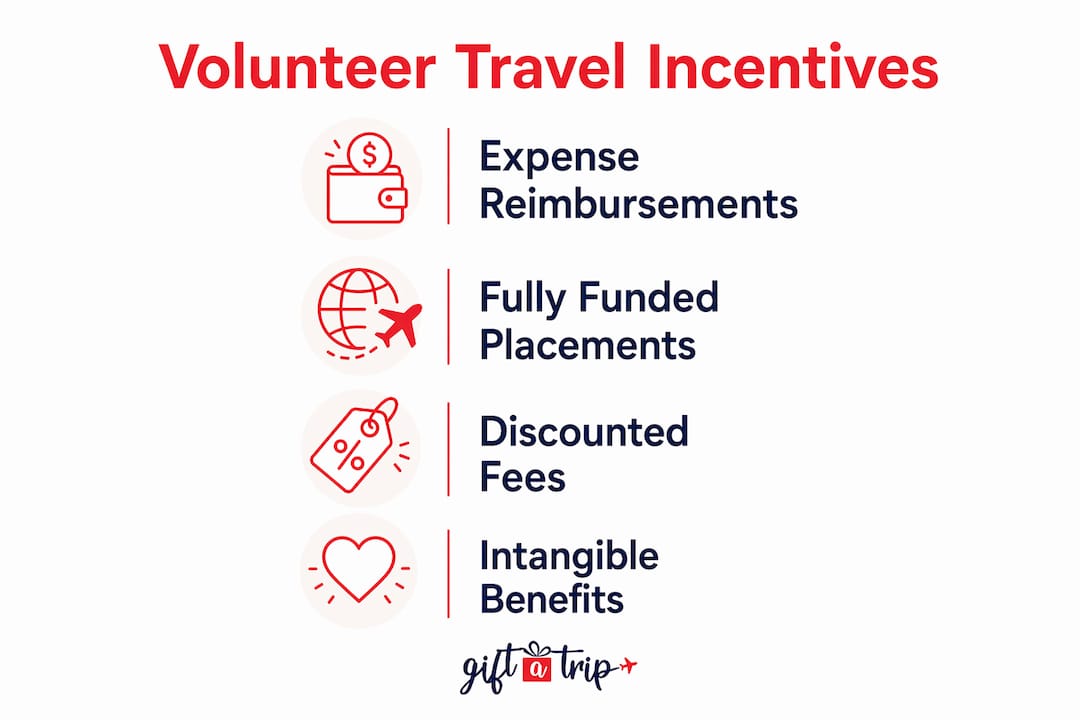
Intangible incentives
Transferable skills and CV enhancements represent a powerful non-monetary incentive, especially for early-career professionals. Volunteers gain cross-cultural communication skills, project management experience, and professional networks that carry real career value. These benefits of volunteer travel often outlast the trip itself.
Pro Tip: When promoting your program, list the specific skills volunteers will develop alongside the financial incentives. Concrete skill outcomes attract motivated candidates who are less likely to drop out.
How do tax regulations affect volunteer travel incentives?
Tax rules shape how coordinators frame their programs and what documentation they must provide to volunteers. Getting this right protects both the organization and the volunteer.
-
Confirm 501©(3) status. Only volunteers serving registered 501©(3) organizations qualify to deduct travel expenses as charitable contributions. Coordinators must provide written confirmation of the organization’s tax-exempt status to every volunteer who asks.
-
Set documented service hours. The IRS requires that volunteer travel serve a genuine charitable purpose. The standard benchmark is 8 hours per day, 5 days per week of documented service. Programs that fall short of this threshold risk having volunteer deductions disallowed during an audit.
-
Keep detailed records. Volunteers need receipts, itineraries, and signed hour logs to substantiate their deductions. Coordinators should provide a standardized documentation packet at the start of every placement. Clear documentation is the single most effective audit defense available to volunteers.
-
Separate personal travel from service travel. If a volunteer extends their trip for personal tourism, only the service-related portion qualifies for deduction. Coordinators should spell this out in writing before departure to avoid confusion and potential IRS scrutiny.
-
Communicate transparently about program fees. Volunteers cannot deduct fees that include personal benefits. Nonprofits that retain less than 12% of fees for administration and clearly itemize how the rest is spent build the trust needed for volunteers to feel confident claiming their deductions.
Pro Tip: Create a one-page tax summary sheet for volunteers at program enrollment. Include the organization’s EIN, a sample hour log template, and a list of deductible expense categories. This small investment in communication prevents a lot of post-trip confusion.
For a deeper look at how taxes interact with travel rewards, Giftatrip’s guide on tax treatment of certificates covers compliance considerations that apply to travel-based recognition programs.
What are best practices for designing volunteer travel incentive programs?
Effective volunteer travel programs do not happen by accident. Coordinators who build them well follow a consistent set of principles.
-
Frame incentives as cost-offsets, not free vacations. Programs that market themselves as free travel attract the wrong volunteers and create legal exposure. Successful programs use service-first language and define incentives as support for genuine work. That framing also strengthens the case for tax deductibility.
-
Align projects with community-identified needs. Organizations like Globe Aware work with local communities before volunteers arrive to ensure projects reflect actual priorities. This approach shifts the program from a charity model to a partnership model, which produces better outcomes and more satisfied volunteers.
-
Build loyalty incentives for returning volunteers. Offering returning volunteer discounts reduces participation barriers and rewards commitment. Repeat volunteers require less orientation time and deliver more impact, so the discount pays for itself in program efficiency.
-
Publish a clear fee breakdown. Volunteers who see exactly where their program fees go are far less likely to suspect “voluntourism” exploitation. Transparency about administration costs, housing, meals, and local staff salaries builds the credibility that keeps volunteers referring friends.
-
Partner with established funding sources and platforms. Government grants, corporate sponsors, and platforms like Giftatrip that offer travel certificate solutions can supplement your budget and add recognition value without straining your operating costs.
Coordinators planning accommodations for volunteers can also draw on hospitality insights from resources like Dragonfly Dream Weddings, which documents how lodging and meal provisions shape the overall guest and volunteer experience.
Examples of impactful volunteer travel programs in 2026
Real programs show what travel incentives look like in practice. The table below compares key features across program types that coordinators can use as benchmarks.
| Program type | Travel coverage | Daily cost to volunteer | Key incentive |
|---|---|---|---|
| European Solidarity Corps | Full (flights, housing, meals, insurance) | $0 (fully funded) | Pocket money allowance + health coverage |
| Affordable NGO support programs | Housing and meals included | $15–$20 | Low barrier to entry, professional roles |
| Community development placements | Housing included, meals variable | $20–$40 | Cultural immersion, skill certification |
| Corporate-sponsored volunteer trips | Partial (varies by sponsor) | Varies | CV enhancement, networking |
The European Solidarity Corps stands out because it removes every major financial barrier. Volunteers aged 18–30 receive travel, accommodation, meals, and insurance at no personal cost, plus a small allowance. That model proves that fully funded volunteer travel rewards are achievable when government or institutional backing is in place.
Affordable NGO support programs show that even without full funding, volunteer travel as a two-way gift works. Communities receive skilled support, and volunteers gain immersion and professional networks they could not build at home. That mutual benefit model is what separates high-impact programs from short-term tourism dressed up as charity.
For coordinators designing their own programs, the $15–$20 daily cost benchmark is a useful floor. It signals to prospective volunteers that the program is priced for access, not profit.
Key Takeaways
Travel incentives for volunteers work best when they combine financial transparency, documented service hours, and genuine community alignment to maximize both volunteer satisfaction and tax-deduction eligibility.
| Point | Details |
|---|---|
| Define incentives as cost-offsets | Frame travel rewards as service support, not free vacations, to attract committed volunteers. |
| Document service hours carefully | The IRS standard of 8 hours/day, 5 days/week is the benchmark for qualifying travel deductions. |
| Publish fee breakdowns | Nonprofits retaining under 12% for administration and disclosing costs build volunteer trust. |
| Use fully funded models as benchmarks | The European Solidarity Corps covers travel, housing, meals, and insurance at zero cost to volunteers. |
| Add loyalty discounts for repeat volunteers | Returning volunteer discounts reduce barriers and improve program efficiency over time. |
Why I think most nonprofits undervalue the tax angle
Most coordinators I have seen focus almost entirely on the experiential side of volunteer travel rewards. They lead with cultural immersion, community impact, and personal growth. Those are real benefits, and they matter. But the tax deductibility angle is consistently underused, and that is a missed opportunity.
A volunteer who knows their airfare and lodging are potentially deductible is looking at a meaningfully lower net cost of participation. That changes the math for people who want to serve but are watching their budgets. Coordinators who explain this clearly at recruitment, not buried in an FAQ, see higher sign-up rates from people who are serious about service.
The other thing I have learned is that transparency about fees is not just an ethical obligation. It is a recruitment tool. When volunteers see that less than 12% of their program fee goes to administration and the rest funds local housing, meals, and staff, they stop questioning whether the program is legitimate. That trust converts hesitant prospects into committed participants.
The best programs I have observed treat incentives as a system, not a list of perks. Tax benefits, loyalty discounts, skill development, and community partnership all reinforce each other. Pull one out and the whole structure feels weaker. Build them together and you have a program that volunteers talk about long after they return home.
— Donovan
How Giftatrip supports volunteer recognition programs
Nonprofits looking to add a tangible recognition layer to their volunteer programs have a practical option in digital travel certificates. Giftatrip offers digital travel certificates redeemable at major resorts, hotels, and cruise lines, with taxes and resort fees covered and minimal blackout dates.
These certificates work well as milestone rewards for volunteers who complete long placements or return for a second year of service. Giftatrip handles secure digital delivery and allows personalized messaging, so coordinators can recognize volunteers without adding logistics overhead. For programs that want to offer something memorable beyond a certificate of appreciation, Virgin Voyages cruise certificates represent a high-perceived-value reward that fits comfortably within a nonprofit recognition budget.
FAQ
What are travel incentives for volunteers?
Travel incentives for volunteers are structured benefits that offset the cost of service-related travel, including tax-deductible expenses, discounted program fees, and fully funded placements covering airfare, lodging, and meals.
Can U.S. volunteers deduct travel expenses on their taxes?
Yes. Volunteers serving registered 501©(3) organizations can deduct service-related travel costs, provided they document a minimum of 8 hours per day, 5 days per week of charitable work.
What does the European Solidarity Corps offer volunteers?
The European Solidarity Corps provides fully funded placements for volunteers aged 18–30, covering travel, accommodation, meals, health insurance, and a pocket money allowance for programs lasting 2 weeks to 12 months.
How should nonprofits frame travel incentives to attract serious volunteers?
Nonprofits should present travel incentives as cost-offsets for genuine service, not free vacations. Service-first language increases credibility, strengthens tax-deduction eligibility, and attracts volunteers who are committed to the mission.
How can digital travel certificates work as volunteer rewards?
Digital travel certificates, such as those offered by Giftatrip, give volunteers a flexible, high-value reward redeemable at hotels, resorts, and cruise lines. They are easy to distribute, require no physical logistics, and carry strong perceived value for milestone recognition.