
A peak season surcharge in travel is the extra amount you pay for the same flight, room or cruise because you chose a high-demand date. It rarely appears as a line called “peak season surcharge.” It shows up as a higher fare on a holiday weekend, a mandatory resort fee, or add-ons that turn a discounted base price into a much larger total. For anyone buying travel as a gift, a reward or a prize, the cleanest way to keep those extras from landing on the recipient is a certificate that covers taxes and fees up front and does not tie the trip to the busiest weeks. That is how we build our travel certificates at Gift A Trip.
This guide explains where peak pricing and fees actually appear, what the federal fee rule does and does not cover, and how HR managers, sales leaders, event planners, charities and individual gift givers can plan around them.
TL;DR
- “Peak season surcharge” is a term borrowed from freight shipping. In consumer travel the same effect comes from dynamic pricing, resort fees and add-on charges.
- Airfares can jump sharply around holidays. Forbes describes a New York to Chicago flight under $100 in the fall that can cost five times as much or more around Thanksgiving.
- The FTC’s fee rule, in effect since May 12, 2025, requires hotel and short-term rental sites to show mandatory fees in the advertised price. It does not apply to airlines.
- When you give travel, ask three questions: are taxes and fees included, which dates are excluded, and who pays if the trip lands in a peak week?
- Gift A Trip certificates are built around included taxes and fees and minimal blackout dates, so the recipient is not asked to cover surprises.
Table of Contents
- What a peak season surcharge means for travel
- Where peak pricing and fees show up
- What the numbers look like
- What the FTC fee rule changes, and what it leaves out
- Why gifting makes peak pricing a bigger problem
- A checklist before you buy travel as a gift or reward
- How recipients can dodge peak pricing
- Our perspective
- Give travel without the surprise
- FAQ
- Sources
What a peak season surcharge means for travel
The phrase “peak season surcharge” is most familiar from freight shipping, where carriers add a temporary fee during high-demand months. Search results for the term are mostly about containers and parcel delivery for that reason. Travel works differently. Airlines, hotels and cruise lines mostly build peak demand into the price itself, so there is no separate surcharge to spot. You just see a bigger number.
That makes it harder to compare. A fare that looks like a bargain on a Tuesday in October can be a different product altogether the Wednesday before Thanksgiving. Forbes explains that dynamic pricing can produce high prices on popular travel days, such as the days before and after holidays, and lower prices on weekdays, in shoulder seasons or off-season.
The second layer is fees that are not part of the base price. Resort fees, sometimes called facility or destination fees, are mandatory charges that historically appeared only at final checkout. The same CBS News report notes that airlines have shifted revenue toward add-ons such as seat selection while keeping base fares lower. So a peak-season trip can cost more in two ways: a higher base rate and more extras stacked on top.
Where peak pricing and fees show up
Different travel products add cost in different ways. This table summarizes the common patterns.
| Travel product | How peak demand raises the cost | What to check |
|---|---|---|
| Flights | Dynamic pricing raises fares on holiday-adjacent days | Travel day, not just travel week |
| Hotels and resorts | Higher nightly rates plus mandatory resort or facility fees | Whether the fee is in the displayed total |
| Vacation rentals | Cleaning and service fees added to the nightly rate | Total price before payment |
| Cruises | Holiday sailings cost more than the same ship and route on nearby dates; gratuities and packages add to the base fare | What the fare includes and what is billed separately |
| Packages | Bundled rates can reduce the gap, but car and activity costs may sit outside | What the bundle covers |
Two features of peak travel matter most to gift buyers. Prices move with demand on specific days, and many fees are tied to the property rather than the season, so they stay with the stay no matter when it happens.
What the numbers look like
Several published figures show how large the gap between an advertised price and a final cost can get.
- Holiday flights. Forbes reports that a direct New York to Chicago flight that may cost under $100 in the fall can rise five times or more in the days before and after Thanksgiving.
- Spring break. AAA data cited by CBS News in March 2025 showed domestic airfares up 7% and hotel stays up 8% year over year for the period.
- Hotel fees. Checkbook researchers found that 48 of 75 sampled three-, four- and five-star hotels in major U.S. cities charged resort or facility fees, ranging from $2 to $60 per night.
- Resort fee example. An FTC example reported by al.com is a $199 per night resort with a mandatory $39 daily resort fee. Under the rule, the fee has to be part of the total price shown.
A worked example makes the point. Take a four-night resort stay at $199 per night with a $39 daily fee. The advertised $199 suggests $796 before taxes. With the fee, the stay is $952 before taxes: $156 more, or about 20% above the headline figure. Move the same stay into a holiday week where the nightly rate rises, and the gap between what a recipient expects and what they pay grows. If they were handed a gift card for $800, they now cover the difference.
What the FTC fee rule changes, and what it leaves out
The FTC’s Rule on Unfair or Deceptive Fees took effect on May 12, 2025. According to Checkbook’s summary, it requires booking websites for hotels, vacation rentals, and concert and sports tickets to disclose all mandatory fees in the advertised price. Taxes, government charges, shipping charges and optional extras can be left out of the headline price if they are disclosed before payment and as prominently as the total.
Two limits matter for travel buyers:
- It does not apply to airlines. Airfare add-ons such as seat selection stay outside this rule.
- It does not cap fees. The rule governs how fees are displayed, not how high hotels and ticket vendors can set them.
The rule covers short-term lodging, including hotels, motels, vacation rentals and listings on rental platforms, per al.com’s explainer. A vacation rental’s mandatory cleaning fee, for example, must be included in the upfront total. If you want to see how this plays out for one amenity type, this breakdown of hotel room fees under the FTC rule shows what the displayed total has to include.
A cleaner display does not make the fee disappear, though. It just makes it visible earlier. If you are buying travel for someone else, the more useful question is who pays it. Our guide to resort fees and travel gifts goes deeper on that, and why resort fees matter to every traveler covers what they pay for.
Why gifting makes peak pricing a bigger problem
When you book your own trip, you see the total, decide, and pay. When you give travel, the person who experiences the extras is not the person who chose the product. Three situations come up again and again for our readers.
An employee reward. An HR manager hands out a travel reward as recognition. If the recipient later finds taxes, resort fees or a peak-week rate gap they must pay out of pocket, the reward feels smaller than the label. Our write-up on why to cover taxes and fees in rewards lays out the case.
A sales incentive. A sales leader promises a trip for hitting target. The winners want to travel when they can, which is often a school holiday or a long weekend. Those are the dates when dynamic pricing hits hardest.
A charity auction or event prize. The winner pays for the experience at the auction and expects it to be complete. Extras discovered at redemption reflect on the organizer.
A personal gift. A birthday, anniversary or honeymoon gift to a person with fixed school or work calendars. The gift needs to work when they can go.
For each, the gift should state clearly what is covered. Our page on travel gift card fees and the guide to certificates that include taxes and fees show what to look for in the terms.
A checklist before you buy travel as a gift or reward
Use this order. Each step is quick, and together they remove most surprises.
- Confirm what the price includes. Taxes, gratuities, resort or facility fees and service charges should be listed. If any are left to the recipient, price them in.
- Look at blackout dates. A certificate with long blackout periods can exclude exactly the weeks your recipient is free. Fewer restrictions mean fewer holiday conflicts.
- Check how dates are chosen. Open or flexible date use lets the recipient book when demand is lower. Our explanation of open date travel vouchers covers validity windows, and flexible date certificates covers tax questions for gifts and HR.
- Match the product to the recipient. A cruise gift suits a different person than a golf and spa resort stay. Browse cruise, resort and golf and spa options before choosing.
- Plan the handover. Digital delivery is quick for last-minute rewards. A physical presentation suits a milestone. See our travel gift presentation ideas.
- For large groups, plan distribution. The travel certificate distribution guide for HR and events covers the practical steps.
How recipients can dodge peak pricing
Even with a covered certificate, the recipient benefits from choosing dates wisely. A few habits help.
Shift the dates, not the destination. Holiday weeks cost more across the board. Midweek stays and shoulder seasons, the weeks between peak and off-peak, are where the gap shows. This guide to cheap weekend getaways shows how moving travel dates can lower accommodation costs.
Remember the seasons flip by hemisphere. Peak season depends on the destination and on where the traveler starts. A trip to a Southern Hemisphere destination in the northern summer can be priced high even when it is low season locally.
Book holiday cruises early. Christmas and New Year sailings are among the highest-priced departures on a ship’s calendar, so planning far ahead helps, as does comparing the same itinerary on nearby dates.
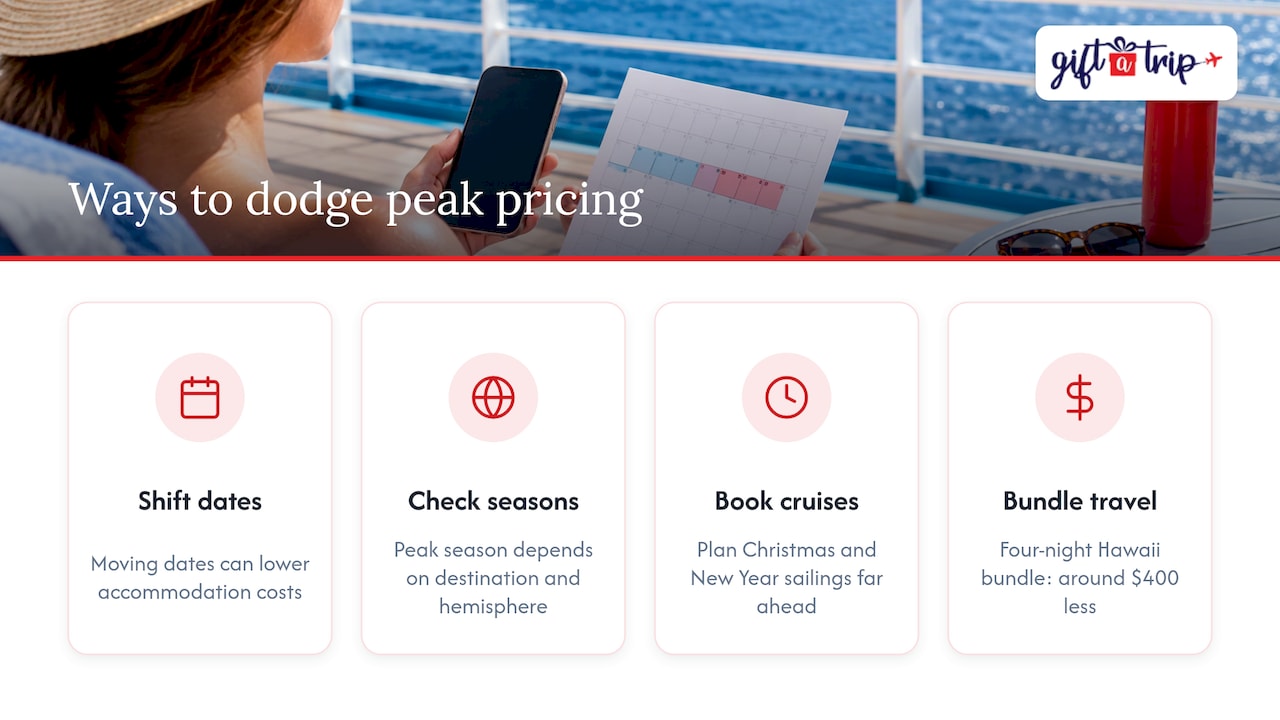
Bundle where it makes sense. Travel expert Emily Kaufman, cited by CBS News, found that bundling airfare and hotel on a four-night Hawaii trip came in around $400 below buying them separately. Choosing all-inclusive or breakfast-included hotels was another of her suggestions for controlling the total.
Our perspective
We see peak season pricing as a design question for the person giving the trip. The giver chooses the product, so the giver should settle the extras before the recipient ever sees them.
That is why our certificates are built around taxes, gratuities and fees being covered, and around minimal blackout dates. A recipient who opens a gift should be thinking about where to go, not about what the gift left unpaid.
For corporate programs, the same logic applies at scale. Bulk orders with no minimum, custom trip selection sites and branded gift boxes let a team lead give each winner a clear, complete reward, whatever the calendar looks like.
Donovan
Give travel without the surprise
If you are choosing a gift or reward, start with certificates that are designed to keep the total clear. Our Flex Trip Collections give recipients a choice of destinations, and individual certificates cover cruises, resorts and hotels, and golf and spa getaways. Our certificates include taxes and fees, carry minimal blackout dates and arrive by secure digital delivery. Physical presentation is also available through Red Box Delivery at $69 one-off.

For teams, our corporate gifting page covers custom trip selection sites, airfare vouchers in all denominations, custom Flex Trip Collections and custom, branded gift box delivery. There is no minimum order, so it works for a single award or a company-wide program. Individuals can start on the Gift A Trip home page.
FAQ
What is a peak season surcharge in travel?
It is the extra cost of traveling during high-demand periods. In shipping it is a named carrier fee. In consumer travel it usually arrives as higher fares and rates through dynamic pricing, plus fees such as resort charges. The effect is the same: the same trip costs more on busy dates.
Does the FTC fee rule stop peak season fees?
No. The rule, effective May 12, 2025, requires hotels, vacation rentals and ticket sellers to show mandatory fees in the advertised total. It does not cap those fees, and it does not apply to airlines. Taxes and government charges can be shown separately if disclosed before payment.
When are travel prices highest in the U.S.?
Fares and rates typically climb around holidays, such as the days before and after Thanksgiving, and during school breaks like spring break. Summer is also a high-demand season for many destinations. Exact timing varies by destination, so compare nearby dates for the specific trip.
How can I give travel without passing peak costs to the recipient?
Choose a certificate where taxes and fees are covered, blackout dates are limited, and the terms say what is included. Then let the recipient pick dates. Gift A Trip certificates are built around those points, with included taxes and fees and minimal blackout dates.
Is a travel gift good for corporate rewards?
Yes, when the reward is complete and the recipient does not cover extras. Corporate programs benefit from no-minimum ordering, branded delivery and a choice of destinations, so each winner can use the reward on dates that suit them.
Sources
- How Does Dynamic Pricing For Airlines Affect Your Travels? (Forbes)
- How not to get soaked by drip pricing by airlines and hotels (CBS News)
- Spring break travel is expected to break records (CBS News)
- New Federal Rule Bans Hidden Fees for Hotels and Tickets (Checkbook)
- What is the new Junk Fees rule? (al.com)