
There is no single validity period for travel certificates in the United States. Most airline certificates and credits run about 12 months from issue. Some disruption credits last five years, and some gift cards never expire. The date that counts is the one printed on your certificate, and it often comes in two parts: a book-by deadline and a travel-by deadline.
This guide shows how the major issuers handle validity, what the federal gift card rule does and does not cover, how to check your own expiration date, and what to do before a certificate runs out. If you buy certificates for a team or a client list, there is a section for you too.
TL;DR
- Validity is set by the issuer and the product. Twelve months is common for airline credits and certificates, but several programs differ.
- Read both dates: the last day to book and the last day to travel. They are not always the same.
- Federal law sets a five-year minimum for expiring store gift cards. It does not turn every travel credit or certificate into a gift card.
- Blackout dates and advance-booking rules can shorten your real window well before the printed expiration.
- For gifts and rewards, choose products with clear terms and give the recipient the dates in writing.
Table of Contents
- Why “valid” means different things on different certificates
- What the federal rule says about expiration
- How long major U.S. airline credits and certificates last
- Book-by dates versus travel-by dates
- How to check a certificate’s expiration date
- What happens when a certificate expires
- Practical timing: use the window you have
- If you buy certificates for employees or clients
- Our perspective: validity is a design question
- Travel certificates with clear terms for gifts and rewards
- A short checklist before you buy or hold any travel certificate
- FAQ
- Sources
Why “valid” means different things on different certificates
People search for certificate validity expecting one answer. The market does not offer one, because three different products get called “travel certificates”:
- Gift cards, bought with cash and loaded with a dollar balance.
- Credits and certificates issued after a change or cancellation, which are the airline’s way of holding your money.
- Prepaid travel certificates, bought as a gift and redeemable for a stay, cruise or package.
Each follows different rules. Gift cards fall under a federal statute. Airline credits follow the carrier’s own terms. Prepaid stay and cruise certificates follow the terms of the issuing brand and the seller. We cover the differences between vouchers and certificates in our breakdown of travel vouchers versus certificates.
What the federal rule says about expiration
Federal law prohibits selling or issuing a store gift card with an expiration date unless it expires at least five years after the date of issue, or after the date funds were last loaded, and the terms are clearly and conspicuously stated. The text sits in 15 U.S.C. § 1693l-1.
Two cautions follow from that:
- The rule is about gift cards and similar prepaid cards. An airline credit that replaces a ticket you cancelled is a different instrument, which is why so many of those credits run only one year.
- States can add their own protections. Our guide to the five-year federal floor and state gift card rules walks through how the two layers fit together.
If you hold something you paid for as a gift and it carries a short expiration, check which category it belongs to before assuming either that it is protected or that it is not.
How long major U.S. airline credits and certificates last
Airline terms change, so treat the table as a snapshot and confirm on the issuer’s page before you rely on it.
| Issuer and product | Validity as published | What to watch |
|---|---|---|
| American Airlines, flight credits for unused tickets | Travel generally must begin within 1 year of the original ticket issue date (American Airlines) | The clock starts at original ticket issue, not when you cancel |
| United Airlines, travel certificates | Most expire 12 months after original issue (United) | Certificates carry a book-by date; future flight credits carry a travel-by date |
| United Vacations, travel credits | Valid for travel within 395 days of the original departure date (United Vacations) | Travel must commence by the expiration date |
| Delta, eCredits after an eligible Delta disruption | 5 years from issuance if you choose a credit instead of a refund (Delta) | Voluntary-cancellation eCredits last 1 year from the original ticket date, minus any cancellation fees |
| JetBlue, travel certificates | Travel must be booked and completed before the date listed on the document (JetBlue) | Bookings must be requested at least seven days before travel |
| Southwest, flight credits | Credits created on or before May 27, 2025 do not expire; newer flight credits expire after six or 12 months, depending on fare (Southwest) | Getaways credits last 18 months; qualifying disrupted-flight credits last five years |
| Southwest, gift cards | No expiration date, fully transferable (Southwest terms) | Cash-value gift cards behave differently from credits |
The pattern is worth stating plainly. One year is the common default. Longer windows tend to appear when the airline caused the problem, as with Delta’s five-year disruption eCredits. And a gift card bought with cash is treated more generously than a credit created by a cancellation.
The Southwest detail that trips people up
Southwest’s expiration depends on when the credit was created and on the fare type. Credits from reservations booked and ticketed, or voluntarily changed, on or after May 28, 2025 carry expiration dates based on fare. Credits created on or before May 27, 2025 do not expire. Southwest also notes that credits from reservations booked with a gift card may not expire or may expire after six or 12 months, depending on fare. Two people holding “a Southwest credit” can have very different deadlines.
Delta: the reason for cancellation matters
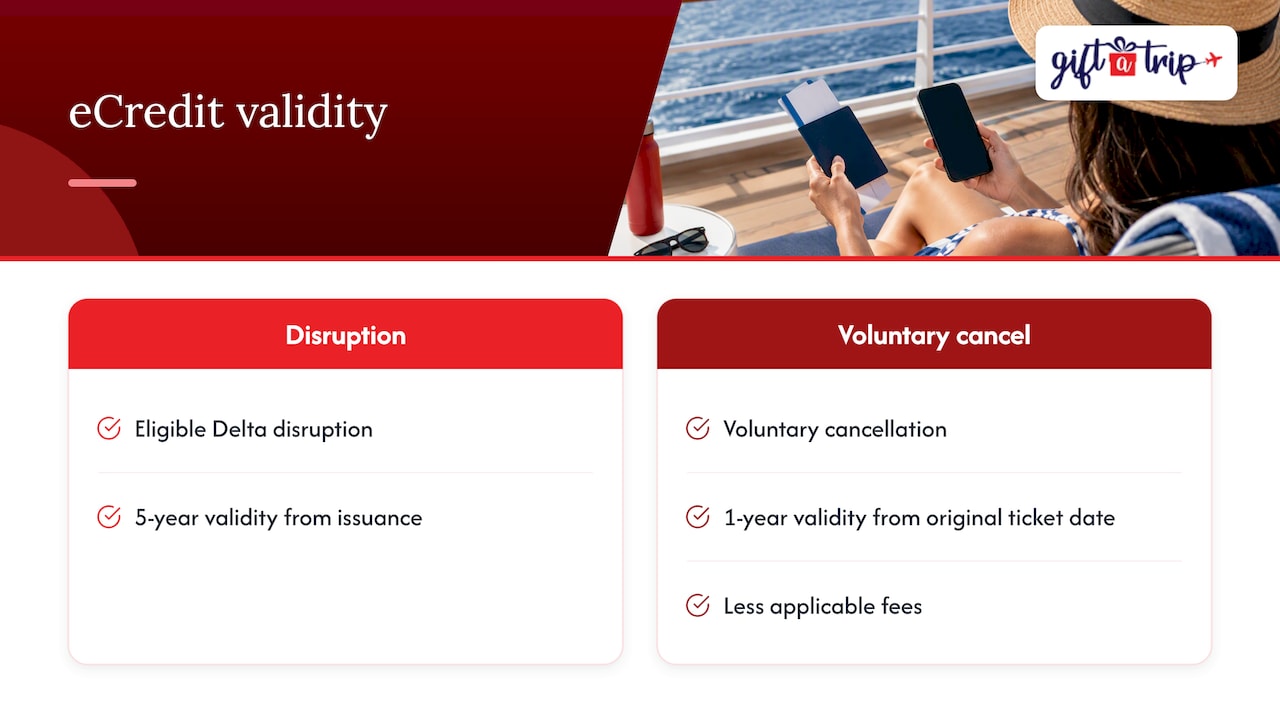
Delta ties validity to why the trip was cancelled. If an eligible Delta disruption led you to choose a credit rather than a refund, the eCredit is valid for five years from issuance. If you cancelled voluntarily, the eCredit is valid for one year from the original ticket date, less applicable fees. Same airline, same type of credit, a four-year difference.
Book-by dates versus travel-by dates
This is the most common source of expired certificates. United is the clearest example: it distinguishes a book-by date from a travel-by date depending on the product. Future flight credits have a travel-by date, while certificates have a book-by date. Read the documentation for the specific item in your account rather than assuming one rule covers both.
JetBlue works the other way around for its certificates: travel must be booked and completed before the expiration date on the document, and bookings must be requested at least seven days before the travel date. That seven-day rule means your effective deadline is a week earlier than the date printed.
A simple way to protect yourself is to calculate three dates the day you receive any certificate:
- Last day to start booking, which is the printed expiration minus any advance-request period.
- Last day to travel, if different from the booking date.
- Your own deadline, set two to three weeks before the earliest of the above, so you have room to change plans.
Put all three in your calendar with an alert.
How to check a certificate’s expiration date
Start with the document itself, then the issuer’s account tools.
- Find the printed terms. The expiration, book-by and travel-by dates are usually on the certificate or in the delivery email.
- Log in to the issuer’s account. Delta, for example, lets you view certificates and eCredits tied to your SkyMiles number under My Profile on delta.com, or enter the certificate number at delta.com/redeem (Delta).
- Check transferability. United says its travel certificates are not transferable and may not be sold, traded or bartered, and that any such transaction makes the certificate null and void (United). If you plan to pass a certificate on, confirm this first.
- Confirm blackout dates and availability. JetBlue states that certificate travel is subject to availability and specific blackout dates, which can narrow the practical window regardless of the stated expiration (JetBlue).
- Keep the original confirmation. If a booking later changes, the record of the original issue date is what supports your claim.
One more point from JetBlue: for certificates issued on or after May 17, 2023, cancelling a booking reactivates the certificate so you can rebook for a new date, provided travel is completed by the original expiration. Cancelling does not extend the deadline. It only returns the certificate to you.
What happens when a certificate expires
In most cases, nothing can be done. United’s published terms carry no official extension. Other issuers state fixed windows and apply them. Extensions in the past have come from specific policy announcements, not from a customer’s request, so do not count on one.
What you can do:
- Act before expiration, not after. Book a refundable or changeable option while the certificate is still live, so the commitment is made even if your plans shift. Check the issuer’s rules on what happens when you change the booking, since terms differ.
- Ask about hardship or disruption. If the airline caused the problem, the longer disruption windows may apply, as with Delta’s five-year eCredits. Ask which category your credit falls into.
- Look at the credit’s origin. A credit created by a voluntary change and one created by an airline cancellation can carry different dates, as the Delta and Southwest examples above show.
The New York Times has reported that confusion around airline travel credits is widespread because carrier policies vary and change often (New York Times). That article dates from 2021, but the lesson holds: confirm current terms with the issuer.
Practical timing: use the window you have
A short validity period mostly hurts people who wait. If you have a 12-month certificate, book within the first few months, while availability is widest. If your trip involves lodging, lock it in early. For a family trip to Orlando, for example, booking a vacation home stay well ahead of travel gives you room to meet an advance-request rule like JetBlue’s seven days and still finish your travel before the expiration.
If you want a plain-language overview of how long different vouchers stay usable, this gift voucher validity overview covers the topic from the booking-platform side.
If you buy certificates for employees or clients
Validity matters more when you are the giver. An expired reward is a wasted budget line and a disappointed employee. A few rules we suggest for HR and sales managers:
- Match the product to the audience. Recipients who need flexibility are better served by open-date products than by fixed-date ones. Our page on open-date travel vouchers explains the trade-offs.
- Check redemption restrictions up front. Airline gift products can carry block-out periods, covered in our airline gift card restrictions guide for HR.
- Understand the redemption steps. Recipients redeem more often when the path is short. See the travel certificate redemption process guide.
- Review transferability. If a recipient may want to hand the gift to a family member, run through the transferable travel gift card checklist.
- Think about tax treatment. Reward programs have tax implications that vary by structure, so read how taxes are handled in travel certificates and confirm your setup with your payroll or tax adviser.
We also keep a broader guide on where to buy travel gift certificates without expiration and booking surprises.
Our perspective: validity is a design question
We sell travel certificates for a living, so we see the same failure again and again. A gift is given with enthusiasm, then sits in an inbox until the date has passed. The recipient did nothing wrong. The terms were just buried.
From our side, three things reduce that risk. First, a certificate should state what it covers, with taxes and fees clear, so the recipient is not surprised at booking. Our positioning is all-inclusive pricing with taxes, gratuities and fees covered, and minimal blackout dates, because a certificate you cannot book is worth little however long it is valid. Second, there should be no minimum order, so a manager can buy one certificate for one person without building a program around it. Third, delivery should be secure and digital, so the recipient has the terms in front of them from day one.
If you are comparing options, ask every seller the same four questions: What is the exact expiration date? Is there a separate booking deadline? Which blackout dates apply? Can the certificate be passed to someone else? A seller who answers in writing is a seller worth buying from.
— Donovan
Travel certificates with clear terms for gifts and rewards
If you are giving a trip rather than holding a credit, start with what the recipient will actually do: pick a destination and book. Our Flex Trip Collections let the recipient choose among resorts, hotels, cruises and vacation packages from major brands.

For teams, our corporate gifting program covers custom trip selection sites, airfare vouchers in all denominations, custom Flex Trip Collections and branded gift box delivery. If you want a physical presentation, Red Box Delivery is $69 one-off. You can also browse certificates by type on our certificate catalog, including Royal Caribbean certificates and golf and spa resort stay certificates. Check the terms shown on each certificate page for its exact validity.
A short checklist before you buy or hold any travel certificate
- Is it a gift card, a credit, or a prepaid certificate?
- What is the printed expiration, and is there a separate book-by date?
- Is there an advance-booking requirement, such as JetBlue’s seven days?
- Which blackout dates apply?
- Is the certificate transferable?
- What happens to it if you cancel a booking?
- Where is the issue date recorded, and where is the confirmation stored?
If you can answer all seven, you know your real window.
FAQ
How long do United travel certificates last?
Most United travel certificates expire 12 months after their original issue date. Certificates carry a book-by date, while future flight credits carry a travel-by date, so read the documentation for your specific item. United also says certificates are not transferable.
Do travel gift cards expire?
It depends on the issuer and product. Federal law bars store gift cards from expiring within five years of issuance or of the last funds load, with clearly stated terms. Some issuers go further: Southwest gift cards have no expiration date.
Can an expired travel certificate be extended?
Usually not. United’s published terms include no official extension, and most issuers apply their stated windows. Act before the deadline, and if the cancellation was airline-caused, ask whether a longer disruption window applies to your credit.
How do I find out when my certificate expires?
Check the printed terms first, then the issuer’s account tools. With Delta, you can see certificates and eCredits under My Profile on delta.com or enter the certificate number at delta.com/redeem. Note any booking-ahead rule too, since JetBlue requires requests at least seven days before travel.
Sources
- 15 U.S.C. § 1693l-1, general-use prepaid cards and gift cards
- American Airlines, travel credits and trip credits
- United Airlines, travel credits
- United Vacations, travel credits
- Delta Air Lines, certificates, eCredits and gift cards
- JetBlue, travel certificates
- Southwest Airlines, expiration of flight credits
- Southwest Airlines, gift card terms and conditions
- New York Times, airline travel credits questions and answers
- Heroes Vacation Home Orlando, book your stay
- Gift voucher validity overview