
PCI compliant gift card payments come down to one rule: every card number, expiration date and security code that passes through your business is your responsibility, whether you sell gift cards, take them as payment at an auction, or buy them in bulk for a team. The safest setup is the one where the fewest card details touch your own systems. For HR managers, event planners and charities, that usually means paying once, in one order, with a provider that delivers the certificates digitally, instead of collecting card details from many people yourself.
TL;DR
- PCI DSS, the Payment Card Industry Data Security Standard, applies to any business that stores, processes or transmits card data, regardless of size or volume. Gift card payments are included.
- Never keep card security codes, full magnetic-stripe data or PINs after a payment is authorized, even encrypted.
- Using a compliant processor or hosted checkout reduces your exposure but does not hand off your responsibility.
- The current standard is PCI DSS v4.0.1, and the revised SAQ A (the shortest self-assessment form) took effect on March 31, 2025.
- Buying travel certificates in one organized order keeps the number of card payments you handle low.
Table of Contents
- What PCI DSS means when gift cards are involved
- Who needs to care, and why
- Check 1: Know exactly which data you may keep
- Check 2: Take payments through a hosted page, not your own form
- Check 3: Remember that a compliant provider does not make you compliant
- Check 4: Match your validation to your size
- Check 5: Treat compliance as a routine, not a one-time audit
- How a bulk travel certificate order keeps your exposure low
- Order your certificates in one clean step
- FAQ
- Sources
What PCI DSS means when gift cards are involved
PCI DSS is the security standard set by the PCI Security Standards Council, the body behind the card brands’ data-protection rules. It is a baseline of technical and operational requirements for protecting payment account data. According to the Council, whether a business must formally validate is decided by the payment brands, acquirers (the banks that process your card payments) or other compliance-program managers.
Gift cards are not a loophole. A prepaid card may carry no personal data, but its number, expiration date and security code can still be used for fraud if stolen, so a merchant accepting payment with one is responsible for protecting that data. Bank of America’s merchant guidance adds that in-scope cards include any debit, credit or prepaid card branded by American Express, Discover, JCB, Mastercard or Visa. That covers phone-only acceptance and seasonal businesses too.
One distinction helps. A closed-loop gift card works only at the retailer that issued it. An open-loop card carries a card-network logo and runs through the same networks as ordinary card payments. When a gift card program touches those rails, PCI obligations can apply, especially if card numbers pass through your own systems.
Who needs to care, and why
Different readers meet the standard from different sides:
- Retailers and businesses selling gift cards or promotional rewards accept card payments, so they are directly in scope.
- Charities running auctions and event planners often take card payments at a table, on a phone or through a bidding page. Each of those is a channel with its own exposure.
- HR and sales managers buying rewards may not be merchants, but they still hand over card or purchase-order details and collect names, emails and addresses. Choosing a provider and an ordering method that limits who sees payment data protects you.
- Individual gift buyers are protected mostly by the seller’s compliance. The practical step is to pay through the seller’s checkout rather than sending card details by email or text.
The rest of this article focuses on the five checks that matter most when gift card payments are involved.
Check 1: Know exactly which data you may keep
PCI DSS v4.0.1 splits card information into two groups. Cardholder data is the card number (PAN), cardholder name, expiration date and service code. Storing the PAN must be kept to a minimum and rendered unreadable.
Sensitive authentication data is the second group: full track data from the magnetic stripe or chip, card verification codes (CVV2, CVC2, CID) and PINs. These must not be stored after authorization, even if encrypted, with narrow exceptions for card issuers. Card associations can levy substantial fines for violations.
Where this goes wrong in gift programs:
- A spreadsheet of donor or employee card details kept “for next year’s auction”.
- Security codes written on order forms or entered into notes fields.
- Card numbers pasted into email threads to “confirm” a bulk order.
The fix is simple: do not collect what you do not need, and purge what you do. Stripe’s checklist puts it this way: map where card data flows, don’t store unneeded card data, tokenize what you must keep, and encrypt data in transit with TLS 1.2 or higher.
Check 2: Take payments through a hosted page, not your own form
The easiest way to shrink your exposure is to never let card data reach your servers. With a hosted payment page, the customer is redirected to the processor’s site to type the card number, and only an acknowledgement comes back to the merchant. The Council’s e-commerce guidance is from an earlier version of the standard, but the principle holds in v4.0.1.
This matters for the way a gift card business, a charity or a school fundraiser sets up its site:
- Use a hosted or fully embedded payment page from a validated processor.
- Keep your own pages free of fields that capture card numbers.
- For phone orders, enter the card straight into a validated terminal or payment page. Do not write it down.
- For in-person events, use a validated card reader and keep paper receipts free of full card numbers.
The PCI standard still reaches the pages you control. A web server that merely generates the payment form can still be in scope, because anything that could affect how cardholder data is handled counts.
Check 3: Remember that a compliant provider does not make you compliant
This is the point most small organizations miss. PCI DSS v4.0.1 states plainly that using a compliant third-party service provider does not make you compliant or remove your responsibility. The Council’s own FAQ says the same about merchants that outsource all payment processing: you still need to:
- confirm the provider is compliant for the services it offers;
- keep a written agreement that spells out who is responsible for what (Requirement 12.8.2);
- monitor the provider’s compliance status at least annually (Requirement 12.8.4);
- complete your own validation, typically SAQ A.
Providers must supply an Attestation of Compliance (AOC) or the relevant parts of their Report on Compliance on request. File it with your records each year.
Check 4: Match your validation to your size
Validation means proving compliance to your acquiring bank. What you submit depends on your merchant level, which comes from your annual transaction volume. Mastercard tells merchants to determine their level from the most recent 52 weeks of transactions and submit documents to their acquirer.
In broad terms, as summarized by BD Emerson’s 2026 level table:
| Level | Visa / Mastercard volume per year | Typical validation |
|---|---|---|
| 1 | More than 6 million transactions | Annual report by a Qualified Security Assessor, quarterly scans, AOC |
| 2 | 1 to 6 million transactions | Annual SAQ, quarterly scans, AOC |
| 3 and 4 | Below that | Varies by card brand and acquirer |
Most small organizations sit at the bottom of the table. PCICompliance.com notes that most small businesses are Level 4, where the processor typically expects an annual SAQ, quarterly scans of internet-facing systems and an AOC. Ask your acquirer which documents it needs. If you are a small venue or event business, this walkthrough of PCI validation steps for small merchants shows how SAQs and vulnerability scans work in practice.
What changed recently
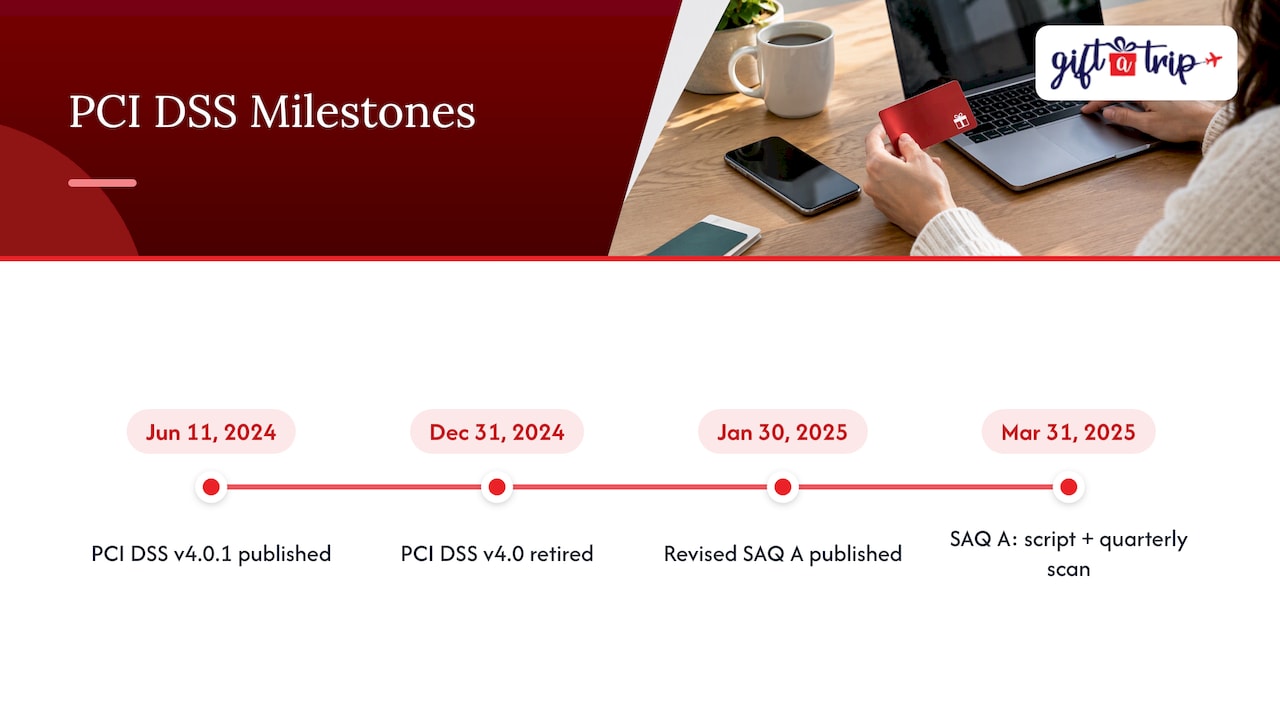
PCI DSS v4.0.1, published June 11, 2024, was a limited revision with no requirements added or deleted, and v4.0 was retired on December 31, 2024. The revised SAQ A was published on January 30, 2025 and took effect on March 31, 2025. It dropped Requirements 6.4.3 and 11.6.1 and added a condition: you must confirm your site is not susceptible to script attacks. SAQ A merchants still owe quarterly external scans under Requirement 11.3.2. Both points are reported in BD Emerson’s summary.
SAQ A itself is narrow. It is for card-not-present merchants whose account-data functions are completely outsourced to validated third parties, and it does not apply to face-to-face sales. A charity taking cards at a live gala belongs in a different questionnaire than one taking pledges on a hosted web page.
Check 5: Treat compliance as a routine, not a one-time audit
An assessment is a snapshot. Bank of America’s guidance notes that changes to systems, applications, networks, passwords and personnel all affect ongoing compliance. A practical yearly rhythm for a small organization:
- Quarterly: run the external vulnerability scans your SAQ requires.
- Every time staff change: remove access and reset shared passwords. Use unique IDs and multi-factor authentication for anything touching payment systems.
- Each year: update your SAQ and AOC, collect each provider’s current AOC, and review your data map.
- Before each event or campaign: confirm which channels will take card payments and who handles them.
Fraud prevention sits beside compliance. Our guide to rules that stop gift card fraud covers the consumer and merchant habits that complement the technical controls above.
How a bulk travel certificate order keeps your exposure low
For an HR or sales manager, the compliance question is less “how do I process cards?” and more “how many places will card and personal data pile up?” A reward program run through many small purchases, employee reimbursements or collected card details multiplies those places. One organized order does the opposite: one payment, one record, and recipients who get their certificates digitally.
That is how the process is built at Gift A Trip. We have no minimum order, we deliver certificates digitally, and taxes and fees are included in the certificate price, so there are no extra charges to collect after the fact. If your program covers dozens of people, our bulk order guide for corporate planners shows how to structure it, and our checklist for choosing a travel gift card provider lists what to confirm before you pay.
Charity auctions benefit in the same way. Travel packages donated or purchased as certificates are delivered without anyone needing to keep a winning bidder’s card details on a clipboard. Once a winner pays through your hosted checkout, the certificate follows digitally. Before you list a certificate as a prize, read up on gift card expiration rules so your terms match the law.
Our view
We sell travel certificates to HR teams, event planners, charities and individual gift givers, and the same pattern shows up in how they think about payment security: the fewer hands card data passes through, the better. A gift program should be easy to run without turning your inbox, your spreadsheets or your front desk into a store of payment details.
That is why we built the experience around one order, secure digital delivery, personalized messaging and certificates with taxes and fees included. You pay once, and recipients redeem without you collecting anything further from them. Whether you are rewarding a sales team or filling an auction catalog, a clean order trail is part of running the program responsibly.
Donovan
Order your certificates in one clean step
If you are building a reward, loyalty or event program, our corporate gifting page covers custom trip selection sites, airfare vouchers in all denominations, custom flex trip collections and branded gift box delivery. For a single gift, individual travel certificates cover cruises, resorts and hotels, and golf and spa getaways. If you want a physical presentation, Red Box Delivery is a one-off $69 fee, listed on our gift delivery page.

Browse cruise, resort and hotel certificates and place one order for the whole program.
FAQ
Do all merchants have to be PCI compliant?
Yes, in principle. The standard applies to every entity that stores, processes or transmits cardholder data, and that includes phone-only and seasonal businesses. How you prove it depends on your size and on what your acquiring bank requires, so ask your bank which documents it expects.
Is taking credit card information over the phone PCI compliant?
It can be, if the card goes straight into a validated terminal or payment page and is never written down or stored. Security codes must never be kept after authorization. Phone orders are a card-not-present channel, but they involve your staff and equipment, so they affect which questionnaire you complete.
Are gift cards themselves in PCI scope?
Yes, when they are payment cards. A prepaid card’s number, expiration date and security code are sensitive even without personal details, and the business accepting it must protect them. A closed-loop card that never touches card networks has fewer obligations, but any payment used to buy it is still card data.
Does using a payment processor make me compliant?
No. A compliant processor reduces how much data you handle, but you must still confirm its compliance, keep a written agreement, review its status each year and validate your own environment, usually with SAQ A.
Sources
- What is PCI DSS compliance? | Stripe
- PCI Security Standards Council: PCI DSS
- PCI DSS 4.0: Your questions answered | OneTrust
- PCI Compliance FAQ | Bank of America Merchant Help
- Gift Card | finera glossary
- PCI DSS v4.0.1 (Middlebury College copy)
- PCI DSS v4.0.1 (Utah State University copy)
- Payment Card Industry Data Security Overview | NCOSC
- PCI DSS checklist for businesses | Stripe
- PCI DSS E-commerce Guidelines | PCI SSC
- Does PCI DSS apply to merchants who outsource all payment processing? | PCI SSC
- Mastercard Site Data Protection Program
- What Is PCI Compliance? Levels and SAQ Types | BD Emerson
- Do Gift Cards Need PCI Compliance? | PCICompliance.com
- SAQ Instructions and Guidelines, PCI DSS v4.0.1 r1
- PCI Compliance for Bookings: An Escape Room Owner’s Guide