
Jump to Section:
Yes, some travel gift cards are transferable, but it depends entirely on the issuer’s fine print. Your best bet for flexible gifting comes down to two categories: open-loop prepaid cards or purpose-built transferable travel certificates. Before you buy either one, check the issuer’s terms and conditions for language on transfer rights, expiration dates, and redemption limits.
TL;DR:
- Transferability varies widely and depends on the issuer’s terms; open-loop prepaid cards and travel certificates generally offer the most flexibility.
- Many airline and hotel gift cards restrict transferability, with some explicitly stating they are non-transferable, while others remain silent on the issue.
- Verifying transfer terms requires checking the issuer’s official conditions, expiration dates, and redemption channels, and saving proof of these terms is recommended.
- Fees, restrictions, and conditions such as locked redemption platforms or excluded fees can limit the actual usefulness of transferable cards to cash-like value.
- Digital delivery and proper tracking facilitate safe gifting and reassignments, especially in bulk or corporate contexts, where paperwork and proof are essential.
Table of Contents
- What Does “Transferable” Mean for Travel Gift Cards?
- Which Card Types Actually Give You the Most Flexibility?
- How Do You Verify Transferability Before You Buy?
- What Fees and Restrictions Should You Watch For?
- How Do You Gift or Reassign a Travel Card Safely?
- Why Transferable Travel Gift Cards Matter More in 2026
- Where Gift A Trip Fits Into Flexible Gifting
- Where to Verify Transferability Rules Yourself
- Sources
- FAQ
What Does “Transferable” Mean for Travel Gift Cards?
A transferable travel gift card can legally change hands after purchase. The original buyer can hand it off, and the new holder can redeem it without contacting the issuer for permission. A non-transferable card, by contrast, ties the balance to the original purchaser’s account or name, which makes regifting risky or outright impossible.
This distinction sounds simple until you start comparing card types, because “travel gift card” covers several very different products.
Open-loop prepaid cards run on Visa or Mastercard networks and work almost anywhere those networks are accepted, including airlines, hotels, and travel agencies. Travel-platform cards are issued by a specific booking site or online travel agency and only redeem within that platform’s ecosystem. Airline and hotel-branded cards are tied to one company’s flights, rooms, or loyalty program. Travel certificates are a distinct category built specifically for gifting, often covering resort stays, cruises, or vacation packages, with taxes and fees already bundled in.
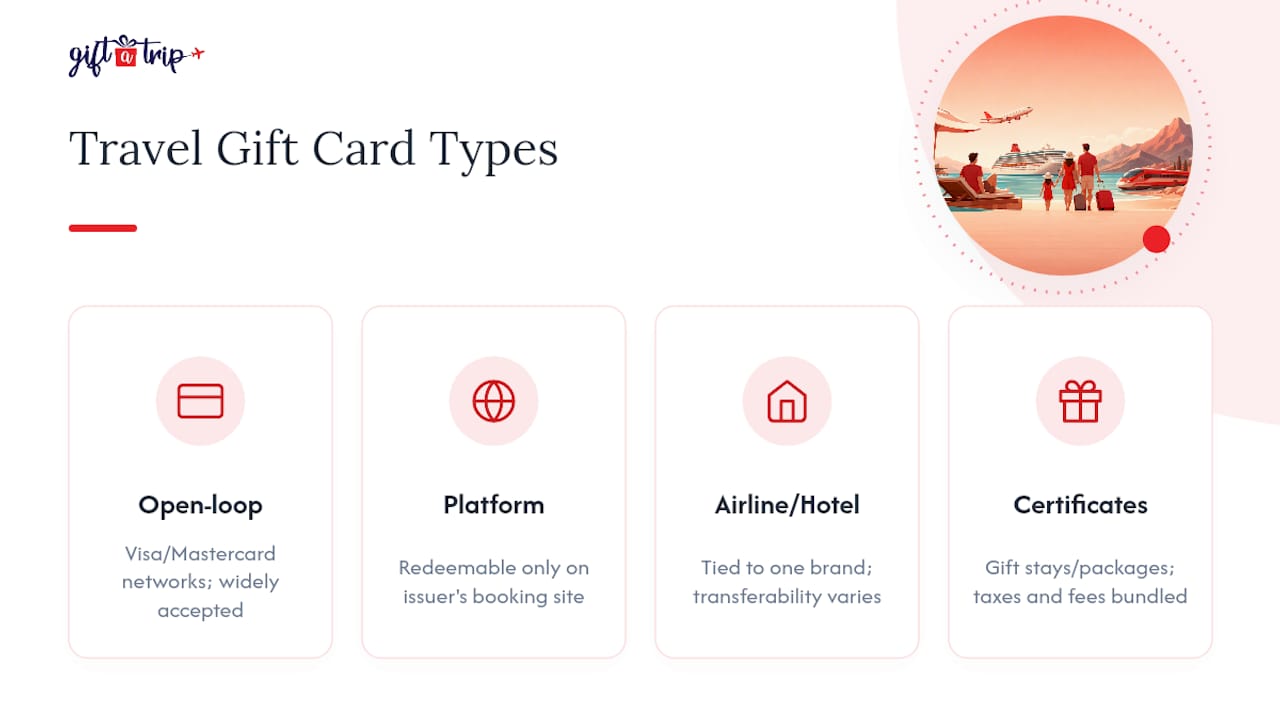
Open-loop cards and travel certificates tend to permit reassignment more readily because neither is anchored to a single loyalty account. Airline and hotel cards vary widely. Some, like Air Canada’s gift cards, state outright that their gift cards and eGift cards are fully transferable. Others stay silent on the issue, which usually means the issuer treats them as non-transferable by default.
Which Card Types Actually Give You the Most Flexibility?
Not every “travel gift card” behaves the same way once you try to hand it to someone else. Here’s how each category typically holds up:
- Open-loop prepaid cards carry the broadest merchant acceptance of any category, since they run on standard payment networks rather than a single brand’s system. That universality is exactly why travel gift-card explainers point to them as the safest single option when you don’t know a recipient’s preferred airline or hotel chain.
- Travel-platform cards offer plenty of flexibility inside their own ecosystem: dozens of hotels, hundreds of flight routes, filterable by price or date. Step outside that platform, though, and the balance is worthless. Many platforms also lock the credit to the account that redeemed it first.
- Airline and hotel-branded cards are the least predictable of the bunch. Delta’s gift card terms allow purchase and use for flights, but restrict the balance from covering ancillary fees like seat upgrades or checked bags, and the cards are generally non-refundable except where law requires it. Southwest publishes similar step-by-step redemption guidance for buyers who need to check use cases before purchase.
- Travel certificates are frequently designed around gifting from the start, which means clearer language on reassignment, plus bulk-distribution tools for buyers ordering more than one at a time. That design intent shows up in how certificates get distributed for corporate gifting at scale, where dozens or hundreds of recipients need individual codes tracked and delivered.
How Do You Verify Transferability Before You Buy?
Reading the fine print takes five minutes and saves a lot of frustration later. Work through this checklist before you swipe your card:
- Find the actual terms and conditions page, not just the marketing copy on the product listing. Search for words like “transferable,” “assignable,” or “resale.”
- Check the expiration date and any inactivity fees. Some cards lose value or expire outright after a set period of non-use.
- Confirm currency and regional restrictions. A card issued in one country’s currency may not redeem cleanly if the recipient lives elsewhere.
- Verify redemption channels. Does the card work online, over the phone, or only in person? Can the holder split the balance across multiple bookings, or is it all-or-nothing?
- Contact issuer support directly if anything is ambiguous, and keep a screenshot or saved email of their answer. That record matters if a dispute comes up later.
Pro Tip: Save a PDF or screenshot of the issuer’s terms and conditions at the time of purchase. Terms pages get updated, and having the original wording protects you if a transfer is questioned six months down the road.
What Fees and Restrictions Should You Watch For?
Even a transferable card comes with strings attached. Away’s gift card terms state plainly that gift cards cannot be returned, resold, transferred for value, or redeemed for cash except where law requires it, and the company advises customers to treat the card like cash from the moment it’s issued. That’s common language across the industry, and it means a lost or stolen card code is usually gone for good.
Other pitfalls to check for:
- Balances that can’t be combined with loyalty points or split across two bookings.
- Redemption locked to one platform or one brand’s inventory.
- Ancillary fees like baggage or seat selection excluded from coverage.
- No cash-back option if the trip costs less than the card’s value.
Treat every travel gift card exactly like cash. Store the code somewhere secure, and never share it over an unverified channel before the recipient is ready to redeem it.
How Do You Gift or Reassign a Travel Card Safely?
Digital delivery beats a physical card for one simple reason: it leaves a paper trail. E-gifts arrive instantly, which travel gift-card explainers note makes them ideal for last-minute gifting while also making the code easier to track and reassign if plans change.
- Buy digital whenever possible. Save the confirmation email and the code itself in a secure password manager, not a text message thread.
- If you need to reassign a card, contact the issuer first. Some require proof of original purchase, a name change request, or a formal transfer form.
- For corporate or bulk gifting, use personalized messaging and batch tracking. Distributing certificates to a sales team or client list works better with a documented redemption process that logs who received which code and when.
- If a transfer is disallowed outright, the simplest workaround is booking the trip directly on the recipient’s behalf, or swapping the card internally within a company for one an employee can actually use.
Why Transferable Travel Gift Cards Matter More in 2026
Demand for flexible gifting has shifted hard since travel plans became less predictable and last-minute changes turned normal. Buyers no longer want a card locked to one airline seat or one hotel chain gathering dust in an inbox.
Corporate HR teams and event planners have picked up on this fastest. Reward programs, sales incentives, and charitable auctions all run smoother when a certificate can move between recipients without a phone call to customer service. A prize winner who can’t use a flight credit isn’t a win for anyone, least of all the company that paid for it. Transferable certificates solve that friction directly, which is exactly why they’re showing up more often in employee recognition budgets and auction catalogs than single-brand airline cards ever did.
— Donovan
Where Gift A Trip Fits Into Flexible Gifting
The platform offers digital travel certificates emphasizing secure delivery, included taxes and fees, minimal blackout dates, and options for corporate distribution for gifting to multiple recipients.

That structure matters for real situations. An HR manager rewarding twenty employees needs bulk codes and personalized messaging, not twenty separate airline account logins. A couple celebrating an anniversary wants a certificate that redeems toward a resort stay or cruise without hunting through blackout calendars. A charitable auction organizer needs a prize that won’t fall through if the winning bidder can’t travel on the exact dates listed. Gift A Trip’s travel certificate distribution guide for HR and events walks through how bulk orders and redemption tracking work for exactly these cases. If you’re ready to see what a certificate actually looks like before you buy, start with the digital travel certificate guide or browse a specific option like the Virgin Voyages cruise certificates to compare redemption terms directly.
Where to Verify Transferability Rules Yourself
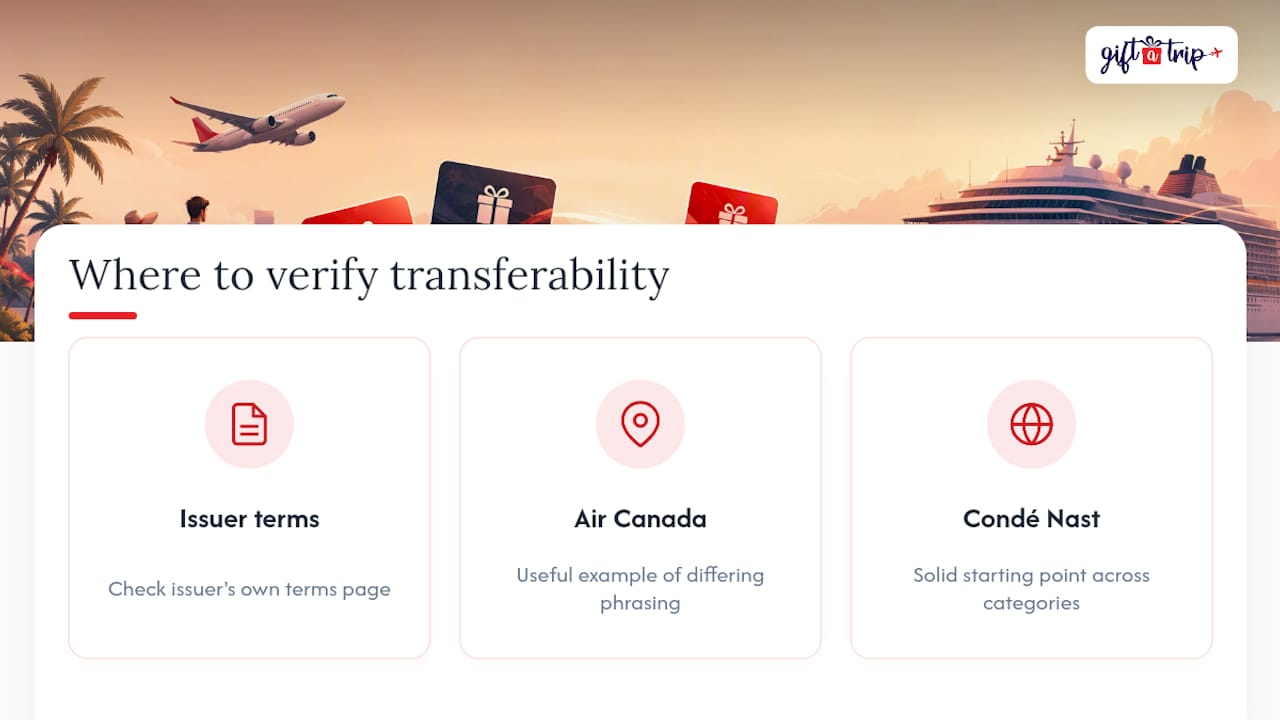
Before buying any travel gift card, check the issuer’s own terms page rather than relying on a retailer’s summary. Air Canada’s transferability language and Away’s gift card terms are two useful examples of how differently issuers phrase transfer rights. For a broader sense of what’s available across categories, Condé Nast Traveler’s roundup of travel gift cards is a solid starting point.
Sources
- Air Canada gift cards (transferability excerpt)
- Delta gift cards — usage and limitations
- Purchase a Southwest gift card (help article)
- Away gift card terms
- 25 Best Gift Cards for Every Type of Traveler
FAQ
What Is the Best Gift Card for International Travel?
Open-loop prepaid cards tend to work best internationally because they run on major payment networks rather than one country-specific brand, though currency conversion fees can still apply. Purpose-built travel certificates that cover resort or cruise stays abroad are another strong option since taxes and fees are typically bundled into the price already.
Is There a Gift Card That Works on Any Airline?
No single gift card guarantees acceptance across every airline, since most airline-branded cards only redeem with that specific carrier. An open-loop prepaid card used to purchase a ticket, or a travel certificate that isn’t tied to one airline, gets you closer to that flexibility.
Can I Buy an eGift Card for Someone in Another Country?
Yes, but currency and regional restrictions vary by issuer, so check the terms before purchase. Digital delivery makes cross-border gifting easier logistically, though the recipient may still face currency conversion or redemption limits depending on where the balance can be used.
What Are the Best Airline Gift Cards to Buy?
The strongest options are cards from issuers that publish clear transferability language and reasonable redemption rules, such as Air Canada or Delta. If flexibility matters more than brand loyalty, a transferable travel certificate or open-loop prepaid card usually beats a single-airline card.
Can Gift Cards Be Transferred to Another Person?
It depends entirely on the issuer’s terms. Some, like certain airline eGift cards, explicitly allow transfer, while others, such as Away’s gift cards, prohibit resale or transfer for value outright. Always confirm the specific policy before assuming a card can change hands.