
Under federal law, gift-card funds cannot expire before five years from issuance or the last load, but states can and often do impose stricter protections. That five-year floor comes from the CARD Act and its implementing rule, 12 CFR §1005.20, which also caps inactivity fees and forces issuers to disclose terms before purchase. Several states go further, banning expiration outright or requiring cash redemption on low balances, so the actual rules governing your card depend on both federal law and where you live.
TL;DR:
- Many states prohibit gift card expiration dates altogether, meaning certain cards may never expire despite the federal five-year minimum.
- If a gift card is reloaded after the initial purchase, the five-year clock resets from the last load date, extending the card’s validity.
- Inactivity fees can only be charged after 12 months of non-use and must be clearly disclosed before purchase to comply with federal rules.
- Unclaimed balances may be held by the state where the buyer resides or the issuer’s state of incorporation, affecting where you can reclaim forgotten funds.
- Buying or gifting gift cards through reliable digital platforms that capture purchaser information simplifies compliance and helps prevent loss or dispute issues.
Table of Contents
- Gift Card Expiration Laws: The Federal Baseline
- How State Gift Card Laws Go Further Than Federal Rules
- Gift Card Fee Laws: When Issuers Can Charge for Inactivity
- Gift Card Unclaimed Property Rules: Where Unused Balances Go
- How to Check and Reclaim a Gift Card Balance
- A Gift Card Compliance Checklist for Businesses That Issue Cards
- Myths and Scams: What Actually Drains Gift Card Value
- How Compliant Travel Certificate Issuers Manage Expiration Risk
- Why Consumer-Friendly Gift Card Policies Make Business Sense
- Gift a Trip: Travel Certificates Built Around Clear Terms
- Primary Sources for Gift Card Expiration Rules
- Sources
- FAQ
Gift Card Expiration Laws: The Federal Baseline
The CARD Act of 2009 set the floor every gift card issuer in the country has to clear, and the CFPB’s implementing regulation spells out exactly how. If you buy a gift card today, the money on it legally has to remain redeemable for at least several years, measured from either the date of purchase or the date you last added funds to the card, whichever is later. That second trigger matters more than most people realize: reloading a card resets the five-year clock on the newly added funds, even if the original balance has been sitting there for years.
The Federal Reserve’s 2010 announcement of the final rule made clear this applies broadly, covering gift certificates, store-branded gift cards, and general-use prepaid cards issued by banks or card networks. A $50 card from a national retail chain and a Visa-branded prepaid gift card bought at a pharmacy both fall under the same five-year minimum, even though one is a closed-loop card usable only at one merchant and the other is an open-loop card usable almost anywhere Visa is accepted.
Replacement cards add a wrinkle that trips up a lot of cardholders. A retailer can issue you a new physical card with a shorter printed expiration date, as long as the underlying funds still meet the five-year rule from their original load date. In practice, that means the plastic in your wallet might say “expires 2027” while your money legally remains good until 2029, because it was reloaded after the card was first issued. Issuers are required to disclose this mechanic clearly rather than let a printed date mislead you into thinking your balance is gone.
Federal law also dictates what issuers must tell you and how they must handle replacement:
- Fee expiration disclosure: The card or its packaging must state, in plain language, when funds expire (a common phrasing is “funds expire 5 years from the date funds were last loaded”).
- Contact information: Cards must list a toll-free number or website where you can check your balance and terms.
- No-cost replacement: If a card is lost, stolen, or damaged, some issuers charge a reasonable replacement fee, but many voluntarily waive it entirely.
- No shortcut around the five-year rule: Issuers cannot use a replacement card to shorten the legal life of your remaining funds, regardless of what date is printed on it.
One distinction the law does draw is between products that count as “gift certificates” or “store gift cards” under the rule and certain excluded categories, like reloadable prepaid cards not marketed as gift cards, or cards distributed as part of a loyalty, rewards, or promotional program with no money paid for them. Promotional cards, the kind you get free with a purchase, often carry shorter expiration windows because they were never sold for value in the first place. If you paid actual money for the card, the five-year floor almost always applies.
How State Gift Card Laws Go Further Than Federal Rules
Federal law sets the minimum, not the ceiling, and this is where most of the confusion starts. A card can be perfectly legal under 12 CFR §1005.20 and still violate the law in the state where it was bought, because dozens of states layer their own consumer protections on top of the federal floor.
The National Conference of State Legislatures tracks these state statutes precisely because the variation is significant. Some states prohibit expiration dates on gift cards entirely, meaning a card sold there never expires, full stop, regardless of what the federal rule with a minimum expiration period would otherwise allow. Other states permit expiration dates but require merchants to redeem the remaining balance in cash once the card’s value drops below a set threshold, often somewhere between $5 and $10. A handful of states extend dormancy periods well past five years before any fee or reporting obligation kicks in, and some ban inactivity fees on gift cards altogether, even though federal law would technically permit a limited fee after 12 months.
Why does this matter if the federal floor already protects you? Because “floor” is the operative word. States are free to require more consumer-friendly terms, and many do, which means the specific rights attached to your card depend heavily on your zip code. A California resident and a resident of a state without a no-expiration rule could hold identical gift cards from the same national chain and technically have different legal protections, even though the card itself looks the same.
A few patterns show up repeatedly across state statutes:
- No-expiration states: A cluster of states simply forbid expiration dates on gift certificates and store gift cards sold within their borders.
- Cash-redemption states: Several states require merchants to cash out small remaining balances rather than force customers to keep spending down to zero.
- Extended-dormancy states: A number of states push the window before a card is considered “dormant” for escheatment purposes well beyond the federal minimum.
- Fee-restrictive states: Some states ban inactivity, service, or dormancy fees on gift cards regardless of the federal 12-month allowance.
If you want to know exactly what applies to a card in your hand, the fastest path is searching “[your state] gift card law” alongside terms like “expiration,” “dormancy fee,” or “cash redemption,” and cross-checking anything you find against your state attorney general’s consumer protection page. NCSL’s tracker is the most reliable starting point because it aggregates the actual statute citations rather than secondhand summaries.
There’s a practical takeaway for anyone buying cards regularly, especially for gifts: national issuers with cards sold across all 50 states tend to default to the strictest applicable rule as a matter of operational simplicity, which is part of why so many big retailers now advertise “never expires” on their gift cards. A small local business or independent boutique, on the other hand, may not have built its card program around 50 different state requirements, and its terms and conditions are worth an actual read before you buy or gift one. That gap between how national brands and small issuers handle compliance is one of the more overlooked pieces of gift card fine print.
Gift Card Fee Laws: When Issuers Can Charge for Inactivity
Federal law doesn’t ban dormancy or inactivity fees outright, but it boxes them in tightly. Under the CARD Act framework, an issuer can only charge an inactivity, service, or dormancy fee after a card has gone unused for at least 12 consecutive months, and even then, only one such fee per month is allowed. Stacking multiple fee types to drain a balance faster, or charging more than once monthly, violates the rule.
Disclosure requirements are just as strict as the fee limits themselves. Before you buy a gift card, the issuer has to clearly and conspicuously tell you whether any fees apply, how much they cost, and under what conditions they kick in. This disclosure typically appears on the card packaging itself, not buried in a separate terms document you’d only find after purchase. If a card charges a monthly maintenance fee after a year of inactivity but never disclosed that at the point of sale, that’s a legal problem for the issuer, not something you’re expected to have anticipated.
States frequently tighten this further. Some extend the inactivity window well past 12 months before any fee can apply, and a meaningful number ban inactivity and dormancy fees on gift cards entirely, treating any such charge as an unfair trade practice regardless of disclosure. This is one of the clearest examples of the federal floor doing exactly what it’s designed to do: setting a baseline that states are free to exceed in the consumer’s favor.
Watch for these patterns when you’re checking the fine print on any card:
- Legitimate fee language looks something like: “A $2.00 monthly maintenance fee applies after 12 months of inactivity.” That’s disclosed, capped at once per month, and respects the federal waiting period.
- A red flag is any fee applied before the 12-month mark, multiple fees in a single month, or fee terms that weren’t disclosed until after you’d already bought the card.
- Another red flag is a merchant treating a card as “expired” and voiding the balance entirely rather than just applying a disclosed inactivity fee, since outright forfeiture inside the five-year window is not legal under federal rules.
If you believe a fee was charged improperly, your first move is contacting the issuer directly and citing the specific disclosure you received, or didn’t receive, at purchase. If that doesn’t resolve it, you can file a complaint with the Consumer Financial Protection Bureau or your state attorney general’s consumer protection division, both of which handle exactly this kind of dispute regularly.
Gift Card Unclaimed Property Rules: Where Unused Balances Go
Money sitting unused on a gift card doesn’t just disappear, and it doesn’t necessarily stay with the issuer forever either. Every state has an unclaimed property, or escheatment, law that eventually claims dormant financial assets, including gift card balances in some states, and transfers them to state custody until the rightful owner comes forward.
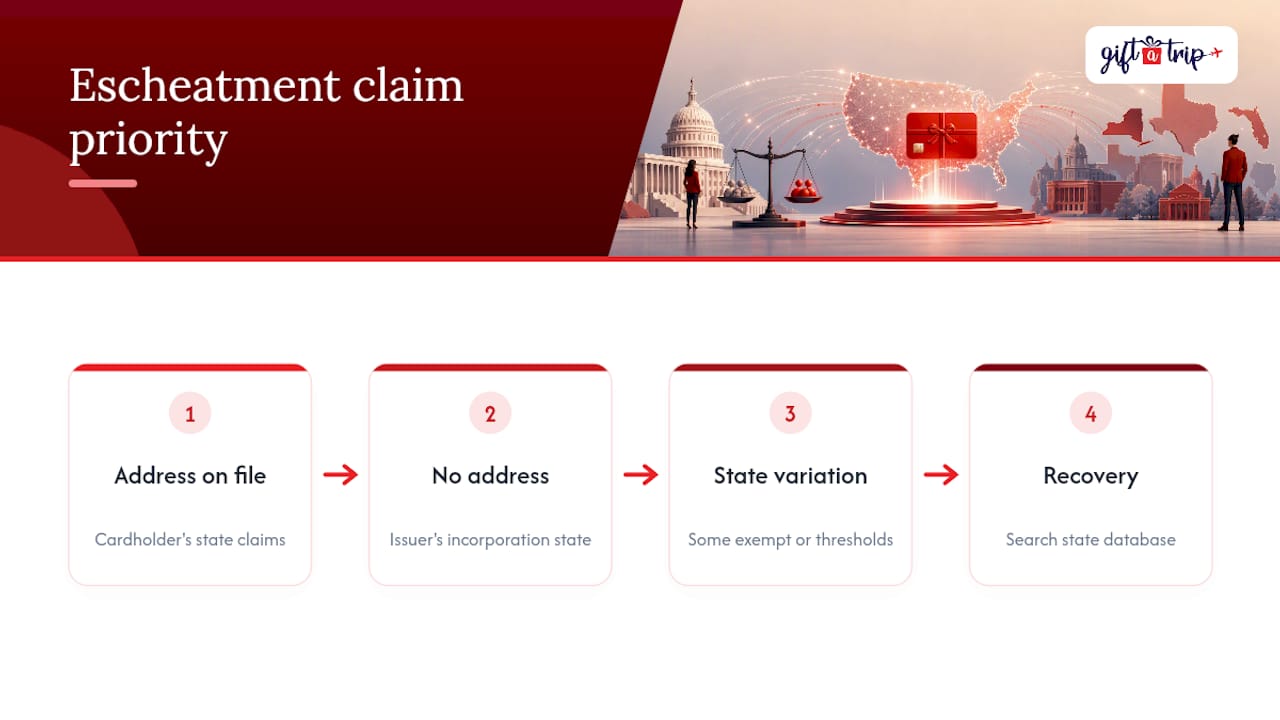
The jurisdictional question of which state gets to claim that money is more consequential than it sounds. The general rule follows the cardholder’s last known address, meaning the state where you live, or where the issuer believes you live, typically has first claim. The complication is that most gift cards are sold without collecting a purchaser’s address at all, since you can walk into a store and buy one with cash. When there’s no address on file, priority defaults to the issuer’s state of incorporation instead, a rule with real consequences for businesses.
As Baker Tilly’s guidance on gift card escheatment risk explains, issuers who don’t capture purchaser addresses at the point of sale often end up owing unclaimed property obligations to whichever state they’re incorporated in, rather than the states where their customers actually live. A retailer incorporated in Delaware but selling cards nationwide could end up reporting a disproportionate share of unclaimed balances to Delaware simply because that’s the fallback rule, not because most of its customers live there.
Escheatment isn’t a straight line from card to state coffer. Many states exempt gift cards from escheatment entirely, some exempt only cards below a certain balance, and a growing number of states have carved out gift certificates from their unclaimed property statutes altogether, precisely because the CARD Act already regulates them at the federal level. The rules genuinely vary state by state, and that variation is exactly why the NCSL tracker is worth bookmarking before assuming your balance is at risk.
If you think an old gift card balance might have been escheated, the good news is that unclaimed property is never permanently lost, only held. Every state runs a free, searchable unclaimed property database, and you can typically search by name to see if any funds, including old gift card balances, are sitting under your name in state custody. Filing a claim usually requires proof of identity and, ideally, the original card or a receipt, though most state programs will work with whatever documentation you can produce.
How to Check and Reclaim a Gift Card Balance
Old gift card sitting in a drawer? Here’s the sequence that actually gets you your money back, in the order that saves the most time.
- Check the balance first, using the toll-free number or website printed on the back of the card. This takes two minutes and rules out the simplest explanation, that the funds are simply still there and usable.
- Dig up any receipt or purchase confirmation you still have, especially for older cards. Proof of purchase speeds up every step that follows if there’s a dispute.
- If the balance shows zero or the card is reported “expired,” contact the issuer’s customer service directly and ask specifically whether the card falls under the federal rule with a minimum expiration period, when it was last loaded, and why the funds aren’t accessible.
- If the issuer can’t explain it satisfactorily, search your state’s unclaimed property database by name. This is free in every state and takes only a few minutes to run.
- If you find a match, file a claim through the state portal, submitting whatever identification and card documentation the state requests.
- If none of that resolves it, escalate to your state attorney general’s consumer protection office or file a complaint with the CFPB directly.
Pro Tip: Take a photo of both sides of every gift card the moment you receive it, before it disappears into a wallet or junk drawer. That image preserves the card number, expiration language, and issuer contact info even if the physical card gets lost, and it’s often the only proof you’ll have if a balance dispute comes up years later.
One more thing worth repeating because it costs people real money every year: never read a gift card number or PIN to anyone who calls, texts, or emails you asking for it, no matter how official they sound. Legitimate businesses, government agencies, and utility companies do not accept payment via gift card, ever. If someone demands one, you’re being scammed, full stop.
A Gift Card Compliance Checklist for Businesses That Issue Cards
If your business sells or issues gift cards, whether as a retail product or an employee incentive, compliance isn’t optional, and the requirements are more specific than most owners assume.
Disclosures at point of sale. Federal law requires clear, conspicuous language on the card or its packaging stating when funds expire (or confirming they don’t) and disclosing any fees, including amount and trigger conditions. If you’re selling in a no-expiration state, your packaging needs to reflect that too, not just default to the federal five-year language.
Replacement-card policy. Best practice is offering free replacement for lost, stolen, or damaged cards, since the CFPB’s guidance makes clear that any replacement fee has to be reasonable and disclosed, and a replacement card can never be used to shorten the underlying funds’ legal five-year life.
Recordkeeping for escheatment defense. Capture purchaser name and address at sale wherever operationally possible, even for a portion of transactions. As Baker Tilly notes, issuers without this data typically default to reporting unclaimed balances to their state of incorporation, which can mean owing money to a state where you have few or no actual customers. Track issuance dates and load dates for every card meticulously, since these dates are what determine both the five-year federal floor and your dormancy reporting obligations.
- Maintain a clear, written gift card policy covering expiration, fees, and replacement terms.
- Store purchaser data securely but retrievably for as long as your state’s escheatment statute requires.
- Review your program annually against NCSL’s state tracker, since state rules do change.
- Consult an unclaimed-property specialist or attorney before launching a card program in a new state, or if your existing program has never been audited.
Pro Tip: If you issue cards or certificates digitally rather than as physical plastic, you’re already ahead on compliance. Digital delivery inherently captures the purchaser’s email and often their name at the point of sale, which solves the address-collection problem that trips up so many physical-card programs. A turnkey approach to tracking purchasers and load dates makes this recordkeeping far less of a headache than retrofitting it onto an existing paper-card system.
Some businesses also consider voluntary disclosure agreements with state unclaimed-property offices if they discover past noncompliance, a route that can significantly reduce penalties compared to waiting for an audit to find the gap first. That’s a conversation for a specialist, not a DIY fix.
Myths and Scams: What Actually Drains Gift Card Value
The biggest myth about gift card expiration is that cards always expire after five years. In reality, a multi-year period is the federal minimum life for the funds, and plenty of cards, especially those from states with no-expiration laws or large national retailers, never expire at all. The five-year figure is a floor, not a universal deadline stamped on every card in the country.
A related misconception treats escheatment as the issuer “keeping” your money forever. It doesn’t. Escheated funds move to state custody specifically so you can reclaim them later, often with no time limit on when you can file a claim.
The real threat to your gift card balance isn’t a legal expiration date. It’s scams. The FTC’s consumer guidance documents the pattern clearly: someone posing as a government agency, a relative in trouble, or a business demanding overdue payment convinces a victim to buy gift cards and read the numbers over the phone. Once that code is shared, the money is gone, immediately and irreversibly, in a way no expiration law will ever touch.
- Never buy gift cards at someone else’s instruction over the phone or by text.
- Never read a gift card’s PIN or activation code to anyone who contacts you first.
- If a card is compromised, report it to the issuer immediately and file a report with the FTC.
How Compliant Travel Certificate Issuers Manage Expiration Risk
Running a gift card or travel certificate program responsibly means building compliance into the product itself, not treating it as an afterthought. Digital delivery is one of the more effective controls available: it eliminates lost physical cards, captures purchaser contact information automatically, and creates a clean record of issuance and load dates from day one, exactly the data that determines escheatment obligations later.

The strongest programs pair that with prominent, plain-language disclosures on contact information and replacement policy, offering free replacement whenever a certificate is lost or the recipient never received it, rather than treating replacement as a revenue opportunity. Program design choices matter too. Avoiding dormancy fees entirely, tracking every reload against the original issuance date, and defaulting toward a no-expiration policy nationwide all reduce both legal exposure and the operational mess of reconciling 50 different state rule sets.
Why Consumer-Friendly Gift Card Policies Make Business Sense
The conventional wisdom treats expiration dates and dormancy fees as revenue tools worth defending. I’d argue the math rarely supports that anymore. Large national issuers increasingly default to no-expiration policies not out of generosity but because complying with 50 different state statutes individually costs more in legal overhead than any fee revenue recovers.
Smaller issuers can capture the same benefit without matching a giant’s scale: collect purchaser addresses at sale, skip dormancy fees, and disclose everything in plain language. That alone resolves most of the compliance risk described above. Clear labeling and free replacement aren’t just legal hygiene. They’re what a customer actually remembers when they decide whether to buy from you again.
— Donovan
Gift a Trip: Travel Certificates Built Around Clear Terms
Compare that to the drawer full of unused retail gift cards most households are sitting on, cards where the terms are buried in fine print and the balance eventually gets forgotten. Giftatrip takes a different approach: every travel certificate comes with transparent expiration and replacement terms stated up front, not tucked into a receipt nobody keeps.

For businesses, that clarity extends to bulk ordering. Corporate buyers running employee recognition or incentive programs can order in volume with taxes and resort fees already included in the price, and Giftatrip’s digital delivery means every certificate is tied to a purchaser record from the moment it’s issued, which simplifies tracking for HR teams and reduces the recordkeeping headaches described earlier in this guide. If you’re planning a reward program, the travel certificate distribution guide for HR and events walks through how bulk orders and recordkeeping fit together in practice.
Whether you’re shopping for a single anniversary gift or setting up a company-wide incentive program, the fastest way to see what’s available is to browse travel certificates and gift options directly and check current inclusions and blackout-date policies before you buy.
Primary Sources for Gift Card Expiration Rules
- CFPB regulation 12 CFR §1005.20: the federal rule implementing the five-year floor, fee limits, and disclosure requirements.
- NCSL: Gift Cards and Gift Certificates statutes and legislation: the state-by-state tracker for stricter rules and cash-redemption thresholds.
- FTC consumer guidance on avoiding and reporting gift-card scams: federal guidance on the scams that actually cost consumers the most.
- Federal Reserve press release on gift-card rules: the original announcement explaining how the five-year rule and fee limits work.
- Baker Tilly: Six keys to managing gift card escheatment risk: industry guidance on escheatment priority and recordkeeping for issuers.
Readers comparing gift cards to other prepaid travel products may also find this overview of travel vouchers useful for understanding how durability terms differ across product types.
Sources
- CFPB regulation 12 CFR §1005.20
- Federal Reserve press release on gift-card rules
- NCSL: Gift Cards and Gift Certificates statutes and legislation
- Baker Tilly: Six keys to managing gift card escheatment risk
FAQ
Are gift cards legally allowed to expire?
Yes, but not before five years from issuance or the last load, under the CARD Act and 12 CFR §1005.20. Several states go further and ban expiration entirely.
Will a gift card from 10 years ago still work?
It might. If the funds were never escheated to the state, the balance is likely still active with the issuer, especially in a no-expiration state; if it was escheated, you can typically reclaim it through your state’s unclaimed property database.
Is it illegal to have an expiration date on a gift card?
Not under federal law, as long as the date is at least five years out and properly disclosed, but it is illegal in states that specifically ban gift card expiration dates altogether.
Do all gift cards expire after five years?
No. Five years is the federal minimum, not a universal rule, and many national issuers and no-expiration states allow gift card funds to remain valid indefinitely.
Do travel gift cards expire the same way retail gift cards do?
Travel certificates purchased for value generally fall under the same CARD Act protections as retail gift cards, though issuers like Giftatrip that emphasize clear, upfront terms often build in longer redemption windows and fewer blackout restrictions than a typical store card.
What should I do if a store refuses to honor my gift card’s balance?
Cite the federal rule with a minimum expiration period and your state’s specific statute to the merchant directly, and if that fails, file a complaint with your state attorney general’s office or the CFPB.