
Jump to Section:
TL;DR:
- Travel vouchers are issued as compensation after disruptions, whereas certificates are purchased upfront for gifting or incentives. Understanding their differing validity, transferability, and refund rules is essential to ensure expectations are met. Legal regulations prevent airlines from substituting vouchers for cash refunds without explicit passenger consent.
Most people use “travel voucher” and “travel certificate” like they mean the same thing. They do not. The difference between travel vouchers and certificates affects everything from whether your gift is transferable to whether you can get a cash refund if plans change. For anyone choosing a travel gift, planning a corporate rewards program, or dealing with a disrupted flight, understanding that distinction is not a technicality. It is the thing that determines whether you actually get what you expected.
Table of Contents
- Key takeaways
- The difference between travel vouchers and certificates
- How vouchers and certificates actually differ in practice
- Legal and regulatory considerations
- Practical scenarios for individuals and organizations
- Common misconceptions worth clearing up
- My honest take on the voucher vs. certificate confusion
- Give a travel experience that actually works
- FAQ
Key takeaways
| Point | Details |
|---|---|
| Definitions differ by context | Travel vouchers are typically issued as compensation or credits, while certificates are pre-purchased instruments for gifting and booking. |
| Policies drive real differences | Validity periods, transferability, and cash redemption rules vary by issuer, not just by what the document is called. |
| Legal rights protect consumers | Under EU and UK law, passengers cannot be forced to accept vouchers instead of cash refunds for flight cancellations. |
| Gifting favors certificates | Travel certificates generally offer more flexibility, broader redemption options, and better transferability for recipients. |
| Verify terms before accepting | Always check expiration dates, name-matching requirements, and partial-use rules before committing to any voucher or certificate. |
The difference between travel vouchers and certificates
Before comparing them, you need solid definitions. Both instruments carry monetary value tied to travel, but they originate from different contexts and serve different purposes.
A travel voucher is most commonly issued by a travel company as a form of credit or compensation. Airlines issue vouchers when flights are canceled, when passengers voluntarily give up their seats, or when a fare dispute gets resolved. Hotels sometimes issue them after a service failure. The key characteristic: vouchers are reactive. They exist because something happened, and the company owes you something. They are not usually purchased outright.
A travel certificate is typically purchased upfront, often as a gift. It carries a fixed value and can be redeemed for a specific type of travel experience, such as a hotel stay, cruise, or vacation package. Certificates are proactive instruments. You buy them with the intention of giving someone a travel experience.
Here is where the terminology gets murky. Different companies use these terms interchangeably:
- Alaska Airlines issues “bonus travel certificates” that function like credits for future flights, complete with fare rules and refund mechanics governed by specific redemption terms.
- Frontier Airlines calls its compensation instruments “vouchers,” and their usage conditions read more like a certificate than what most travelers expect.
- U.S. government agencies use the term “travel voucher” to describe a reimbursement claim form, specifically the DD Form 1351-2, which has nothing to do with gifting or compensation credits.
The takeaway: the label on the document matters less than the specific terms attached to it. For a deeper look at how certificates function as flexible gift instruments, Giftatrip’s guide to travel certificate basics breaks down the mechanics clearly.
How vouchers and certificates actually differ in practice
This is where the travel voucher vs certificate comparison gets practical. The following comparison highlights the most important operational differences:
| Feature | Travel voucher | Travel certificate |
|---|---|---|
| How it is issued | Compensation or credit after an event | Purchased upfront, often as a gift |
| Validity period | Typically 30 to 90 days | Usually 12 months or longer |
| Transferability | Generally non-transferable | Often transferable to the recipient |
| Cash redemption | Rarely convertible to cash | Usually not cash-convertible |
| Partial use | Often single-use, full value | May allow partial use with remaining balance |
| Name matching | Strict name match required | Issued to a named recipient but more flexible |
Frontier Airlines illustrates the voucher side clearly. Their vouchers expire in 90 days, are single-use, non-transferable, require an exact name match, and cannot be converted to cash. If the ticket costs more than the voucher, you pay the difference. If you miss the 90-day window, the value disappears.

Alaska Airlines’ bonus travel certificates operate differently. They are valid for one year, redeemable online for eligible flights, and if unused value remains after redemption, it may be returned as a credit certificate under the applicable fare rules.
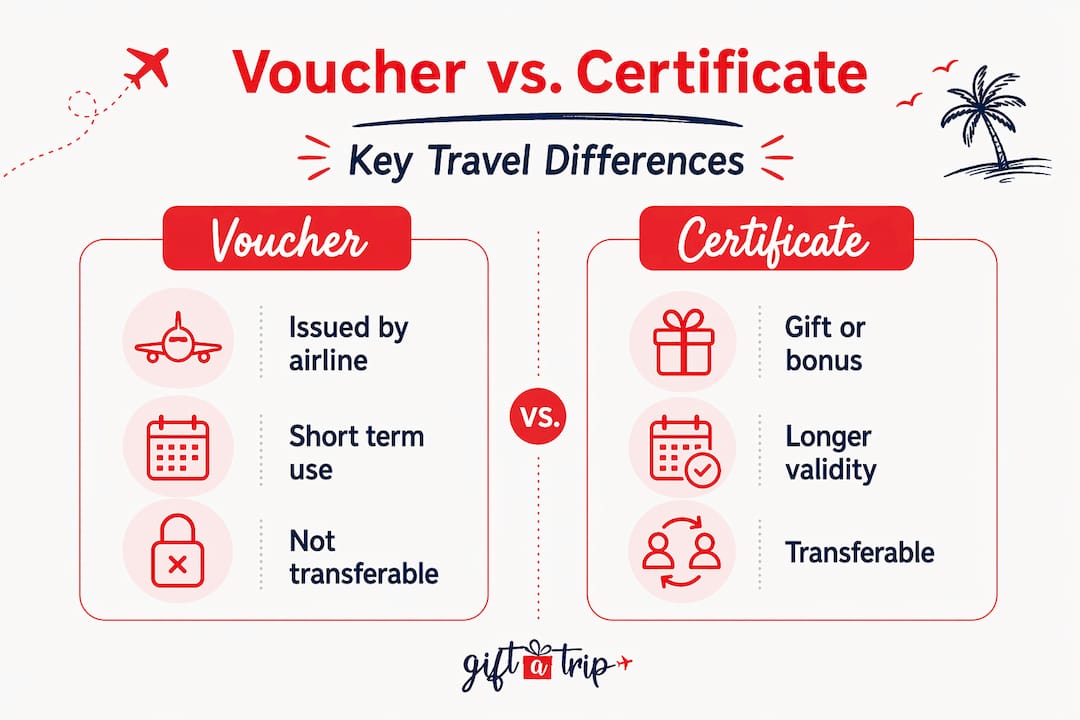
Neither is inherently better. The question is always: what do you need it to do?
Pro Tip: When you receive any travel voucher or certificate, screenshot or print the terms immediately. Expiration dates and redemption rules are often buried in confirmation emails that are easy to lose.
For organizations exploring how travel certificates stack up against cash incentives for employee rewards, the comparison of certificates vs. cash bonuses offers a data-informed perspective.
Legal and regulatory considerations
Laws shape how vouchers work in ways most travelers never realize. The EU261 and UK261 regulations are the clearest example of this.
Under both frameworks, airlines must pay cash compensation within seven days of a cancellation or significant delay. They cannot substitute a voucher for that cash unless the passenger explicitly agrees. Accepting a meal voucher or a hotel stay during a disruption does not waive your right to cash compensation. Those welfare vouchers are separate from statutory compensation.
“Airlines may offer vouchers as an alternative to refunds, but passengers are under no obligation to accept them in place of the cash they are legally owed.” — EU261/UK261 regulatory guidance via ClaimWinger
This distinction matters enormously if you fly internationally. A passenger who accepts a voucher assuming it equals their legal compensation may later discover the voucher covers only a fraction of the refund they were owed. It is also worth knowing that care vouchers and compensation are treated as separate items under these regulations.
For government employees in the U.S., the situation is completely different. A government travel voucher is a reimbursement claim document. Confusing the authorization stage with the voucher claim process causes payment delays. It is an internal finance document, not a consumer travel product.
Practical scenarios for individuals and organizations
Knowing the definitions is one thing. Knowing when to use each instrument is what creates real value. Here is a structured framework for the most common situations:
-
Corporate rewards and incentive programs. Travel certificates are the stronger choice. They are purchased in bulk, delivered digitally, and redeemable by the named recipient for experiences they choose. Unlike vouchers, certificates are not tied to a specific disruption event. Giftatrip offers solutions specifically for employee travel incentives with customizable options.
-
Personal gifting for milestones. Certificates win here too. A honeymoon cruise certificate or a resort stay for an anniversary is a concrete, emotionally resonant gift. Vouchers, because they stem from compensation scenarios, carry the wrong emotional weight for gifting.
-
Flight disruptions and cancellations. If an airline offers you a voucher, evaluate it carefully. Check the expiration date, whether it is tied to your name only, and whether you are waiving a cash refund right by accepting it.
-
Redeeming leftover travel credits. If you have a voucher with a short window, use it as quickly as possible for a flight you would book anyway. Do not hold it for a “perfect trip” that may not materialize before it expires.
-
Managing certificate expiration. When you give a travel certificate as a gift, communicate the expiration date clearly. Many certificates last 12 months, but that window passes faster than people expect, especially when life gets busy.
Pro Tip: For organizations buying travel certificates in bulk, look for providers that cover taxes and resort fees within the certificate value. Hidden add-on costs at redemption are a common source of recipient frustration.
The benefits of travel vouchers as gifts are real, but only when the terms align with what the recipient actually needs.
Common misconceptions worth clearing up
Several persistent myths about these instruments cause real problems at redemption time.
- “Vouchers and certificates are just different words for the same thing.” They often come with completely different rules, even when issued by the same company for similar purposes. The terminology varies by issuer policy, not by any universal standard.
- “I can give my voucher to a friend if I cannot use it.” Most airline vouchers are non-transferable by design and require exact name matching. Handing one to a friend often renders it completely unusable.
- “Unused value carries over.” Some certificates allow partial use with a remaining balance returned as credit. Others expire the full value on first use. Alaska Airlines’ bonus travel certificates handle this with fare rule-governed refunds, but that is not standard across the industry.
- “A travel voucher is like a gift card.” Not quite. Gift cards are typically open-value instruments with minimal restrictions. Travel vouchers usually come with specific redemption windows, destination restrictions, and usage rules that gift cards do not.
- “Government travel vouchers work like airline vouchers.” They do not. A U.S. government travel voucher is a reimbursement claim form. Mixing up these categories causes serious processing delays for military and federal employees.
The safest habit: read the specific terms of whatever you receive before making any travel plans around it.
My honest take on the voucher vs. certificate confusion
I have spent years watching people lose real value because they treated a voucher like a flexible credit and a certificate like a rigid contract, when the reality is usually the opposite.
The industry does not help. Companies use these terms inconsistently, and the fine print is buried in confirmation emails no one reads until they are standing at a check-in counter. What I have learned is that the label barely matters. The questions that actually matter are: When does this expire? Can someone else use it? Can I apply partial value? And if plans change, what happens to the rest?
Where I see the most frustration is with corporate gifting teams that purchase vouchers without checking transferability rules. A voucher tied to one employee’s name is worthless if that employee leaves or cannot use it. Certificates, particularly those from purpose-built platforms, tend to offer much cleaner terms for this reason.
The empowering move is not just reading this article. It is treating every piece of travel paper, digital or physical, as a contract. Because that is what it is.
— Donovan
Give a travel experience that actually works
If you are shopping for a travel gift that your recipient can use on their own terms, without expiration anxiety or name-matching hoops, Giftatrip has built exactly that kind of product.

Giftatrip’s travel certificates cover resorts, vacation packages, and cruise lines, with taxes and resort fees included in the value. Corporate teams use them for employee recognition and sales incentives. Individuals give them for birthdays, anniversaries, and honeymoons. The Virgin Voyages cruise certificates are a standout option for anyone who wants to give a cruise experience without locking the recipient into a fixed date or cabin. Delivery is digital, the terms are transparent, and the recipient gets to choose when and how they travel.
FAQ
What is the main difference between a travel voucher and a certificate?
A travel voucher is typically issued as compensation or credit after an event like a flight cancellation, while a travel certificate is purchased upfront as a gift or incentive. Vouchers usually have shorter validity and stricter usage rules than certificates.
Can I transfer a travel voucher to someone else?
Most airline vouchers are non-transferable and require exact name matching at redemption. Travel certificates, especially those purchased for gifting purposes, are generally more flexible and can be given to a named recipient.
Are travel vouchers refundable for cash?
Typically no. Most travel vouchers cannot be converted to cash. However, under EU261 and UK261 regulations, airlines must offer cash refunds for cancellations and can only substitute vouchers if the passenger explicitly agrees.
What are the benefits of travel vouchers compared to cash gifts?
The benefits of travel vouchers include directing the recipient toward a specific travel experience, which research suggests creates stronger emotional impact than cash. They also allow organizations to manage gifting budgets while offering something memorable and tangible.
How do I avoid losing the value of a travel voucher or certificate?
Check the expiration date immediately upon receiving it and set a calendar reminder well before that date. Verify name-matching rules, whether partial use is allowed, and any blackout dates before making travel plans around it.