Jump to Section:
TL;DR:
- Vacation package certificates deliver memorable experiences with flexible booking and measurable value.
- They outperform traditional gifts by creating lasting emotional impact and significantly boosting performance.
- Important considerations include expiration dates, blackout periods, and loyalty point implications.
Vacation package certificates deliver results that most gifts simply cannot match. Incentive travel boosts performance by 22% and returns $4 in productivity for every dollar spent, according to the IRF 2026 Trends Report. Yet many people still confuse these certificates with generic vouchers or assume they come loaded with restrictions. The reality is quite different. Whether you’re searching for a memorable birthday gift, planning an anniversary surprise, or building a corporate rewards program that actually moves the needle, vacation package certificates offer flexibility, emotional impact, and measurable value. This article breaks down exactly how they work, why they outperform traditional gifts, what limitations to watch for, and how to use them effectively.
Table of Contents
- What are vacation package certificates?
- Why vacation certificates outperform traditional gifts
- Key limitations and considerations
- Maximizing the impact: Best practices for gifting and rewarding
- Why experience-based rewards are redefining gifting and recognition
- Discover flexible vacation certificate solutions
- Frequently asked questions
Key Takeaways
| Point | Details |
|---|---|
| Proven ROI | Vacation package certificates deliver measurable performance boosts and offer up to $4 productivity per dollar spent. |
| Personal impact | Certificates create unforgettable experiences for recipients—far more memorable than traditional gifts. |
| Smart gifting strategy | Understanding certificate limitations and best practices ensures your gift or reward is well-received and maximally effective. |
| Flexible solutions | Vacation certificates are tailored for both personal celebrations and employee rewards, fitting any occasion. |
What are vacation package certificates?
Now that you know vacation certificates offer impressive outcomes, let’s clarify what they actually are and how they work.
A vacation package certificate is a prepaid travel credential, either digital or physical, that entitles the recipient to a specific travel experience. That experience might be a resort stay, a hotel night, a cruise, or a bundled vacation package. The certificate holds a defined value or a set itinerary, and the recipient redeems it by following a booking process outlined in the certificate’s terms.
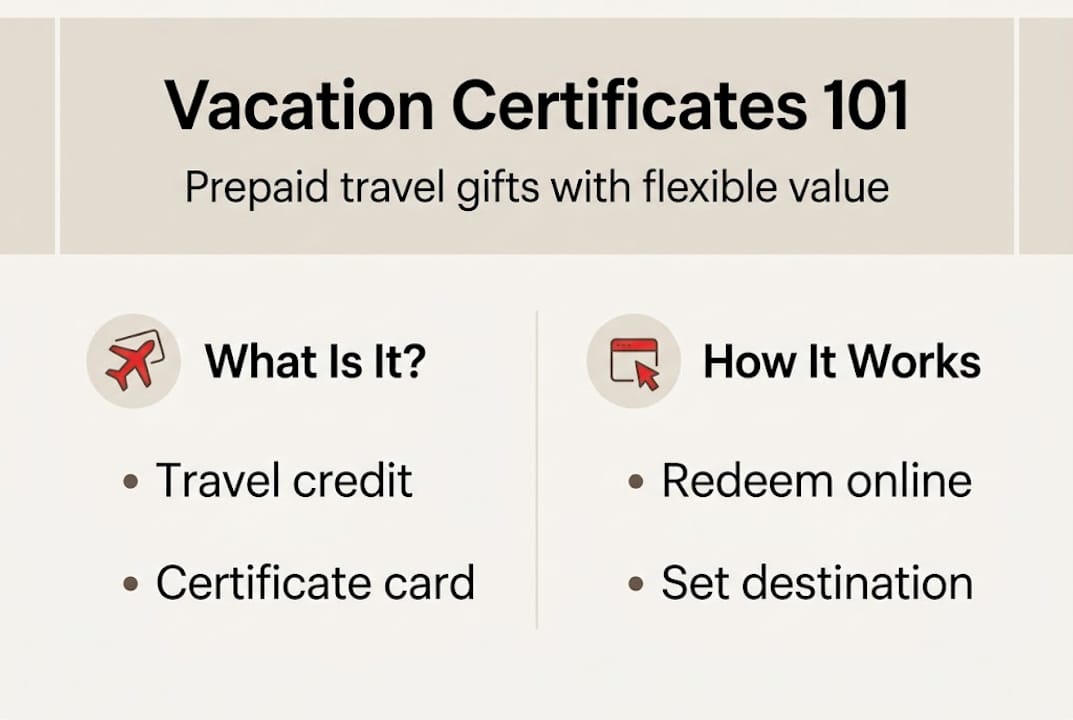
Redemption is typically straightforward. The recipient contacts the provider or logs into a booking portal, selects available dates, and confirms their reservation. Most certificates cover core costs like accommodations and, in many cases, taxes and resort fees. Platforms like Gift A Trip make travel certificates explained in detail, helping both givers and recipients understand what’s included before any money changes hands.
The range of vacation types is broad. Common options include:
- Resort stays at beachfront or mountain properties
- Hotel nights at major brand properties worldwide
- Cruise certificates redeemable with lines like Virgin Voyages or Royal Caribbean
- All-inclusive vacation packages bundling flights, hotels, and meals
- City getaway packages for urban travel experiences
One important nuance: certificates may carry redemption restrictions, expiration dates, or exclusions tied to specific properties or travel windows. These aren’t deal-breakers, but they do require attention. A certificate with a 12-month redemption window and a handful of blackout dates around major holidays is still highly usable, provided the recipient knows the terms upfront.
Booking support matters too. Quality certificate providers offer customer service to help recipients navigate the process, especially for more complex packages involving flights or multi-destination itineraries. When you choose a certificate from a reputable platform, that support layer is often built in, reducing friction for the recipient and making the gifting experience feel seamless rather than stressful.
Why vacation certificates outperform traditional gifts
Understanding how vacation certificates work, it’s clear their results differ from typical gifts. Let’s break down why they truly stand out.
Most traditional gifts, whether it’s a gift card to a retailer, a bottle of wine, or a branded item, are forgotten within weeks. Experiences are different. Travel creates memories that people recall and share for years. That emotional staying power is one reason vacation certificates consistently outperform physical gifts in both personal and corporate settings.

The data is hard to ignore. Incentive travel returns $4 in productivity for every dollar invested, and programs using travel rewards see a 22% boost in performance. These aren’t soft metrics. They represent real output from real employees who feel genuinely recognized.
| Gift type | Perceived value | Memory longevity | ROI potential |
|---|---|---|---|
| Physical gift (branded item) | Low to medium | Days to weeks | Minimal |
| Retail gift card | Medium | Weeks | Low |
| Cash bonus | Medium | Short-term | Moderate |
| Vacation certificate | High | Years | Strong |
For personal gifting, the logic is equally compelling. A vacation certificate for a couple’s anniversary or a milestone birthday signals that you put real thought into the gift. It’s not something they’d buy themselves on a Tuesday. It’s an invitation to do something extraordinary together, and that distinction carries emotional weight that no Amazon wishlist item can replicate.
For corporate managers, the travel incentive certificates guide at Gift A Trip shows how structured travel rewards can be layered into existing recognition programs. The flexibility to offer different certificate tiers, from a weekend resort stay to a full cruise, means you can match the reward to the achievement.
Statistic spotlight: Companies using travel incentives report a 22% performance increase and $4 in productivity gains per dollar spent, making them one of the highest-ROI reward tools available.
Pro Tip: Reserve your premium travel certificates for top performers. A turnkey travel rewards approach, where certificates are pre-selected and ready to deploy, lets managers act quickly without losing the personal touch that makes recognition meaningful.
Key limitations and considerations
While certificates shine for both gifts and rewards, there are practical nuances worth knowing before you choose one.
The most common concern is expiration. Certificates may carry expiration dates and redemption windows that vary by provider. A certificate that expires in six months is very different from one valid for 18 months. Always check this before purchasing, and communicate the deadline clearly to the recipient so they can plan accordingly.
Blackout dates are another factor. Most certificates restrict booking during peak travel periods like Thanksgiving week, Christmas, and New Year’s. Some also exclude specific properties or regions. This doesn’t make them unusable. It just means recipients need to plan with a bit of flexibility.
Loyalty points are often off the table. Booking via third-party packages typically does not earn hotel loyalty points, and flights booked through bundled packages may result in lower qualifying dollars toward airline status. For frequent travelers who prioritize points accumulation, this is worth flagging upfront.
Here’s a quick checklist of things to review before gifting a vacation certificate:
- Expiration date: How long does the recipient have to book and travel?
- Blackout dates: Which dates or seasons are excluded?
- Property exclusions: Are specific hotels or resorts off-limits?
- Loyalty point eligibility: Will the recipient earn points through this booking?
- Booking support: Is there a customer service team to assist with redemption?
- What’s included: Are taxes, resort fees, and transfers covered?
“Read the fine print before you gift. A certificate that surprises the recipient with unexpected restrictions isn’t a gift, it’s a headache. Transparency at the point of gifting sets everyone up for success.”
For corporate travel rewards programs, this transparency is especially important. Employees who receive a reward and then struggle to redeem it will associate the frustration with the company, not the certificate provider. Choose platforms that offer clear documentation and responsive support.
Maximizing the impact: Best practices for gifting and rewarding
Knowing the limits, you may wonder how to truly maximize the value of vacation certificates. Here’s how to make them unforgettable gifts and powerful rewards.
Personalization is the single biggest lever you can pull. A certificate paired with a handwritten note explaining why you chose this particular trip for this particular person hits completely differently than a generic envelope. For corporate managers, attaching a brief message that connects the reward to a specific achievement makes the recognition feel earned and intentional.
Here’s a step-by-step approach to gifting vacation certificates effectively:
- Match the certificate to the recipient. A beach resort certificate works beautifully for a couple celebrating an anniversary. A city getaway suits a solo traveler. Know your audience.
- Present with clear instructions. Include redemption steps, the expiration date, and contact information for booking support. Remove all guesswork.
- Add a personal message. Explain why you chose this gift. Connect it to a memory, a milestone, or a goal.
- For corporate programs, track engagement. Note who redeemed, when, and what feedback they shared. This data improves future reward cycles.
- Follow up after the trip. Ask about the experience. This closes the loop and reinforces the recognition.
For managers building structured programs, the numbers support investing more per person for top performers. Top-performing companies spend roughly $5,100 per person on incentive travel, targeting the top 20% of their workforce for the highest-value experiences.
| Recipient tier | Recommended certificate value | Occasion type |
|---|---|---|
| Top performer (top 20%) | $1,500 and above | Annual recognition |
| Strong contributor | $500 to $1,500 | Quarterly milestone |
| Team-wide recognition | Under $500 | Project completion |
| Personal gift (anniversary) | $300 to $800 | Special occasion |
Explore business gift certificate solutions to find tiered options that fit different budget levels, and review employee reward packages for structured program ideas that scale across teams.
Why experience-based rewards are redefining gifting and recognition
Most articles about gifting stop at the tactical level: pick a gift, wrap it nicely, measure the smile. We think that misses the bigger picture entirely.
The shift toward experience-based rewards isn’t a trend. It’s a correction. For decades, corporate recognition leaned heavily on plaques, branded merchandise, and cash bonuses. These things communicate value in a transactional way. They say, “You did a good job, here’s something.” What they rarely do is create a story the recipient tells their family at dinner.
Travel does that. A well-chosen vacation certificate says, “We see you, and we want you to experience something extraordinary because of what you’ve contributed.” That’s a fundamentally different message. Incentive travel’s 22% performance boost isn’t just about the trip itself. It’s about the anticipation, the experience, and the memory that follows.
For personal gifting, the same principle applies. The person who receives a vacation certificate for their 40th birthday will remember it long after the trip ends. The emotional ROI, the connection, the gratitude, outlasts anything that can be ordered online and delivered in two days.
We believe the future of both personal and corporate gifting runs through experiences, and enhancing employee rewards with travel is one of the most direct ways to make recognition feel real. The financial case is already made. The emotional case is even stronger.
Discover flexible vacation certificate solutions
Ready to act? Gift A Trip offers a wide range of vacation certificates built for every occasion and budget, from romantic getaways to large-scale corporate reward programs.

Browse vacation packages recognition options designed for milestones, employee rewards, and charitable auctions. If you’re looking for something with a unique twist, explore Virgin Voyages certificates for a cruise experience that stands apart from traditional travel gifts. Taxes and resort fees are covered, blackout dates are minimal, and digital delivery makes the process simple. Visit Gift A Trip to find the right certificate for your next gift or recognition moment.
Frequently asked questions
Do vacation package certificates expire?
Yes, most certificates have expiration dates, so it’s important to check the terms before gifting or redeeming. Providers vary widely, with some offering redemption windows as short as six months and others extending to 18 months or more.
Can vacation package certificates be used during peak travel seasons?
Some certificates exclude peak seasons and certain resorts, so reviewing the specific terms for each certificate is essential. Blackout dates and exclusions are standard practice across most providers, particularly around major holidays.
Will recipients earn hotel loyalty points when booking with certificates?
Typically, third-party package bookings do not earn hotel loyalty points and may result in lower flight qualifying dollars toward airline status programs.
How are vacation certificates presented as gifts?
Vacation certificates are usually delivered digitally or physically, paired with redemption instructions and personalized messaging to make the gift feel complete and easy to use.
What evidence supports the effectiveness of travel rewards?
Research shows incentive travel boosts performance by 22% and delivers $4 in productivity for every dollar spent, making it one of the strongest ROI tools in both personal and corporate gifting.
Recommended
- Travel certificates explained: flexible gift solutions
- Vacation Gift Certificates: Smart Corporate Reward Solutions
- Vacation Gift Vouchers: 7 Ways to For Employee Recognition
- How to gift travel certificates for memorable experiences
- Packages and Offers – Zodia Craiului – Boutique hotel in Transylvania
- Golf Blab E-Gift Cards