
Jump to Section:
Never give a gift card number or PIN to anyone who calls, texts, or emails asking for it. That single rule stops most gift card fraud before it starts. Keep your receipt, photograph the card front and back, and if you’ve already been scammed, contact the issuer and file a report at Reportfraud right away. Merchants should pair that consumer vigilance with account velocity limits and trained staff who never read activation codes over the phone.
TL;DR:
- Physical gift cards remain vulnerable to tampering, with signs like misaligned PIN stickers and resealed packaging indicating potential fraud.
- Organized crime rings tamper with, resell, and launder gift card balances rapidly, making delays and weak controls ineffective against high-volume fraud.
- Consumer prevention includes inspecting cards, photographing, and reporting suspicious activity immediately, while merchants should enforce technical and operational safeguards.
- Digital travel certificates eliminate physical tampering risks, offering traceability and direct delivery, making them a safer alternative for both consumers and businesses.
- Speed in reporting fraud, combined with layered merchant controls and staff training, remains crucial to recovering funds and preventing loss.
Table of Contents
- Why Gift Cards Are a Fraud Target
- Common Gift Card Scams and Red Flags
- Practical Prevention Steps for Consumers
- Practical Prevention Steps for Merchants
- If You’ve Been Scammed: Reporting, Recovery, and Timeline
- A Publisher’s Perspective on Safer Digital Gifting
- Quick Takeaways Checklist
- Emerging Technology in Gift Card Fraud Prevention
- Legal and Regulatory Protections for Gift Card Buyers
- Building a Fraud Prevention Strategy for Your Business
- The Real Gap in Most Gift Card Advice
- An Alternative: Why Choose Secure Digital Travel Certificates
- Sources
- FAQ
Why Gift Cards Are a Fraud Target
Gift cards move like cash but leave almost no trail, which is exactly why criminals prefer them over stolen credit cards. Once a code is redeemed, the value transfers instantly and anonymously. There’s no chargeback, no bank to call, no signature to dispute.
That anonymity has attracted organized retail crime networks, not just lone scammers working a phone script. ICE Homeland Security Investigations has documented how these groups tamper with cards on store shelves, then resell the harvested balances through secondary markets, turning a $50 card into laundered cash within hours.
Three attack types dominate the landscape:
- In-store tampering, where someone alters a physical card before a shopper buys it
- Victim-assisted fraud, where a scammer convinces a target to purchase and hand over cards directly
- Online balance-harvesting, where bots scrape card numbers and check for active balances at scale
Each requires a different defense, which is why a one-size-fits-all warning label on a rack rarely works.
Common Gift Card Scams and Red Flags
Most gift card fraud follows a handful of recognizable patterns. Learning them takes five minutes and can save you hundreds of dollars.
- Impersonation scams. A caller claims to be the IRS, a utility company, tech support, or even a relative in trouble, and demands payment in gift cards. No legitimate government agency, utility, or business will ever require payment this way, according to FTC consumer guidance. If someone asks for gift cards to settle a debt or avoid arrest, hang up.
- Tampered-display cards. Fraudsters peel back the PIN sticker, note the code, then reseal the packaging or apply a fake barcode sticker over the real one. When you activate the card at checkout, the balance loads onto a number the criminal already has.
- Online balance-harvesting. Automated scripts hit gift card balance-check pages thousands of times a minute, testing random or sequentially guessed numbers until one returns a live balance.
- Manager or IT impersonation. Someone posing as corporate IT or a district manager calls a store and pressures an employee to read back activation codes “for a system check.”
Pro Tip: A card with a wrinkled, lifted, or misaligned PIN sticker has usually been tampered with, even if the barcode looks fine. When in doubt, grab a different card from the back of the rack, not the front.
Practical Prevention Steps for Consumers
Most gift card fraud is preventable at the point of purchase, not after the fact. Slow down for thirty seconds before you buy or use one.
- Inspect the packaging for scratched, resealed, or misaligned PIN covers, and check that the barcode sticker matches the printed number underneath.
- Pick a card from the middle or back of a display rack rather than the front, since tampered cards are often placed for easy customer access.
- Pay by credit card rather than cash or debit when buying gift cards, which gives you dispute options the issuer can’t offer.
- Photograph the front and back of the card and keep the receipt until the full balance is redeemed.
- Never share a card number, PIN, or photo of the back with anyone who contacts you first, even if they claim to be your bank or a government agency.
- Check balances only on the official issuer or retailer website, not a third-party site you found through search, since some retailer advisories warn that harvester sites exist specifically to skim numbers submitted by shoppers.
If a card feels tampered with or a balance comes back lower than expected, don’t argue with the cashier. Contact the issuer immediately using the number printed on the card, not a number a caller gives you, and follow up with a report at ReportFraud.ftc.gov. Fast action matters because some issuers can freeze remaining funds before a scammer redeems them.
Pro Tip: Buy a physical card as a backup gift only if you’ve inspected it yourself in the store. If you’re gifting remotely or in bulk, a digital certificate with delivery tracking removes the tampering risk entirely.
Practical Prevention Steps for Merchants
Retail staff and loss-prevention teams need layered defenses, since no single control stops every scam scenario.
Technical controls deserve first priority. Signifyd’s merchant guidance recommends account-age rules that flag new accounts making large gift card purchases, velocity limits that cap how many cards one account or IP address can buy per hour, and tarpitting, which deliberately slows down automated balance-check requests so bot scripts can’t scrape thousands of numbers per minute. Purchase caps on single transactions also blunt bulk fraud attempts.
Operational policy matters just as much as software. Every retailer should adopt a written rule that activation codes are never read aloud to a caller, emailer, or texter, regardless of how urgent or official the request sounds. A documented policy with role-based verification is one of the more effective defenses against manager-impersonation scams targeting front-line staff.
Physical merchandising closes the loop. Keep cards in tamper-evident packaging, store high-value cards behind the counter rather than on open racks, check displays for resealed packaging during every shift change, and make sure security cameras cover the gift card aisle.
- Rotate stock and inspect displays at least once per shift, not once per week.
- Share tampering patterns with card issuers and local law enforcement when you spot a cluster.
Pro Tip: Train cashiers to ask one question before every gift card sale over $100: “Did someone on the phone tell you to buy this?” That single prompt catches a surprising number of victim-assisted scams before the transaction completes.
If You’ve Been Scammed: Reporting, Recovery, and Timeline
Speed is everything once you realize a card has been compromised or a scammer has convinced you to hand over codes.
- Gather your evidence. Pull together the receipt, photos of the card front and back, timestamps of any calls or texts, and screenshots of messages from the scammer.
- Call the issuer immediately. Use the customer service number printed on the card or listed on the issuer’s official website, never a number a caller provided. Ask them to flag or freeze the remaining balance.
- File with the FTC. Report the scam at ReportFraud.ftc.gov, which routes complaints to investigators and helps build the pattern data agencies use to track fraud rings.
- File with IC3 if it happened online. If the scam involved a website, app, or online marketplace, the FBI’s Internet Crime Complaint Center is the appropriate additional channel.
- Contact local police if instructed. Some issuers require a police report number to process a claim.
Recovery isn’t guaranteed. It depends heavily on how fast you report it, whether any balance remains unredeemed, and how cooperative the issuer is, since some issuers can freeze funds before a scammer cashes out but only if you call within hours, not days.
A Publisher’s Perspective on Safer Digital Gifting
Physical gift cards carry a structural weakness that no amount of shelf inspection fully eliminates: anyone who touches the packaging before you buy it has a shot at the code. Digital travel certificates sidestep that problem because there’s no scratch-off PIN to peel and no resealed wrapper to fake. Delivery happens straight to an inbox, and corporate distribution tools generate order logs and fulfillment metadata that make each certificate traceable from purchase to redemption. If you’re evaluating any digital certificate vendor, ask for delivery logs, plain-language redemption terms, and full fee disclosures before you buy.
Quick Takeaways Checklist
Six actions cover most of what matters here:
- Never share a gift card number or PIN with anyone who contacts you first.
- Inspect packaging and PIN covers before buying; skip anything that looks resealed.
- Keep your receipt and photograph the card as proof of purchase.
- Report fraud immediately to the issuer and at ReportFraud.ftc.gov.
- Merchants: enable velocity and account-age controls, and cap large purchases.
- Train staff never to read activation codes over the phone, no exceptions.
Speed determines outcomes more than almost any other factor, so treat the first hour after discovering fraud as the most important one.
Emerging Technology in Gift Card Fraud Prevention
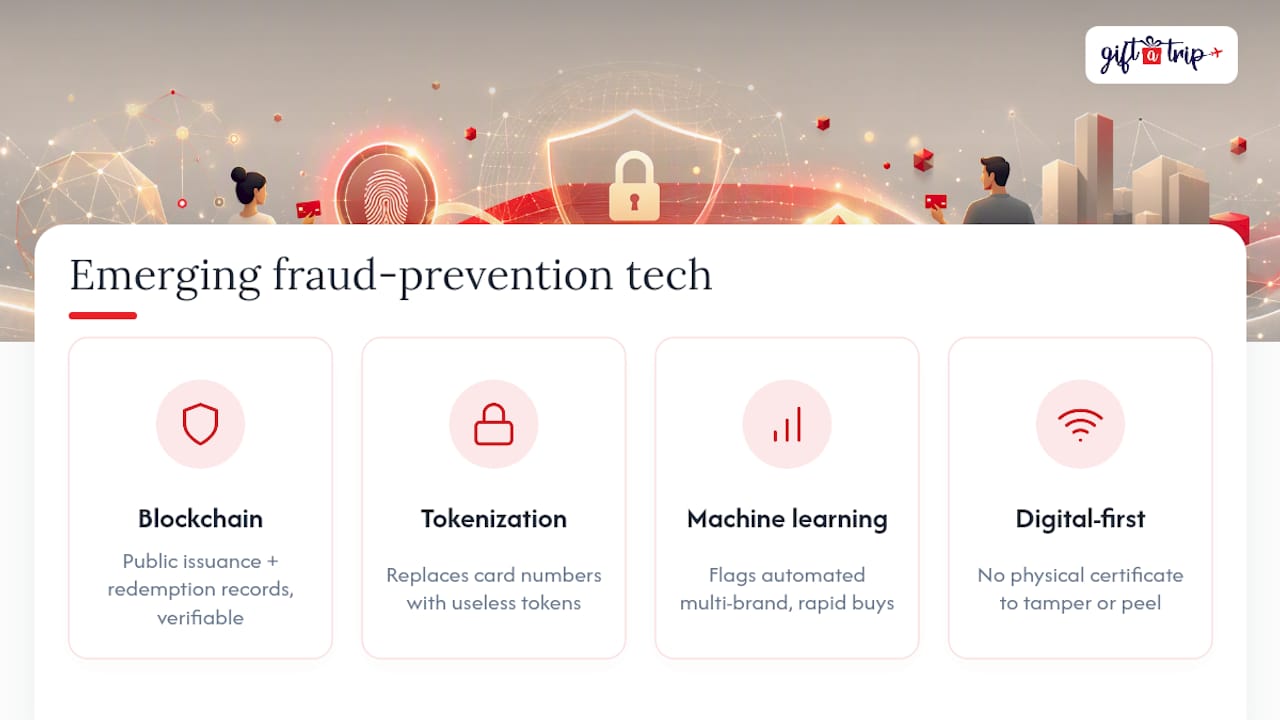
Blockchain-based gift card ledgers are gaining attention because they can make each card’s issuance and redemption history publicly verifiable, which makes it much harder for a criminal to resell a card that’s already been partially redeemed. Tokenization, a technique already standard in credit card processing, replaces a card’s actual number with a randomized token during transmission and storage, so even if a database is breached, the stolen tokens are useless without the issuer’s decryption key.
Machine-learning fraud models are also becoming standard at larger retailers, flagging purchase patterns that look automated, such as a single account buying maximum-value cards across multiple brands within minutes. Combined with the velocity and tarpitting controls merchants already use, these models shrink the window fraud rings have to act before a transaction gets frozen for review.
None of this replaces basic vigilance. A tokenized backend doesn’t stop someone from peeling a PIN sticker off a physical card on a store shelf, and a blockchain ledger doesn’t prevent a scammer from talking a victim into buying five $200 cards over the phone. Technology raises the cost of large-scale, automated fraud; it does far less against the low-tech, high-pressure scams that still account for a huge share of consumer losses. The practical takeaway is that digital-first products, where the certificate never exists as a physical object someone can tamper with before purchase, sidestep an entire category of these risks by design.
Legal and Regulatory Protections for Gift Card Buyers
Federal consumer protection here runs primarily through the FTC, which treats any gift card payment demand tied to a supposed debt, fine, or emergency as a scam indicator, and which operates ReportFraud.ftc.gov as the central reporting portal that feeds law enforcement investigations nationwide. On the enforcement side, ICE HSI’s Project Red Hook specifically targets organized retail crime rings that tamper with cards at scale, treating gift card fraud as connected to broader money laundering activity rather than isolated petty theft.
Card issuers themselves operate under state gift card laws that vary by jurisdiction, covering issues like expiration dates, dormancy fees, and minimum card values, though enforcement and consumer remedies differ from state to state. Federal rules under the CARD Act set a baseline: gift cards generally can’t expire for at least five years from purchase, and dormancy fees face restrictions, though the exact fine print depends on the issuer and card type.
None of these frameworks make a victim automatically whole after a scam. Recovery still depends on quick reporting and issuer cooperation rather than a guaranteed legal remedy, which is precisely why the reporting steps covered earlier carry so much practical weight. Regulation punishes and deters; it rarely reverses a transaction that’s already cleared.
Building a Fraud Prevention Strategy for Your Business
A serious fraud prevention program has three moving parts: training, monitoring, and response. Skipping any one of them leaves a gap fraud rings will eventually find.
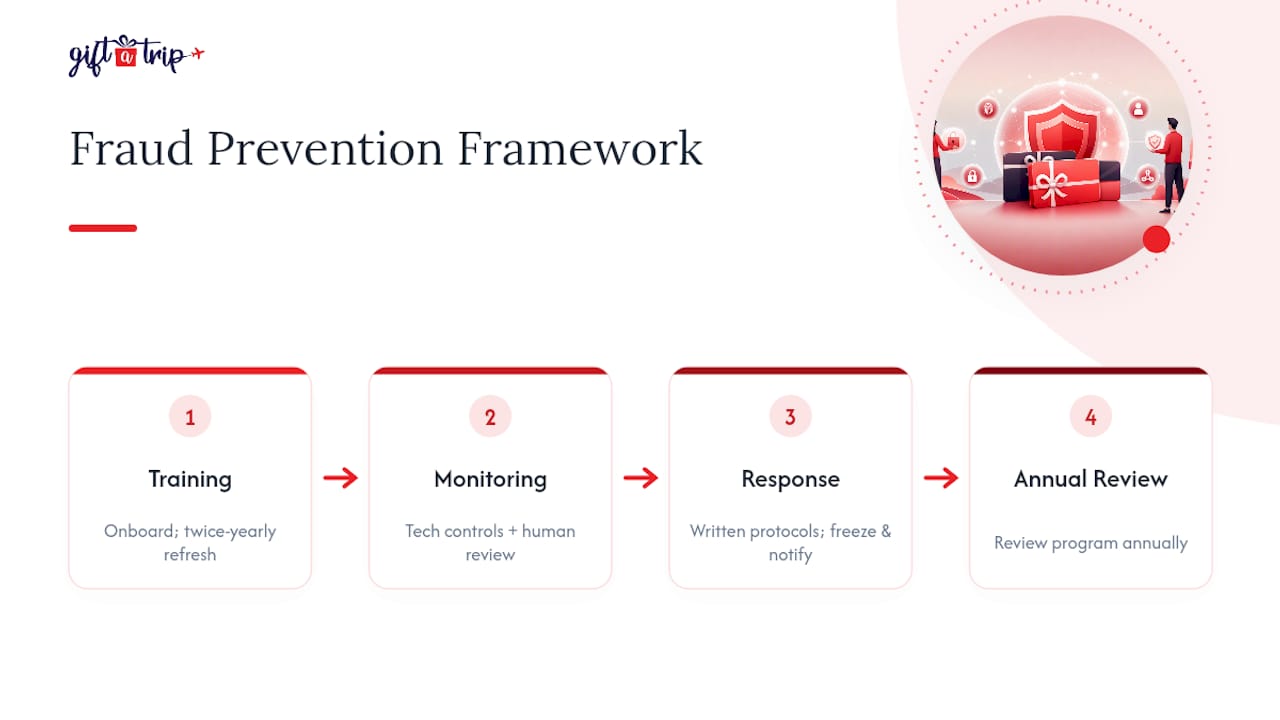
Employee training should happen at onboarding and repeat at least twice a year, since scam scripts evolve and staff turnover erodes institutional memory fast. Cover the specific scenario of manager or IT impersonation calls requesting activation codes, and role-play the correct response: hang up, verify through a known internal number, and log the attempt.
Monitoring means combining the technical controls covered earlier, velocity limits, account-age rules, and purchase caps, with a human review layer for transactions that trip multiple flags at once. Assign a specific staff member or team to review flagged transactions daily rather than letting alerts pile up unread.
Response protocols need to be written down before an incident happens, not improvised during one. Define who freezes a suspicious account, who contacts the issuer or law enforcement, and how findings get documented and shared with other locations or franchise partners. A written policy against sharing activation codes, paired with an audit trail of every activation, closes most of the operational gap that scammers exploit.
Review the whole program annually, since fraud tactics shift faster than most retail policies get updated.
The Real Gap in Most Gift Card Advice
Most gift card safety guides treat prevention as a purely consumer problem: inspect the card, don’t fall for the phone scam, done. That advice is correct but incomplete. The bigger structural issue is that physical gift cards are, by design, an anonymous bearer instrument sitting on an open shelf, and no amount of consumer vigilance changes that underlying vulnerability.
Where conventional advice falls short is treating merchant controls and consumer behavior as separate problems. They’re the same problem viewed from two ends of the same transaction. A store with strong velocity limits still gets burned if a cashier reads activation codes to a fake district manager. A careful shopper still gets scammed if a criminal tampered with a card before it ever reached the shelf.
If there’s one priority worth acting on first, it’s this: reduce your exposure to physical tampering altogether where you can, and treat every unsolicited request for a card number as a hard stop, no exceptions, no matter how convincing the caller sounds.
— Donovan
An Alternative: Why Choose Secure Digital Travel Certificates
If physical gift cards keep you worried about tampered packaging or harvested codes, a digital travel certificate sidesteps the problem structurally rather than just procedurally. Giftatrip delivers certificates straight to an email inbox, so there’s no scratch-off PIN for anyone to peel back on a store shelf and no resealed wrapper to inspect before checkout.

Corporate buyers get an added layer of accountability that physical cards can’t match: order logs and delivery confirmations that make every certificate traceable from purchase to redemption, which matters enormously for HR teams running employee reward programs or event planners handling bulk orders; for detailed advice on booking controls and vendor verification, see this guide for corporate bookers. Giftatrip’s travel certificate distribution guide for HR and events walks through exactly how that tracking works for organizations managing dozens or hundreds of certificates at once.
For personal gifting, the same logic applies. A digital travel certificate redeemable for resort stays, cruises, or vacation packages carries none of the physical tampering risk this article just walked through, and taxes and resort fees are built into the price up front. If you’re ready to send a gift that skips the gift card aisle entirely, browse the current selection of travel certificates and pick one that matches the occasion.
Sources
- Avoiding and reporting gift card scams | Consumer Advice (FTC)
- Tackling the rise in gift card fraud | ICE HSI
- How to prevent gift card fraud: Tips for merchants (Signifyd)
- Reportfraud
FAQ
Can someone steal your information from a gift card?
Yes. If a criminal tampers with a card before you buy it, records the PIN, and monitors it for activation, they can drain the balance the moment you load funds onto it, according to ICE HSI’s fraud enforcement guidance.
What should I do if my gift card was used fraudulently?
Contact the card issuer immediately using the number on the card, then file a report at ReportFraud.ftc.gov with your receipt, photos, and any communication from the scammer.
How do you check if a gift card is scammed?
Look for a scratched, lifted, or misaligned PIN cover, resealed outer packaging, or a barcode sticker that doesn’t match the printed number underneath. Any of these signs means the card has likely been tampered with.
How can merchants reduce gift card fraud without slowing down checkout?
Automated controls like velocity limits and account-age rules run in the background and don’t add friction at the register, while a simple staff rule against reading activation codes over the phone stops manager-impersonation scams without touching legitimate transactions.
Are digital travel certificates safer than physical gift cards?
Digital certificates remove the physical tampering risk entirely since there’s no PIN sticker or packaging to alter before purchase, and platforms like Giftatrip generate delivery logs that add traceability physical cards don’t offer.