
Most travel gift cards are not refundable for cash. When plans fall through, issuers typically hand back a travel credit or a replacement code, not money to your original payment method. If a cash-back option matters to you, buy from an issuer with an explicit refund clause or pay with a credit card that supports a chargeback. Read the terms page before you check out, not after.
TL;DR:
- Most travel gift cards are nonrefundable, with only a few offering cash refunds; check the terms page carefully before purchase.
- Airline and hotel gift cards typically convert unused balances into travel credits or certificates, not cash, unless explicitly stated otherwise.
- Federal law requires clear disclosure of expiration and refund policies but does not guarantee a cash refund, making it essential to verify these details upfront.
- Transferability varies: name-locked vouchers are hard to reassign, while flexible certificates sold by third parties often have clearer exchange terms.
- Prioritizing open-loop, multi-brand certificates with broad redemption options and transparent terms reduces the risk of losing value due to vagueness or restrictive rules.
Table of Contents
- What Does “Refundable” Actually Mean for Travel Gift Cards?
- How Do Airlines and Hotels Usually Handle Refunds?
- What Federal Law Actually Protects You
- Checklist: How to Buy a Refundable Travel Gift Card
- What to Do If You Need Cash Back
- Why Gift A Trip Certificates Reduce Buyer Risk
- The Real Problem Isn’t Refunds, It’s Vague Terms
- Get a Travel Gift With Terms You Can Actually Read
- Sources
- FAQ
What Does “Refundable” Actually Mean for Travel Gift Cards?
“Refundable” gets used loosely, and that’s where buyers get burned. There are really four possible outcomes when a travel gift card doesn’t get used or a trip gets canceled, and only one of them puts cash back in your account.
- Cash refund: money returns to the original payment method. Rare for travel gift cards, and usually only offered when a state law forces it or the issuer builds it into the product on purpose.
- Travel credit: the balance stays with the issuer, often tied to a new booking window or expiration date.
- Replacement code: a fresh certificate or voucher number, sometimes with different terms than the original.
- Nonrefundable: the balance is forfeited if unused, full stop.
Issuers lean toward credit instead of cash for a practical reason: fare rules and provider accounting are built around ledger credits, not refund transactions. Airlines, in particular, treat a gift card balance more like a store credit account than a debit card. Transferability also shapes your options. A name-locked voucher tied to one traveler often can’t be refunded or reassigned, while an open-loop travel certificate that works across hotels, cruises, and resorts tends to carry clearer exchange terms because it isn’t tethered to one airline’s booking system.
How Do Airlines and Hotels Usually Handle Refunds?
The default position across most major issuers is simple: nonrefundable, no cash redemption, credit or reissue instead. Delta’s gift card terms state plainly that cards are nonrefundable and not redeemable for cash except where the law requires it. Canceled travel purchased with a Delta gift card typically gets converted into travel credit rather than sent back to your bank.
Southwest follows a similar pattern. Its gift card terms describe unused funds from a canceled booking converting into flight credit, which may or may not be freely transferable depending on how the original ticket was booked. United Vacations uses comparable language for its own gift certificates, spelling out nonrefundable status up front rather than leaving it buried in fine print.
Three patterns show up again and again:
- Nonrefundable single-brand gift cards — the most common structure, especially for airline-branded cards.
- Name-locked vouchers — issued to one traveler, hard to transfer or refund.
- Transferable certificates — sold by third-party travel certificate merchants, often with clearer exchange rules than airline-issued cards.
Statistic callout: Every major example checked for this article, Delta, Southwest, and United Vacations, states nonrefundable terms as the default policy for its travel gift cards. Cash-back is the exception issuers carve out, not the baseline they start from.
What Federal Law Actually Protects You
Federal rules give you disclosure protection, not a refund guarantee, and that distinction trips up more buyers than anything else on this list.
12 CFR §1005.20, enforced through the CFPB, requires clear disclosure of fees and expiration terms for most purchased gift cards, and generally bars expiration dates shorter than five years from the purchase or last-load date. It does not require issuers to refund travel gift cards in cash.
That’s the gap buyers miss. The regulation makes sure you can see the terms; it doesn’t force the terms to be generous. State laws sometimes add cash-refund requirements for small remaining balances, but coverage varies widely, so don’t assume your state has one. Purchased certificates also get stronger protection under this rule than promotional vouchers or goodwill credits, which fall into a murkier legal category.
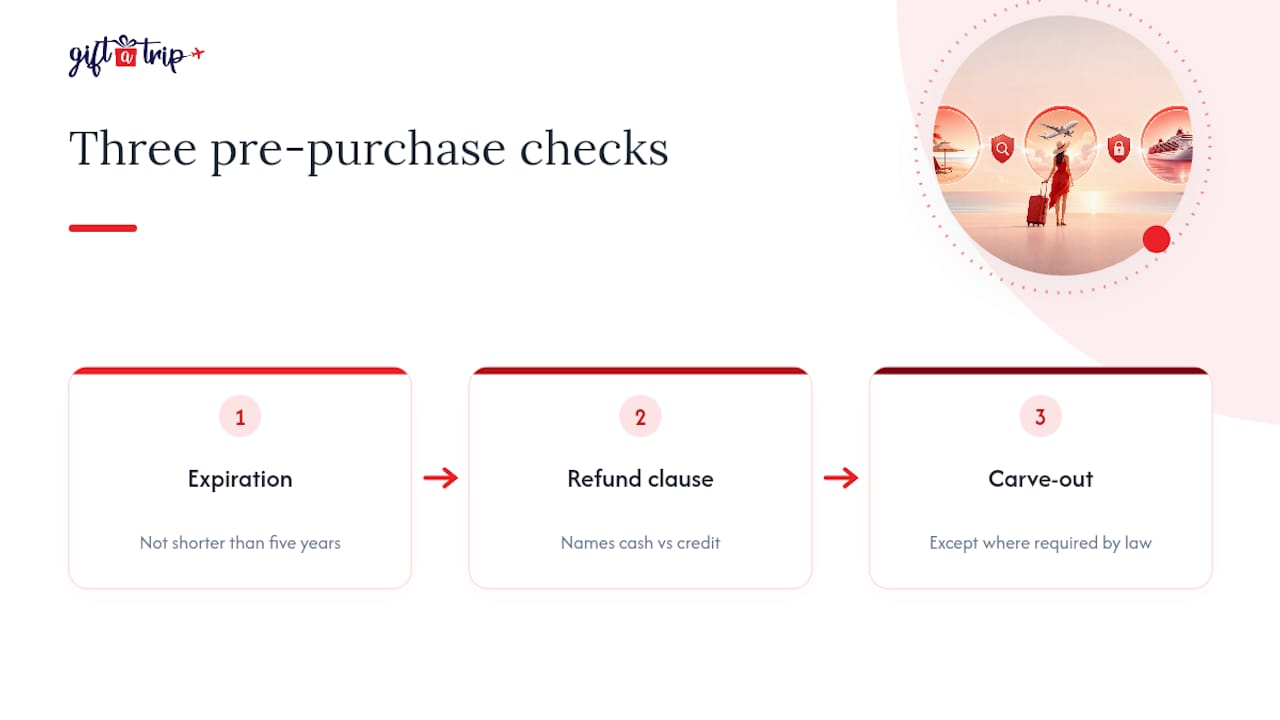
Before buying, scan the terms page for three specific phrases: an expiration clause, a refund clause naming cash versus credit, and any “except where required by law” carve-out. That last phrase is often where your real rights live.
Checklist: How to Buy a Refundable Travel Gift Card
Run through this before you enter payment details, not after the confirmation email lands.
- Read the refund clause word for word. Look for whether it says “cash” or only “credit” or “voucher.”
- Check the expiration date. Under federal disclosure rules, most purchased cards can’t expire in under five years, but travel credits issued after a cancellation often carry a shorter window.
- Confirm transferability. Can you give the card to someone else, or is it locked to one name?
- Look for blackout dates. Fewer restrictions mean more usable flexibility for the recipient.
- Tally the fees. Activation fees, redemption fees, and resort fees can eat into value fast, and understanding how those fees work before you buy prevents an unpleasant surprise later.
- Confirm redemption scope. One airline only, or a network of hotels, cruises, and resorts?
- Save everything. Screenshot the terms page, save the receipt, and keep the confirmation email.
- Pay with a credit card when possible. It gives you a dispute path the issuer’s own policy might not.
Pro Tip: Sellers that publish a documented return window, sixty to ninety days is common among third-party certificate merchants, are worth prioritizing over issuers that bury refund language in a support FAQ you have to hunt for.
What to Do If You Need Cash Back
If a card turns out to be nonrefundable and you still want your money back, work through these steps in order rather than jumping straight to a dispute.
- Contact the issuer in writing. Ask specifically for a cash refund or a replacement code, and reference the exact terms clause you’re relying on.
- File a credit-card chargeback or bank dispute if the purchase is recent enough and the card terms conflict with what you were told at checkout. Point-of-sale evidence, a screenshot of the terms link on the checkout receipt, meaningfully improves your odds here.
- Escalate to your state consumer protection office if the issuer stonewalls, especially if your state has a small-balance cash-refund law.
- Consider small-claims court as a last resort for larger balances; it’s slow, but it’s an option when everything else fails.
Realistically, chargebacks resolve in weeks if your documentation is solid. State complaints can take months. Success isn’t guaranteed either way, which is exactly why choosing the right card up front beats fighting for a refund later.
Why Gift A Trip Certificates Reduce Buyer Risk
Gift A Trip builds its certificates around the exact friction points that cause refund disputes elsewhere. Taxes and resort fees are included in the certificate value, so recipients don’t hit a surprise charge at check-in that triggers a complaint. Digital delivery means proof of purchase and terms are documented from the moment you buy, and minimal blackout dates mean fewer redemption headaches down the line.
According to the Better Business Bureau’s profile for Gift A Trip, the company maintains an active business listing, which gives buyers a way to independently verify its standing before purchasing.
The Real Problem Isn’t Refunds, It’s Vague Terms
Most complaints about travel gift cards aren’t really about refund policy. They’re about buyers who never saw the policy in the first place. A card can be perfectly nonrefundable and still be a good purchase, as long as the buyer knew that going in and picked the trip accordingly.
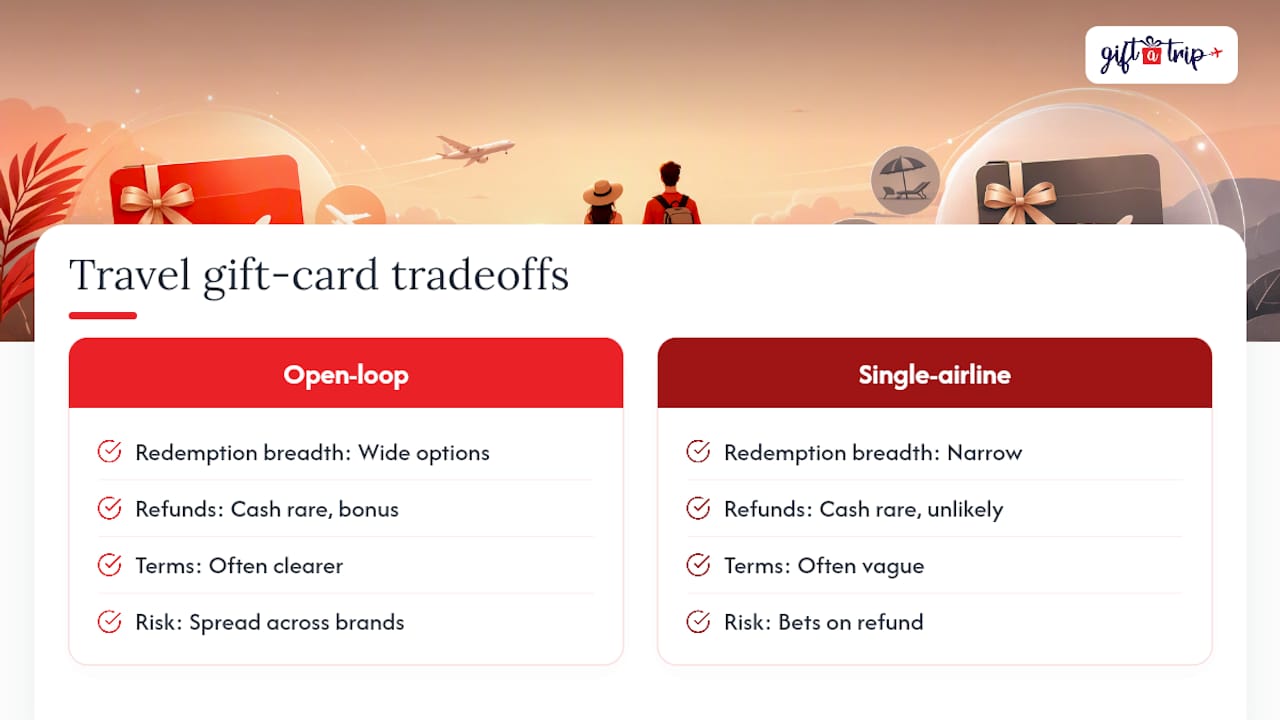
The conventional advice, “always buy refundable,” oversells what’s realistic. Cash refunds on travel gift cards are the exception across nearly every major issuer checked here, and chasing that guarantee often means settling for a worse redemption network or higher fees elsewhere. The better question isn’t “is this refundable?” It’s “if this can’t be refunded, is the redemption scope wide enough and the terms clear enough that it doesn’t matter?”
That’s where open-loop, multi-brand certificates earn their keep over single-airline gift cards. They spread the risk across more usable options instead of betting everything on getting cash back from one issuer’s support line. Prioritize clarity and redemption breadth first. Cash refundability, when you can find it, is a bonus, not the baseline you should expect.
— Donovan
Get a Travel Gift With Terms You Can Actually Read
Giftatrip is built for exactly the scenario this article walks through: buyers who don’t want to gamble on vague refund language. Certificates include taxes and resort fees up front, redemption instructions are spelled out before you buy, and blackout dates are kept to a minimum so a gift doesn’t turn into a headache six months later.

If you’re buying for a birthday, anniversary, or honeymoon, the travel certificate options let you see redemption scope and terms before you commit. Corporate buyers ordering in bulk for employee rewards or client gifts can get custom-branded boxes and negotiated terms through the corporate gifting program, which is where the clearest flexibility usually shows up for larger orders. Either path starts the same way: check the certificate’s terms page, then decide if it fits the trip you’re picturing.
Sources
- CFPB — 12 CFR §1005.20 (Regulation E) / Gift card disclosure rules
- Delta — Travel gift card terms (example: nonrefundable; no cash redemption)
- Southwest — Gift card terms (example policy language describing credits and nonrefundable status)
FAQ
Which Gift Cards Are Refundable?
Very few travel gift cards refund to cash. Most convert unused value into a travel credit or replacement code, so check the issuer’s terms page for an explicit cash-refund clause before assuming one exists.
What Is the Best Gift Card for Travel?
An open-loop travel certificate that covers multiple hotels, resorts, or cruise lines, rather than one airline, tends to offer more usable flexibility because it isn’t tied to a single provider’s booking rules. Certificates like those from Giftatrip that include taxes and fees up front also reduce the surprise charges that lead to refund requests.
Can I Get Money Back Instead of a Travel Voucher?
Usually not automatically. Federal rules under 12 CFR §1005.20 require clear disclosure of terms but don’t mandate cash refunds, so your best routes are the issuer’s written refund policy, a credit-card chargeback, or a state consumer protection complaint.
Is There a Gift Card That Can Be Used for Any Airline?
Single airline-branded gift cards are typically locked to that one carrier. Multi-brand travel certificates that include flight credit or airline-agnostic redemption options offer broader flexibility than a card issued directly by one airline.