
Good travel gift card etiquette comes down to four things. Match the card to the traveler, give an amount that buys something real, hand over the terms along with the card, and add a personal note. Do those four and a travel gift card is one of the most welcome presents you can give. Skip them and it can end up as a drawer card with an unclear balance. Below are ten rules for 2026, with a separate set of cautions for employers, event hosts and fundraisers.
TL;DR
- Choose a card the person can actually use, based on where they live, how they travel and what they enjoy.
- Pick an amount that covers something meaningful, and tell them the value discreetly on the card or a slip.
- Include the terms, the receipt and a handwritten or personalized note.
- At work, a gift card is generally treated by the IRS as a cash equivalent, so check your company policy and tax treatment before you hand them out.
Table of Contents
- Ten rules for giving a travel gift card in 2026
- Common mistakes to avoid
- Our view: a travel gift should be easy to redeem
- Giving travel at scale: what we offer
- FAQ
- Sources
Ten rules for giving a travel gift card in 2026
1. Match the card to the traveler, not to your budget
The fastest way to waste a travel gift is to buy one for a company the recipient will never use. A card for a ski resort chain means little to someone who hates the cold. A hotel card for a region they never visit is just plastic.
Ask yourself three questions. Where do they live, and which airport do they fly from? Do they prefer cruises, resort stays, road trips or city weekends? Do they travel solo, as a couple or with kids? Etiquette guidance for gift cards consistently comes back to the same idea: fit the card to the recipient’s interests, location and lifestyle. Frommer’s roundup of travel gift cards shows how broad the field is, with cards for airlines, hotels, tours, theme parks, national parks, activities and cruises.

If you honestly do not know their taste, choose flexibility over specificity. A broad travel certificate that works across several brands is safer than a single-airline card.
2. Pick an amount that buys something meaningful
A card should cover something real. Town & Country’s etiquette guidance says the value should suit the recipient, what you are comfortable giving and what the intended store or business costs, and it warns that a card too small to cover a meaningful purchase can leave the recipient paying a large balance.
Travel is expensive, so this matters more here than for coffee or books. A small amount toward a cruise or resort stay can feel like a token, while the same amount toward airport lounge food, a day tour or a night of lodging feels intentional. Frame the gift around what it covers: a night, a day trip, a dinner on the trip.
If you want to give a bigger trip, you do not need to give it alone. Relatives or friends can pool funds toward one certificate, with one person organizing it and one note signed by everyone.
3. Say the amount, discreetly
Making someone check a balance is a small inconvenience. Town & Country recommends discreetly noting the amount, for example on the card itself or on an accompanying slip. Do it quietly: put it in the note or on the back of the sleeve rather than announcing it at a party.
Another route is to describe the experience instead of the number. Something like, “This covers a long weekend at a beach resort,” tells the recipient what to do with it and avoids a price tag. Choose the number when the card is small and the experience when the card is large.
4. Always add a personal note
A gift card without a message feels like a transaction. A line or two changes that. Mention where you hope they go, a trip you shared, or why you chose it: “For the anniversary trip you keep postponing.”
Physical cards suit a handwritten note. For digital delivery, send a personalized message with the card, and a short email or text to say it is on its way, so it is not mistaken for spam. Digital cards are practical because Condé Nast Traveler’s gift guide notes they can skip shipping time, which is helpful for last-minute birthdays, long-distance relatives and remote teams.
5. Pass on the terms and the receipt
This is the rule most people skip. The Consumer Financial Protection Bureau’s Unwrapping gift cards guide advises the giver to provide the card’s terms and conditions and the receipt, since they explain how the card works and help avoid surprises.
With travel cards, the terms matter even more because redemption is rarely as simple as swiping at a register. Tour companies and cruise lines each set their own rules for what their cards cover, as Frommer’s points out. Before you give a card, read it for:
- Which bookings, dates and channels it applies to
- Whether it can be combined with other offers or cards
- Whether taxes, resort fees and gratuities are included or paid on top
- How long the recipient has to book, and how long to travel
- Blackout dates and booking restrictions
Then tell the recipient the one or two points they most need. Our guide to travel certificates without expiration and booking restrictions covers what to look for in more detail.
6. Know the federal rules on fees and expiration
It helps to know what a card can and cannot do. According to the CFPB, federal rules prevent inactivity or service fees during the first 12 months, and a gift card cannot be sold with an expiration date less than five years away. State law may add protections. The FTC has long advised buyers to check fees, expiration and exceptions before purchasing.
There is a catch for travel. Many travel products are not a simple stored-value card. Some are vouchers or certificates redeemed through a booking process, with their own windows to book and travel. That makes the terms rule even more important: the recipient should know from the start how long they have, not find out later. If a certificate has an open date, say so. Our piece on open date travel vouchers explains how those windows work.
7. Tell them about international use before they plan around it
People often ask whether gift cards work abroad. The answer depends on the card. Frommer’s lists hotel cards that cover properties in more than 170 countries and airline cards for global destinations, but also advises checking airline expiration dates and fees, and notes that tour and cruise providers set their own coverage rules.
If your recipient dreams of a trip overseas, confirm the card applies to the destination, and the currency or booking channel is clear. If they plan a domestic road trip, a hotel card with wide US coverage is the simpler pick.
8. Present it like a gift
Presentation counts, especially with something you cannot unwrap in the usual sense. Put a printed card in a nice envelope with a small travel item, such as a luggage tag, a passport cover or a map of the destination. Send a digital card with a scheduled delivery so it arrives on the day, not the week before.
For larger occasions, premium packaging adds to the moment. Our Red Box Delivery option is $69 and delivers the certificate in a gift box, which suits weddings, retirements and milestone anniversaries.
9. Treat workplace and client gifts differently
The etiquette changes when the giver is an employer. Three points stand out.
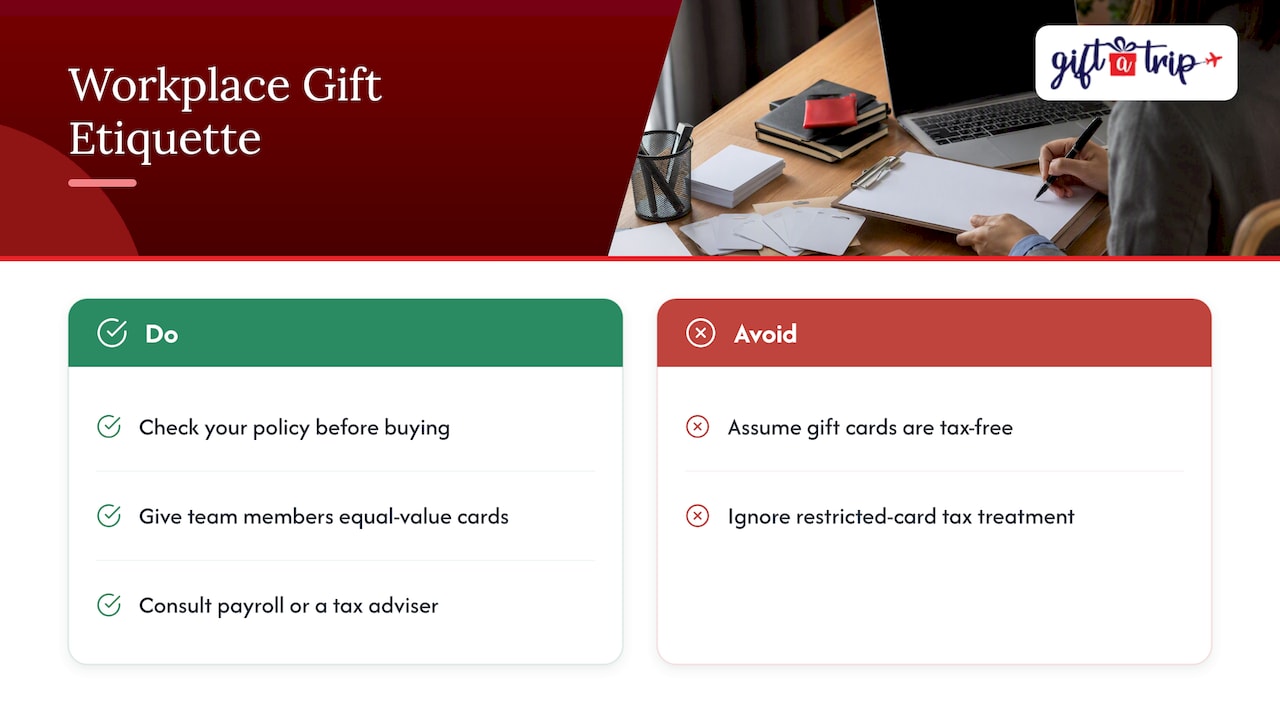
Check your policy first. Many companies set limits on gift values, permitted gift types and reporting, and add conflict-of-interest controls. Know yours before you buy.
Treat everyone equally. When you recognize several team members, equal-value cards reduce any sense of favoritism.
Understand the tax side. The IRS says cash and cash-equivalent benefits, including gift certificates and gift cards redeemable for general merchandise, cannot be excluded as de minimis fringe benefits. An IRS publication adds that an employer-provided gift card is generally treated as a cash equivalent even when restricted to certain purchases or a limited redemption period. Calling it a holiday or recognition gift does not by itself make it tax-free. Speak with your payroll or tax adviser before you build a program around cards. Our walkthrough on gifting employee travel with tax in mind explains the options to raise with them.
10. At events and auctions, announce it
When a card is a prize, transparency is the etiquette. UC San Diego’s event gift guidance says gift cards should be announced in advance as opportunity drawings and not quietly handed out to every participant. The same university caps each student event gift card at $15 to $20 and limits cumulative gifts to $600 per student per calendar year, but those are one institution’s rules, so look up your own organization’s limits.
For charity auctions, describe the prize clearly: what it covers, how to redeem it, how long it lasts and any restrictions, so the winner does not feel misled after paying a premium bid.
Common mistakes to avoid
- Giving a card with no context. No note, no amount, no terms. The recipient is left to work it all out.
- Buying a niche card for a general traveler. A single-property card is wonderful for someone who loves that property and frustrating for everyone else.
- Underestimating costs. A small card toward a high-cost trip can feel awkward unless you frame it as a contribution.
- Forgetting the recipient’s timeline. A new parent or a person with a heavy work season may not travel for months. Choose a certificate with a generous booking window.
- Ignoring tax rules at work. Cards given to employees are generally treated as cash equivalents.
For a longer list of manners, see our travel gift etiquette rules, and for help vetting sellers, our seven checks for choosing a provider.
Our view: a travel gift should be easy to redeem
We spend our days on the redemption end of travel gifts, so we have a strong opinion about what separates a good one from a frustrating one. Etiquette is mostly about removing friction for the person on the receiving side.
A gift that arrives with unclear fees, a short window or a confusing booking path asks the recipient to do work. That is why we focus on all-inclusive pricing, with taxes, gratuities and fees covered, minimal blackout dates and no minimum order, plus digital delivery that lets you personalize the message. The best compliment a recipient can give is not “thank you for the card.” It is “I booked it in ten minutes.”
For businesses, the same principle applies at scale. Give people a real choice of destinations and brands, keep administration simple for the HR or sales team, and be upfront about how the certificate is treated for tax. A reward that creates a paperwork headache for the employee is not a reward.
— Donovan
Giving travel at scale: what we offer
If you are buying one certificate for a birthday or hundreds for a sales incentive, we make it straightforward. You can browse cruises, resorts and hotels, and golf and spa getaways, or pick a flexible trip collection when you do not know the destination.

Teams get more options: custom trip selection sites, airfare vouchers, custom flex trip collections and branded gift box delivery, all through our corporate gifting page. If you are planning distribution, our certificate distribution guide for HR and events and our redemption process guide walk through it step by step.
FAQ
Is $25 too cheap for a travel gift card?
Not necessarily, but it should be framed well. On its own, $25 will not cover much in travel, so present it as a contribution, such as toward a meal on the trip, or pool it with others. Town & Country’s guidance is to make sure the value can buy something meaningful.
Should I put the amount on a travel gift card?
Yes, discreetly. Writing it on the card, the sleeve or the note saves the recipient from checking a balance. If the gift is large, you can describe what it covers instead of stating the number.
Do travel gift cards work internationally?
Some do and some do not. Certain hotel cards cover properties in more than 170 countries and some airline cards reach global destinations, according to Frommer’s, but tour companies and cruise lines set their own rules. Check the terms for your destination before you give it.
Can I give travel gift cards to employees?
Yes, but the IRS generally treats gift cards as cash equivalents, so they are not tax-free de minimis gifts. Check your company policy and speak with your payroll or tax professional before you start a program. Give equal-value cards to people recognized for the same thing.
Do travel gift cards expire?
Federal rules say a gift card cannot be sold with an expiration date less than five years away, and cannot charge inactivity fees in the first 12 months, according to the CFPB. Travel certificates and vouchers can come with separate booking and travel windows, so read the terms and share them with the recipient.
Sources
- The Best Travel Gift Cards: Just the Ticket, Frommer’s
- 25 Best Gift Cards for Every Type of Traveler, Condé Nast Traveler
- Gift Card Etiquette, Town & Country
- Unwrapping gift cards, Consumer Financial Protection Bureau
- Gift Cards Tips for Buying, Giving, and Using, FTC
- De minimis fringe benefits, IRS
- Federal, State and Local Governments publication, IRS
- Gifts and Awards, UC San Diego