
Branded travel gift cards, meaning custom-logoed travel certificates redeemable at resorts, hotels, cruise lines or vacation packages, work well for organizations that need a high-perceived-value reward with minimal fulfillment headaches. They suit employee recognition, sales incentives, event prizing, and charity auctions equally well. If your program needs broad appeal, tax-inclusive pricing, and bulk deployment without months of lead time, they belong on your shortlist. The rest of this guide covers customization, logistics, and how to vet a vendor.
TL;DR:
- The majority of the cost savings and reliability come from bulk discounts and clear communication about blackout dates, taxes, and lead times.
- Digital certificates are typically delivered within days after proof approval, while physical orders require additional time for printing and packaging.
- A well-designed travel incentive program can boost employee performance by an average of 22 percent, provided fulfillment is consistent and error-free.
- Expect vendors to deliver secure, non-transferable codes, detailed proofing opportunities, and comprehensive redemption reporting to prevent fraud and support resolution.
- Including taxes and resort fees in the certificate price simplifies budgeting and minimizes surprises, especially with vendors like Gift A Trip that bundle those costs.
Table of Contents
- What Are Branded Travel Gift Cards?
- Do Branded Travel Gift Cards Actually Improve Program Performance?
- How Do You Customize and Present Branded Travel Certificates?
- What’s the Ordering and Fulfillment Timeline for Bulk Orders?
- What Should You Know About Redemption Rules and Pricing?
- How Do Certificates Fit Into Reward Program Operations?
- Procurement Checklist: What to Require From a Vendor
- What Legal and Compliance Rules Apply to Branded Travel Certificates?
- What Security Features Prevent Fraud on Bulk Certificate Orders?
- What Technology Do You Need to Deploy Certificates at Scale?
- How Do Vendors Handle Support and Dispute Resolution?
- What Do Successful Branded Travel Certificate Programs Look Like?
- The Real Bottleneck Isn’t the Reward, It’s the Fulfillment
- Ready to Deploy? What Gift A Trip Brings to a Bulk Order
- Sources
- FAQ
What Are Branded Travel Gift Cards?
Branded travel gift cards are custom-branded travel certificates, not the consumer gift cards an airline or hotel chain sells directly to shoppers at a kiosk. The distinction matters for procurement: a corporate buyer is purchasing a bulk batch of vouchers, printed or digitally rendered with company logos, meant for distribution to employees, customers, or event guests rather than for individual retail purchase.
These certificates come in three delivery formats. Digital certificates arrive by email or a distribution portal, ready for instant redemption. Printable templates let event planners produce physical cards on demand for on-site prizing. Boxed physical presentations add unboxing value for milestone awards or executive gifts.
Behind the scenes, vendors manage the inventory that makes redemption possible. A provider like Gift A Trip negotiates partner rates across resorts, cruise lines, and vacation packages, then issues secure certificates that recipients redeem directly with those partners. The buyer never touches booking logistics. That separation between what the corporate buyer manages (branding, distribution, budget) and what the vendor manages (inventory, redemption, partner relationships) is what makes bulk orders viable at all.
Do Branded Travel Gift Cards Actually Improve Program Performance?
Yes, and the data is specific enough to plan around. Employees in well-designed incentive travel programs show an average 22% performance increase compared to non-participants. That’s not a soft engagement metric. It’s a measurable lift tied directly to sales output, project completion, or whatever behavior the program targets.
The 22% Number: Programs that use travel-based incentives, including branded travel certificates, see participants outperform non-participants by roughly 22% on average, according to Booking.com’s business travel incentive research.
The reason travel outperforms cash-equivalent rewards comes down to psychology, not just optics. Travel incentives shift the reward from transactional to transformational, building an emotional connection to the brand that a cash bonus or gift card to a big-box retailer rarely creates. Recipients remember a trip. They rarely remember a $50 deposit.
Practically, that translates into three buyer-facing advantages: broad recipient appeal (nobody dislikes a vacation), higher perceived value per dollar spent compared to merchandise, and built-in promotional potential when winners share the experience internally or on social channels. Programs built around resort gift certificates for employee rewards routinely lean on this effect deliberately.

How Do You Customize and Present Branded Travel Certificates?
Decoration and packaging decisions affect both cost per unit and how the gift lands with recipients. Match the method to the volume and the occasion, not the other way around.
- Full-color digital branding works for most bulk orders. It’s the fastest and cheapest option, and it scales to thousands of recipients without added production cost.
- Embossed or foil-stamped physical cards suit executive or milestone gifts where tactile quality signals importance.
- Boxed presentations with printed inserts fit sales-incentive finales, retirement gifts, or auction prizes where the unboxing moment is part of the reward.
- Debossed or laser-etched add-ons (luggage tags, travel wallets) pair well with a digital certificate to raise perceived value without inflating shipping complexity.
At scale, personalization runs through batch upload systems: HR or the event team submits a spreadsheet of recipient names, and the vendor merges names, messages, and denominations into individual certificates in one proofing pass rather than one-by-one.
Pro Tip: Request one physical proof and one digital proof before approving a batch order over 100 units. Catching a logo alignment issue on one sample saves a reprint on a thousand.
What’s the Ordering and Fulfillment Timeline for Bulk Orders?
Bulk orders move on a predictable sequence, and knowing the steps ahead of time prevents last-minute panic before an event date.
- Submit specs and recipient list. Confirm logo files, denomination tiers, and personalization data upfront to avoid mid-batch revisions.
- Review and approve proofs. Digital proofs typically turn around within a day or two; physical box mockups take longer.
- Vendor processes the batch. Digital certificates can often be generated and queued within days once proofs are approved; boxed physical orders need more lead time for printing and assembly.
- Choose your distribution method. Options include single-use redemption codes sent individually, scheduled batch emails timed to an event, group distribution through a portal, or physical shipment to a central office or directly to recipients.
- Confirm reporting access. Ask for a redemption dashboard or delivery report so HR can verify every recipient actually received their certificate.
Before signing off on an order, confirm three operational details in writing: how taxes are handled on the certificate value, how many blackout dates apply across the redemption network, and whether the vendor provides secure file handling for the recipient list. Practical distribution guidance for HR and events teams covers most of these questions before you ever get a vendor on a call.
What Should You Know About Redemption Rules and Pricing?
Blackout dates and brand-specific restrictions are the most common source of recipient frustration, and they vary by partner network. A cruise line certificate might restrict peak holiday sailings; a resort certificate might exclude a handful of high-demand weekends. Reputable vendors negotiate these down to a minimal list rather than eliminating them entirely, since resort and cruise partners set their own occupancy rules.
Pricing runs on two models: face-value certificates priced at the redemption amount, or discounted bulk pricing where volume buyers pay less per unit than the certificate’s stated value. Packaging and shipping fees apply separately for boxed orders. The biggest cost lever for large programs is usually denomination tiering, since a $250 certificate purchased in bulk of 500 costs meaningfully less per unit than the same value bought individually.
Ask directly whether taxes and resort fees are included in the certificate value. Gift A Trip includes taxes and resort fees in its certificates, which removes a common surprise cost for recipients. Corporate buyers should still consult their accounting team on how certificate value gets treated as a taxable benefit for employee recipients, since that determination depends on program structure, not the vendor.
How Do Certificates Fit Into Reward Program Operations?
Travel certificates typically sit in the same reward catalog tier as merchandise and gift cards, presented as a point-redemption option or a standalone award for top performers. IRF reports gift cards account for roughly 30–34% of program allocations in North America and Europe, with continued growth expected into 2026, and travel certificates increasingly ride alongside that category rather than competing against it.
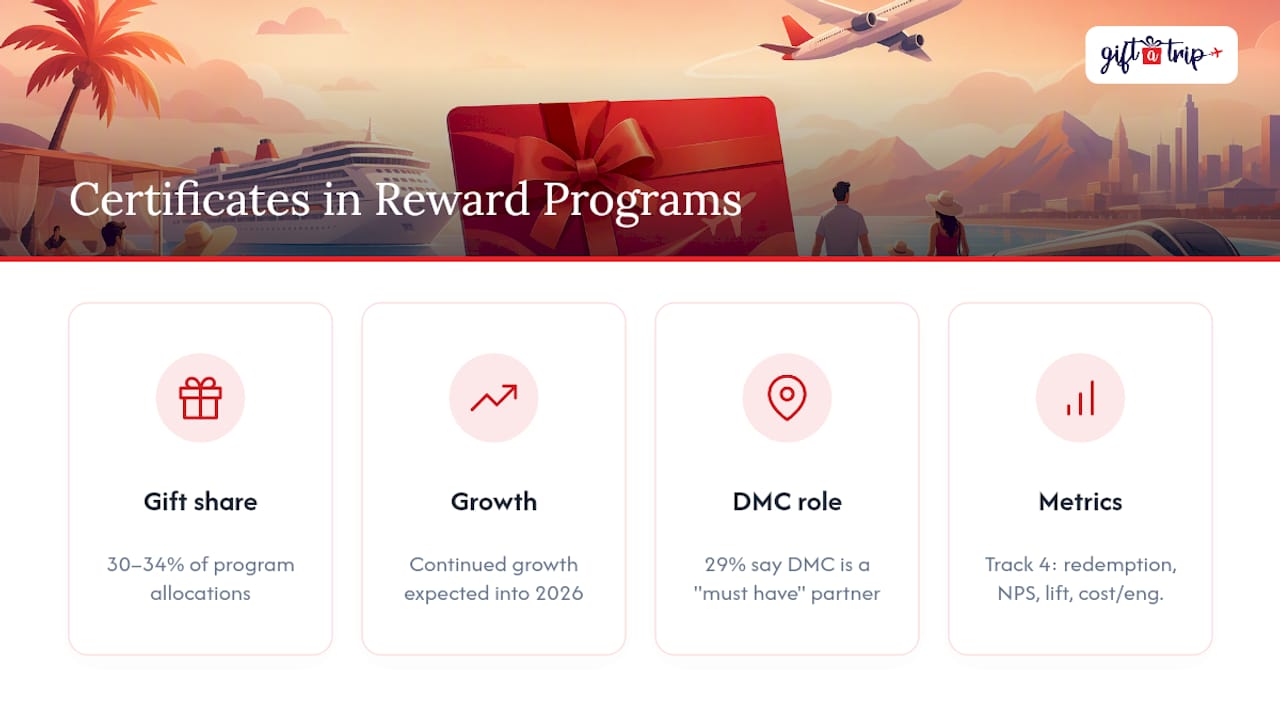
For larger or destination-specific programs, 29% of incentive planners rate a good Destination Management Company a “must have” partner. Bringing in a DMC or local travel partner makes sense once your program moves beyond simple certificate distribution into coordinated group travel or milestone trip redemptions.
Once certificates are in the field, track four numbers: redemption rate (the clearest signal of whether recipients actually value the reward), participant satisfaction or NPS, performance lift among participants versus a control group, and cost per engagement across the whole batch. A program with a 90% redemption rate and a measurable sales lift tells you the reward matched the audience. A program stuck at 40% redemption tells you something else, usually denomination mismatch or unclear communication about how to redeem.
Procurement Checklist: What to Require From a Vendor
Before signing a purchase order, confirm the vendor delivers on these non-negotiables:
- Secure digital delivery with unique, non-transferable redemption codes.
- Sample proofs (digital and physical) before full batch production.
- Tax-inclusive pricing stated clearly, with resort fees itemized or included.
- Realistic lead times in writing, not verbal estimates.
- Post-deployment reporting on delivery and redemption status.
Reject any vendor that can’t produce a written redemption policy, that ships certificates without secure delivery confirmation, or that discloses a long blackout list only after the contract is signed.
Pro Tip: Copy this line directly into your RFP: “Vendor must confirm tax-inclusive pricing, provide a written blackout date list, and deliver redemption reporting within 30 days of distribution.” The bulk-order guide for corporate planners has additional RFP language if you need it.
What Legal and Compliance Rules Apply to Branded Travel Certificates?
Every certificate needs clear terms and conditions covering redemption windows, transferability, and what happens if a partner brand changes availability. State laws on gift card expiration and dormancy vary, and while enforcement typically targets consumer retail gift cards more than corporate incentive certificates, a vendor’s terms should still specify an expiration policy in writing rather than leaving it implied.
Consumer protection expectations still apply even in a business-to-business purchase, since the end recipient is an individual redeeming a consumer-facing product. That means the certificate’s terms should be written in plain language, disclosed before purchase (not buried in fine print after checkout), and consistent with what the vendor actually delivers at redemption. A certificate that promises “no blackout dates” but excludes half the calendar is a compliance problem waiting to surface as a complaint.
For corporate buyers, the practical compliance steps are straightforward: request the full terms and conditions document before finalizing a bulk order, confirm expiration and transfer rules match what was verbally represented in sales conversations, and keep a copy of those terms on file in case a recipient disputes a redemption denial months later. If your program spans multiple states or countries, ask the vendor whether certificate terms are adjusted by jurisdiction or standardized across the board. A standardized approach is usually simpler to administer but worth confirming rather than assuming.
What Security Features Prevent Fraud on Bulk Certificate Orders?
Fraud risk on bulk travel certificates centers on two failure points: duplicated codes and intercepted delivery. A reputable vendor issues single-use, non-transferable redemption codes tied to a unique identifier, so a code can’t be redeemed twice even if it circulates beyond the intended recipient.
Secure delivery matters just as much as the code itself. Digital certificates should arrive through encrypted email delivery or a login-protected distribution portal, not as a plain attachment that could be forwarded or intercepted. For large batches, ask whether the vendor offers scheduled, staggered delivery rather than a single mass send, since staggered delivery limits exposure if one distribution channel gets compromised.
On the buyer side, the recipient list itself is sensitive data, names, email addresses, sometimes department or performance information tied to the reward. Confirm the vendor handles that file with encrypted transfer and doesn’t retain it longer than needed for fulfillment. Ask directly how they store recipient data post-delivery and whether that data gets deleted or archived.
Physical certificates carry a different risk profile: counterfeiting and unauthorized reproduction. Look for vendors that use certificate numbering, verification portals where a recipient or resort partner can confirm authenticity before honoring redemption, and print security features comparable to what banks use on checks for high-denomination physical certificates. If a vendor can’t explain how they prevent a photocopied certificate from being redeemed twice, that’s a real gap in a bulk order worth thousands of dollars.
What Technology Do You Need to Deploy Certificates at Scale?
Most bulk deployments don’t require custom development work, but a few technical questions determine whether integration is smooth or painful. Ask whether the vendor offers API access for automated certificate issuance, particularly if your organization runs a recognition platform or incentive software that triggers rewards based on performance milestones.
CRM connectivity matters most for programs with recurring reward cycles, quarterly sales incentives or ongoing employee recognition, since manually re-uploading recipient lists every cycle wastes administrative time and introduces error risk. If your program runs through a platform like a benefits administration system or a sales performance management tool, confirm the vendor supports CSV batch upload at minimum, and API integration if your volume justifies the setup cost.
Compatibility also extends to how recipients actually redeem. A certificate that only works through a clunky, non-mobile-friendly redemption page will frustrate recipients trying to book from a phone. Ask to see the actual redemption flow a recipient experiences, not just the marketing description of it, before committing to a large order.
For most mid-size programs, sophisticated API integration isn’t necessary. Simple, secure batch upload and email delivery cover the majority of use cases. Reserve the API conversation for organizations issuing certificates continuously across multiple departments or business units, where manual handling would genuinely create a bottleneck.
How Do Vendors Handle Support and Dispute Resolution?
Support responsiveness matters more with travel certificates than with most corporate gifts, because redemption issues surface months after purchase, often when a recipient is actively trying to book a trip and hits a snag. Ask a prospective vendor what their support channel looks like for recipients, not just for the corporate buyer, since a poor recipient experience reflects on your brand even though you didn’t build the redemption system.
Dispute resolution typically covers three scenarios: a certificate that won’t redeem due to a technical error, a partner resort or cruise line that’s unexpectedly unavailable for the requested dates, and a recipient who claims never to have received their certificate at all. A vendor with a clear process addresses each of these within a stated timeframe, ideally with a named point of contact rather than a generic support inbox.
For the corporate buyer, ask specifically about escalation. If ten employees report the same redemption issue simultaneously, does the vendor have a batch-resolution process, or does each case get handled one at a time? That answer tells you a lot about how the vendor scales support alongside fulfillment.
Keep your own internal contact designated for certificate-related questions too. Recipients will sometimes reach out to HR before they reach out to the vendor, and having someone on your team who knows the redemption terms and the vendor’s support contact prevents a simple question from turning into a frustrated employee complaint.
What Do Successful Branded Travel Certificate Programs Look Like?
That number holds up because it reflects a broad base of program data, not a single company’s anecdote.
Programs that succeed tend to share a structural trait: they protect a few high-value elements rather than spreading budget thin across many small rewards. A sales team that gives every rep a $25 certificate sees far less behavioral change than one that gives top performers a $500 certificate with real redemption flexibility. The concentration of value, not the total spend, drives the performance signal.
Auction and event use cases show a similar pattern. A branded travel certificate donated to a charity auction routinely outbids merchandise items of equivalent face value, because bidders assign travel a higher emotional premium than a physical good. Event planners running milestone-anniversary galas or employee-appreciation events report the same dynamic: a travel certificate as the night’s grand prize generates more engagement and buzz than a comparable-value electronics package.
The common thread across every well-run program is fulfillment reliability. A 22% performance lift means nothing if half the certificates arrive late or contain redemption errors. Programs that pair a strong reward with dependable, tax-inclusive, low-blackout fulfillment are the ones that repeat the reward structure year over year, which is itself a quiet signal of program success.
The Real Bottleneck Isn’t the Reward, It’s the Fulfillment
Most advice on incentive travel rewards focuses on picking the right destination or the right denomination. That’s the easy part. The actual failure point in most bulk programs is fulfillment: unclear blackout dates discovered after the contract is signed, tax handling nobody confirmed in writing, or a recipient list mishandled during a rushed distribution window.
The conventional advice tells HR teams to “choose an experience that resonates.” Fine, but that advice assumes fulfillment is a solved problem. It isn’t, especially for organizations ordering a few hundred certificates for the first time without a procurement template to follow.
What the data actually supports is more specific: treat branded travel gift cards as a supply chain decision first and a morale decision second. Get the tax-inclusive pricing, the blackout list, and the reporting structure locked down before you get attached to a particular resort brand or cruise line. The 22% performance lift is real and worth chasing, but it only shows up when the certificate actually reaches the recipient intact and redeemable. Prioritize the vendor conversation about lead times and secure delivery before the conversation about logo placement.
— Donovan
Ready to Deploy? What Gift A Trip Brings to a Bulk Order
Gift A Trip is built specifically for the procurement scenario this guide walks through: secure digital delivery, customizable gift boxes for bulk orders, and certificates that already include taxes and resort fees, so finance isn’t chasing down hidden costs after the fact. Corporate teams get personalized messaging options and minimal blackout dates across a partner network spanning resorts, hotels, cruise lines, and vacation packages.
If you’re planning a bulk order for the first time, start with the bulk order gifting guide for corporate planners, which walks through proofs, lead times, and RFP language step by step. For teams further along, the distribution guide for HR and events covers delivery scheduling and reporting in detail. When you’re ready to see actual certificate options, browse cruise certificates to get a sense of denomination ranges and partner brands available for your next program.
Sources
- Business travel incentive program (Booking.com Business travel resources)
- The IRF 2026 Trends Report
FAQ
What Are Branded Travel Gift Cards?
They’re custom-logoed travel certificates redeemable at resorts, hotels, cruise lines, or vacation packages, typically purchased in bulk for corporate rewards, event prizes, or auctions rather than sold individually at retail.
How Much Do Branded Travel Certificates Typically Cost?
Pricing runs on face value or discounted bulk rates depending on volume, with packaging and shipping as separate line items; ask each vendor whether taxes and resort fees are included, since Gift A Trip includes both in its certificate pricing.
How Long Does a Bulk Order Take to Fulfill?
Digital certificates can move from proof approval to delivery within days once specs are confirmed, while boxed physical orders need additional lead time for printing and assembly.
Do Branded Travel Gift Cards Actually Improve Employee Performance?
Data from incentive travel research shows participants in well-designed travel incentive programs average a 22% performance increase compared to non-participants.
What Should I Require From a Vendor Before Signing a Contract?
Require secure digital delivery, sample proofs, tax-inclusive pricing in writing, a documented blackout date list, and post-deployment redemption reporting before finalizing any bulk order.