
A de minimis fringe benefit is a small, occasional perk (think a birthday cake or a couple of event tickets) so minor that tracking its value would be impractical, and the IRS lets employers exclude it from wages under 26 CFR § 1.132-6. Cash and cash equivalents, including general-use gift cards, never qualify no matter how small the amount. The real test isn’t dollar value. It’s whether the benefit is rare enough and hard enough to measure that formal accounting would be unreasonable.
TL;DR:
- Benefits that are rare, infrequent, and difficult to measure in value may qualify as de minimis if tracking effort exceeds their worth, with no specific dollar limit applying.
- General-use gift cards and cash equivalents are never considered de minimis, regardless of their amount, and are taxable as wages.
- Occasional meals tied to overtime work can be excluded only if they are rare, necessary, and directly enable overtime, with routine or predictable meals being taxable.
- Proper documentation, frequency limits, and careful differentiation between gifts and cash equivalents are essential to maintain de minimis status and avoid payroll mistakes.
- Travel certificates are often not de minimis due to their high value and broad usability, requiring thorough documentation and review with a tax professional before claiming exclusion.
Table of Contents
- What Counts as a De Minimis Fringe Benefit Under IRS Rules
- Examples Every HR Team Should Know By Heart
- Occasional Meals and Local Transportation Have Their Own Rules
- How to Handle Reporting and Avoid Payroll Mistakes
- A Practical Checklist to Protect Your Exclusion
- Where Corporate Travel Gifting Fits Into the Picture
- Why the Dollar-Amount Myth Won’t Die
- Run Your Gifting Program Without the Payroll Guesswork
- Sources
- FAQ
What Counts as a De Minimis Fringe Benefit Under IRS Rules
The IRS test hinges on two words: administratively impracticable. If figuring out the value of a perk, tracking who got it, and reporting it on payroll would cost more effort than the perk is worth, the benefit likely qualifies for exclusion under Publication 15-B. Frequency matters just as much as value. A modest gift given once a year to one employee looks very different from the same gift handed out every week.
Here’s a wrinkle most HR teams miss: the IRS often measures frequency at the employer level, not the individual level. Under the employer-wide frequency rule in 26 CFR § 1.132-6, if your whole workforce receives a benefit only occasionally, it can still qualify as de minimis even if one particular employee happens to receive it more than a coworker. The flip side: if tracking frequency across thousands of employees is itself impracticable, that impracticability can work in your favor, but you need to document why.
There’s no dollar ceiling written into the tax code. The IRS has never published a magic number like “$75 is safe, $76 is not.” Instead, examiners look at facts and circumstances: how often the benefit occurs, how easy it would be to put a price tag on it, and whether the item resembles compensation dressed up as a gift. That ambiguity is exactly why so many businesses get this wrong, treating “small dollar amount” as the whole test when it’s really just one factor among several.
Examples Every HR Team Should Know By Heart
Some perks clear the bar easily. Others fail it every time, regardless of how cheap they are. Knowing the difference before your December gifting season starts saves you a painful W-2 correction in January.
Typically excludable when occasional:
- Birthday or holiday gifts of low fair market value, such as a bottle of wine or a small gift basket
- Occasional event tickets, such as a pair of seats to a sports game handed out infrequently
- Coffee, snacks, or soft drinks available in a break room
- Occasional company parties or picnics for employees and their families
- Flowers or a fruit basket sent for a hospitalization or death in the family
Never excludable, regardless of amount:
- Cash of any amount
- Gift cards or gift certificates redeemable for general merchandise, including WSU’s payroll office confirms that even small-value Starbucks cards count as cash equivalents
- Season tickets to sporting events
- Regular meal allowances paid on a schedule
- Monthly transit passes above the IRS-established excludable limit or gym memberships provided routinely
There’s a narrower gray zone worth knowing. The IRS has said a certificate redeemable for one specific, low-value tangible item, not a dollar amount, not a choice of merchandise, might be treated differently than a general-use gift card, according to IRS guidance on de minimis fringe benefits. That’s a narrow exception, not a loophole, so document exactly what the certificate is redeemable for before you assume it’s safe.
Occasional Meals and Local Transportation Have Their Own Rules
Overtime meal money gets special treatment, but only if you thread three needles at once. Under the three-condition test outlined in Publication 5137, the Fringe Benefit Guide, a meal or meal reimbursement is excludable only when it’s occasional, provided because overtime work extended the employee’s hours, and the meal itself is what enables the employee to keep working (not just a convenience).
Miss any one of those three and the exclusion disappears. A team that orders dinner every single Thursday because that’s “just how Thursdays go” has turned an occasional benefit into a routine one, and routine kills the exclusion. The same logic applies when meals are baked into an established policy or union agreement: once the practice is predictable enough to plan around, it’s no longer administratively impracticable to track, according to IRS technical guidance.
Local transportation follows a parallel logic. A one-off cab ride home because an employee worked unsafely late hours can qualify. A standing monthly transit pass generally cannot, because it’s predictable and easy to price. Employers handling frequent business travel meals should also look at broader meal planning guidance for corporate travel to separate occasional travel costs from routine per diem arrangements that carry different tax treatment entirely.
How to Handle Reporting and Avoid Payroll Mistakes
If a benefit doesn’t clear the de minimis bar, it goes straight into taxable wages. That means income tax withholding, Social Security, and Medicare all apply, and the value needs to show up on the employee’s Form W-2 for the year it was received. If a benefit does qualify as de minimis, you generally don’t need to report it at all. No W-2 entry, no separate 1099, nothing.
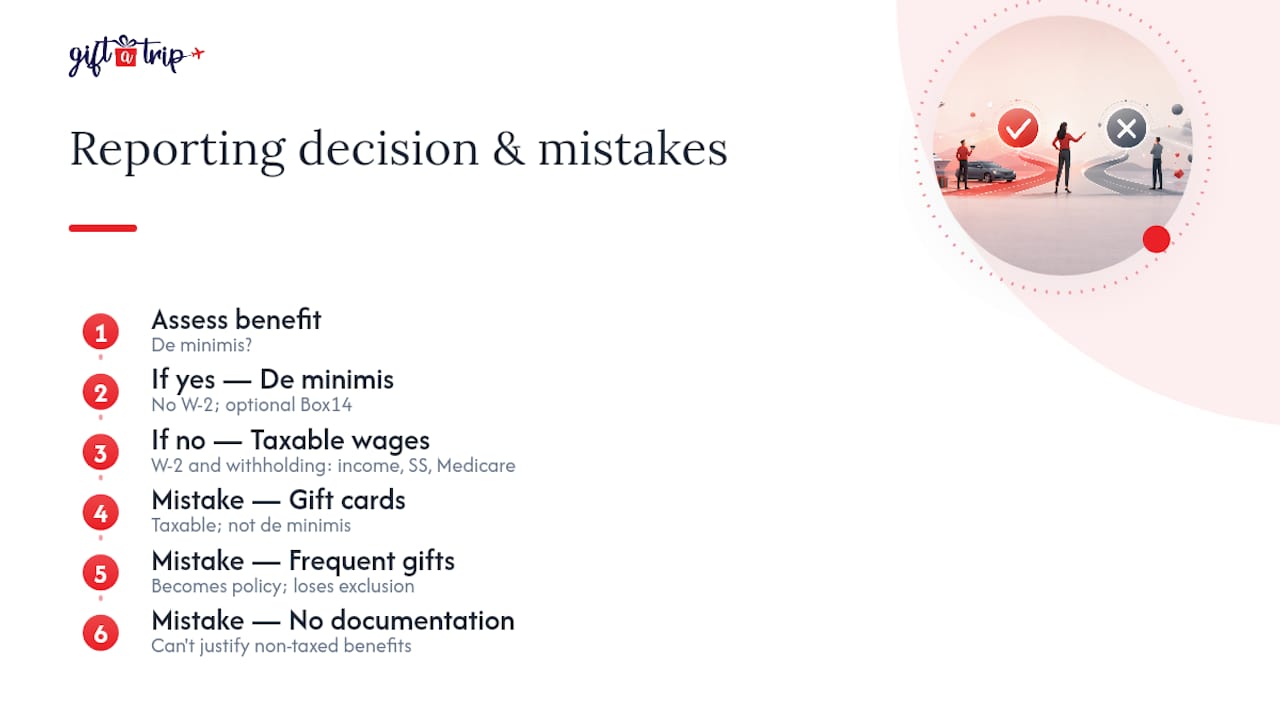
Some employers choose to note qualifying benefits in Box 14 of the W-2 anyway, purely for internal recordkeeping. It’s optional, not required, but it can help during an audit if you need to show a pattern of consistent treatment.
The mistakes that get companies in trouble are almost always the same three. First, treating gift cards as de minimis because the amount feels trivial, when cash equivalents are taxable at any dollar figure. Second, letting an “occasional” gesture calcify into an unwritten policy, say, birthday lunches every single month, which practitioner analysis notes strips away the administrability argument the exclusion depends on, per this Tax Adviser analysis. Third, having no documentation at all, so when an IRS examiner asks why a benefit wasn’t taxed, nobody in HR can explain the reasoning.
A Practical Checklist to Protect Your Exclusion
Build your gifting program around these controls, and you’ll rarely have to second-guess a payroll decision:
- Cap frequency per employee. Set an informal ceiling of a limited number of times per year, and don’t formalize it in writing as a guaranteed benefit.
- Choose low-value in-kind items over cash equivalents. A gift basket beats a gift card every time from a tax standpoint.
- Avoid general-use certificates. If a certificate can be spent on anything, treat it as cash.
- Document the occasion and the recipients. A quick note (“holiday gift, entire team, December 2026”) protects you later.
- Never write a routine rule or make a standing promise. The moment a perk becomes an entitlement, it stops being occasional.
Pro Tip: If a gift feels more like compensation than a courtesy, treat it as wages up front and loop in tax counsel before your next pay cycle. Retroactively correcting a W-2 is far more painful than withholding a little extra tax today.
Where Corporate Travel Gifting Fits Into the Picture
Travel certificates have become a popular alternative to gift cards for employee recognition, and Giftatrip works with HR teams on bulk digital delivery, custom messaging, and packaging that folds taxes and resort fees into the certificate value up front. That last point matters for payroll planning: knowing the all-in cost of a reward before it’s distributed makes it much easier to decide, in advance, whether a gift belongs in the de minimis category or needs to be run through payroll as wages.

Here’s the caveat every HR team needs to sit with: many travel certificates carry enough value that they function more like a cash equivalent than an occasional courtesy, especially when the certificate can be redeemed broadly across hotel brands or cruise lines. That’s not a reason to avoid travel gifting. It’s a reason to document the business purpose, the frequency, and the structure of each award, and to review it with your own tax advisor before assuming any certificate is automatically tax-free. Giftatrip’s distribution resources are built for HR teams navigating exactly this kind of decision.
Why the Dollar-Amount Myth Won’t Die
The most persistent piece of bad advice on this topic is some version of “keep it under $100 and you’re fine.” That number appears nowhere in the tax code, and treating it as gospel has probably caused more accidental W-2 errors than any other misconception in this space. The IRS test was built around administrability and frequency, not price tags, and the sources that matter most, Publication 15-B and the Treasury regulations themselves, never mention a threshold.
What gets underweighted is the frequency trap. Businesses obsess over whether a gift is “small enough” while completely overlooking how often it happens. A $15 gift given weekly is far more likely to fail the test than a $150 gift given once a year, yet most internal HR policies I’ve seen focus entirely on the wrong variable.
If you take one action after reading this, make it the frequency cap. Set a real limit on how often any single perk recurs, write it down internally (not as a public policy, just as an HR control), and revisit it every year. That single habit closes more compliance gaps than any dollar-based rule ever could.
— Donovan
Run Your Gifting Program Without the Payroll Guesswork
Giftatrip gives HR teams a faster path to structured, well-documented employee gifting than piecing together gift cards, vendor invoices, and manual tracking spreadsheets. Every certificate ships with taxes and resort fees already built into the value, bulk orders come with customizable gift boxes and personalized messaging, and digital delivery means no physical inventory to manage during a busy recognition season.

Giftatrip does not provide tax advice, and employers should confirm the tax treatment of any award with their own accountant or tax counsel before distribution. What Giftatrip does provide is the operational side: a documented, consistent process that makes it far easier for HR to explain a program’s structure if that documentation is ever needed. The Travel Certificate Distribution Guide for HR and Events walks through bulk ordering and delivery setup, and you can browse current options through Gift A Trip’s certificate shop to see what fits your next recognition cycle.
Sources
- Publication 15-B, Employer’s Tax Guide to Fringe Benefits
- 26 CFR § 1.132-6 — De minimis fringes
- Tax Adviser article on de minimis fringe benefits
FAQ
Are gift cards a de minimis fringe benefit?
No. Gift cards are considered cash equivalents and taxable as wages regardless of amount, per WSU payroll guidance.
Is there a dollar limit for de minimis fringe benefits?
No fixed dollar threshold exists; the IRS evaluates administrability and frequency, per Publication 15-B.
Do de minimis fringe benefits need to be reported on Form W-2?
Generally no, if the benefit truly qualifies as de minimis, though some employers optionally note it in Box 14 for internal records.
Can occasional overtime meals be excluded from wages?
Yes, but only when the meal is occasional, tied directly to overtime work, and necessary to enable that overtime, per the three-condition test in Publication 5137.
Are travel certificates considered de minimis fringe benefits?
Usually not, since most travel certificates carry enough value and flexibility to resemble cash equivalents, so employers should document the business purpose and confirm tax treatment before assuming exclusion applies.