Jump to Section:
For companies that want travel certificates and high-value experiential rewards instead of generic gift cards, Gift A Trip is the recommended Tremendous alternative in 2026. Two things set it apart: a catalog built specifically for travel redemptions rather than a generic points marketplace, and bulk ordering tools designed for corporate HR, sales, and rewards teams that need to distribute hundreds of certificates at once with secure digital delivery.
If you’re scoping a pilot, here’s what to line up first:
- Request a live demo of the bulk order flow and custom gift-box branding.
- Ask for sample redemption terms (blackout dates, taxes and fees included, expiration windows).
- Confirm delivery methods available (digital certificate, physical presentation box, or both).
- Get pricing for a small batch (10 to 50 certificates) before committing to a full-scale rollout.
The rest of this guide walks through how to evaluate any rewards platform against Tremendous, including the RFP questions, cost breakdowns, and implementation realities that actually separate a good fit from a mediocre one.
TL;DR:
- Travel certificates from Gift A Trip tend to boost redemption rates and engagement for milestone or top-performer rewards over generic gift cards.
- The platform offers a catalog focused on resorts, hotels, cruises, and vacation packages, with included fees and minimal blackout dates, optimizing impact.
- Evaluating vendors requires consistent RFP questions covering catalog relevance, integration ease, compliance, security, and total cost of ownership to ensure a good fit.
- Implementation timelines vary from days for manual pilots to two months or more for complex enterprise integrations, emphasizing the need for clear scope.
- Security documentation like SOC 2 Type II and ISO 27001 certifications, plus data residency details, should be verified early in the vendor selection process.
Table of Contents
- What Are the Best Tremendous Alternatives for Corporate Rewards?
- Quick Buyer Checklist: Essential RFP Questions
- How Do Feature Categories Actually Compare?
- Pricing and Total Cost of Ownership: What to Watch
- Implementation, Support, and Security: What to Expect
- When Do Travel Certificates Outperform Generic Gift Cards?
- How Gift A Trip Delivers Travel Rewards at Scale
- Key Takeaways
- Buyer Guides and Next Steps for Pilots
- Sources
- FAQ
What Are the Best Tremendous Alternatives for Corporate Rewards?
Most guides comparing Tremendous competitors focus on payout speed and card network coverage. That’s the wrong lens if your program’s goal is impact, not just delivery mechanics. G2’s own alternatives and competitors listing shows buyers weigh user experience and customer support just as heavily as catalog size, which tells you something: a platform’s back-end reliability matters as much as what’s in the catalog.
Tremendous built its reputation on flexible payouts (gift cards, prepaid cards, ACH, PayPal) at scale, which works well for high-volume, low-touch use cases like survey incentives or one-off referral bonuses. But when the goal shifts to recognition that people remember, generic payout flexibility becomes a weakness rather than a strength. A $50 gift card blends into someone’s inbox. A travel certificate toward a resort stay gets shared with a spouse and talked about at the next team meeting.
That’s the gap Gift A Trip fills among great alternatives to Tremendous: a catalog built around resorts, hotels, cruise lines, and vacation packages from major travel brands, with taxes and resort fees included and minimal blackout dates. For teams evaluating affordable alternatives with a narrower, more intentional catalog, that focus is the differentiator, not a limitation.
Quick Buyer Checklist: Essential RFP Questions
Before you sign anything, run every vendor through the same set of questions. Consistency here is what lets you compare apples to apples across three or four demos instead of relying on gut feel.
- What integrations exist for our HRIS and payroll systems today, versus what requires custom API work?
- Does the platform support SSO, and through which providers?
- What is the actual fulfillment footprint, not just claimed “global” coverage?
- How are taxes and compliance handled in each market we operate in?
- What SLA do you guarantee for reward delivery and support response times?
- What security certifications does the platform currently hold?
- How is data residency handled for employee information?
- What does the reward catalog look like in the specific countries our recipients live in?
- Can bulk orders be branded or customized for corporate gifting occasions?
- What reporting is available out of the box versus what requires a paid add-on?
- What happens to unredeemed rewards after expiration?
- Who owns data mapping and integration testing during onboarding?
A set of 12 targeted RFP questions focused on fulfillment footprint and supplier accountability tends to expose whether a vendor genuinely operates where they claim, or simply resells through a third party.
Weight these based on program scope. A 50-person pilot cares most about catalog fit and pricing transparency. A 5,000-employee global rollout should weight integrations, compliance, and SLAs far more heavily, since those are the items that break at scale, not on day one.
Pro Tip: During live demos, score every vendor on the same 1 to 5 scale across five categories: catalog relevance, integration effort, reporting depth, support responsiveness, and pricing transparency. Vendors sound similar in slide decks. A scorecard keeps you honest.
How Do Feature Categories Actually Compare?
Catalog depth is the feature that gets underweighted most often, and it shouldn’t be. A platform with thousands of generic gift card options looks impressive until you check redemption rates. Buyer guidance on incentive platforms makes the point plainly: the highest-impact rewards are the ones people actually redeem and value, and travel certificates tend to outperform generic gift cards on engagement when the catalog is relevant and redemption friction stays low.
Delivery and redemption mechanics vary more than most buyers expect:
- Digital travel certificates deliver instantly by email with redemption instructions attached.
- E-vouchers function similarly but may route through a third-party redemption portal, adding a step.
- Physical fulfillment (branded gift boxes, printed certificates) suits milestone awards and executive gifting.
- API-triggered rewards fire automatically from a CRM or HRIS event, useful for sales incentive programs tied to deal closure.
Integrations decide whether a rewards program runs itself or becomes a manual, error-prone process for someone on your team. Two-way sync with an HRIS means new hires and departures update reward eligibility automatically. SSO integration removes a login barrier that otherwise kills adoption rates before they start. Slack and Teams integrations let managers send spot recognition without leaving the tool their team already lives in.
On reporting, demand three things at minimum: participation rate by department, redemption lag (how long between issuance and redemption), and budget utilization against forecast. A platform that can’t break down redemption lag by reward type is hiding a problem, because slow redemption is usually the first sign a catalog isn’t resonating.
“Global coverage” should mean something concrete: local currency display, region-appropriate catalog options, and tax handling that matches each market’s rules, not just an English-language interface deployed worldwide. Rewards platform buying guidance notes that tax and compliance handling needs to work automatically across markets, or the finance burden lands back on your team.
Pricing and Total Cost of Ownership: What to Watch
Rewards platforms typically price one of three ways: a flat monthly or annual subscription, a per-reward transaction fee, or a hybrid combining a smaller platform fee with per-transaction costs. None of these is inherently better. What matters is whether the pricing model matches your program’s redemption volume and predictability.
The real risk isn’t the sticker price. Buyer guides consistently warn that the cheapest platform often costs more once you factor in hidden fees, currency conversion, and compliance handling that weren’t itemized in the initial quote.
Watch for these hidden costs specifically:
- Fulfillment fees for physical packaging or branded gift boxes.
- Currency conversion markups on international redemptions.
- Tax handling fees passed through per transaction rather than bundled.
- Support overage charges once you exceed a bundled ticket allowance.
- Integration or API access fees billed separately from the core subscription.
- Unredeemed balance policies that quietly reduce your effective spend.
Compare that total, not the headline price, across every vendor on your shortlist.
Implementation, Support, and Security: What to Expect
Rollout timelines vary more by integration complexity than by vendor size. Simple pilots with manual reward issuance can launch within days. Enterprise rollouts involving HRIS sync, SSO, and custom API work typically run two months or longer, depending on how much custom mapping your IT team needs to do.
- Scope the integration honestly. Prebuilt connectors for common HRIS platforms save weeks; custom API work adds them back.
- Clarify who owns data mapping. Some vendors handle field mapping as part of onboarding; others hand you documentation and expect your team to do the work.
- Confirm the support model up front. Ask whether you get a named client success contact or a shared support queue, and what response time is guaranteed in writing.
- Request security documentation before signing, not after. SOC 2 Type II and ISO 27001 certifications should be available on request, along with a clear answer on where employee data is stored and processed.
- Ask for a compliance checklist covering GDPR if any recipients are in the EU, since data handling requirements differ meaningfully from US-only programs.
CHRO-level evaluation frameworks increasingly treat this as a board-visible decision rather than a procurement afterthought, which means the security and compliance paperwork deserves the same scrutiny as the pricing sheet.
When Do Travel Certificates Outperform Generic Gift Cards?
Not every reward moment calls for a trip. But three scenarios consistently favor travel certificates over generic gift cards, and it’s worth being honest about why.

Milestone awards are the clearest case. A five or ten-year work anniversary deserves something that doesn’t get spent on groceries by Thursday. Top-performer incentive programs are the second: sales teams chasing a quota respond differently to “hit your number and earn a trip” than to “hit your number and earn a $200 card,” because the former creates a story people tell each other during the chase. Retention-focused rewards for high performers at flight risk are the third, since a travel certificate signals investment in someone’s life outside work in a way a points balance never quite does.
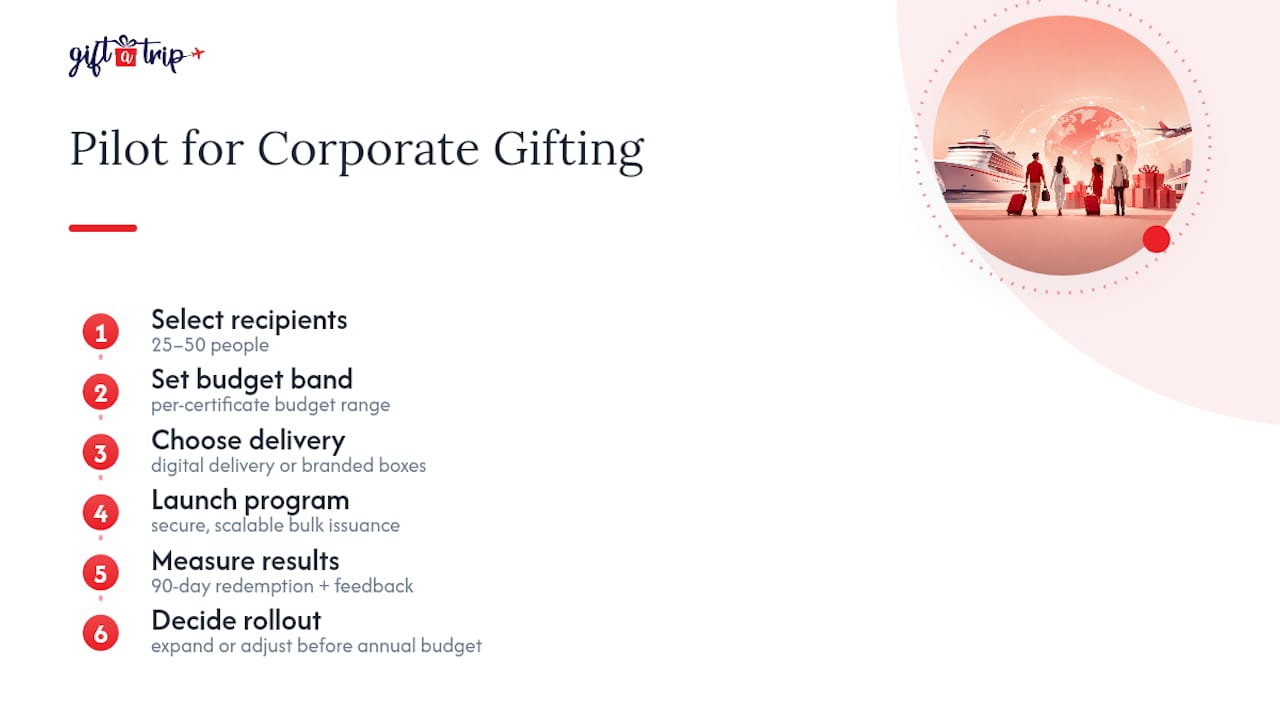
Designing a pilot to test this doesn’t require a huge budget. Start with a sample of 25 to 50 recipients, set a budget band per certificate that matches a meaningful but not extravagant experience, and define success metrics before launch: redemption rate within 90 days, recipient satisfaction (even an informal follow-up survey works), and manager-reported perception of the reward’s impact. Pair the rollout with a short communication plan, an announcement email or Slack post explaining what the certificate covers and how to redeem it, since unclear redemption instructions are the single biggest killer of engagement in any new reward format.
Plan for the trade-offs too. Travel certificates involve redemption timing that recipients control, so your reporting will show a longer tail than instant gift card redemption. Scheduling constraints (a family needing school-year flexibility, minimal blackout dates) matter more than they would for a cash-equivalent reward. And tax and reporting treatment for higher-value travel awards may differ from smaller cash-equivalent rewards, so loop in finance before the pilot launches, not after the first W-2 season following it.
Hospitality-industry perspective backs this up directly: convenience is consistently rated a top priority in business travel decisions, which is exactly why minimal blackout dates and included fees matter more for adoption than catalog size alone.
— Donovan
How Gift A Trip Delivers Travel Rewards at Scale
Gift A Trip built its platform around one specific problem: making travel gifting simple for organizations that need to issue dozens or thousands of certificates without losing the personal touch that makes travel rewards land. The catalog covers resorts, hotels, cruise lines, and vacation packages from major travel brands, with taxes and resort fees included and minimal blackout dates baked into every certificate.

For corporate accounts, that means customizable gift boxes for bulk orders, personalized messaging options, and secure digital delivery that scales from a 10-person sales incentive to a company-wide recognition program. Unlike a general-purpose payout platform, every certificate in the catalog is built for one job: giving someone a trip worth talking about.
A minimal pilot looks like this: pick 25 to 50 recipients, a defined budget band per certificate, and a 90-day measurement window tracking redemption rate and recipient feedback. That’s enough data to justify a broader rollout or adjust course before committing a full annual budget.
If you’re ready to scope one, request a demo through the corporate gifting page and ask specifically about bulk pricing tiers, redemption windows, and branded packaging options for your first batch.
Key Takeaways
Travel certificates with included fees and minimal blackout dates drive higher redemption and recall than generic gift cards for milestone and top-performer rewards.
| Point | Details |
|---|---|
| Lead with catalog fit | Match the reward catalog to your program’s goal before comparing pricing or platform features. |
| Use a consistent RFP scorecard | Score every vendor demo on catalog relevance, integrations, reporting, support, and pricing transparency. |
| Calculate true TCO | Add subscription costs, per-reward fees, and a currency and support buffer before comparing vendors. |
| Verify security documentation early | Request SOC 2 Type II and ISO 27001 proof, plus data residency answers, before signing. |
| Pilot with Gift A Trip for travel rewards | Gift A Trip offers a travel-focused catalog with included fees, bulk ordering, and secure delivery suited to a small pilot before full rollout. |
Buyer Guides and Next Steps for Pilots
For deeper background on evaluation criteria, see the CHRO evaluation checklist and the RFP question list for global fulfillment referenced above.
To scope a pilot directly, explore travel certificate mechanics or review corporate travel gift ideas for program design inspiration.
Sources
- Top 10 Tremendous Alternatives & Competitors
- How to Choose a Rewards Platform: The Complete 2026 Guide
- What CHROs Should Evaluate Before Choosing a Recognition Platform in 2026
- How to Choose an Incentive Program Platform: A Buyer’s Guide – Incentives Marketplace
FAQ
What Are Some Words Similar to “Tremendous” in This Context?
When buyers search for “tremendous alternatives,” they typically mean substitutes, competitors, or comparable platforms, terms like “great alternatives,” “excellent substitutes,” or “top alternative options” all describe the same search for a comparable rewards platform.
Is Gift A Trip a Direct Competitor to Tremendous?
Not exactly. Tremendous specializes in flexible cash-equivalent payouts, while Gift A Trip focuses specifically on travel certificates for resorts, hotels, cruises, and vacation packages, making it a better fit when the goal is high-impact experiential recognition rather than broad payout flexibility.
How Long Does It Take to Launch a Rewards Platform Pilot?
Simple pilots with manual issuance can launch within days, while enterprise integrations involving HRIS sync or custom API work typically take two months or longer depending on integration complexity.
What Security Certifications Should I Require From a Rewards Vendor?
Ask for proof of SOC 2 Type II and ISO 27001 certifications, along with a clear answer on data residency and GDPR compliance if any recipients are based in the EU.
Are Travel Certificates More Expensive Than Gift Cards?
Not necessarily. Gift A Trip certificates include taxes and resort fees in the listed price, which often makes the true cost more predictable than a gift card program with separate fulfillment or currency conversion fees layered on top.