TL;DR:
- Group travel incentives motivate employees more effectively than cash bonuses by fostering emotional bonds and shared experiences. They significantly improve retention and performance metrics while building organizational culture and trust. Leaders’ active participation enhances program impact and long-term loyalty.
Group travel incentives are defined as corporate reward programs that bring qualifying employees together for a shared travel experience, funded by the organization as recognition for performance. The reasons for group travel rewards go well beyond a free vacation. Research from SITE and Maritz confirms that 50% of employees rate group travel as extremely motivating, outperforming cash bonuses across every working generation. For HR and sales managers searching for a retention and performance tool that actually sticks, the advantages of group travel programs are backed by hard data and behavioral science. This article breaks down the evidence, the psychology, and the practical design decisions that make group incentive travel one of the most effective tools in the corporate rewards toolkit.
Why choose group travel incentives over other reward types?
Group travel incentives deliver measurable results that cash bonuses simply cannot match. Employees who attend incentive trips are 89% more likely to stay at their job and 93% more motivated to qualify for future programs. Those two numbers alone make a compelling case for any HR leader trying to reduce turnover costs.
The performance lift is equally striking. The IRF European Top Performer Study 2026 reports that well-executed programs produce a 22% average performance improvement, with average program spending of $5,100 per person. That figure sounds significant until you weigh it against the cost of replacing a high-performing salesperson, which routinely exceeds one year’s salary.
Cash rewards, by contrast, get absorbed into routine expenses within days. A bonus check pays a car repair or a credit card bill. A trip to a resort in Cancún or a cruise through the Mediterranean becomes a story the employee tells for years. The emotional residue of a shared experience is what drives repeat qualification behavior, not the dollar amount on a check.
The benefits of group travel incentives also show up in retention metrics that most HR teams track quarterly. When employees know a meaningful reward is within reach, they sustain effort over longer periods. Travel is categorized as aspirational, while cash is absorbed as routine income. That distinction explains why travel programs create motivation cycles that outlast any single bonus cycle.

Pro Tip: Build your ROI case before the program launches. Track baseline sales performance, retention rates, and engagement scores so you have a clean comparison point after the trip.
How does group travel build team bonds that individual rewards cannot?
Group travel functions as a performance system, not a perk. The distinction matters because it changes how you design, budget, and measure the program. When a team earns a trip together, the shared qualification process builds peer accountability before anyone boards a plane.
The behavioral economics behind group travel incentives are well established. Anticipation alone drives sustained effort. Employees talk about the upcoming trip, encourage each other to hit targets, and form social bonds around a shared goal. Once the trip happens, those bonds deepen through shared meals, excursions, and informal conversations that never happen in a conference room. Group travel creates social capital and shared memories that make participants feel genuinely valued, with 89% of attendees reporting that feeling after the experience.
Individual rewards, whether cash or solo travel certificates, do not replicate this effect. A solo trip rewards the individual but leaves the team dynamic unchanged. Group travel changes the social fabric of the organization. Colleagues who share a meaningful experience return to the office with stronger trust, better communication, and a clearer sense of belonging.
“Group incentive travel transforms transactional performance into long-term relational loyalty. The experience creates an emotional memory that cash rewards cannot replicate, anchoring employees to the organization through shared identity rather than financial calculation.”
Leadership involvement amplifies every one of these effects. 99% of top-performing firms feature active executive participation in their incentive travel programs, compared to 89% of average performers. When a CEO joins the group for dinner or a VP leads a morning activity, it signals that the organization genuinely values its top contributors. That signal is worth more than any bonus line on a pay stub.
The advantages of group travel programs also include what researchers call “trophy value.” Participants return home with a story, a status marker, and a memory that reinforces their identity as a high performer. That identity shift motivates future behavior in ways that a deposit to a checking account never will.
What should decision-makers consider when designing a group travel program?
Effective program design starts with integration. A group travel incentive that sits outside your broader HR and performance strategy will underdeliver. The qualification criteria, the communication plan, and the measurement framework all need to align with your existing performance goals before you select a destination.
Budgeting for quality
Top-performing companies spend $2,000 more per salesperson than their peers on travel and non-travel rewards. That gap reflects a deliberate choice to invest in program quality rather than cut costs. A budget trip to a mediocre property signals the opposite of what you intend. If the experience feels like a consolation prize, it will motivate accordingly.
Destination selection
Destination criteria should cover four factors: safety and accessibility, air connectivity, local destination management company (DMC) partnerships, and the availability of inclusive group activities. Destinations with strong DMC networks give you access to curated experiences that feel exclusive without requiring your team to manage logistics from scratch. Group accommodation that keeps the team together, rather than scattered across a city, also strengthens the bonding effect. Group accommodation arrangements consistently show that proximity during shared events deepens relationship-building.
Measurement from day one
Only 25% of organizations track true ROI or business impact from their incentive travel programs. The rest measure participant satisfaction, which tells you whether people enjoyed the trip but not whether it moved the needle on sales or retention. Set your KPIs at the design stage. Track sales growth, retention rates, and repeat qualification rates before, during, and after the program cycle.
Program design trends in 2026
- Micro-moments over free time. Curated group activities that create relationship-building moments at lower cost are replacing long blocks of unstructured free time.
- Inclusive activity design. Programs that accommodate diverse physical abilities, dietary needs, and cultural preferences see higher satisfaction and broader participation.
- Flexibility within structure. Offering two or three curated activity options per day gives participants agency without fragmenting the group experience.
- Personalized recognition moments. A brief, sincere acknowledgment of each qualifier’s specific achievement during the trip creates a memory that outlasts the itinerary.
How do group travel rewards compare with individual and cash rewards?
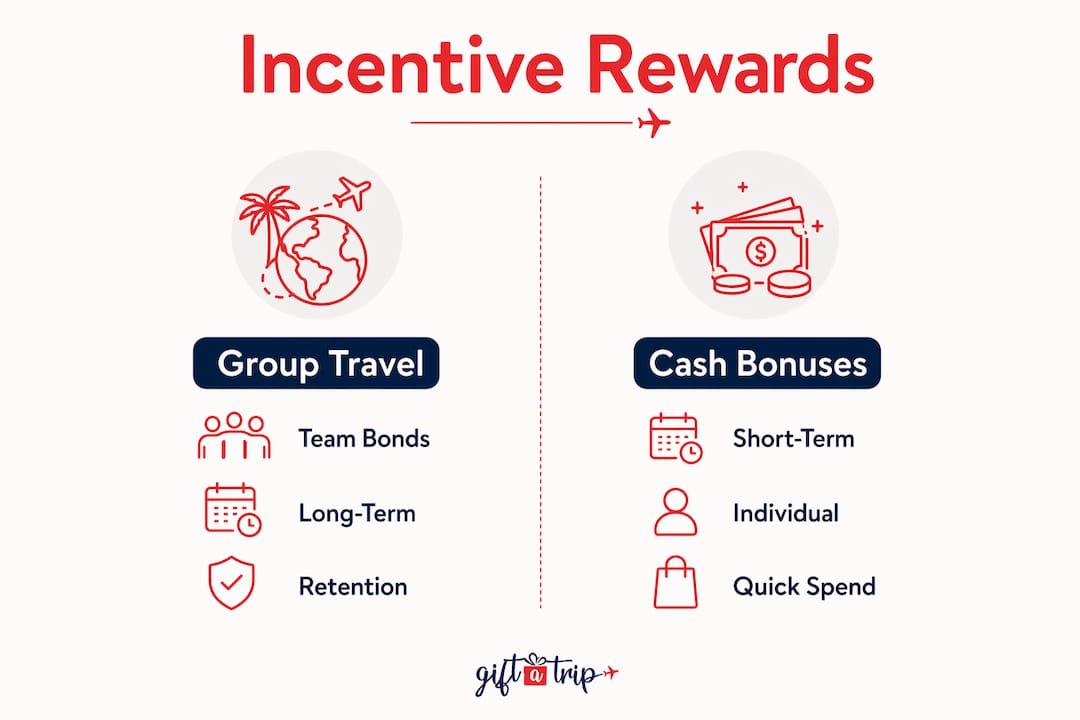
The core difference between group and individual incentive travel is relational. Individual travel rewards the person. Group travel rewards the team and, in doing so, rewards the organization.
Cash bonuses operate on a transactional logic. They are fast to administer, easy to budget, and universally understood. They are also forgotten quickly. Travel rewards transform transactional motivations into long-term loyalty by providing emotional experiences cash cannot match. That transformation is the core argument for choosing travel over cash when retention and culture are the goals.
The comparison between group and individual travel is more nuanced. Individual travel certificates give top performers flexibility and personal choice, which some employees value highly. The SITE and Maritz research shows that 61% rate individual travel as extremely motivating, compared to 50% for group travel. Individual travel scores higher on personal motivation. Group travel scores higher on team cohesion, peer relationships, and organizational loyalty.
The practical implication for HR and sales managers is that the two formats serve different goals. Use individual travel certificates to reward your top 5% of performers with maximum personal impact. Use group travel programs to build culture, strengthen teams, and create recurring motivation cycles across a broader population. The travel certificates vs cash bonuses comparison consistently favors travel when the goal is long-term engagement rather than short-term output.
Group travel also creates a recurring motivation cycle that cash bonuses cannot. The announcement of next year’s program, the qualification period, the trip itself, and the post-trip storytelling phase each generate distinct waves of engagement. Cash bonuses generate one wave at payment and then flatline. That cycle difference is why organizations with mature group travel programs see compounding returns over multiple years.
Key Takeaways
Group travel incentives outperform cash rewards on retention, team cohesion, and long-term motivation because they create shared emotional experiences that employees carry forward into future performance cycles.
| Point | Details |
|---|---|
| Retention impact is measurable | 89% of incentive trip attendees are more likely to stay, and 93% are motivated to qualify again. |
| Performance lift justifies cost | Programs average a 22% performance improvement, making the $5,100 per-person investment defensible. |
| Group travel builds culture | Shared experiences create social bonds and peer accountability that individual or cash rewards cannot replicate. |
| Measure business outcomes, not just satisfaction | Only 25% of programs track true ROI; set KPIs at the design stage to justify future budgets. |
| Leadership involvement is a differentiator | 99% of top-performing firms feature active executive participation, which amplifies the program’s motivational signal. |
Group travel incentives are a strategic investment, not a line item
I have spent years watching organizations treat incentive travel as a discretionary expense, the first thing cut when budgets tighten and the last thing defended when results are questioned. That framing is the problem. When you position a group travel program as a perk, it gets evaluated like a perk. When you position it as a performance system with defined KPIs and executive sponsorship, it gets evaluated like the business investment it actually is.
The organizations that get the most from group travel incentives are not the ones with the biggest budgets. They are the ones where a senior leader genuinely shows up, where the qualification criteria connect directly to business goals, and where someone on the team is responsible for measuring outcomes beyond a post-trip survey. Those three conditions matter more than the destination.
What I find most underappreciated is the anticipation phase. The motivation generated between program announcement and departure is often longer and more sustained than the motivation generated by the trip itself. A well-communicated program with a compelling destination creates months of focused effort. That is a return on investment that starts before you spend a dollar on flights.
Employee expectations around experience design are also shifting. Teams in 2026 want programs that feel personal and inclusive, not generic resort packages with a company logo on the welcome bag. The organizations that adapt their program design to reflect those expectations will see stronger qualification rates and higher post-trip engagement. Those that do not will find their programs generating diminishing returns regardless of how much they spend.
— Donovan
How Giftatrip supports corporate group travel incentive programs
Corporate teams looking to add travel rewards to their incentive programs often face the same friction: administration complexity, inconsistent delivery, and difficulty scaling across a large workforce.
Giftatrip addresses that friction directly. The platform offers digital travel certificates redeemable at resorts, hotels, cruise lines, and vacation packages from major brands, with taxes and resort fees covered and minimal blackout dates. HR and sales managers can order in bulk, add personalized messaging, and deliver certificates digitally without managing logistics manually. For teams exploring cruise-based rewards, Virgin Voyages cruise certificates offer a premium group travel experience that qualifiers remember. Giftatrip also provides a distribution guide for HR teams to manage certificate delivery at scale.
FAQ
What makes group travel incentives more effective than cash bonuses?
Group travel creates lasting emotional memories and social bonds that cash rewards cannot replicate. Research shows travel is categorized as aspirational, while cash is absorbed as routine income, making travel a stronger long-term motivator.
How much should a company budget for group travel incentives?
The IRF reports an average spend of $5,100 per person, with top-performing companies spending $2,000 more per salesperson than peers. Higher investment correlates directly with stronger performance outcomes.
How do I measure the ROI of a group travel incentive program?
Track sales growth, retention rates, and repeat qualification rates from the program’s start, not just post-trip satisfaction scores. Only 25% of organizations currently measure true business impact, which means most programs are underreporting their own value.
Can group travel incentives work for remote or distributed teams?
Group travel incentives are particularly effective for distributed teams because the shared physical experience creates bonds that virtual interaction cannot. The trip becomes the one moment where the team exists in the same space, which amplifies its relational impact.
How often should a company run a group travel incentive program?
Annual programs are the most common cadence and align well with fiscal year performance cycles. The post-trip storytelling phase from one program naturally feeds anticipation for the next, creating a continuous motivation cycle across the calendar year.