
Jump to Section:
TL;DR:
- Flexible travel rewards are transferable points that can be moved to multiple airline and hotel partners, offering more redemption options and greater value. They work best when used strategically, with careful timing and active monitoring of transfer bonuses, for premium class flights and luxury stays. These rewards are especially beneficial for businesses and givers seeking meaningful travel incentives, but require planning to avoid complexity and devaluation risks.
Flexible travel rewards are loyalty points you can transfer to multiple airline and hotel partners, giving you far more redemption options than any single fixed program. Unlike cash back or portal credits, these points let you choose your redemption based on where the best value appears at any given moment. Programs like Chase Ultimate Rewards and Amex Membership Rewards are the most recognized examples of this model. The core advantage is optionality. You hold points in a central account and only move them when you find an award worth transferring for. That timing control is what separates flexible rewards from every other loyalty currency.
What are flexible travel rewards, and how do they differ from fixed programs?
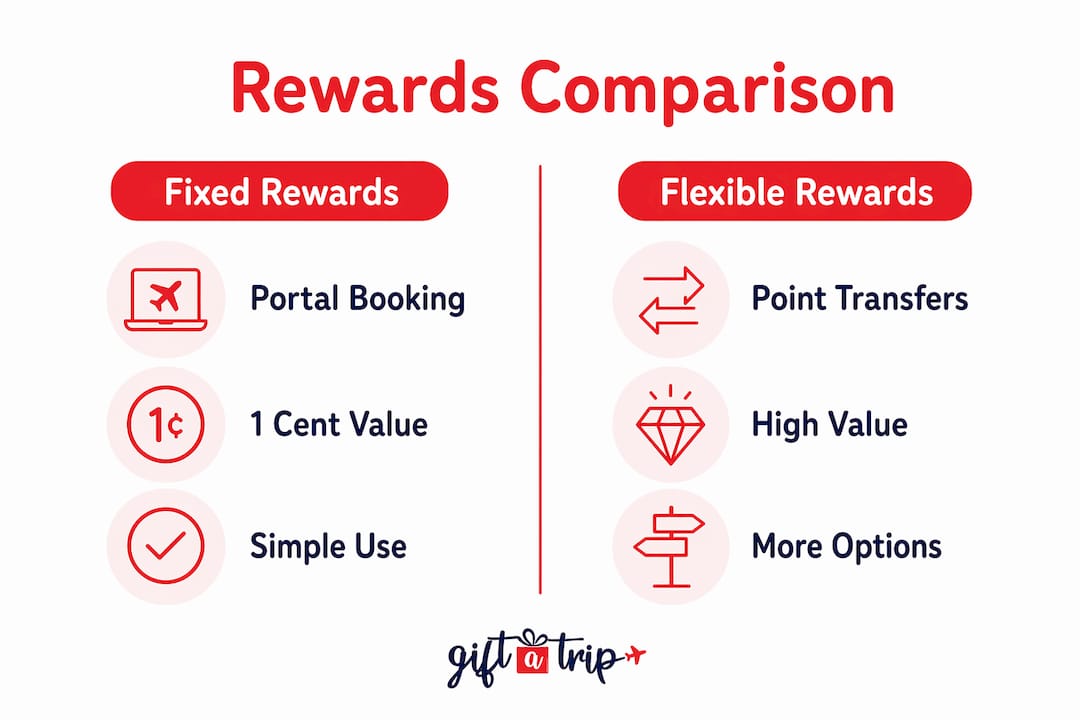
Flexible travel rewards are transferable points that move to various airline and hotel partners, unlocking award availability and higher potential value than fixed programs can offer. Fixed rewards, by contrast, lock you into a travel portal or statement credit redemption. You get predictability, but you trade away upside.

The practical difference shows up at checkout. A fixed credit gives you roughly 1 cent per point when you book through a portal. A flexible point transferred to the right airline partner can return 2 cents or more per point on a business class seat. That gap is significant over thousands of points.
Fixed rewards suit travelers who book last minute, dislike research, and want a simple dollar value attached to every point. Flexible rewards suit travelers willing to plan ahead and search for high-value award space. Neither is wrong. The right choice depends entirely on how you travel.
| Feature | Fixed rewards | Flexible rewards |
|---|---|---|
| Redemption options | Portal or statement credit | Multiple airline and hotel partners |
| Typical value per point | 1–1.25 cents | Up to 2 cents or more |
| Ease of use | High | Moderate to low |
| Devaluation risk | Moderate | Lower, due to multiple partners |
| Best for | Casual or last-minute travelers | Planners seeking premium value |
Pro Tip: If you book fewer than four trips per year and rarely fly business class, a fixed rewards card will serve you better than a flexible program. Save the complexity for when the payoff is real.
How do point transfers work in flexible travel rewards programs?
Point transfers are the engine of flexible rewards. You move points from your central bank account, such as Chase Ultimate Rewards or Amex Membership Rewards, directly into an airline or hotel loyalty account. Most top programs transfer at 1:1, meaning 10,000 bank points become 10,000 airline miles. Some exceptions exist, with ratios ranging from 0.8 to 2 depending on the partner.

Transfers are typically one-way and instant or near-instant. Once you move points into a partner program, you cannot reverse the transfer. That makes timing critical. You should only transfer points after confirming award space is available, not before.
Transfer bonuses add another layer of value. Chase ran 25 transfer bonuses in 2025 and 14 in the first half of 2026 alone. These bonuses, often 25%–40% extra miles, can dramatically increase what your points are worth. Tracking them takes effort, but the payoff is real.
Key mechanics to understand before transferring:
- Partner availability: Not every program connects to every airline. Confirm your target airline is a transfer partner before earning points in a specific bank program.
- Award seat confirmation: Search for available award space first. Transfer only after you find the seat you want.
- Expiration after transfer: Points in bank programs stay valid as long as your account is active. Once transferred, expiration rules vary by partner and can be as short as 18–24 months without account activity.
- Transfer timing: Some transfers take minutes; others take up to 48 hours. Factor this into your booking window.
Pro Tip: Set a calendar alert for transfer bonus announcements from your bank program. These promotions are time-limited and rarely repeated within the same year.
What are the flexible travel benefits for businesses and gifting?
Businesses get outsized value from flexible travel rewards because the points serve two purposes at once. They reduce travel costs for the company and create a gifting currency for employees and clients. Business travel cards typically include free employee cards, no foreign transaction fees, and credits for TSA PreCheck or Global Entry, all of which simplify expense management.
The accounting benefit alone justifies the switch for many companies. Dedicated business card accounts separate personal and business expenses automatically. That reduces reconciliation time and gives finance teams cleaner data for reporting.
For HR and recognition programs, flexible points translate directly into travel incentives for employees. A points transfer to a hotel partner becomes a weekend stay. A transfer to an airline becomes a flight upgrade. These rewards carry emotional weight that cash bonuses rarely match.
Businesses using travel rewards for gifting programs typically see benefits across several areas:
- Employee morale: Travel experiences create lasting memories, which ties positive feelings to the employer rather than the paycheck.
- Sales motivation: Points-based incentives tied to performance targets give sales teams a concrete, aspirational goal.
- Client appreciation: Transferring points to fund a client’s hotel stay is a high-impact gesture at a fraction of the retail cost.
- Milestone recognition: Work anniversaries, promotions, and project completions all carry more weight when the reward involves a real trip.
Giftatrip’s corporate gifting programs extend this logic further by offering travel certificates that function like flexible rewards without requiring points management. Companies can order in bulk, personalize the delivery, and cover taxes and resort fees upfront.
How can you maximize value from flexible travel rewards?
Maximizing flexible rewards requires a plan, not just a card. The highest-value redemptions, business class flights and luxury hotel stays, require advance research and patience. Transferring points through portals or for statement credits is simpler but typically yields only 1–1.25 cents per point. The real returns come from partner transfers, which can reach 2 cents or more per point on premium awards.
A hybrid approach works best for most travelers and businesses. Use annual travel credits for fixed, predictable costs like checked bags or lounge access. Reserve your flexible points for high-value redemptions where the transfer math clearly wins. This balanced strategy avoids burning premium points on low-value bookings.
Practical strategies for getting the most from your points:
- Identify your target redemption first. Decide where you want to go and what cabin class you want before choosing which card to use. Work backward from the award to the earning strategy.
- Search award space before transferring. Confirm a seat exists before moving points. Award space disappears fast, and transfers are irreversible.
- Stack earning categories. Use your flexible rewards card for the spending categories that earn the most points, typically dining, travel, and online purchases.
- Monitor transfer bonuses actively. A 30% transfer bonus turns 50,000 points into 65,000 miles. That can be the difference between economy and business class on a long-haul flight.
- Keep partner accounts active. Log into airline and hotel accounts at least once every 12 months. A small activity, like buying a magazine or transferring a small number of miles, resets the expiration clock.
- Combine certificates with points. For gifting, pair flexible points with travel gift certificates to cover experiences that points alone may not reach, such as resort packages with fees included.
Flexible points are the most valuable loyalty currency precisely because they protect against devaluation. When one airline partner devalues its award chart, your points stay in the bank and you simply transfer to a different partner.
What are the common pitfalls of flexible travel rewards?
Flexible rewards carry real complexity, and that complexity has a cost. The cognitive load of tracking transfer partners, monitoring award space, and timing transfers correctly is higher than most people expect. Casual travelers often find the effort outweighs the reward.
Devaluation is the second major risk. Airlines and hotels change their award charts with little notice. A business class redemption that cost 60,000 miles in january may cost 80,000 miles by march. Flexible programs reduce this risk by giving you multiple partners, but they do not eliminate it.
Common mistakes to avoid:
- Transferring points speculatively. Never move points without confirmed award space. You may end up with miles in a program you cannot use.
- Ignoring expiration after transfer. Once points land in a partner account, the clock starts. Track activity requirements for every program you use.
- Chasing bonuses without a strategy. Earning points across five different programs sounds productive. It often results in small balances in each that are not enough for any meaningful redemption.
- Overlooking fees. Award tickets often carry fuel surcharges and booking fees that can add hundreds of dollars to a “free” flight.
Pro Tip: Consolidate your earning into one or two flexible programs rather than spreading points across many cards. A large balance in one program is almost always more useful than small balances in several.
Combining flexible points with fixed-value options like travel certificates gives you a safety net. When the transfer math does not work out, a certificate with a guaranteed value still delivers a real travel experience.
Key Takeaways
Flexible travel rewards deliver the highest potential value of any loyalty currency, but only when you transfer strategically, track partner rules, and plan redemptions in advance.
| Point | Details |
|---|---|
| Definition of flexible rewards | Transferable points redeemable with multiple airline and hotel partners for higher value than fixed programs. |
| Transfer ratio standard | Most top programs transfer at 1:1, with exceptions ranging from 0.8 to 2 depending on the partner. |
| Expiration risk after transfer | Partner programs can expire points in as little as 18–24 months without account activity. |
| Best maximization strategy | Use a hybrid approach: fixed credits for predictable costs, flexible points for premium award redemptions. |
| Business and gifting value | Flexible rewards fund employee incentives, client gifts, and milestone recognition at a fraction of retail cost. |
Why I think most people are using flexible rewards wrong
I have spent years watching travelers collect points with real discipline and then redeem them for $200 in portal credits. That is the equivalent of buying a sports car and only driving it in a parking lot.
The entire point of flexible rewards is the transfer. The moment you use your Chase or Amex points for a statement credit, you are leaving the best part of the program untouched. The value is in the partner ecosystem, not the portal.
What I have found works is treating flexible points like a savings account with a specific goal attached. You do not touch them until you know exactly what you are buying. That mindset shift changes everything. Instead of redeeming whenever you have enough points, you wait until you find a business class seat to Tokyo or a five-night hotel stay in Rome that would cost $4,000 in cash but only 60,000 points.
The other thing most guides do not say clearly enough: transfer bonuses are where serious value gets created. In 2026, the frequency of these promotions from major bank programs means a patient earner can add 25%–40% more miles to a transfer without spending an extra dollar. That is not a minor optimization. That is the difference between a coach seat and a lie-flat bed.
For businesses, the calculus is even cleaner. Flexible points fund travel packages as rewards that employees actually remember. Cash bonuses disappear into rent and groceries. A trip to a resort stays in the memory for years. If you manage a team and you are not using travel as a recognition tool, you are competing for talent with one hand tied behind your back.
My honest advice for newcomers: pick one flexible program, learn it deeply, and ignore everything else for the first year. Breadth comes later. Depth comes first.
— Donovan
How Giftatrip fits into your travel rewards strategy
Flexible points require research, timing, and patience. Not every gifting situation allows for that. When you need to reward an employee, celebrate a client, or send a meaningful gift without managing transfer ratios, Giftatrip offers a direct path.

Giftatrip’s digital travel certificates are redeemable at resorts, hotels, cruise lines, and vacation packages from major brands. Taxes and resort fees are covered. Blackout dates are minimal. For corporate buyers, bulk orders come with customizable gift boxes and personalized messaging. Whether you are rewarding a top performer or gifting a honeymoon, Giftatrip delivers the travel experience without the complexity of points management. You can also explore Virgin Voyages cruise certificates as a high-impact option for milestone gifts and team recognition programs.
FAQ
What are flexible travel rewards in simple terms?
Flexible travel rewards are loyalty points held in a bank program, such as Chase Ultimate Rewards or Amex Membership Rewards, that you can transfer to multiple airline and hotel partners. This gives you more redemption options and higher potential value than fixed rewards programs.
How do flexible rewards compare to cash back?
Cash back gives you a fixed, predictable dollar value per point, typically 1 cent. Flexible points can return 2 cents or more per point when transferred to the right partner for a premium award, but they require more research and planning to reach that value.
Can flexible points expire?
Points in bank programs stay valid while your account is active. Once you transfer to a partner, expiration rules shift to that partner’s policy, which can be as short as 18–24 months without account activity.
Are flexible travel rewards good for businesses?
Yes. Business cards with flexible rewards offer free employee cards, no foreign transaction fees, and credits for travel programs like TSA PreCheck. Companies also use flexible points to fund employee incentives and client gifts at a fraction of retail cost.
What is the best way to use flexible travel rewards?
The best approach combines a hybrid strategy: use fixed travel credits for predictable costs and reserve flexible points for high-value transfers to airline or hotel partners. Always confirm award availability before transferring, and monitor transfer bonuses to maximize miles earned.