Jump to Section:
TL;DR:
- Employee recognition travel programs reward employees with funded travel to motivate performance and loyalty. They outperform cash bonuses in motivational value and are essential for broadaining incentive reach across all departments. Proper design, tax compliance, inclusive qualification, and disciplined measurement ensure program success and demonstrate clear ROI.
Employee recognition travel programs are defined as structured corporate incentive initiatives that reward employees with funded travel experiences in exchange for achieving specific performance, tenure, or behavioral goals. These programs consistently outperform cash bonuses and gift cards as motivators. Research shows 61% of qualifiers rate individual travel as “extremely motivating,” a figure that surpasses every other non-cash reward category. This employee recognition travel guide walks HR professionals and corporate leaders through the full program lifecycle: from prerequisites and design to execution, measurement, and ROI communication. The industry term for this category is incentive travel, and understanding that distinction matters because it shapes how you budget, comply with tax law, and measure results.
What are the critical prerequisites before launching a travel recognition program?
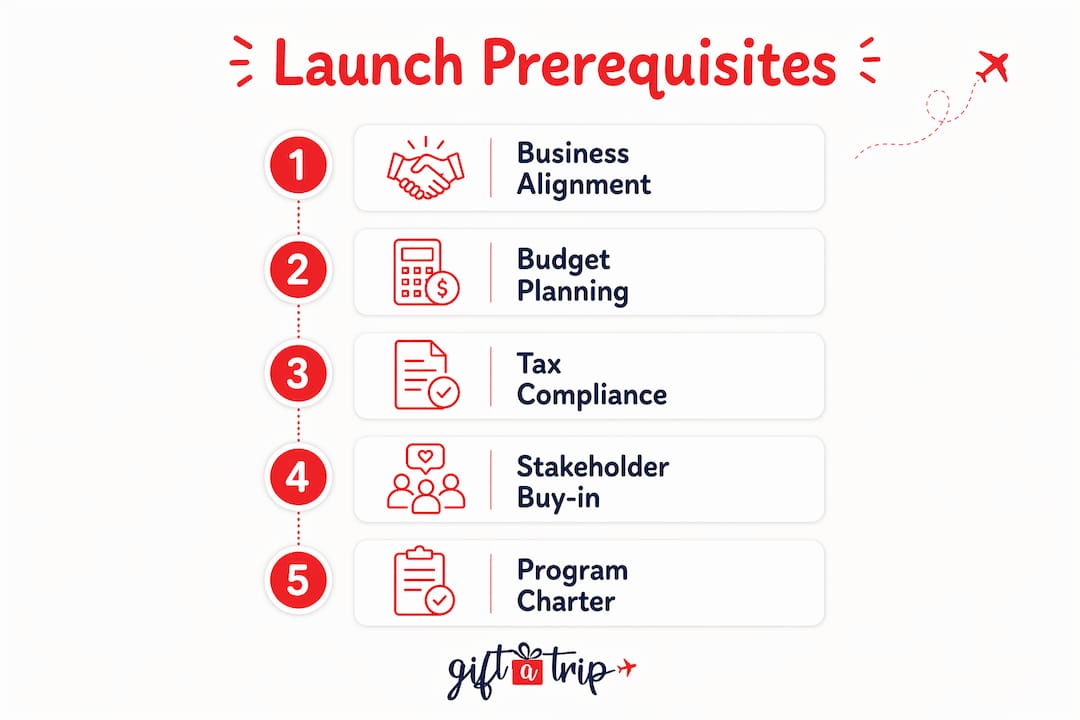
Every successful incentive travel program starts with alignment, not a destination. Before booking anything, HR leaders must connect program objectives directly to business goals. A program designed to reduce turnover requires different qualifying criteria than one built to accelerate sales. Misalignment at this stage wastes budget and confuses participants.

Budget and per-person investment are the next foundational decisions. Top-performing organizations treat incentive travel as a talent investment, not a discretionary perk. Leading companies invest in top-tier trips that exceed average reward values of €13,000 per person. That figure signals the level of perceived value required to drive genuine behavioral change.

Tax compliance is non-negotiable. The IRS treats the fair market value of non-cash incentive trips as taxable income. Up to $1,600 is excludable for employee achievement awards that meet specific IRS requirements, including written plans and non-discriminatory distribution. HR teams must work with finance and legal counsel to structure awards correctly and communicate tax implications to participants before the trip, not after.
Stakeholder buy-in requires cross-functional involvement from the start. Finance needs to approve the budget model. Legal must review compliance. Operations and IT leaders need a seat at the table because, as research now confirms, 60% of qualifiers work in operations or technology, not sales. Designing a program without those departments represented produces a program those departments will not trust.
Pro Tip: Build a one-page program charter before your first planning meeting. It should state the business objective, qualifying criteria, budget range, and tax treatment. Circulate it to all stakeholders for sign-off before any vendor conversations begin.
| Prerequisite | Key action |
|---|---|
| Business alignment | Define the specific behavior or outcome the program rewards |
| Budget framework | Set per-person investment based on desired perceived value |
| Tax compliance | Confirm IRS treatment and structure awards to meet exclusion rules |
| Stakeholder inclusion | Involve finance, legal, operations, and IT from day one |
How to design an inclusive and motivating travel recognition program
The most common design mistake is building a program exclusively for the sales team. Research from SITE Global shows that the majority of incentive travel qualifiers now work in operations or technology. A program that ignores those groups misses the employees who keep the business running daily.
Choosing who qualifies
Qualification criteria should reflect the full range of behaviors that drive business results. Sales revenue is one metric. Customer satisfaction scores, project delivery, safety records, and peer nominations are equally valid. Broadening the qualifier pool increases program reach and signals that the organization values contribution across all functions.
Individual vs. group travel rewards
Individual travel rewards give employees the freedom to choose their destination, timing, and travel companion. Individual travel rates highest among all non-cash motivators. Group incentive trips, by contrast, build team cohesion and create shared memories that reinforce company culture. The strongest programs offer both: a group trip for top performers and individual travel certificates for a wider tier of achievers.
Tiered trip structures
Tiered structures maintain motivation across more performance levels. A regional weekend getaway serves as the entry tier. A domestic resort stay sits in the middle. An international luxury trip anchors the top. This architecture gives employees at every performance level a realistic target and a reason to keep pushing. Group accommodation logistics for multi-day group trips require early planning, particularly for larger cohorts traveling together.
- Define three to five performance tiers with clear, measurable thresholds.
- Assign a travel experience to each tier that reflects its relative value.
- Communicate the full tier structure at program launch so every participant sees the complete reward ladder.
- Review tier thresholds annually and adjust based on workforce performance data.
- Confirm that each tier’s reward carries sufficient perceived value to motivate the target audience.
Pro Tip: Offer a travel certificate option within each tier. Certificates give employees flexibility to travel when it suits their life, which dramatically increases perceived value without increasing your cost per award.
Sustainability and generational inclusivity also shape destination and activity choices. Younger employees often prioritize experiences with environmental responsibility credentials. Older employees may favor comfort and accessibility. Best-performing programs design around participants’ evolving preferences, prioritizing flexibility and personalization at every tier.
What are best practices for executing and communicating travel recognition programs?
Execution quality determines whether a program feels like a genuine honor or a logistical afterthought. The recognition experience begins long before the trip departs.
Phased communication
A phased communication plan builds anticipation and extends the program’s motivational impact across the full performance cycle. The announcement phase sets the stage and explains qualifying criteria. Mid-cycle updates remind participants of their progress. Pre-trip communications create excitement. Post-trip storytelling reinforces the experience for future qualifiers.
Effective programs embed recognition moments directly into the travel experience. An exclusive awards ceremony at the destination, a private dinner with senior leadership, or a locally curated experience tied to the company’s values all deepen the emotional connection. These moments are what participants remember and retell. Pre-trip storytelling and post-trip narrative extend the event’s motivational impact well beyond the trip itself.
Using digital travel certificates
Digital travel certificates add flexibility for both the employer and the employee. HR teams can issue certificates instantly, customize messaging, and manage bulk distribution without the logistics of physical delivery. Employees can redeem certificates on their own schedule, which removes the friction of fixed travel dates. Giftatrip offers digital travel certificates redeemable at resorts, hotels, cruise lines, and vacation packages, with taxes and resort fees covered and minimal blackout dates.
Handling exceptions and alternatives
Not every employee can travel. Health conditions, caregiving responsibilities, and visa restrictions are real barriers. Offering non-travel alternatives such as gift cards, stipends, or equivalent experiences maintains fairness and prevents perceived inequity. Ignoring this group damages program credibility across the entire workforce.
- Identify potential barriers during program design, not after launch.
- Prepare a written alternative reward policy and communicate it alongside the main program.
- Train managers to handle exception requests with consistency and sensitivity.
- Document all exceptions to inform future program design.
Pro Tip: Send a brief mid-cycle survey to all eligible employees asking about travel preferences and potential barriers. The data will sharpen your design and prevent last-minute exceptions that disrupt logistics.
How to measure effectiveness and demonstrate ROI of travel recognition programs
85% of incentive travel program owners rate their program’s impact as good or excellent. Fewer than 25% actually track ROI or business metrics. That gap is the single biggest vulnerability in most corporate travel recognition programs. Without data, the program is one budget cycle away from elimination.
Key performance indicators
The right KPIs connect travel rewards to business outcomes, not just participant satisfaction. Track these metrics before, during, and after each program cycle:
| KPI | What it measures |
|---|---|
| Qualifier retention rate | Percentage of award winners still employed 12 months post-trip |
| Repeat qualifier rate | Percentage of winners who qualify again the following cycle |
| Loyalty survey score | Self-reported organizational commitment among qualifiers vs. non-qualifiers |
| Business outcome delta | Change in sales, customer satisfaction, or productivity among qualifiers |
| Program satisfaction score | Participant-rated quality of the travel experience and recognition process |
Top-performing organizations are twice as likely to report measurable value from incentive travel. The differentiator is disciplined measurement, not program size or budget. Tracking long-term business impact, including sales growth, customer retention, and employee morale, requires baseline data collected before the program launches.
Communicating results to leadership
Quantitative data alone rarely secures C-suite support. Pair retention rates and productivity deltas with participant stories. A single quote from a 10-year employee describing how the trip changed their relationship with the company carries weight that a spreadsheet cannot replicate. Strategic use of travel incentives shifts programs from discretionary perks to recognized components of talent management and business growth. Frame every leadership presentation around that shift.
Key Takeaways
Travel recognition programs deliver measurable retention, loyalty, and performance gains when built on clear objectives, inclusive design, tax-compliant structures, and disciplined ROI measurement.
| Point | Details |
|---|---|
| Travel outperforms cash | 61% of qualifiers rate individual travel as extremely motivating, above cash and gift cards. |
| Inclusion drives reach | 60% of qualifiers work in operations or technology, so program design must extend beyond sales. |
| Tax compliance is required | The IRS taxes non-cash trip value as income; structure awards to meet the $1,600 exclusion threshold. |
| Tiered structures motivate broadly | Offering entry, mid, and top-tier trips gives every employee a realistic and motivating target. |
| Measurement justifies investment | Fewer than 25% of programs track ROI; top performers who do are twice as likely to prove value. |
Why travel recognition programs deserve a harder look in 2026
The programs I have seen fail share one trait: they were designed as perks, not as business tools. The HR team picked a nice destination, sent invitations to the usual sales winners, and called it done. No baseline data. No qualifying criteria tied to actual business goals. No post-trip measurement. The C-suite cut the budget the moment revenue softened.
The programs that survive budget pressure are the ones with a story built from data. When you can show that 89% of qualifiers report stronger loyalty post-trip and that 93% want to qualify again, you are no longer defending a perk. You are defending a retention mechanism. That is a different conversation entirely.
The shift I find most significant in 2026 is the broadening qualifier profile. Operations and technology employees now dominate the qualifier pool. That means the old playbook, built around sales competition and leaderboard culture, no longer fits the workforce. HR leaders who redesign their programs around this reality will see broader engagement and stronger business outcomes. Those who do not will run programs that feel irrelevant to most of their workforce.
My advice: treat the measurement framework as a design requirement, not an afterthought. Build your KPIs before you book the first hotel room. The data you collect in year one becomes the argument you make in year two.
— Donovan
Travel certificates that make recognition simple
Giftatrip gives HR teams a practical way to deliver travel recognition at any scale, from a single top performer to a company-wide appreciation program.
Giftatrip’s digital travel certificates are redeemable at resorts, hotels, cruise lines, and vacation packages from major brands, with taxes and resort fees covered and minimal blackout dates. Certificates arrive instantly via secure digital delivery, which removes the logistics burden from HR teams managing bulk awards. Customizable gift boxes and personalized messaging options let you tailor each award to the recipient. For teams ready to build a full distribution process, the travel certificate distribution guide walks through every step from issuance to redemption. Giftatrip also offers vacation package certificates designed specifically for employee recognition programs.
FAQ
What is an employee recognition travel program?
An employee recognition travel program is a structured incentive initiative that rewards employees with funded travel experiences for achieving specific performance, tenure, or behavioral goals. The industry term for this category is incentive travel.
How do travel rewards compare to cash bonuses for employee motivation?
Individual travel rates higher than cash and gift cards as a motivator, with 61% of qualifiers calling it extremely motivating. Cash bonuses are quickly absorbed into daily expenses, while travel creates lasting memories that reinforce loyalty.
Are employee travel rewards taxable?
The IRS treats the fair market value of non-cash incentive trips as taxable income. Awards up to $1,600 may be excludable under employee achievement award rules if the program meets specific IRS requirements.
How do I measure the ROI of a travel recognition program?
Track qualifier retention rates, repeat qualifier rates, loyalty survey scores, and business outcome changes such as sales growth or customer satisfaction. Top-performing organizations that measure these metrics are twice as likely to demonstrate measurable program value.
What should I offer employees who cannot travel?
Offer equivalent non-travel alternatives such as gift cards, cash stipends, or experience-based rewards. Equivalent alternatives are necessary to maintain fairness and prevent perceived inequity among employees who face travel barriers.