
TL;DR:
- Vacation rewards programs are loyalty systems that offer travel discounts, points, or perks for spending or participation. They can provide significant value when used strategically but often involve restrictions, fees, and risks of devaluation. Travel certificates offer a flexible energy alternative, avoiding many complexities associated with points-based programs.
A vacation rewards program is a structured membership or loyalty system that gives members exclusive travel discounts, points, or perks in exchange for spending money or meeting participation requirements. These programs cover a wide range of travel benefits, from discounted resort stays and hotel upgrades to cruise packages, car rentals, and flight credits. The industry broadly uses the term “travel loyalty program” to describe the same concept, though vacation rewards programs can also include corporate incentive travel and subscription-based travel memberships. Understanding how these systems work helps both individual travelers and corporate professionals get real value rather than leaving benefits on the table.
What is a vacation rewards program and how does it work?
A vacation rewards program earns members points, miles, vouchers, or direct discounts through spending, travel, or membership participation. The mechanics vary by program type, but the core loop is consistent: you qualify, you earn, and you redeem.
Earning methods typically fall into three categories:
- Spending-based earning: Credit card purchases, hotel stays, or cruise bookings generate points automatically.
- Membership-based access: You pay an upfront or recurring fee to unlock discounted travel inventory.
- Attendance or participation: Some programs require attending a presentation or completing an enrollment step before rewards activate.
Redemption works differently across program types. Point values range from 0.6 cents per point for some hotel programs to over 2.0 cents for premium transferable bank currencies. That gap matters. A 50,000-point balance is worth $300 in one program and $1,000 in another.
Common restrictions include blackout dates, activation fees, and expiration windows. Free or discounted travel rewards often come with mandatory presentations, fees, and blackout periods that complicate actual redemption. Reading the fine print before enrolling is not optional.

Pro Tip: Focus your earning on one or two programs with transferable points. Spreading activity across five programs usually means you never accumulate enough in any single one to redeem for meaningful travel.
What are the real benefits and limitations of vacation rewards programs?
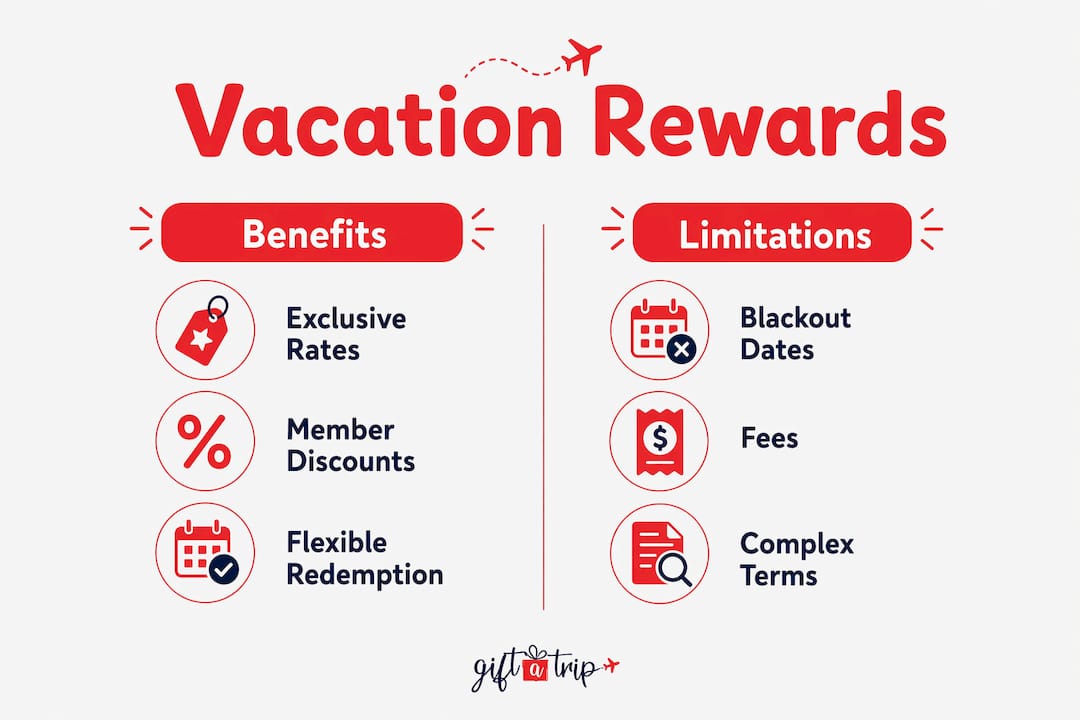
Vacation rewards programs deliver genuine value when used correctly. The benefits are real, but so are the pitfalls.
Benefits worth knowing
Exclusive below-market rates are the primary draw. Members of well-structured programs access resort inventory at prices unavailable to the general public. For corporate professionals, incentive travel programs motivate top performers by targeting the top 10–20% of a sales team with tiered travel rewards. That targeting makes the reward feel earned and meaningful, which drives performance more effectively than cash bonuses of equivalent value.
Individual incentive travel programs are gaining traction because they give qualifiers the power to design their own itineraries. Employees who choose their own destination and travel dates report higher satisfaction than those sent on group trips with fixed schedules.
Limitations that catch people off guard
“Travel rewards programs profit partly from breakage. Between 15% and 30% of points go unredeemed, which is why programs are designed with complex rules and expiration dates that work against the member.”
Issuer profits rely on unspent points, which creates a structural incentive to make redemption harder than earning. Programs also carry devaluation risk. Membership points are a prepaid expense without investment characteristics and can lose value over time based on operator demand. A points balance that buys a five-night resort stay today may only cover three nights next year.
High-pressure sales presentations are another documented limitation. Travel overview sessions typically run 60–90 minutes and introduce the program while offering exclusive deals conditional on attendance. Some programs use this format to push membership upgrades under time pressure.
How do vacation rewards programs compare to other travel rewards?
Not all travel reward systems work the same way. The differences between vacation rewards programs, hotel loyalty clubs, credit card rewards, and travel memberships are significant enough to affect which one fits your situation.
| Program type | Cost to join | How you earn | Redemption flexibility | Key risk |
|---|---|---|---|---|
| Hotel loyalty program | Free | Stays and credit card spend | Brand-locked | Limited to one hotel group |
| Travel rewards credit card | Annual fee | All purchases | Transferable, multi-partner | Annual fee erodes value if underused |
| Vacation rewards / travel membership | Upfront or recurring fee | Membership access | Inventory-dependent | Devaluation, non-resale |
| Timeshare | Purchase price plus fees | Deeded property ownership | Fixed or floating weeks | Ownership obligations, resale difficulty |
Hotel loyalty programs are free to join and reward stays with elite benefits like room upgrades and late checkout. The trade-off is brand lock-in. Marriott Bonvoy points only work within the Marriott portfolio. Credit card rewards offer transferability and flexibility but usually carry annual fees that must be offset by spending volume.
Travel memberships sit in a different category entirely. Unlike timeshares requiring ownership, travel memberships focus on points or discounted access that is prepaid. The access can be valuable, but the points rarely carry resale value and the operator controls pricing. Knowing how to book strategically for high-value perks makes a measurable difference in what you actually get from any of these programs.
How do you choose the best vacation rewards program?
Choosing the right program starts with honest answers about how you actually travel, not how you plan to travel.
- Travel frequency: Frequent travelers benefit most from hotel loyalty programs or premium credit card rewards. Occasional travelers often get better value from a one-time travel certificate or a flexible vacation rewards program with no recurring fees.
- Cost structure: Evaluate total cost of ownership. An annual membership fee of $300 only makes sense if you redeem at least that much in discounts each year.
- Redemption flexibility: Programs with few blackout dates and broad destination options deliver more consistent value. Narrow inventory or peak-season restrictions reduce the practical value of any points balance.
- Program reputation: Member reviews on independent forums reveal redemption experiences that marketing materials do not. Look for patterns in complaints about point devaluation or customer service.
- Corporate alignment: HR teams and corporate planners should assess whether the program supports motivation and retention goals. Corporate travel rewards work best when they align with company culture and employee preferences rather than defaulting to one-size-fits-all group trips.
For corporate professionals, the shift toward individual incentive travel reflects a broader best practice: participant choice keeps travel rewards appealing year over year. Programs that let employees pick their own destination and timing consistently outperform fixed-destination group incentives in satisfaction scores.
Pro Tip: Concentrate your spending in one transferable points currency and redeem for high-value categories like resort stays or cruises. Redeeming for merchandise or gift cards typically returns the lowest cents-per-point value in any program.
Key Takeaways
Vacation rewards programs deliver real value when you understand the mechanics, choose the right program type, and redeem strategically rather than letting points expire unused.
| Point | Details |
|---|---|
| Point values vary widely | Redemption rates range from 0.6 cents to over 2.0 cents per point depending on the program. |
| Breakage benefits issuers | Between 15% and 30% of points go unredeemed, so programs are designed to make redemption complex. |
| Program types differ fundamentally | Hotel loyalty, credit card rewards, travel memberships, and vacation programs each carry distinct costs and flexibility trade-offs. |
| Corporate programs need participant choice | Individual incentive travel programs outperform group trips in employee satisfaction and motivation. |
| Read terms before enrolling | Mandatory presentations, blackout dates, and devaluation risk are common and often underreported. |
What I’ve learned about vacation rewards programs after years of watching them
The single biggest mistake I see both consumers and corporate planners make is treating vacation rewards programs as a category rather than evaluating each one on its own terms. A hotel loyalty program and a subscription travel membership are not the same product. Calling both “vacation rewards” and comparing them side by side is like comparing a gym membership to a personal trainer. The structure, cost, and commitment are fundamentally different.
The “free travel” framing that many programs use is the second trap. Nothing in a vacation rewards program is free. The cost is embedded in membership fees, mandatory presentation attendance, or the complexity of redemption rules designed to trigger breakage. When a program leads with “free vacation,” the first question should be: what does it actually cost to redeem?
For corporate planners specifically, I would push back on the instinct to default to group incentive trips. The data on individual incentive travel is clear. Employees who design their own travel experience report higher satisfaction, and that satisfaction translates into longer retention. The 2026 HR guide on travel packages as rewards makes this case with specifics worth reviewing before your next budget cycle.
The programs worth participating in share three traits: transparent fee structures, flexible redemption with minimal blackout dates, and a track record of not devaluing points aggressively. Those three filters eliminate most of the noise.
— Donovan
Travel certificates as a flexible alternative for rewards programs
Travel certificates offer a direct, transparent alternative to points-based vacation rewards programs, with no expiration complexity or devaluation risk.

Giftatrip specializes in digital travel certificates redeemable at resorts, hotels, and cruise lines including Virgin Voyages and Crystal Cruises, with taxes and resort fees covered and minimal blackout dates. For HR teams, the platform supports bulk certificate distribution for employee recognition, sales incentives, and milestone rewards. Certificates ship digitally with personalized messaging, making them practical for large-scale programs and individual gifting alike. For corporate planners looking to move beyond points complexity, Giftatrip’s vacation packages for employee recognition deliver a fixed, high-perceived-value reward with none of the redemption friction that undermines traditional loyalty programs.
FAQ
What is a vacation rewards program in simple terms?
A vacation rewards program is a membership or loyalty system that gives members travel discounts, points, or perks in exchange for spending money or meeting participation requirements. Members earn rewards and redeem them for resort stays, flights, cruises, or other travel benefits.
How do vacation reward points work?
Members earn points through purchases, stays, or membership enrollment, then redeem those points for travel. Point values typically range from 0.6 cents to over 2.0 cents per point depending on the program and redemption category.
Are vacation rewards programs worth it?
They are worth it when the program has transparent fees, flexible redemption, and minimal blackout dates. Programs with complex rules and high breakage rates often benefit the issuer more than the member.
What is the difference between a vacation rewards program and a travel membership?
A vacation rewards program typically earns points through spending or participation, while a travel membership charges an upfront or recurring fee for access to discounted inventory. Travel membership points rarely carry resale value and can be devalued by the operator.
How can companies use vacation rewards programs for employees?
Corporate incentive travel programs reward top performers, typically the top 10–20% of a sales team, with travel experiences. Individual incentive travel programs, which let employees choose their own destination, consistently deliver higher satisfaction than fixed group trips.