Jump to Section:
TL;DR:
- Experiential rewards like resort gift certificates boost employee retention and engagement more effectively than cash bonuses. They create lasting emotional and social connections by transforming recognition into memorable stories, reinforcing company culture and brand value. Properly designed, these programs deliver measurable ROI, improve morale, and foster long-term loyalty across teams.
More than half of companies using experiential rewards like resort gift certificates drive higher retention than those leaning entirely on cash bonuses. That single fact should give every HR leader pause. For decades, the default answer to recognizing great performance has been a check, a bonus line on a pay stub, or a prepaid card. But mounting evidence tells a different story. Employees remember a weekend at a resort with their family far longer than they remember a deposit that disappears into their checking account. This guide breaks down the research, the practical frameworks, and the real business outcomes that make resort gift certificates one of the smartest tools in a modern rewards strategy.
Table of Contents
- Why go beyond cash: The real motivators
- Key business impacts: Retention, engagement, and ROI
- Designing an effective resort certificate program
- Real-world examples: Success stories in corporate rewards
- Why memorable rewards are the future of employee recognition
- Ready to transform your employee rewards?
- Frequently asked questions
Key Takeaways
| Point | Details |
|---|---|
| Experiential rewards outperform cash | Travel experiences build lasting engagement and loyalty beyond what cash can achieve. |
| Measure outcomes for ROI | Tracking engagement and retention is crucial to prove and improve your program’s impact. |
| Program design is critical | Align certificate rewards with company culture, milestones, and transparent achievement levels. |
| Employee stories drive results | Memorable travel rewards spark company pride and positive word-of-mouth. |
Why go beyond cash: The real motivators
Cash bonuses feel intuitive. They seem flexible, universally appreciated, and easy to distribute. The problem is that they rarely land the way leaders expect. Once a cash bonus hits an employee’s bank account, it blends in with rent payments, grocery bills, and credit card debt. The emotional signal it was meant to send gets lost almost immediately.
Employees often describe cash bonuses as feeling like delayed salary rather than genuine recognition. That distinction matters enormously because recognition is supposed to communicate I see you, I value what you did, not simply here is more compensation. When the message is blurred, the motivational lift disappears quickly.
Experiential rewards work differently because they create a category of experience the employee would rarely fund on their own. A four-night resort stay feels indulgent. Spending your own bonus money on that same vacation feels irresponsible when bills exist. The gift certificate removes the guilt and unlocks genuine enjoyment, which is exactly the emotional connection you want employees to associate with their employer.
As the research on incentive travel in hospitality puts it clearly: cash is quickly forgotten or spent with guilt, while travel is shareable, justifies luxury, and aligns the employee’s experience with the service-oriented values many organizations hold.
Here is what experiential rewards accomplish that cash simply cannot:
- Emotional anchoring: A resort stay becomes a story. Employees talk about it, photograph it, and share it with friends and family. Every retelling reinforces a positive connection to their employer.
- Social proof within the team: When colleagues hear about a resort reward, they want one too. This drives competitive motivation across the entire team.
- Perceived value exceeds face value: A $500 resort certificate feels worth far more than a $500 cash deposit because the experience it unlocks feels premium and out of the ordinary.
- Brand alignment: For companies in hospitality, travel, or service industries, rewarding employees with resort stays reinforces the very culture and values the organization champions.
“Travel rewards are shareable, memorable, and justify luxury experiences employees would never personally fund. Cash spent on necessities creates no lasting connection between the reward and the employer.”
This psychological edge is not accidental. It is the result of how human memory encodes experiences versus transactions. Experiences attach to identity. Transactions do not.
Key business impacts: Retention, engagement, and ROI
The shift from cash to experiential rewards is not just emotionally compelling. It produces measurable business outcomes that CFOs and HR directors can both point to. According to the IRF 2026 Trends Report, top-performing companies that integrate rewards with HR processes and measure outcomes see 53% higher retention compared to organizations that rely on conventional reward structures.
That number deserves emphasis. Losing a mid-level employee costs a company between 50% and 200% of that employee’s annual salary when you factor in recruiting, onboarding, and lost productivity. If a well-structured resort certificate program reduces turnover meaningfully, the ROI calculates itself.
Here is a simple framework for tracking business impact from a resort certificate program:
| Metric | Before program | After program (6 months) |
|---|---|---|
| Employee retention rate | Baseline % | Track improvement |
| Engagement survey score | Baseline score | Compare post-program |
| Sales performance | Baseline revenue | Measure uplift |
| Program participation rate | N/A | Target 80%+ |
| Reported job satisfaction | Baseline rating | Survey post-reward |
The real insight here is that ROI should never be measured in money alone. The ROI of resort gift certificates includes culture value, team cohesion, and the word-of-mouth benefit that comes when employees speak positively about their workplace. These are compounding assets that strengthen your employer brand over time.
Pro Tip: Run an engagement survey four to six weeks after distributing resort certificates. Employees who have redeemed or planned their trip will show measurably higher satisfaction scores, giving you a clean before-and-after benchmark.
Travel-based recognition also correlates strongly with morale in teams that experience seasonal pressure cycles. Sales teams, customer service departments, and project-based teams often hit burnout peaks. A resort reward at the end of a high-pressure quarter tells employees their effort was noticed and gives them something exciting to look forward to during the next cycle.

Looking at resort reward program examples, organizations that align destination rewards with clear performance milestones consistently outperform those that distribute rewards arbitrarily. Structure matters as much as the reward itself.
Designing an effective resort certificate program
A resort gift certificate program succeeds or fails based on how well it is designed before the first certificate is ever distributed. Vague programs with no clear qualification criteria or communication plan produce confusion, not motivation. Here is how to build one that actually moves the needle.
Step 1: Define your achievement tiers. Not every recognition moment is the same. A five-year anniversary deserves a different reward than hitting a monthly quota. Build at least two or three tiers that match certificate value to achievement significance. This structure signals that not all contributions are equal, while still ensuring broad participation.
Step 2: Tie rewards to specific milestones. Generic rewards feel generic. When an employee receives a resort certificate that is explicitly linked to closing the company’s largest deal of the year or reaching a ten-year anniversary, the recognition carries emotional weight. The hotel certificate guide outlines how milestone-based distribution increases perceived value significantly.
Step 3: Integrate with your existing HR calendar. Hotel stay business rewards work best when they are woven into performance review cycles, quarterly recognition events, or annual company milestones rather than distributed as surprise one-offs with no context.
Step 4: Communicate clearly and consistently. Employees need to know how to earn a reward, what the reward includes, and how to redeem it. Ambiguity kills motivation. Create a simple one-page overview that explains the program in plain language and distribute it to all eligible team members at the program launch.
Step 5: Track outcomes to refine future cycles. Gather data after every program cycle. Which rewards were redeemed fastest? Which tiers saw the highest participation? Use that information to improve the program for the next period.
Here is a direct comparison of reward types to put this in context:
| Reward type | Memorable? | Shareable? | Perceived as personal? | Long-term loyalty impact |
|---|---|---|---|---|
| Cash bonus | Low | No | No | Minimal |
| Gift card | Low to medium | Rarely | No | Low |
| Merchandise | Medium | Sometimes | Moderate | Moderate |
| Resort certificate | Very high | Yes | Yes | High |
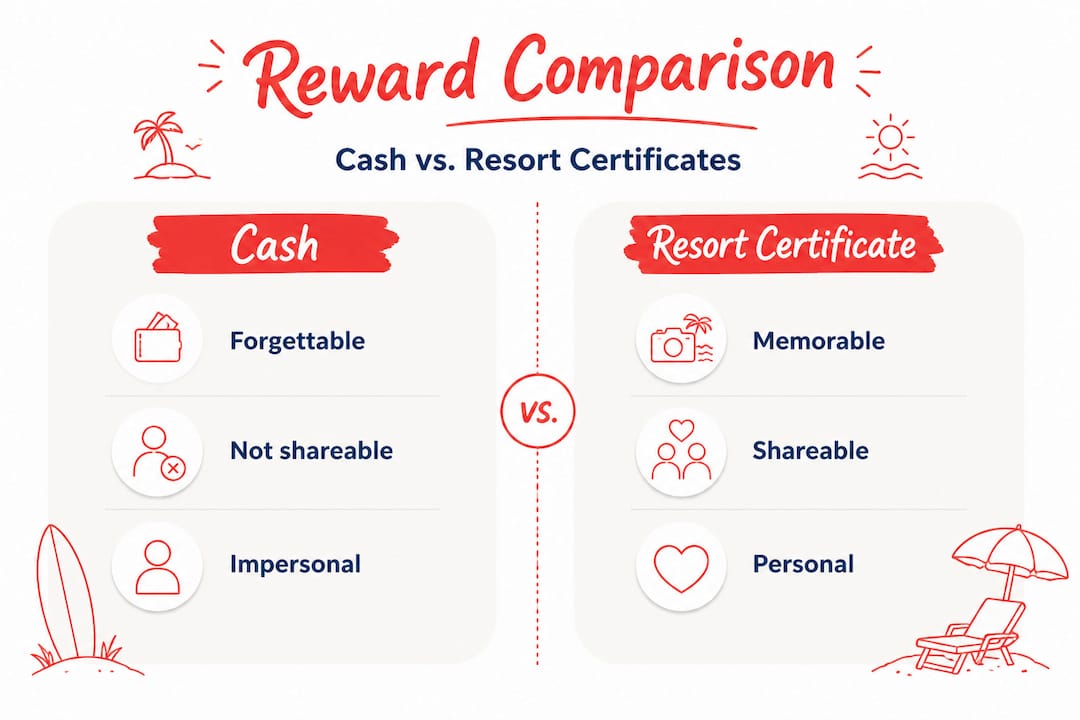
As the research on corporate retreats confirms, tiering by achievement, integrating recognition into milestones, and tracking pre and post metrics are the behaviors that separate high-performing incentive programs from those that fade after the first cycle.
Pro Tip: When building your tiers, include a “surprise and delight” tier for unexpected moments of excellence. An employee who handles a crisis beautifully or steps up during a teammate’s absence should not have to wait for a formal review cycle to feel seen.
Real-world examples: Success stories in corporate rewards
Theory is useful, but concrete examples make the case. Here are scenarios drawn from the kinds of outcomes HR leaders and business teams consistently report when they move to resort certificate-based recognition.
The sales team turnaround. A national sales team had plateaued after two straight quarters of strong performance. Leadership replaced the quarterly cash bonus with a tiered resort certificate program, reserving top-tier certificates (four-night resort stays) for the top 20% of performers. Within one quarter, participation in the program was enthusiastic, inter-team competition increased, and managers reported the most engaged sales meetings in two years.
The long-tenured employee retention win. A mid-size professional services firm was losing employees with seven to ten years of tenure at an alarming rate. They introduced a milestone-based certificate program awarding increasingly premium resort stays at the five, seven, and ten-year marks. Within eighteen months, retention in that tenure bracket improved noticeably, and exit interviews cited the recognition program as a key factor in decisions to stay.
The anniversary milestone upgrade. One HR leader replaced a standard plaque-and-dinner anniversary recognition with a travel gift package that included a resort certificate plus curated travel essentials. Employees reported feeling genuinely celebrated rather than processed through a formality. Several took to internal social channels to share their trip experiences, generating organic positive content about the company culture.
- Employees who received resort certificates reported telling an average of five or more people about the reward
- Teams with certificate-based recognition programs showed higher scores on internal culture surveys
- Managers noted that upcoming reward cycles were discussed proactively, indicating forward-looking motivation
“The moment a reward becomes a story an employee tells their friends at dinner, you have succeeded in connecting your brand to something they genuinely care about.”
The IRF 2026 Trends Report makes clear that companies integrating these rewards into HR strategy and measuring outcomes consistently see stronger retention and engagement results than those using ad hoc or cash-only approaches.
Why memorable rewards are the future of employee recognition
Here is an uncomfortable truth most incentive conversations avoid: giving employees more money rarely creates loyalty. It creates expectation. Every incremental cash bonus becomes the new baseline, and anything less feels like a cut. The ceiling of cash motivation is surprisingly low.
What builds genuine loyalty is the sense that an employer sees an employee as a full human being with a life outside the office. A resort certificate communicates something a bonus line never can: we want you to rest, to experience something beautiful, to make a memory with the people you love.
We have observed, time and again, that the most powerful rewards spark stories rather than just gratitude. Gratitude fades. Stories compound. An employee who spent a weekend at a unique resort reward destination talks about it months later. That story is walking employer brand marketing, and you cannot buy it with a direct deposit.
The other lesson worth challenging is the idea that recognition should be concentrated in annual events. Injecting smaller resort reward moments throughout the year, tied to specific wins or behaviors, keeps motivation alive between major milestones. Cultures that celebrate consistently outperform cultures that celebrate once a year.
HR leaders who build recognition systems around memorable, shareable experiences are not just winning today. They are building the kind of workplace that attracts talent in years to come, because employees who feel genuinely celebrated become your most credible recruiters.
Ready to transform your employee rewards?
Building a recognition program that employees actually talk about does not require a complete overhaul of your HR systems. It requires choosing the right reward vehicle and pairing it with thoughtful execution.
Gift A Trip makes it straightforward for HR teams and business leaders to bring resort gift certificates into their recognition programs. Whether you are looking for a corporate gifting guide to shape your overall strategy or a curated set of travel gift ideas that match your team’s goals, the platform offers flexible, customizable certificates redeemable at top resorts and hotels with taxes and fees included. Bulk ordering, personalized messaging, and secure digital delivery make the logistics seamless, so your team can focus on recognizing great work rather than managing fulfillment.
Frequently asked questions
How do resort gift certificates improve employee retention?
Resort certificates create memorable recognition that builds emotional connection to the company, and organizations using them see up to 53% higher retention compared to those using conventional reward structures.
Are resort gift certificates more effective than cash bonuses?
Yes. Cash is quickly spent and forgotten, while travel rewards are deeply memorable, shareable with family and friends, and create a positive association with the employer that lasts far longer.
What should HR teams track when offering resort certificates?
HR teams should benchmark pre and post program metrics including retention rates, employee engagement scores, participation rates, and satisfaction survey results to measure true program impact.
Can resort gift certificates be integrated with other employee recognition programs?
Absolutely. They can supplement or fully replace existing awards by tiering by achievement or linking certificates to specific milestones alongside your current recognition framework.
How do you ensure all employees feel included in a resort gift program?
Offer flexible travel options that accommodate different preferences, communicate program criteria transparently, and ensure qualification standards are clearly defined, consistently applied, and accessible to all eligible team members.