
Jump to Section:
TL;DR:
- Tax-inclusive travel gifts cover all taxes and fees upfront, ensuring no extra costs at check-in.
- They provide recipients with complete, worry-free experiences, enhancing gifting confidence and satisfaction.
- Verify clear language, written guarantees, and specific coverage details before purchasing to ensure true tax inclusion.
Imagine gifting someone a dream beach vacation, only to have them hit with unexpected resort fees and tax surcharges at check-in. That sinking feeling is more common than most gift givers realize. Many travel vouchers look generous on the surface but pass hidden costs directly to the recipient. Tax-inclusive travel gifts solve this problem by covering every fee upfront, so the person you’re celebrating gets exactly what you intended: a complete, worry-free experience. This guide breaks down what tax-inclusive really means, how to spot it, and how to gift travel with total confidence.
Table of Contents
- What are tax-inclusive travel gifts?
- How taxes and fees are handled with travel gifts
- Spotting and purchasing tax-inclusive travel gifts
- Making the most of tax-inclusive travel gifting
- Why most people misunderstand tax-inclusive gifting—what actually works
- Gift tax-inclusive travel with confidence
- Frequently asked questions
Key Takeaways
| Point | Details |
|---|---|
| Full value coverage | Tax-inclusive travel gifts ensure recipients can redeem the complete stated value without surprise fees. |
| Jurisdiction matters | Tax treatment for travel vouchers varies by country and provider, so verify the inclusivity before gifting. |
| Look for transparency | Clear, tax-inclusive statements and explicit provider guarantees are essential for hassle-free gifting. |
| Watch for exclusions | Some gifts may exclude taxes or fees, especially airline or multi-purpose vouchers; always read details. |
What are tax-inclusive travel gifts?
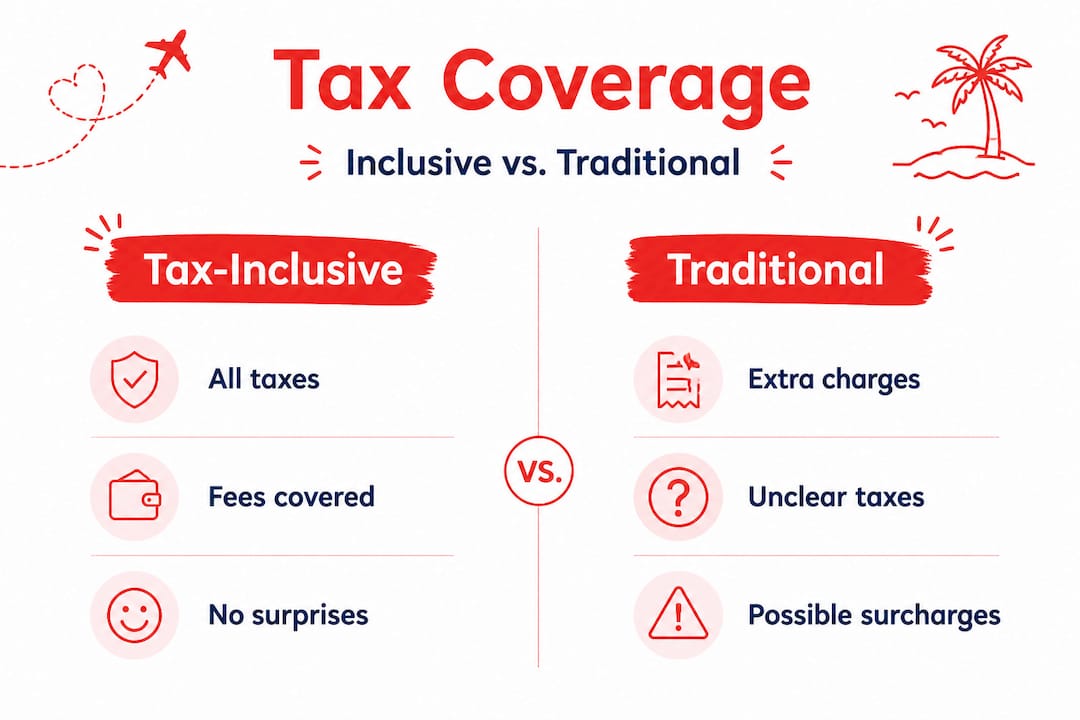
At their core, tax-inclusive travel gifts are travel vouchers as gifts where the stated dollar value already accounts for every applicable tax, fee, and surcharge. The recipient doesn’t pull out a credit card at the front desk to cover government levies, resort fees, or processing charges. What you see is what they get.
This is a meaningful distinction because not all travel vouchers work this way. Traditional travel gift cards often state a face value that sounds impressive but excludes taxes. When the recipient goes to redeem it, the actual usable value shrinks. They end up paying the difference out of pocket, which undermines the entire spirit of the gift.
According to tax-inclusive gift definitions, “tax-inclusive travel gifts refer to travel vouchers or gift cards where the stated value includes all applicable taxes, fees, and surcharges, ensuring the recipient can redeem the full amount without additional payments for taxes.” That clarity is the whole point.
Why it matters for the giver
When you choose a tax-inclusive certificate, you’re not just purchasing a dollar amount. You’re purchasing a complete experience. There’s no guesswork about what additional costs might surprise the recipient later. For milestone occasions like anniversaries, honeymoons, or retirement celebrations, that peace of mind is genuinely priceless.
Why it matters for the recipient
For the person receiving the gift, tax-inclusive means freedom. They can plan their trip without budgeting for mystery fees. They arrive at the resort knowing the stay is fully covered. No awkward calculations at check-in, no last-minute scrambling for extra cash.

Key differences at a glance:
| Feature | Tax-inclusive voucher | Traditional voucher |
|---|---|---|
| Taxes covered? | Yes, upfront | No, paid at redemption |
| Hidden fees? | None | Possible |
| Recipient’s out-of-pocket cost | Zero (for covered stay) | Varies by destination |
| Gifting confidence | High | Uncertain |
| Transparency | Fully stated | Often vague |
What a truly tax-inclusive travel gift should include:
- All government taxes and levies
- Resort fees or facility charges
- Processing or booking surcharges
- Any mandatory destination-specific fees
- Clear written confirmation of what is covered
“The best travel gift is one where the recipient never has to think about money. Tax-inclusive certificates make that possible by handling every charge at the point of purchase, not redemption.”
How taxes and fees are handled with travel gifts
Now that you understand tax-inclusive gifts, it’s crucial to know how taxes and fees are managed for recipients. The mechanics behind tax coverage vary based on the type of voucher, the destination, and the jurisdiction where the gift is purchased and redeemed.
Most travel certificates cover a predictable set of charges. These typically include national and local sales taxes, hotel occupancy taxes, tourism levies, resort fees, and fuel surcharges for cruise packages. However, the treatment of these charges isn’t always uniform across every provider or every country.
One of the clearest examples of jurisdictional variation involves Australia and New Zealand. Based on GST treatment of vouchers, in New Zealand and Australia, “GST on generic travel gift cards and vouchers is accounted for at redemption, not at the point of sale; for specific supplies, at sale. Unredeemed ‘breakage’ triggers GST.” This means a generic multi-destination gift card delays the tax accounting moment, while a voucher for a specific hotel stay handles GST immediately at purchase.
Edge cases are also worth noting. As voucher tax exclusions confirm, “vouchers may exclude certain taxes or fees depending on airline or jurisdiction; multi-purpose vouchers treated as generic for GST timing.” Airline-issued vouchers, for example, sometimes exclude airport departure taxes or fuel surcharges, even when the voucher appears comprehensive at first glance.
How to verify tax coverage before you buy
- Read the full terms: Don’t rely on headlines or marketing language. Look for explicit language about taxes, fees, and surcharges in the fine print.
- Ask directly: Contact the provider and ask, “Does this certificate cover all government taxes, resort fees, and surcharges for the recipient?” Get it in writing.
- Check the redemption process: Review how the recipient redeems the certificate. If they’re prompted to enter payment information during booking, clarify why.
- Look for third-party confirmation: Platforms that work with employee voucher incentives and corporate programs typically carry more rigorous compliance and transparency standards.
- Understand what “inclusive” covers geographically: A certificate that covers all taxes in the US may not cover destination-specific levies in certain international locations.
The distinction between specific and generic vouchers matters practically, too. A certificate tied to a named resort is treated as a specific supply and typically clears tax obligations at purchase. A broadly redeemable gift card is generic, meaning tax compliance happens when it’s used. This can affect refund policies and expiry rules in ways that matter to your recipient.
Pro Tip: When purchasing travel certificates as gifts for tax-smart travel gifting, always choose certificates tied to specific experiences rather than generic credit. Specific vouchers offer clearer tax treatment, more predictable value, and fewer surprises at redemption.
Comparison of voucher types by tax treatment:
| Voucher type | GST/tax timing | Common inclusions | Risk of hidden fees |
|---|---|---|---|
| Specific resort certificate | At purchase | Taxes, resort fees | Low |
| Generic travel gift card | At redemption | Varies | Moderate |
| Airline-issued voucher | At redemption | Limited | Higher |
| Cruise package certificate | At purchase | Port fees, taxes | Low to moderate |
Spotting and purchasing tax-inclusive travel gifts
Understanding the tax mechanics is only half the battle. Here’s how to make sure your gift is truly tax-inclusive and delivers a seamless experience from the moment you buy it to the moment your recipient checks in.
The first thing to look for is explicit language. A legitimate tax-inclusive offer will state clearly, in the product description and the certificate itself, that all taxes and fees are covered. As tax-inclusive gift definitions clarify, genuine tax-inclusive travel gifts are “vouchers or gift cards where the stated value includes all applicable taxes, fees, and surcharges.” If a product description is vague or uses language like “up to” or “plus applicable taxes,” treat that as a red flag.
Signs a travel gift is genuinely tax-inclusive:
- Explicit statement in the product description that taxes and resort fees are included
- No separate fee line items during the redemption process
- A written guarantee or terms document confirming zero out-of-pocket costs for the recipient
- Transparent confirmation of what specific fees are covered (resort fees, government taxes, etc.)
- Customer service that can answer tax coverage questions directly and without hesitation
- Certificate issued by a recognized platform with a verifiable track record
Red flags to watch for:
- Language like “value up to $X before taxes”
- Vague terms about what the certificate “may” include
- No written breakdown of covered fees
- Redemption processes that require a credit card “for incidentals”
- Providers who can’t clearly answer questions about tax coverage
Platforms that specialize in modern travel gift rewards for corporate and personal occasions typically build tax-inclusive structures into their products by design. They understand that a gift with asterisks isn’t a real gift. When shopping for someone’s milestone birthday, a company incentive trip, or a honeymoon surprise, transparency isn’t optional. It’s the whole experience.
Pro Tip: When comparing travel gift options side by side, don’t just compare face values. Compare what’s actually included. A $500 truly tax-inclusive certificate is often worth more in practice than a $600 certificate that passes taxes to the recipient.
Making the most of tax-inclusive travel gifting
Once you’ve chosen the right tax-inclusive travel gift, here’s how to optimize the experience for both yourself and the recipient.
Knowing what to do with a tax-inclusive certificate is as important as choosing the right one. Many gifters purchase excellent certificates but then fail to communicate clearly with their recipients about how to use them. That communication gap can create unnecessary confusion, even when the product itself is flawless.
Best practices for the gifting process
- Include the full terms with your gift. Give the recipient a copy of the certificate’s coverage details, not just the certificate itself. Knowing exactly what’s covered reduces anxiety and builds excitement.
- Set expectations about redemption timelines. Most travel certificates have validity windows. Let your recipient know how long they have to book and travel so they can plan accordingly.
- Pair the certificate with a personalized message. A handwritten or digital note explaining why you chose travel, and what destination inspired the gift, elevates the experience far beyond the certificate alone.
- Consider the occasion. Holiday gifts benefit from longer validity periods. Employee rewards work best when the booking process is simple and quick. Honeymoon gifts deserve certificates covering the most complete experience possible.
The top travel gifting benefits consistently include the ability to offer complete experiences without financial stress. That’s the standard you should hold your gift to.
Common pitfalls to avoid:
- Assuming all travel certificates are tax-inclusive without verifying
- Ignoring blackout dates that restrict when the gift can be used
- Choosing a certificate with a redemption process that’s too complicated for the recipient
- Failing to confirm whether the certificate covers travel to the specific destination the recipient wants
- Not checking expiration dates before presenting the gift
Scenarios where tax-inclusive gifting shines:
- A milestone 50th birthday surprise where the recipient books their own trip
- An employee recognition award where you want zero administrative friction
- A honeymoon gift from multiple family members pooling resources
- A holiday corporate gift for a team that spans multiple locations
As noted in voucher tax exclusions, certain vouchers still exclude specific taxes depending on the airline or jurisdiction, which is exactly why being deliberate about your choice pays off. For turnkey gifting tips that remove friction entirely, look for platforms where the entire redemption process, taxes and all, is handled in advance.
Pro Tip: If you’re gifting travel to someone who isn’t a frequent traveler, choose a certificate with a dedicated customer support line for recipients. Knowing they can call someone with questions makes the whole experience feel more welcoming, not just more affordable.
Why most people misunderstand tax-inclusive gifting—what actually works
Here’s the reality: most people think tax-inclusive means the gift is a better deal. It is, but not in the way they think. The value isn’t primarily financial. It’s emotional.
When a recipient redeems a travel certificate and doesn’t encounter a single unexpected charge, they don’t just feel relieved. They feel genuinely cared for. They feel like the giver thought of everything. That feeling is what creates the stories people tell for years. “My company sent me on a trip and they covered everything. Not a single extra charge.” That memory is what builds loyalty, gratitude, and connection.
The mistake most gifters make is evaluating travel certificates purely by face value. They compare $400 here versus $450 there and choose based on the number. But a tax-inclusive certificate at $400 that delivers a frictionless experience is exponentially more valuable than a $450 certificate that hits the recipient with $60 in resort fees.
Another persistent misconception is that tax-inclusive only matters for expensive gifts. It actually matters more for modest gifts. When someone receives a certificate worth $200 and then has to pay $40 in fees on top of it, that’s a 20% reduction in perceived gift value. That sting is real, and it’s avoidable.
The most effective approach to travel gifting focuses on creating lasting gifting memories rather than maximizing face value. The certificate that delivers zero surprises, clear instructions, and complete coverage is the one that actually gets used, actually gets remembered, and actually strengthens your relationship with the recipient. That’s the standard worth holding to, whether you’re buying for a spouse’s birthday or an entire employee recognition program.
Gift tax-inclusive travel with confidence
After understanding what genuinely works, the natural next step is finding a platform that builds all of these principles into every product it offers.

Gift A Trip specializes in exactly this. Every flexible travel certificate on the platform is designed so that taxes and resort fees are already covered, meaning your recipient never faces a surprise charge. Whether you’re gifting a romantic resort escape, a Virgin Voyages cruise certificate, or exploring the full range of digital travel gift examples, you’ll find transparent options with minimal blackout dates and secure digital delivery. For every occasion from honeymoons to employee milestones, Gift A Trip makes it easy to give travel that feels as complete as the experience itself.
Frequently asked questions
What does it mean if a travel gift card is tax-inclusive?
A tax-inclusive gift card covers all applicable taxes, fees, and surcharges, so the recipient doesn’t pay extra at redemption. The full stated value is available for the travel experience itself.
Are all travel gift certificates tax-inclusive?
No. As voucher exclusions confirm, some vouchers may exclude certain taxes or fees depending on the provider and jurisdiction, so always verify before buying.
How is GST handled for travel gift vouchers in Australia and New Zealand?
For generic vouchers, GST is applied at redemption; for specific supplies, at the time of sale. Unredeemed values trigger GST as “breakage.”
How do I make sure my travel gift is truly tax-inclusive?
Ask the provider for explicit written confirmation that all taxes and fees are included, and look for clear value statements in the product description before purchasing.