Jump to Section:
TL;DR:
- Experiential gifts like vacations create deeper, lasting happiness than material objects.
- Traveling enhances memories, bonds relationships, and avoids clutter and guilt.
- Corporate travel rewards boost performance, loyalty, and are preferred over cash bonuses.
Most people spend years buying birthday gifts that end up collecting dust or anniversary presents that feel forgettable by the following week. Yet research consistently shows that the gifts creating the deepest joy are not wrapped in boxes at all. Long-term happiness comes more reliably from experiences like vacations than from any physical object, because memories grow richer over time while possessions fade in excitement. This article breaks down the science, the real-life impact for special occasions, and the surprising ROI for corporate rewards, so you can gift with confidence.
Table of Contents
- The science behind gifting experiences
- Vacation gifts for special occasions: Personal impact
- Vacation gifts as corporate rewards: Performance and ROI
- Risks, limitations, and how to avoid gifting pitfalls
- A fresh perspective: Why vacation gifting is the future of meaningful rewards
- Explore vacation gifting solutions
- Frequently asked questions
Key Takeaways
| Point | Details |
|---|---|
| Experiences yield lasting joy | Memorable vacations create happiness and strong bonds that material gifts rarely match. |
| Corporate rewards boost productivity | Incentive travel drives engagement and efficiency better than cash, especially for younger employees. |
| Personalization reduces risk | Matching the vacation experience to the recipient’s preferences ensures positive outcomes. |
| Flexible vouchers prevent disappointment | Offering options and combining with material gifts helps avoid common pitfalls of experience gifting. |
| Vacation gifting is rising | The shift from things to experiences is reshaping how we celebrate and reward others. |
The science behind gifting experiences
Psychologists have studied happiness and gifting for decades, and the verdict is clear. Material gifts produce an initial spike of pleasure, then quickly lose their emotional charge as people adapt to owning them. This is called hedonic adaptation, and it works against any object-based gift over time. Experiences do the opposite: they become more vivid and meaningful as memories compound.
Why does this happen? Three forces drive it:
- Memory creation: Every time you recall a trip, your brain re-experiences positive emotions, effectively re-gifting happiness repeatedly.
- Relationship bonding: Shared experiences strengthen the emotional ties between giver and recipient more than shared ownership of things ever could.
- No clutter: There is nothing to break, discard, or feel guilty about owning. The experience simply lives in memory.
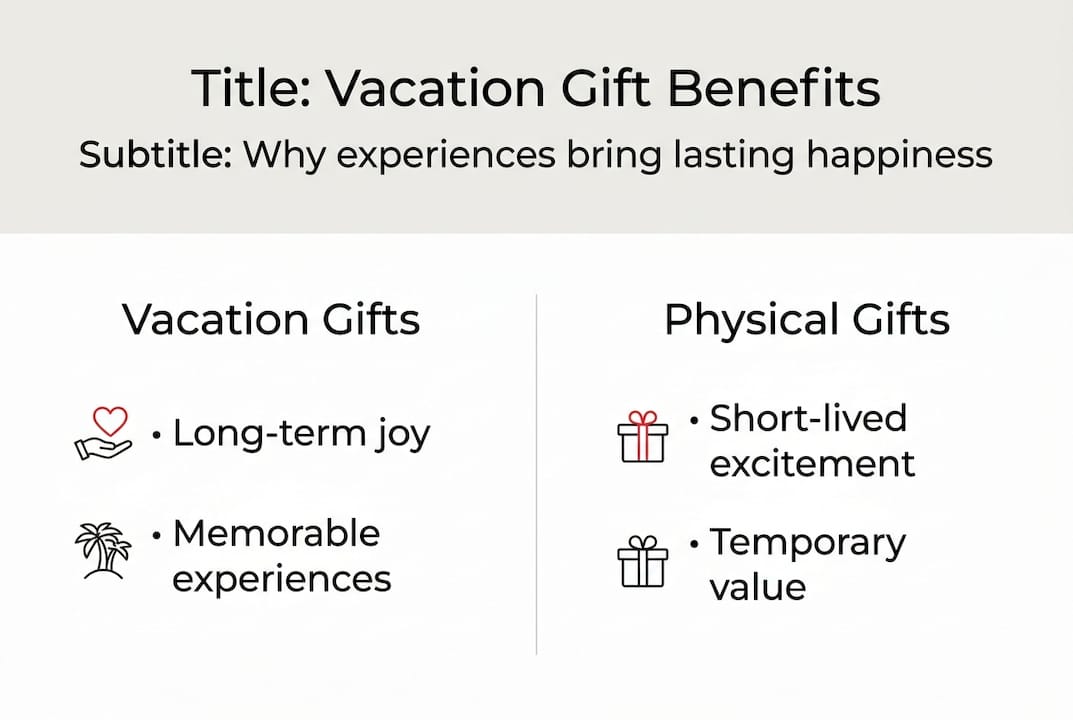
Research confirms that experiential gifts provide more long-term happiness than material ones precisely because of these three factors working together.
| Factor | Material gift | Vacation gift |
|---|---|---|
| Initial excitement | High | High |
| Long-term happiness | Fades quickly | Grows over time |
| Relationship impact | Minimal | Strong bonding |
| Clutter and guilt | Common | None |
| Conversation value | Low | Lasting stories |
This does not mean every vacation gift is perfect for every person. Extroverted recipients who love travel get the most out of experience gifts. Introverts or people with mobility limitations may prefer the flexibility of a certificate they can redeem on their own terms. Understanding the recipient is the first step in impactful travel gifting.
Another important insight: the anticipation of a vacation actually adds a second wave of happiness before the trip even happens. People report elevated mood and excitement in the weeks leading up to travel, which material gifts rarely produce. Following best travel gift practices ensures recipients experience this anticipation fully, which means giving enough lead time and including all relevant booking details at the moment of gifting.
Stat to know: Studies show people predict they will enjoy material purchases more than experiences, but their actual post-event happiness tells the opposite story.
Vacation gifts for special occasions: Personal impact
Knowing why experiences matter, the next question is how to apply this in real life. Birthdays, anniversaries, and family milestones all benefit from vacation gifting, but the approach varies by occasion and recipient.
For a birthday, a solo travel certificate gives the recipient freedom to choose when and where they go. This works especially well for milestone birthdays like 30, 40, or 50, when people often feel an urge to mark the occasion with something significant rather than another kitchen gadget.
For anniversaries, a shared trip is the ideal vehicle for reconnecting. Couples who travel together build stronger memories and report higher relationship satisfaction compared to couples who exchange material gifts. A beach resort certificate or cruise experience puts the focus back on the relationship.
For family celebrations, a multi-destination package brings everyone together in a way that a dinner out never quite achieves. The shared story of that trip becomes part of the family’s identity for years.
Here are practical ways to personalize a vacation gift:
- Match the destination type to the recipient’s personality (adventure seeker, relaxation lover, culture enthusiast)
- Include a handwritten note explaining why you chose this specific experience for them
- Pair with a small material item like a travel journal or packing organizer to add a tangible opening moment
- Choose a certificate with flexible booking dates so the recipient controls timing
Pro Tip: Adding a small physical item alongside a travel certificate creates two moments of joy: the tactile excitement of opening something and the lasting happiness of the experience itself.
That said, not every situation calls for a vacation gift. Research shows that bad experiences can cause prolonged unhappiness in ways that a disappointing material gift simply does not. A trip gone wrong is harder to shrug off than a sweater in the wrong color. The solution is not to avoid vacation gifts but to plan them carefully. Read through gifting a trip strategies and the step-by-step travel gifting guide before purchasing to ensure you match the right experience to the right person.
“The best gift you can give someone is an experience they will never stop talking about.”
Vacation gifts as corporate rewards: Performance and ROI
For businesses, the case for vacation gifting goes beyond sentiment. It is a measurable performance driver.
Incentive travel boosts employee performance by 22% and delivers $4 in productivity for every $1 spent. Even more striking: 54% of employees prefer travel rewards over cash bonuses. When you give someone money, they often use it on bills and forget where it went. When you give them a trip, they remember it forever and associate that memory with your organization.

The generational shift is accelerating this trend. Gen Z workers consistently rank travel experiences above salary bumps when evaluating benefits packages. They want to live the life, not just fund it. Organizations that recognize this early are pulling ahead in talent retention.
Here is how incentive travel compares to traditional cash rewards:
| Reward type | Performance boost | Employee preference | Memory impact | Retention effect |
|---|---|---|---|---|
| Cash bonus | Moderate | 46% | Low | Short-term |
| Travel incentive | 22% increase | 54% | Very high | Long-term |
| Physical gift | Low | Varies | Low | Minimal |
Top companies do not just send employees on any trip. According to research on top-performing European companies, the highest-impact firms invest an average of €5,564 per person and focus on unique, personalized itineraries rather than cutting costs. The experience quality directly correlates with the engagement and loyalty it generates.
For your corporate program, consider these approaches:
- Use travel certificates tied to specific performance milestones, not just tenure
- Allow recipients to choose their travel style (resort, cruise, adventure) for better personalization
- Layer certificates into a tiered reward system to sustain motivation throughout the year
Explore corporate travel gift ideas, learn about corporate travel vouchers, and review tax-smart travel gifting options to build a program that works both motivationally and financially.
Risks, limitations, and how to avoid gifting pitfalls
Vacation gifts are powerful, but they are not foolproof. Knowing the risks upfront is what separates a gift that lands perfectly from one that causes stress.
The biggest risk is a bad experience. Research confirms that negative experiences can linger in memory longer than negative material gifts. A trip with travel disruptions, poor accommodations, or a mismatch of expectations can leave the recipient worse off emotionally than if you had simply given them nothing. This is the trade-off: the same emotional intensity that makes great experiences unforgettable also makes bad ones hard to shake.
Who should think twice before giving a vacation gift?
- Recipients with significant mobility limitations or chronic health conditions
- People who strongly prefer staying close to home
- Individuals going through major life transitions (job loss, illness, grief)
- Anyone who has expressed anxiety about travel planning
For everyone else, the key is reducing uncertainty. Flexible vouchers are the single best tool for this because they give recipients control over timing, destination, and travel style. When people choose their own experience, they are more committed to making it great and more forgiving of minor bumps.
Pro Tip: Always choose certificates with minimal blackout dates and covered resort fees. Hidden costs at checkout kill the joy of a gift faster than almost anything else.
Here is a quick checklist for a successful vacation gift:
- Confirm the recipient enjoys travel and has no major accessibility barriers
- Choose a flexible certificate they can redeem on their schedule
- Include a tangible element (gift box, personalized card, travel accessory) for the opening moment
- Give enough lead time so anticipation can build
- Follow up and ask how the experience went
Review gifting best practices before finalizing any vacation gift to cover all your bases. The extra planning takes 20 minutes and dramatically increases the chance of a home-run outcome.
A fresh perspective: Why vacation gifting is the future of meaningful rewards
Most guides focus on whether to give experiences or things. We think the more interesting question is why so many gifters still default to material presents when the evidence points so clearly the other way.
The answer is comfort and habit. A physical object is easy to return, easy to measure in dollars, and feels safe. A vacation gift requires knowing the recipient, trusting the experience, and accepting some risk. That vulnerability is exactly what makes it meaningful.
What corporate rewards programs have figured out, and most personal gifters have not, is that risk management is a skill. Top firms that invest in unique travel experiences do not just hope for the best. They design the experience thoughtfully, remove logistical friction, and measure outcomes. The same mindset applied to personal gifting transforms a risky bet into a near-certain win.
The future of gifting is not about spending more. It is about giving better. Explore real gift travel stories and you will see this shift happening in real time, one trip at a time.
Explore vacation gifting solutions
If the evidence has you ready to give a gift that genuinely lasts, Gift A Trip makes it simple to act on that intention.
Whether you are celebrating a birthday, rewarding a top employee, or marking a milestone anniversary, you can browse and send digital travel gifts in minutes, with secure travel certificate delivery directly to the recipient’s inbox. For businesses, corporate vacation certificates come with bulk customization, personalized messaging, and covered taxes and resort fees so there are no surprises. Flexible redemption dates mean recipients book when the time is right for them, not when it is convenient for you. Every certificate is backed by major resort and cruise brands, so the experience matches the promise.
Frequently asked questions
Are vacation gifts suitable for everyone?
Vacation gifts work best for recipients who enjoy travel and value shared memories. They are less ideal for people with significant accessibility concerns or strong preferences against leaving home, where a bad experience could cause lasting disappointment.
How can I avoid pitfalls when gifting a vacation?
Personalize the experience to the recipient’s travel style, choose flexible vouchers that allow date and destination flexibility, and pair the certificate with a small tangible item to create a satisfying opening moment.
What are the main benefits of gifting a vacation compared to physical gifts?
Vacation gifts deliver stronger long-term happiness, deeper relationship bonds, and zero clutter. Research shows experiential gifts outperform material ones in sustained emotional satisfaction because memories continue to grow in value.
Do vacation gifts really boost employee performance?
Yes. Incentive travel increases employee performance by 22% and generates $4 in productivity per $1 invested, while 54% of employees prefer it over cash bonuses, making it one of the highest-ROI reward strategies available.