
TL;DR:
- Branded travel packages combine multiple travel components under one trusted brand to offer convenience and guaranteed quality. They range from budget options to luxury bundles and are suitable for various trip types, corporate incentives, or gifts. These packages focus on curation and risk reduction rather than always providing the lowest price.
Branded travel packages are bundled travel products that combine multiple components, such as airfare, accommodations, transfers, meals, and activities, sold together at one price under a recognized brand to guarantee quality and consistency. The industry term for this format is a “package holiday” or “tour package,” and understanding what are branded travel packages helps you make smarter decisions for vacations, gifts, and corporate rewards. These packages range from budget-friendly all-inclusive travel offers to high-end premium travel bundles with VIP perks. Giftatrip, for example, distributes digital travel certificates redeemable for branded packages at major resorts, cruise lines, and hotels. The core appeal is simple: one purchase replaces five separate bookings, and a named brand stands behind every component.
What are the typical components of branded travel packages?
A branded package bundles 2–5 services into one price, with savings that can reach up to 30% compared to booking each element separately. That range matters because the discount depends heavily on the brand, the destination, and the season.
Standard inclusions cover flights, hotel stays, airport transfers, and at least some meals. Premium travel bundles go further, adding private tours, meet-and-greet services, spa credits, or access to special events. The brand controls which suppliers are used, so quality stays consistent across every booking.
Pricing models vary. Some packages use a flat per-person rate. Others tier pricing by room category or travel date. Bundled pricing works because operators negotiate wholesale rates with airlines and hotels, then pass a portion of those savings to travelers while keeping a margin.
Pro Tip: Before purchasing, verify exactly which meals are included (breakfast only vs. full board), whether transfers cover both directions, and if any listed “inclusions” require an additional fee at the destination.
Legal protections also differ by package type. In many markets, regulated package holidays give travelers financial protection if an operator fails. That protection does not apply when you book each component separately.
What are the main types of branded tour packages?
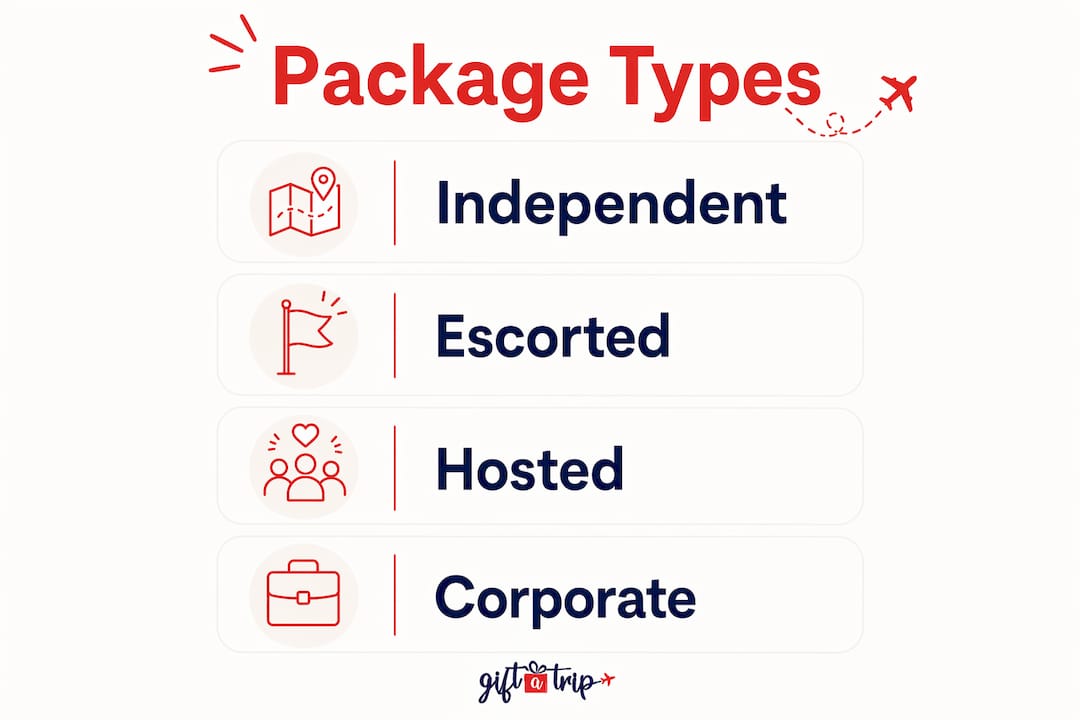
Branded packages fall into four primary categories, each designed for a different traveler profile and trip style.
Independent (FIT) packages bundle flights and hotels but leave the daily schedule entirely to the traveler. These suit experienced travelers who want savings without a fixed itinerary.

Escorted tour packages include a professional tour manager who travels with the group from start to finish. Group sizes are often capped, with some operators setting a maximum of 32 passengers per departure. Organizers who book 6 or more participants may receive complimentary spots.
Hosted packages place a local expert at the destination rather than a traveling manager. Travelers get structured support on arrival without being part of a guided group throughout the trip.
Incentive and corporate packages are purpose-built for employee rewards, sales team motivation, and client appreciation. These often include gala dinners, luxury accommodations, and exclusive experiences that standard leisure packages do not offer.
| Package type | Group structure | Flexibility | Best for |
|---|---|---|---|
| Independent (FIT) | Individual or couple | High | Self-directed travelers |
| Escorted tour | Fixed group, max ~32 | Low | First-time or comfort-focused travelers |
| Hosted | Individual with local support | Medium | Travelers wanting light guidance |
| Incentive/corporate | Company-organized group | Variable | Employee rewards and team events |
Niche formats also exist within these categories. VIP sports travel packages, for instance, combine match tickets, premium hotels, and hospitality suites into one branded product. These are technically escorted or hosted packages with a specific event at their center.
How does the booking and customization process work?
The booking process for branded packages follows a clear sequence, and knowing it helps you get better value and avoid surprises.
- Choose your destination and travel dates. This narrows the available inventory and sets the pricing window. Peak dates cost more, and some packages require minimum stays of 8 nights or longer to qualify for promotional rates.
- Request a quote or select a pre-built itinerary. Travel specialists or automated booking systems typically generate a full itinerary within 48 hours. Some platforms let you configure components yourself; others present fixed options.
- Review inclusions and add-ons. Most packages allow upgrades at the quote stage, such as a higher room category, extra excursions, or airport lounge access. Deposit deadlines often unlock discounts of up to $350 per person, so confirm those dates before committing.
- Confirm and pay the deposit. Branded packages usually require a deposit to hold pricing, with the balance due 60–90 days before departure.
- Receive your travel documents and pre-trip support. Operators send itineraries, vouchers, and contact details for on-the-ground support. High-end packages include a dedicated concierge for the duration of the trip.
White-label technology powers many branded packages sold by retailers, airlines, and loyalty programs. A brand can sell curated travel products under its own name without managing any logistics directly. That is why you see hotel chains, credit card companies, and airlines offering their own branded vacation bundles.
Pro Tip: Book at least 90 days in advance for peak-season packages. Operators release their best pricing early, and many promotional rates disappear once a certain number of seats or rooms are sold.
Luxury travel experiences at the top end of the market include behind-the-scenes access, private chef dinners, and exclusive venue hire. These are negotiated directly with suppliers and are rarely available to independent travelers at any price.
What are the benefits and limitations of branded packages?
The core value of a branded package is risk reduction and curation. Expert operators vet every supplier, manage transfer timings, and handle problems when they arise. That logistical safety net justifies a premium price even when the financial discount is modest.
Understanding the difference between static and dynamic packages is critical. Static packages use pre-purchased inventory, such as chartered flights and hotel blocks, which the operator holds and bears financial risk on. That structure delivers consistent service quality. Dynamic packages, by contrast, use APIs to bundle components at the moment of booking with no inventory held. They offer more flexibility but deliver variable service standards because the operator controls nothing in advance.
A common misconception is that branded packages are always cheaper than booking independently. Discounts are calculated against retail rack rates, which are often higher than the prices a savvy traveler could find through direct hotel booking or fare sales. The real value is convenience and curation, not necessarily the lowest price.
Advantages of branded packages:
- One point of contact for all components
- Vetted suppliers and guaranteed service standards
- Financial protection in regulated markets
- Expert logistical management, especially useful in complex destinations
- Access to exclusive inclusions not available to independent travelers
Limitations to consider:
- Less flexibility to change dates or swap components mid-trip
- Savings may be smaller than advertised when compared to discounted independent rates
- Group tour formats require adapting to a fixed schedule
- Cancellation terms can be stricter than booking direct
Pro Tip: Calculate the package price against real-time rates for each component separately before committing. If the difference is under 10%, weigh whether the convenience and protection are worth the gap.
The guest experience standards built into quality branded packages are a significant differentiator. Operators who specialize in a destination or travel style know which hotels deliver consistently and which ones underperform, knowledge that takes years to build independently.
How are branded packages used for gifting and corporate incentives?
Branded travel packages translate naturally into gift certificates and travel vouchers, making them one of the most effective formats for experiential gifting. A recipient receives a certificate redeemable for a specific package or a credit toward a branded trip, rather than a fixed itinerary they may not want.
Corporate incentive programs use fully-paid branded tour packages, including gala dinners and luxury accommodations, as top-tier employee rewards. The appeal is straightforward: travel rewards are memorable in a way that cash bonuses are not. Companies that offer travel packages as rewards report stronger engagement and retention outcomes compared to standard recognition programs.
Popular gifting occasions for branded packages include:
- Weddings and honeymoons, where couples receive resort or cruise certificates
- Milestone birthdays and anniversaries, where the gift is a curated experience rather than an object
- Corporate recognition events, where top performers receive branded luxury vacation bundles
- Charity auctions, where branded travel certificates command strong bids due to their perceived value
Experiential gifting platforms combine travel with curated local experiences and flexible redemption options. That flexibility is the key differentiator from a traditional voucher. The recipient chooses when to travel, which removes the main friction point of gifted trips.
Giftatrip specializes in this format, offering digital travel certificates redeemable at major resorts, cruise lines, and hotel brands. Taxes and resort fees are covered, and blackout dates are minimal, which makes the certificates genuinely usable rather than aspirational.
Key Takeaways
Branded travel packages deliver the most value when convenience, curation, and risk protection matter more than finding the absolute lowest price on each component.
| Point | Details |
|---|---|
| Core definition | A branded package bundles 2–5 travel components under one brand at one price. |
| Four main types | Independent, escorted, hosted, and incentive packages serve different traveler needs. |
| Static vs. dynamic | Static packages offer consistent quality; dynamic packages offer flexibility but variable standards. |
| Real value | The primary benefit is curation and risk reduction, not always the deepest price discount. |
| Gifting applications | Branded packages convert easily into gift certificates for personal and corporate use. |
The case for branded packages is stronger than most travelers realize
The travel industry has spent years training consumers to obsess over price comparison. I understand the impulse. But after watching how people actually experience travel, the packages that deliver the most satisfaction are rarely the cheapest ones found through a search engine.
What I have seen repeatedly is that the stress of managing five separate bookings, each with its own cancellation policy and customer service line, erodes the enjoyment of a trip before it even starts. A well-constructed branded package removes that friction entirely. The operator has already solved the problems you have not thought of yet.
The 2026 trend I find most significant is the shift toward offer marketing, where airlines embed vacation packages directly into flight search results. That means branded bundles are reaching travelers earlier in the planning process, before they have committed to booking components separately. The brands that execute this well will capture demand that previously went to independent booking.
My practical advice: use branded packages for complex destinations, special occasions, and any trip where something going wrong would be genuinely costly. For a simple city break with direct flights and a hotel you know well, book independently. For a honeymoon in the Maldives or a corporate incentive trip to Europe, the curation and protection of a branded package are worth every dollar.
— Donovan
Giftatrip: branded travel certificates for every occasion
Giftatrip makes it straightforward to give or receive a branded travel experience without locking anyone into a fixed itinerary.
The platform offers digital travel certificates redeemable at major resorts, cruise lines, and hotel brands, with taxes and resort fees included and minimal blackout dates. For corporate teams, Giftatrip provides bulk ordering with customizable gift boxes and personalized messaging, making it a practical solution for employee recognition programs and client appreciation. Individual travelers can browse options like Virgin Voyages cruise certificates or Crystal Cruises luxury packages for premium gifting. Every certificate is delivered securely and digitally, so there is no waiting and no logistics to manage on your end.
FAQ
What are branded travel packages in simple terms?
A branded travel package is a bundle of travel services, such as flights, hotels, and transfers, sold together under one brand at a single price. The brand guarantees quality and manages logistics on the traveler’s behalf.
How do branded packages differ from booking travel independently?
Branded packages use vetted suppliers and provide a single point of contact for all components, while independent booking requires managing each element separately. The package format also offers legal and financial protections that independent bookings typically do not.
Are branded travel packages always cheaper than booking separately?
Not always. Discounts are calculated against retail rack rates, which may be higher than prices available through direct booking or fare sales. The primary value is convenience, curation, and risk protection rather than guaranteed savings.
Can branded travel packages be used as gifts?
Yes. Many branded packages convert directly into gift certificates or travel vouchers redeemable by the recipient at a time of their choosing. Giftatrip specializes in this format, offering digital certificates for resorts, hotels, and cruise lines.
What is the difference between a static and a dynamic travel package?
A static package uses pre-purchased inventory held by the operator, which delivers consistent service quality. A dynamic package bundles components in real time using APIs, offering more flexibility but with variable service standards since no inventory is held in advance.