Jump to Section:
TL;DR:
- Travel gifts create stronger emotional connections and lead to higher long-term motivation than cash or gift cards.
- They boost performance by 15 to 22% and reduce employee turnover through meaningful recognition.
- Implementing tiered, personalized travel rewards enhances workforce engagement and brands the organization positively.
Cash bonuses feel rewarding for about a week. Then they disappear into rent, groceries, or a forgotten bank deposit. If your recognition program relies heavily on cash or gift cards, you may be investing in motivation that evaporates before the next quarter begins. Travel gifts create stronger emotional connections and longer-lasting motivational impact than cash or gift cards, according to the IRF 2026 Trends Report. For HR professionals and sales managers building programs that actually move the needle on engagement, retention, and performance, understanding why travel rewards outperform traditional options is no longer optional. It’s strategic.
Table of Contents
- The science behind travel gifts and motivation
- Comparing travel rewards, cash, and gift cards
- Boosting retention and performance through travel gifts
- How to select and implement travel gifts in your recognition program
- Our take: Why travel-based recognition is the future
- Explore travel recognition solutions
- Frequently asked questions
Key Takeaways
| Point | Details |
|---|---|
| Emotional impact | Travel gifts strengthen employee loyalty by providing memorable, meaningful experiences. |
| Performance boost | Incentive travel drives measurable increases in productivity and engagement. |
| Talent retention | Travel rewards help companies reduce turnover and maintain a competitive workplace culture. |
| Scalable solutions | Personalized travel gifts can be implemented at all organizational sizes using modern delivery platforms. |
The science behind travel gifts and motivation
Why do people remember a trip to Cancún for years but forget a $200 bonus within days? The answer is rooted in psychology, not preference. Experiential rewards activate different memory and emotional processing systems than transactional ones. When an employee receives a travel gift, their brain begins a cycle of anticipation, experience, and reflection that cash simply cannot trigger.
The IRF 2026 Trends Report confirms that travel gifts create stronger emotional connections and longer-lasting motivational impact than cash or gift cards. This isn’t a soft finding. It translates directly into measurable performance outcomes. Incentive travel can increase performance by 15 to 22%, making it one of the highest-ROI tools in any recognition toolkit.
Exploring travel gift package benefits reveals why the format works so well across industries. Three core mechanisms drive the emotional connection:
- Anticipation: The period between receiving a travel gift and taking the trip generates sustained excitement and positive association with the employer.
- Shared memories: Travel experiences become stories employees tell colleagues, family, and friends, extending the recognition moment far beyond the original award.
- Break from routine: A genuine escape reinforces that the employer values the whole person, not just their output.
Here’s how travel gifts compare to cash and gift cards on performance impact:
| Reward Type | Emotional Impact | Performance Boost | Memory Duration |
|---|---|---|---|
| Cash bonus | Low | Short-term | Days to weeks |
| Gift card | Low to moderate | Short-term | Weeks |
| Travel gift | High | 15 to 22% increase | Years |
Reviewing the corporate travel gifting guide shows that organizations integrating travel into their recognition mix consistently outperform those relying on purely transactional rewards. The science is clear. The opportunity is yours to act on.
Comparing travel rewards, cash, and gift cards
About 30 to 34% of recognition programs still rely primarily on cash or gift cards. That’s understandable. They’re easy to administer, universally accepted, and feel like a safe default. But cash and gift cards are seen as transactional, whereas travel delivers emotional and social value that multiplies over time.
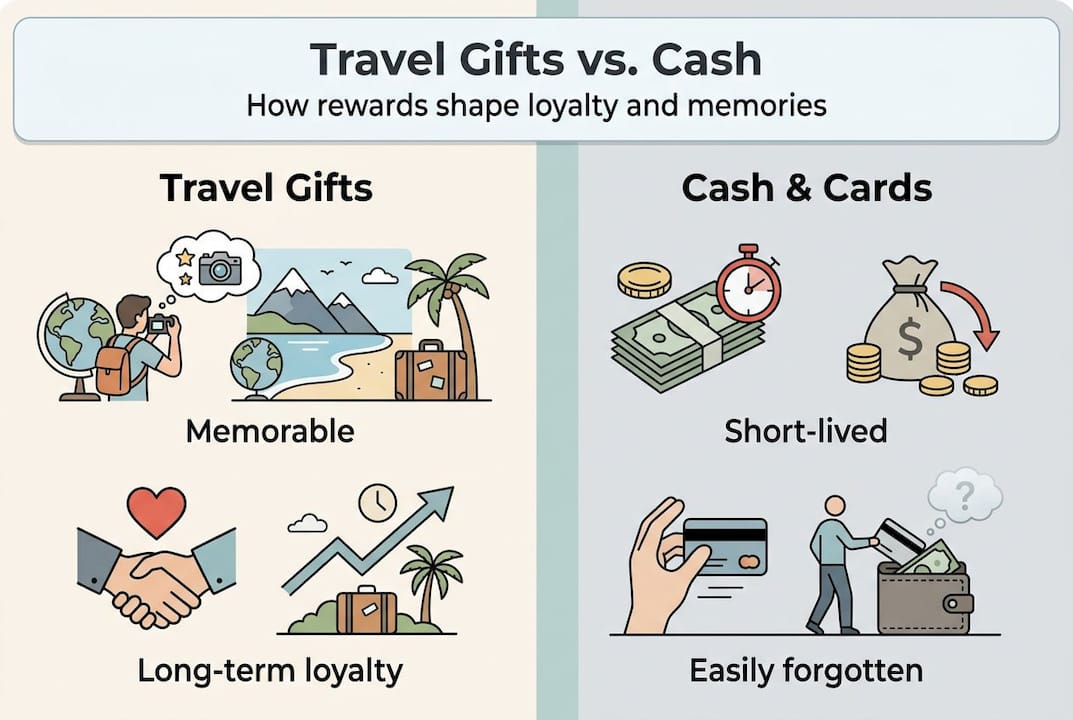
Here’s a direct comparison across the dimensions that matter most to HR and sales leaders:
| Reward Type | Emotional Impact | Performance Boost | Scalability | Perceived Value |
|---|---|---|---|---|
| Cash | Low | Moderate | High | Face value only |
| Gift card | Low to moderate | Moderate | High | Near face value |
| Travel gift | High | 15 to 22% | Moderate to high | Exceeds face value |
The perceived value gap is worth noting. Employees consistently rate travel rewards as more valuable than their actual cost, because the experience feels premium and personal. A $500 travel certificate to a resort often feels worth $800 or more in the employee’s mind.
Knowing when to use travel gifts versus cash is a skill. Here’s a simple decision framework:
- Identify the achievement level. Everyday wins like hitting a weekly target suit smaller, faster rewards. Major milestones like annual top performer or five-year anniversary call for something memorable.
- Assess your workforce demographics. Younger employees and those with families tend to place especially high value on travel experiences.
- Consider public visibility. Travel rewards generate stories and social sharing, amplifying recognition beyond the individual.
- Evaluate budget flexibility. Travel certificates offer fixed-cost predictability, which simplifies budget planning.
Reviewing travel vouchers as rewards and exploring top travel voucher benefits can help you map the right format to each recognition tier.
Pro Tip: Use travel rewards for major milestones and combine them with smaller cash or gift card options for everyday recognition. This layered approach maximizes both engagement frequency and emotional impact without straining your budget.
Boosting retention and performance through travel gifts
Retention is one of the most expensive problems in any organization. Replacing a single employee can cost 50 to 200% of their annual salary when you factor in recruiting, onboarding, and lost productivity. Travel rewards address this problem directly. Companies using incentive travel see up to 31% lower turnover, a figure that should get the attention of any HR budget holder.

The same research confirms that travel rewards increase performance by 15 to 22%, making them one of the few recognition tools with documented impact on both retention and productivity simultaneously. That dual effect is rare and valuable.
How do travel gifts actually drive retention? Several mechanisms work together:
- Loyalty reinforcement: Employees who receive meaningful recognition feel a stronger sense of belonging and are less likely to respond to competitor offers.
- Recognition visibility: Travel rewards are public and memorable. When a colleague returns from a company-sponsored trip, everyone notices. That visibility motivates peers as well.
- Positive peer stories: Employees who share travel experiences become informal brand ambassadors inside the organization, reinforcing a culture where performance is genuinely rewarded.
“Incentive travel creates a psychological contract between employer and employee. It signals that the organization invests in experiences, not just compensation. That signal is worth more than the dollar value of the trip itself.”
Exploring individual travel incentives and vacation package certificates reveals how organizations of all sizes are using travel to build cultures where top performers stay and others aspire to reach that level. The productivity correlation is equally compelling. Motivated employees work harder, collaborate better, and contribute more discretionary effort, all of which compound over time into measurable business results.
How to select and implement travel gifts in your recognition program
Knowing travel rewards work is one thing. Building a program that actually delivers results requires structure, personalization, and the right partners. Here’s how to implement a travel-based recognition strategy that scales:
- Define your recognition tiers. Separate daily recognition from milestone and top-performance rewards. Daily wins might earn points or small gift cards, while quarterly milestones and annual top performers receive travel certificates.
- Choose a tiered travel inventory. Start with domestic hotel stays for mid-tier rewards and scale to resort packages or cruises for elite recognition. A tiered structure with travel for milestones and global inventory for personalization is the proven framework.
- Prioritize personalization. A diverse workforce has diverse travel preferences. Offer options across destinations, trip lengths, and travel styles so every recipient finds something meaningful.
- Partner with a provider offering concierge support. Program administration can become complex at scale. Providers with dedicated support teams reduce the burden on your HR staff and ensure a smooth recipient experience.
- Measure and iterate. Track redemption rates, employee satisfaction scores, and retention data before and after introducing travel rewards. Use that data to refine your tier structure and budget allocation.
Pro Tip: Choose travel providers that offer global options, cover taxes and resort fees, and have minimal blackout dates. These details determine whether employees actually use their rewards or let them expire unused.
Reviewing gifting travel tips and the hotel gift certificates guide provides practical frameworks for matching certificate types to specific recognition occasions. Scalability is achievable. Whether you manage a team of 20 or a workforce of 20,000, the right provider and structure make travel rewards as manageable as any other recognition format.
Our take: Why travel-based recognition is the future
Here’s something most recognition program guides won’t tell you: travel rewards are not just a motivational tool. They are a form of social currency that employees carry into their personal lives, their social networks, and their conversations with future employers.
When an employee posts a photo from a resort they earned through your recognition program, that’s organic employer branding you cannot buy through advertising. It reaches their network with authenticity and credibility that no recruitment campaign can match. Cash never generates that kind of visibility.
The contrarian truth is this: organizations that default to cash-based recognition are not being practical. They’re being forgettable. Culture is built on stories, and travel creates stories. Employees who feel genuinely celebrated through meaningful experiences become advocates, not just workers.
Exploring vacation gift voucher strategies shows how forward-thinking companies are already shifting their recognition philosophy from transactional to experiential. The organizations that make this shift now will have a measurable advantage in talent attraction and retention over the next decade.
“Cash is spent once. A travel experience is relived, retold, and remembered for years. That’s the difference between a reward and a relationship.”
Explore travel recognition solutions
If the data in this article has you rethinking your current recognition approach, the good news is that getting started with travel rewards is simpler than most HR teams expect.
Gift A Trip makes it easy to launch or upgrade a travel-based recognition program without complex logistics. From giving a trip as a gift for individual top performers to deploying a full strategic gifting guide for enterprise-wide programs, the platform covers every scale and occasion. Gift A Trip travel certificates are redeemable at major resorts, hotels, and cruise lines, with taxes and fees included and minimal blackout dates. Bulk ordering, personalized messaging, and digital delivery make administration effortless. Your next recognition milestone deserves a reward people will actually remember.
Frequently asked questions
What type of employee achievements are best suited for travel gifts?
Travel gifts are ideal for celebrating major milestones, surpassing sales goals, or recognizing long-term service and leadership. A tiered structure with travel for milestones ensures the reward matches the significance of the achievement.
How do travel gifts help with talent retention?
Companies using travel rewards report up to 31% lower turnover due to higher engagement and loyalty. The emotional connection created by travel experiences makes employees far less likely to leave for a competitor.
Are travel rewards scalable for larger organizations?
Yes, top programs use concierge management and global travel inventories to ensure scalability for any workforce size. Concierge management and personalized global inventory allow HR teams to maintain quality and consistency even at enterprise scale.
Why are travel rewards more effective than cash or gift cards?
Travel experiences build deeper emotional connections and enduring memories, creating higher long-term motivation. The IRF 2026 Trends Report confirms that travel gifts create stronger emotional connections and longer-lasting motivational impact than cash or gift cards.
Recommended
- Travel Gift Package: 7 Ways to Enhance Employee Rewards
- Vacation Gift Vouchers: 7 Ways to For Employee Recognition
- Travel Gift Packages: Guide to Corporate & Personal Gifting
- Individual Travel Incentives: Employee Recognition Guide
- Why host corporate celebrations to boost engagement – Winelands Function – For Every Occasion, Your Celebration