Jump to Section:
A raffle is a lottery, legally speaking, because it bundles a prize, chance, and a paid ticket, so most states restrict it to qualifying nonprofits. A sweepstakes drops the payment requirement by offering a free entry method, which is why for-profit brands can run one nationwide. The U.S. Postal Inspection Service and the FTC both police this line, and a supplier like Gift A Trip can provide the prize either way.
TL;DR:
- Raffles are restricted to qualifying nonprofits because they satisfy all three lottery elements: prize, chance, and consideration.
- Sweepstakes must provide a genuine, equal opportunity to free entrants, with accessible methods like mail or simple online forms, to avoid illegal lottery classification.
- Running a raffle without proper nonprofit status or permits can lead to fines, prize forfeiture, or criminal charges, especially if online ticket sales are involved.
- State-specific rules, including registration, bonding, and prize value limits, must be thoroughly checked before launching any promotion.
- Prizes, particularly travel rewards, should be clearly defined, include all fees, and be delivered promptly to prevent legal and reputational issues.
Table of Contents
- Sweepstakes vs Raffle: What Actually Separates the Two
- Who Can Legally Run a Raffle (and Who Can’t)
- Structuring a Sweepstakes So It Stays Legal
- Raffle or Sweepstakes: Matching the Format to Your Goal
- Your Compliance Checklist Before Launch Day
- Travel Certificates as Sweepstakes or Raffle Prizes
- Picking the Format That Won’t Blow Up Later
- Where to Get Prizes That Are Ready to Fulfill
- Sources
- FAQ
Sweepstakes vs Raffle: What Actually Separates the Two
Every gambling regulator in the country applies the same three-part test to figure out whether a promotion is an illegal lottery: does it have a prize, does winning depend on chance, and does entering require consideration? Strip out any one leg and the lottery classification collapses. A raffle keeps all three, since a ticket purchase is textbook consideration, which is why raffles fall under gambling law rather than ordinary marketing rules.
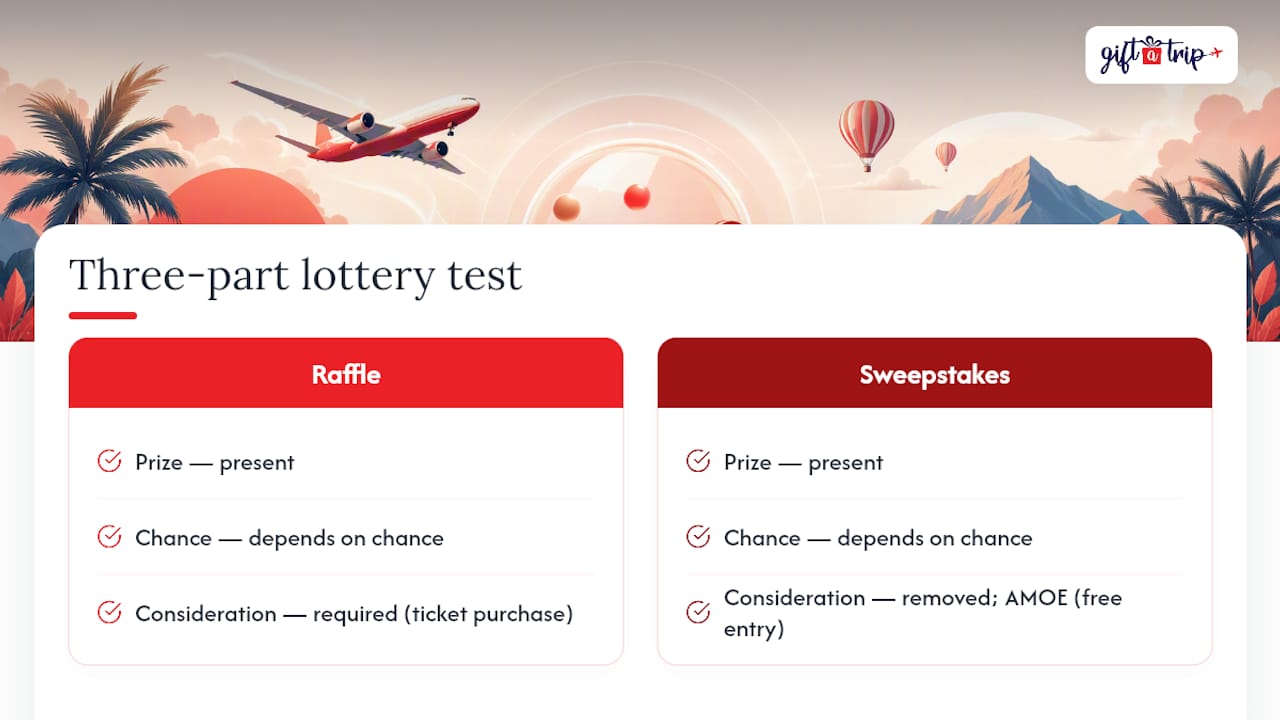
Consideration does not have to be cash. Courts and regulators have found that a genuinely burdensome task, like filling out a long survey, driving to multiple locations, or completing a chain of social media steps, can count as consideration even without money changing hands, according to analysis from The Social Media Law Firm. That is exactly why sweepstakes need a real alternative method of entry, or AMOE, that lets someone enter without buying anything or performing hard labor for the chance.
The AMOE has to offer genuinely equal odds to the free entrant and the paying customer. Klein Moynihan Turco’s marketing law guidance notes that regulators look closely at whether a sponsor still benefits economically from the “free” path, which is often the tell that separates a lawful sweepstakes from a disguised lottery.
Quick test: If removing the entry fee would kill your promotion’s business model, you are probably running a raffle, not a sweepstakes.
Who Can Legally Run a Raffle (and Who Can’t)
Because a raffle satisfies all three lottery elements, most states hand out an exception only to organizations that qualify as tax-exempt nonprofits, not to for-profit businesses chasing a promotional stunt. A regular retailer generally cannot sell raffle tickets and call it marketing.
State rules share a few recurring conditions:
- Nonprofit or charitable status, usually verified through IRS tax-exempt paperwork before a permit is issued.
- A local permit or license, often tied to the county or city where tickets are sold.
- Caps on prize value or ticket price, which vary widely by state.
- Restrictions on online ticket sales, since several states limit or flatly forbid selling raffle tickets over the internet, according to LegalClarity’s breakdown of raffle law.
- Minimum operating history, in some states, before a new nonprofit can apply for a raffle permit.
Pro Tip: Before printing a single ticket, check your state gambling commission’s site directly. The Washington State Gambling Commission is a good model for what these disclosures typically look like: license steps, exemptions, and reporting deadlines spelled out in plain language.
Running a raffle without the right permit is not a paperwork slip. It’s an unlicensed gambling operation in the eyes of the state, and penalties can include fines, forced forfeiture of prize funds, and in repeat or large-dollar cases, criminal referral. A business that tries to skirt the nonprofit requirement by “partnering” with a charity in name only faces the same exposure the charity does, per LegalClarity.
Structuring a Sweepstakes So It Stays Legal
A sweepstakes earns its legal status by making the free entry route real, not decorative. The classic AMOE formats are a mail-in postcard, a toll-free number, or a short online form that takes about as much effort as the paid or “purchase” path. If the free option takes ten minutes and the paid option takes ten seconds, that mismatch alone can create legal exposure.
Every sweepstakes needs official rules that disclose:
- The sponsor’s legal name and address
- Start and end dates for entry
- Odds of winning (or the factors that determine them)
- Approximate retail value of each prize
- Eligibility restrictions, including age and state exclusions
A handful of states, including New York and Florida, require registration and a surety bond once a sweepstakes prize pool crosses a certain dollar threshold. That trigger catches brands off guard because it applies even when no purchase is required at all. National campaigns typically add “void where prohibited” language for exactly this reason, so the promotion self-excludes any state where its structure would not comply.
Social platforms create the riskiest gray zone. Requiring a like, share, tag, or comment to enter can be read as consideration in some jurisdictions, according to Holland & Knight’s marketing law analysis. The safest fix is pairing any social entry mechanic with a non-social AMOE, such as a simple web form, so the social action is never the only door in.
Raffle or Sweepstakes: Matching the Format to Your Goal
The right choice usually comes down to who is running the promotion and how far it needs to reach. A raffle fits a local nonprofit gala where tickets sell in person, the state permit is already secured, and the audience is a defined community willing to pay for a shot at the prize. A sweepstakes fits a for-profit brand, a national contest, or any campaign that wants broad online reach without turning entrants into ticket buyers.
- Revenue: Raffles generate direct ticket revenue; sweepstakes generate leads, engagement, or brand goodwill instead.
- Regulatory burden: Raffles need permits and nonprofit status; sweepstakes need clean AMOE design and possibly state registration above certain thresholds.
- Donor perception: Raffle tickets feel like a donation with a bonus; sweepstakes entries feel like a marketing giveaway, not a charitable act.
- Geographic reach: Raffles are typically local or single-state; sweepstakes scale nationally with the right disclaimers.
Before committing, run through this checklist: Who is the sponsor, a nonprofit or a company? Where do you need entrants to be located? Will tickets or entries be sold online, in person, or both? What is the prize’s retail value? And how much paperwork tolerance does your team actually have?
Your Compliance Checklist Before Launch Day
Skipping steps here is how a well-meaning fundraiser turns into a legal problem. Work through this sequence:
- Map your jurisdictions first. If entrants could come from more than one state, loop in counsel before you finalize the format.
- Pick your structure and lock the AMOE. Decide raffle or sweepstakes early, and if it’s a sweepstakes, design the free entry path before you design the paid one.
- Draft official rules with every required disclosure, including how the AMOE is documented and communicated.
- Check state filing triggers. Confirm whether your prize value requires registration or a bond in states like New York or Florida.
- Fulfill promptly and keep records. Log every entry, notify winners in writing, and issue any required tax forms for high-value prizes.
Pro Tip: Watch for red flags that signal a sweepstakes is drifting into lottery territory: an AMOE buried in fine print, extra hoops the free entrants don’t face, or an entry mechanic that only works through a social platform. Any one of those can undo the legal protection you’re relying on.
The FTC’s consumer guidance is also worth reviewing before launch, since it flags the scam patterns regulators watch for, including fake prize notifications that ask winners to pay fees upfront.
Travel Certificates as Sweepstakes or Raffle Prizes
Travel prizes draw more entries than gift cards, but only if the fulfillment meets the expectations of a business traveler guest. Before naming a trip as your grand prize, verify what’s actually included:
- Whether taxes, resort fees, and gratuities are covered or left to the winner
- Blackout dates and expiration windows, since a prize a winner can’t redeem within a year invites complaints
- The certificate’s stated retail value, which needs to match what your official rules disclose
Digital delivery avoids the mailing delays that generate winner complaints, and clear redemption instructions cut down on support requests after the drawing. Gift A Trip’s travel prize fulfillment guidance covers documentation and tax handling in more depth, though organizers still need their own legal review for the promotion itself, not just the prize.
Picking the Format That Won’t Blow Up Later
Sweepstakes with a real AMOE are the safer default for anything reaching beyond a single community, since they scale without a permit fight in every state. Raffles still make sense, but only when a qualifying nonprofit holds the license and local law clearly allows it. Document every decision along the way, and bring in counsel the moment a promotion crosses state lines or the prize value gets serious.
— Donovan
Where to Get Prizes That Are Ready to Fulfill
Whichever format you choose, the prize itself still has to show up on time and match what your rules promised. That’s where a lot of organizers lose momentum, chasing hotel confirmations or cruise line paperwork instead of running the promotion. Gift A Trip’s Flex Trip Collections solve that specific headache: taxes and resort fees are already built into the certificate, delivery is digital, and blackout dates are kept to a minimum, so winners actually redeem what they won instead of hitting a wall of restrictions.

For nonprofits and marketing teams running bulk or branded prize giveaways, the corporate gifting program covers custom trip selection sites and branded gift box delivery, which matters when you’re outfitting a whole sweepstakes campaign rather than a single grand prize. None of this replaces a lawyer’s sign-off on your promotion’s structure. It just means the prize supply side is one less thing to worry about. Browse the certificate categories to see what fits your budget and prize value before you finalize your official rules.
Sources
Check your state gambling commission directly, review FTC consumer guidance, and read the actual statute for any state where you’ll solicit entries.
This article is general information, not a substitute for advice from a qualified lawyer. Consult a qualified legal professional about your own circumstances before acting on anything here.
- Marketers, beware: Your social‑media sweepstakes or contests could be
- Can a Business Hold a Raffle? Laws and Alternatives – LegalClarity
- What’s the Difference Between a Raffle and a Sweepstakes? – Klein Moynihan Turco
- Washington State Gambling Commission
- The three elements of an illegal lottery: prize, chance, and consideration – The Social Media Law Firm
FAQ
What Is a Legal Alternative to a Raffle?
A sweepstakes with a genuine alternative method of entry is the most common legal substitute, since it removes the payment requirement that makes raffles a regulated lottery. A skill-based contest, where winners are judged rather than chosen by chance, is another legal path for businesses that can’t get a nonprofit raffle permit.
What Is the Difference Between a Sweepstake and a Sweepstakes?
“Sweepstakes” is the correct singular and plural form; “sweepstake” is an informal variant that means the same thing. Both refer to a prize promotion where entry is free or offered through a genuine AMOE, distinguishing it legally from a raffle.
What Counts as a Sweepstakes?
A promotion counts as a sweepstakes when it has a prize and a chance-based winner selection but no required payment, since a real AMOE lets anyone enter without buying anything. If a “free” entry path is buried, unequal, or effectively requires payment anyway, regulators can reclassify it as an illegal lottery, per the three-element test.
How Rare Is It to Win a Sweepstakes?
Odds depend entirely on entry volume and how many prizes are offered, and legitimate sweepstakes are required to disclose those odds or the factors determining them in the official rules. There’s no universal rarity figure, since a small regional giveaway and a national brand campaign have wildly different entry pools.