Jump to Section:
The best surprise trip reveal pairs a keepsake, like a printed boarding pass or itinerary card, with dates you have already confirmed and costs you have already covered. Hand it over, explain any exclusions in plain terms, and let the recipient react without worrying about logistics. Skip the elaborate stunts unless you know the person loves them. A tax-inclusive certificate from a provider like Gift A Trip removes most of the guesswork before you even get to the reveal.
TL;DR:
- Confirm trip availability, passport validity, and disclose all costs upfront to prevent surprises that could ruin the gift experience.
- Use incognito browsing, separate emails, and disable notifications to keep bookings secret until the reveal.
- Keep the reveal simple and personalized, such as a printed boarding pass or destination-themed gift box, tailored to the recipient’s personality.
- Be prepared for varied emotional reactions and allow space for recipients to process the surprise naturally without filming or rushing them.
- Prioritize logistical and financial clarity before focusing on creative presentation, ensuring the trip can truly happen as planned.
Table of Contents
- What Are the Best Surprise Trip Reveal Ideas?
- How Do You Confirm Dates and Documents Before the Reveal?
- How Do You Keep a Surprise Trip a Secret?
- How Do You Present the Reveal and What Keepsakes Work Best?
- What If the Surprise Gets Spoiled Early?
- What Would an Experienced Gifter Check Before Revealing a Trip?
- How Do You Tailor a Reveal to the Recipient’s Personality?
- How Do Surprise Reveals Affect Emotions and Reactions?
- Are There Legal or Ethical Things to Consider Before Surprising Someone With a Trip?
- A Straight Answer on What Matters Most Here
- Why Gift A Trip Makes the Reveal Easier, Not Just the Trip
- Sources
- FAQ
What Are the Best Surprise Trip Reveal Ideas?
Some reveals are built for maximum drama. Others work because they’re quiet, personal, and easy to pull off on a Tuesday night. The right pick depends less on creativity and more on knowing your recipient’s tolerance for spectacle. According to one detailed how-to guide, big “wow” reveals fit some personalities while collaborative reveals work better for planners and control-seekers who want input before anything gets booked.
Here are eight formats worth considering, ranked roughly by ease of execution.
- Faux boarding pass or printed itinerary. This is the fastest option and it photographs well for social media. Print a realistic ticket with the destination, dates, and a personal note in the “seat assignment” line. Works for partners, parents, and coworkers alike. Low-cost version: a home printer and card stock. Premium version: a laminated leather ticket holder from a stationery shop.
- Themed gift box. Fill a box with small props tied to the destination, sunscreen and a seashell for a beach trip, a mini snow globe for a ski week, then bury the itinerary at the bottom.
- Pick 3 to 5 items max so the reveal doesn’t feel cluttered.
- Save the actual trip details for last.
- Add a card explaining what’s covered.
- QR code that plays a video. Record a short message revealing the trip, generate a QR code linking to it, and print the code onto a card. Great for long-distance reveals or grandparents who love a bit of tech novelty.
- Scavenger hunt or clue trail. Hide five or six clues around the house or town, each one hinting at part of the destination, ending at the final reveal item. Works best for kids, spouses who enjoy games, or milestone anniversaries. Keep it under 30 minutes so it doesn’t drag.
- Puzzle that assembles into a destination map. Order a custom photo puzzle of the destination and let the recipient piece it together before the “aha” moment. Slower burn, but memorable for people who like a build-up rather than an instant reveal.
- Balloon pop with a hidden note. Stuff a note or mini itinerary inside a balloon, pop it together, and let the paper fall out. Cheap, fast, and surprisingly effective for kids or casual friend groups.
- Box-in-box reveal. Wrap a small box inside a slightly bigger box, inside an even bigger one, building anticipation with each layer before the final card appears. Works well on camera and for group reveals at a birthday dinner.
- The “packing list” surprise. Hand the recipient a packing list for an unnamed destination (sunscreen, hiking boots, formal wear) and let them guess where they’re headed before revealing the answer. Fun for people who like puzzles but don’t want a full scavenger hunt.
For the physical formats, Canva templates and QR-code generators cover most of what you need, and several travel-reveal guides point to that same combination of printable design tools and quick digital extras for a polished result without hiring a designer.
Pro Tip: Print two versions of any keepsake, one exactly as you plan to use it, and a rough draft to test with a friend first. Typos in a destination name or date are the single most common thing that ruins an otherwise perfect reveal.
How Do You Confirm Dates and Documents Before the Reveal?
The reveal only works if the trip is actually bookable, so logistics come before creativity. Start by confirming availability without tipping your hand. Ask casual questions like “any big plans the second week of March?” instead of “can you take that Friday off?”
Passport and document checks matter more than most people expect, especially for international trips. A good rule of thumb: passports need at least six months of validity beyond the return date for many countries, so check the expiration date early. One approach recommended by travel industry guidance is to ask under a nontravel pretext, something like needing the passport number for a beneficiary form, so you can verify validity without mentioning a trip at all.
Financial transparency deserves its own checklist item. According to The Points Guy, gifting travel without covering or clearly disclosing taxes, resort fees, and gratuities can leave the recipient with costs they didn’t budget for. That single oversight turns a generous gift into an awkward one.
Before you book anything, work through this list:
- Confirm the recipient’s actual days off, not just their calendar’s guess.
- Verify passport expiration dates if the trip crosses a border.
- Decide upfront whether you’re covering taxes, resort fees, and airport transfers, or documenting exactly what’s excluded.
- Book through a separate email account so confirmation emails don’t land in a shared inbox.
- Avoid entering the recipient’s loyalty or rewards numbers, which can trigger notification emails.
- Use incognito or private browsing when researching flights and hotels so ads don’t follow the recipient around later.
Nearly a third of travelers report that unexpected costs, like resort fees added after booking, are among the most stressful parts of a trip. Building that cost into the gift upfront, rather than leaving it as a surprise expense, keeps the experience feeling generous instead of complicated.
If you’re not fully sure about timing or willingness to travel, hold off on nonrefundable bookings. The Points Guy’s guidance is blunt on this point: present the idea first, and only lock in payment once you know the recipient is actually available and interested. A tax-inclusive gifting guide can walk you through exactly which fees typically get missed.
How Do You Keep a Surprise Trip a Secret?
Most spoiled surprises don’t come from a slip of the tongue. They come from a phone. A confirmation email pops up on a shared tablet, a calendar invite syncs to a family account, or a targeted ad for the exact resort you booked shows up on the recipient’s laptop. Digital leaks like these are one of the most common ways secret travel plans get exposed, often before you’ve even finished planning.
A few habits close most of these gaps:
- Book through incognito or private browser windows, or a separate browser profile entirely, so autofill and search history don’t carry over.
- Set up a throwaway email address just for the trip and use it for every booking confirmation.
- Turn off notification sync on shared devices, both iOS and Android push confirmation alerts by default unless you disable it.
- Clear autofill data and browsing history on any shared computer after researching flights or hotels.
- Watch package tracking and paper mail closely. A delivery notification for a themed gift box on a shared account can undo weeks of planning in one text alert.
- If you need someone to cover for a day off, loop in a manager or close friend with a simple cover story rather than explaining the whole plan.
Pro Tip: If you and the recipient share a family plan for streaming, cloud storage, or app purchases, check whether purchase receipts get emailed to a shared address. That’s a leak point almost nobody thinks to check.
How Do You Present the Reveal and What Keepsakes Work Best?
A convincing faux boarding pass takes maybe twenty minutes and makes the whole moment feel official. Start with the destination, dates, and the recipient’s name formatted like an actual ticket, then add a small personal touch in the seat or gate number field, an inside joke, a meaningful date, or initials. Print it on card stock rather than regular paper. The slight weight difference makes it feel less like a printout and more like a keepsake worth saving.
Themed gift baskets work well when they’re tied to the actual destination rather than generic travel items. A few combinations that consistently land well:
- Beach trip: sunscreen, a small shell or starfish ornament, a paperback beach read, and a mini cooler tag with the destination name.
- Ski trip: hand warmers, a mini snow globe, hot cocoa packets, and a luggage tag shaped like a mountain.
- City trip: a local guidebook, a postcard from the destination, and a small phrase book if it’s international.
Small tangible props tied to the destination consistently make the reveal feel more intentional than a plain envelope with a printed confirmation, mostly because they give the recipient something to hold onto before they even process the news.
For kids, keep the language simple and lean into visuals, a big countdown calendar works better than a formal itinerary. For coworkers or employee rewards, a branded gift box with a uniform presentation scales better than trying to personalize dozens of individual reveals, especially when you’re handling more than a handful of recipients at once.
What If the Surprise Gets Spoiled Early?
It happens. A shipment notification pops up, a sibling mentions “the trip” at dinner, or the recipient stumbles across a confirmation email. Here’s how to recover without losing the moment entirely.
- Own it immediately. Don’t try to talk your way out of an obvious slip. A quick, honest “okay, you caught part of it, but there’s more” usually lands better than an awkward denial.
- Pivot to a collaborative reveal. If the secret is out, shift gears and let the recipient help pick the remaining details, dates, room type, excursions. It turns an accident into a shared planning experience instead of a ruined surprise.
- Use flexible booking instead of fixed dates. If you haven’t locked in nonrefundable reservations yet, an open-date or flexible certificate preserves the value of the gift while giving you room to still create a moment, just on a different timeline than planned.
- Reframe the reveal as a celebration, not a failure. The trip is still happening. The recipient is still getting something meaningful. A spoiled surprise is a logistics hiccup, not a ruined gift.
What Would an Experienced Gifter Check Before Revealing a Trip?
A reveal only works if the trip behind it is solid, so run through availability, documents, and cost coverage before you touch a single prop or template. Confirm the destination is actually bookable for the dates you have in mind, check passport status quietly, and decide in advance which fees you’re absorbing.
Gift A Trip’s certificates solve a specific piece of this puzzle: they remove the pressure of guessing whether a resort or cruise line will have availability, since the recipient redeems the certificate on their own schedule. The corporate gifting page also shows how uniform branded boxes with QR-coded redemption instructions scale better for group gifting than trying to book individual itineraries for a dozen employees.
The gifts that land best are the ones where the recipient never has to think about the fine print. If they’re doing math on hidden fees in their head while you’re watching them open the box, something in the planning went wrong.
The personalized messaging option is worth using even on a simple gift. A short handwritten note referencing why you picked that destination does more work than an expensive prop ever will.
How Do You Tailor a Reveal to the Recipient’s Personality?
Not everyone wants a scavenger hunt. Some people find surprises stressful rather than fun, and forcing a big theatrical reveal on someone who prefers quiet, controlled moments can backfire.
Think about how the recipient handles gifts generally. Do they open presents slowly and read every card, or tear through wrapping paper without pausing? Do they like being the center of attention, or would they rather find out privately? A partner who loves planning might enjoy being handed a puzzle to solve. A parent who gets anxious about unknowns might prefer a straightforward card with dates and a clear cost breakdown.
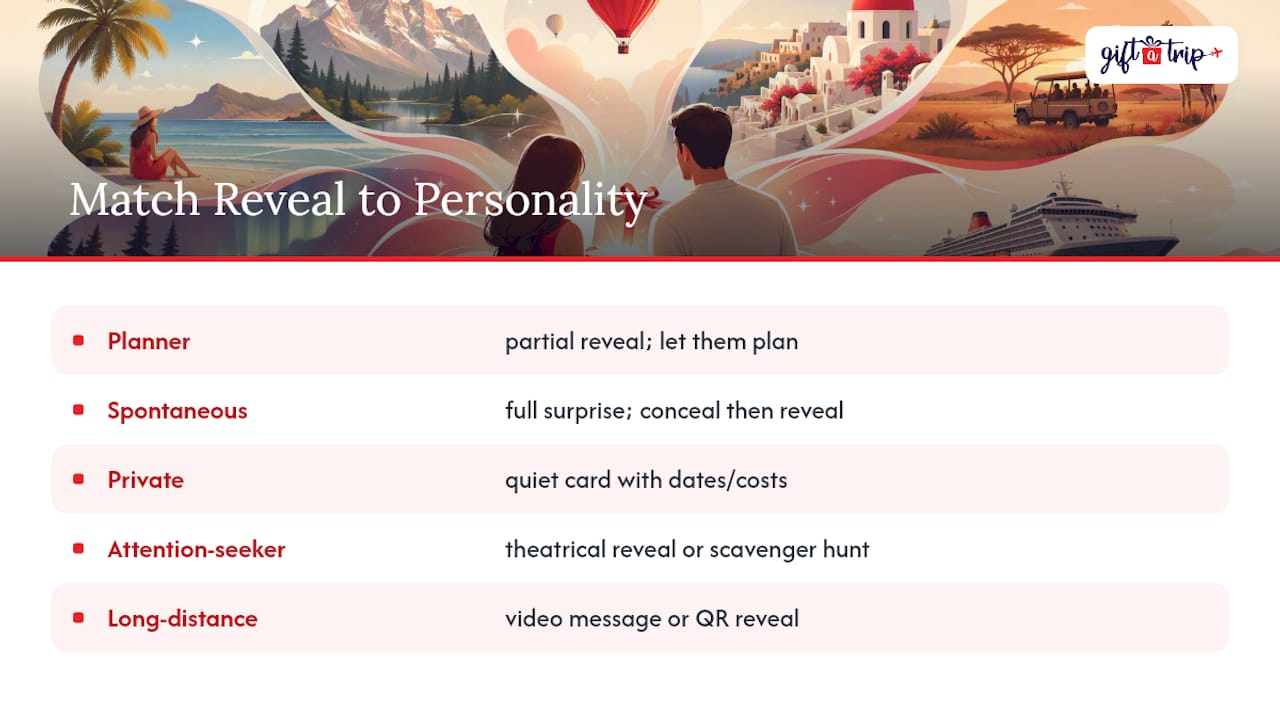
Age and relationship context matter too. Kids respond well to visual countdowns and simple clue trails. Coworkers usually prefer something quick and low-pressure, a card or gift box rather than a scavenger hunt through the office. Long-distance partners might appreciate a video message over a QR code rather than an in-person prop they can’t physically receive.
The safest approach when you’re unsure: ask yourself whether this person would rather be surprised or included. If they’re a planner, loop them in early with a partial reveal and let them help shape the remaining details. If they genuinely love not knowing, go bigger with the concealment and save the full reveal for the actual moment. Matching format to personality matters more than matching format to Pinterest trends.
How Do Surprise Reveals Affect Emotions and Reactions?
Surprise reveals trigger a real emotional spike, part joy, part adrenaline, sometimes a little disorientation. That’s normal, and it’s worth preparing for instead of expecting a clean, movie-ready reaction.
Some people cry. Some people laugh nervously before it registers. Some people ask logistical questions (“wait, when is this?”) before they even process the excitement, which can feel like a letdown if you were expecting an immediate emotional response. None of these reactions mean the gift missed. They mean the brain needs a second to catch up.
Give the recipient space to react in their own way rather than filming for the perfect reaction shot. If they seem overwhelmed rather than thrilled, that’s often anxiety about logistics, work schedules, pet care, cost, not a rejection of the gift itself. Address those practical worries quickly and calmly. “I’ve already cleared it with your manager” or “everything’s paid for, including the resort fees” can turn a stressed reaction into an excited one within minutes.
Also worth knowing: anticipation itself is part of the emotional payoff. If your reveal happens weeks before departure rather than the night before, the recipient gets to enjoy the excitement of looking forward to it, not just the one moment of finding out.
Are There Legal or Ethical Things to Consider Before Surprising Someone With a Trip?
A surprise trip isn’t just a logistics puzzle, it involves a few things worth thinking through before you book anything. Travel insurance is the first thing. If you’re covering the full cost, check whether trip protection covers the recipient even though they didn’t purchase the policy themselves. Some providers require the traveler’s name on the policy from the start, so read the fine print rather than assuming it’s automatically covered.
Consent is the less obvious issue. Surprising someone with a gift is different from surprising them with an obligation. Booking nonrefundable time off work, assuming a partner wants a destination wedding style trip, or planning around a health condition they haven’t disclosed can turn a generous gesture into a stressful one. If there’s any doubt about medical needs, mobility, or work flexibility, a quiet check-in beforehand protects the surprise without ruining it.
There’s also a financial ethics angle. If you’re gifting a trip that requires the recipient to cover any portion, flights, meals, excursions, say so clearly rather than letting them discover it mid-trip. Transparency doesn’t ruin a surprise. It just makes sure nobody feels blindsided by the bill.
A Straight Answer on What Matters Most Here
Most surprise trip content online obsesses over the reveal moment, the balloon pop, the scavenger hunt, the perfectly staged unboxing video, while treating logistics as an afterthought. That ordering is backwards. The reveal is thirty seconds. The trip itself is days or weeks, and it only goes well if dates, documents, and costs were handled properly beforehand.
The conventional advice oversells creativity and undersells transparency. A gorgeous themed gift box means nothing if the recipient later discovers a $200 resort fee wasn’t covered, or finds out the dates conflict with a work deadline you never checked. Prioritize the boring stuff first: confirmed availability, passport validity, disclosed costs. Then spend your creative energy on the presentation.
If you take one thing from this guide, let it be this: secrecy and generosity only work together when the financial and logistical groundwork is solid. A tax-inclusive certificate handles that groundwork for you, which frees you up to actually enjoy planning the fun part.
— Donovan
Why Gift A Trip Makes the Reveal Easier, Not Just the Trip
Once you’ve settled on a reveal style, the certificate you’re gifting should match it. Gift A Trip’s Flex Trip Collections work well for collaborative surprises or recovery situations, since the recipient picks dates later instead of you guessing at their calendar. For an in-person unboxing moment, Red Box Delivery at $69 one-off gives you a sealed, physical box built for exactly the kind of reveal video people share with family. And for something more personal and low-key, individual travel certificates cover resorts, cruises, and vacation packages from major brands without the guesswork of booking specific dates yourself.
Some travel certificates fold taxes and resort fees into the price upfront, so you may avoid disclosing exclusions later or worrying about surprise charges at checkout. Many certificates support a personalized message option, allowing the keepsake card you hand over to carry your own words instead of generic boilerplate. If you’re planning a reveal for a group, the corporate gifting page covers custom trip selection sites and branded box delivery for teams and events.
Ready to pick your reveal format? Browse available certificates and match one to the moment you’re planning.
Sources
A handful of sources are worth bookmarking before you start planning. The Points Guy’s gifting guide covers financial transparency and booking caution in detail. Travel.state.gov’s industry guidance is the most reliable source for passport and document verification tactics. TheLadders’ piece on travel stress explains why digital hygiene matters so much for secret bookings. For destination-specific keepsake ideas, Beaches’ reveal guide and a curated shortlist of family resorts in Tulum offer concrete examples worth borrowing from.
- How to give a surprise trip as a gift – The Points Guy
- What stresses travelers out the most at an airport might surprise you – TheLadders
- How to Gift a Vacation: The Complete Guide to Surprising Someone With a Trip – Experience Divi
FAQ
How Do I Announce a Surprise Trip?
The simplest method is a printed keepsake, a faux boarding pass or itinerary card, handed over once dates and costs are confirmed. Pair it with a short explanation of what’s included so there’s no confusion about fees later.
How Do You Reveal a Surprise Disney Vacation?
A packing list surprise or a countdown calendar with Disney-themed clues works especially well for kids, since it builds excitement over days rather than one moment. Many families also use a themed gift box with ears, a park map, or a character plush hiding the actual reveal card underneath.
What Are Some Creative Ways to Reveal a Trip as a Gift?
Popular formats include a QR code linking to a video message, a scavenger hunt ending in a boarding pass, or a box-in-box reveal for extra suspense. Matching the format to the recipient’s personality matters more than picking the most elaborate option available.
How Do I Announce a Surprise Gift Without Spoiling It?
Book through a separate email account, use incognito browsing, and disable notification sync on any shared devices before you start planning. Watch for shipment tracking alerts too, since a delivery notification on a shared account is one of the most common ways surprises get spoiled early.
What Does Gift A Trip Cost?
Pricing varies by certificate type and destination, and current rates are listed directly on the Gift A Trip site. Red Box Delivery, the physical boxed presentation option, runs $69 as a one-time fee on top of the certificate itself.