Jump to Section:
The highest-impact conference travel prize ideas fall into three buckets: compact kitted travel welcome packs for mass distribution, high-utility tech and drinkware for broad appeal, and flexible prize trips for VIP incentives or grand-prize drawings. Match the category to your budget and audience size before you match it to what looks impressive on a prize table, and you’ll rarely go wrong.
TL;DR:
- Compact travel kits centered on one hero item with three to five supporting pieces are ideal for mass distribution and perceived value.
- Tech accessories like power banks and wireless chargers with at least 20,000 mAh capacity are the most kept prizes but must meet airline safety standards.
- Branded drinkware remains highly retainable, largely because hydration is a daily necessity, ensuring long-term exposure.
- Prize trips should align with the winner’s expectations, include accommodations, airfare, ground transport, and optional excursions, with a clear budget range.
- Digital travel certificates offer a flexible, low-friction alternative to booking trips, making them suitable for sweepstakes, incentives, and recognition programs.
Table of Contents
- What Are the Best Conference Travel Prize Ideas?
- How Do You Structure a Conference Prize Trip?
- How Do You Build a Branded Travel Kit Step by Step?
- What Tech Accessories Work Best as Conference Prizes?
- What Comfort Items Do Attendees Actually Keep?
- How Much Should You Budget, and What’s the Timeline?
- How Do You Choose the Right Prize for Your Attendees?
- The Case for Trips Over T-Shirts
- A Simpler Way to Fulfill Conference Travel Prizes
- Sources
- FAQ
What Are the Best Conference Travel Prize Ideas?
Every strong conference travel prize idea does one of two jobs: it solves a real travel annoyance, or it delivers an experience big enough to justify the hype around winning it. Everything in between tends to get left in a hotel room.
That’s the filter worth applying before you order anything. A branded lanyard solves nothing. A portable charger solves a problem every attendee has felt in a dead-phone panic at gate B14. A three-night trip to a resort solves the much bigger problem of “nobody remembers our incentive program from last year.” The categories below cover both ends of that spectrum, along with the practical details, price bands, and branding calls that separate a prize people keep from one they toss at the airport.
Travel kits and welcome bags. Build these around one hero item, like a packable duffel or a compression cube set, with three to five supporting pieces. This hero-plus-support structure keeps the kit feeling curated rather than random, and it’s the same framework promotional product suppliers recommend for corporate travel kits specifically. Hand these out at check-in or as a hotel room drop for overnight guests.
Tech and charging accessories. Power banks, wireless chargers, and cable organizers rank among the most-kept conference items because they fix a problem attendees hit within hours of arriving. Battery capacity and airline compliance matter more here than branding, which is covered in detail below.
Drinkware. Insulated bottles and tumblers remain one of the top categories for retention going into 2026, according to Merchpath’s roundup of conference swag, largely because hydration is a daily need, not a one-time convenience.
Luggage and ID accessories. Luggage tags, digital luggage scales, and TSA-friendly locks hit a narrow but loyal audience: frequent flyers who actually use gear like this on every trip, not just the one they got it on.
Comfort and wellness items. Sleep masks, earplugs, and electrolyte packets solve the actual misery points of conference travel, jet lag, dry cabin air, and the 6 a.m. wake-up for an 8 a.m. keynote.
Consumables and keepsakes. Snacks, enamel pins, and destination-themed stickers work as low-cost fillers or registration-desk giveaways, not centerpiece prizes.
Prize trips. For your top performers, your raffle grand prize, or your VIP guest list, nothing else on this list competes with an actual trip. More on how to structure one below.
For mass distribution, lean drinkware, tech, and consumables, items that scale to hundreds of attendees without blowing the budget. For VIP hospitality or a keynote speaker gift, skip the tote bag entirely and go toward a prize trip or a premium kit with fewer, better items. Packaging deserves its own line item here too: a kraft box with a printed insert reads as thoughtful; a plastic bag reads as an afterthought, regardless of what’s inside it.
How Do You Structure a Conference Prize Trip?
Prize trips work because they’re aspirational in a way no physical item can match, and they can be built to fit almost any budget. That flexibility is exactly why they’re one of the most versatile travel prize formats marketers reach for when they want a prize people actually talk about after the event.

The principle to hold onto: match the ambition of the trip to your audience’s expectations, not to what sounds good in a planning meeting. A regional sales team competing for a quarterly bonus doesn’t need the same trip as a national award winner at your annual gala.
A well-structured prize trip typically includes:
- Destination choice that fits the winner’s likely preferences, not just what’s cheapest to book
- Accommodation tier clearly defined upfront (3-star convenience vs. 4-star resort experience)
- Trip length, commonly three nights and four days as a baseline format
- Airfare, included rather than left for the winner to book and expense
- Ground transport from airport to hotel, which avoids the awkward “figure it out yourself” gap
- A per-day stipend, often around $100 per person per day, for meals and incidentals
- Optional planned excursions that give the trip a defined itinerary instead of unstructured free time
Budget bands vary widely depending on inclusions, but prize-trip costs most commonly fall within a typical range depending on the trip’s components and length. A weekend getaway sits at the lower end of that range; a bucket-list destination positioned as a grand prize for a loyalty program sits at the top.
Pro Tip: Decide your fulfillment path before you announce the prize, not after someone wins it. Choose either a pre-booked package or a digital travel certificate the winner redeems on their own schedule, and build a cash or voucher fallback into your rules in case travel plans fall through.
Lead time matters more than most planners budget for. Digital travel certificates sidestep most of that pressure since there’s no destination-specific booking to lock in months ahead, while fully pre-booked packages need considerably more runway to secure flights and rooms at reasonable rates.
How Do You Build a Branded Travel Kit Step by Step?
- Decide the use case first. A speaker welcome kit, a VIP hospitality gift, an employee travel kit, and a registration-desk giveaway all call for different budgets and different items, so define which one you’re building before you order anything.
- Pick one hero item. A duffel, a packable jacket, or a quality neck pillow anchors the kit and sets the perceived value for everything packed around it.
- Add three to five supporting items pulled from the categories above, drinkware, a charging cable, a sleep mask, something that rounds out the kit without overstuffing it.
- Decide what gets branded and how. Logo placement on the hero item should be subtle, debossed or tonal rather than a giant print, for a premium feel; smaller supporting items can carry a bolder logo since they read as functional rather than status items.
- Run the procurement checklist: request a physical proof before full production, confirm lead times in writing, order 10 to 15% extra units as a buffer against no-shows and damage, and lock in your assembly and shipping method (in-house packing vs. a fulfillment partner) at least a few weeks out from the event.
Pro Tip: A short printed insert card explaining what’s in the kit and why, “your charger for the flight home, your bottle for the conference floor”, raises the kit’s perceived value more than adding a sixth item would.
What Tech Accessories Work Best as Conference Prizes?
Tech gifts are the highest-retention category on this list, but only when the specs are right. Get the capacity or connector wrong and you’ve spent your budget on something that sits in a drawer.
For power banks, a 5,000 to 10,000 mAh unit works fine for a low-cost mass giveaway, enough for one or two phone charges. A premium prize or VIP kit warrants 20,000 mAh or higher, closer to what a genuinely useful travel charger needs to be.
- Require suppliers to confirm UL or equivalent safety certification on every battery unit before you place a bulk order
- Cap unit capacity to stay within airline carry-on battery limits if a meaningful share of your attendees are flying, and ask your supplier for compliant safety labeling and packaging on each unit
- Stock USB-C, and if your audience skews older devices or mixed platforms, a Lightning cable and a compact multi-plug adapter alongside it
- Consider a branded cable organizer as a supporting item. It’s inexpensive, solves a real tangle problem, and carries a logo well
Battery items also need clear labeling if they’re shipped or checked rather than hand-carried, since airline rules on lithium batteries differ from general cargo rules.
What Comfort Items Do Attendees Actually Keep?
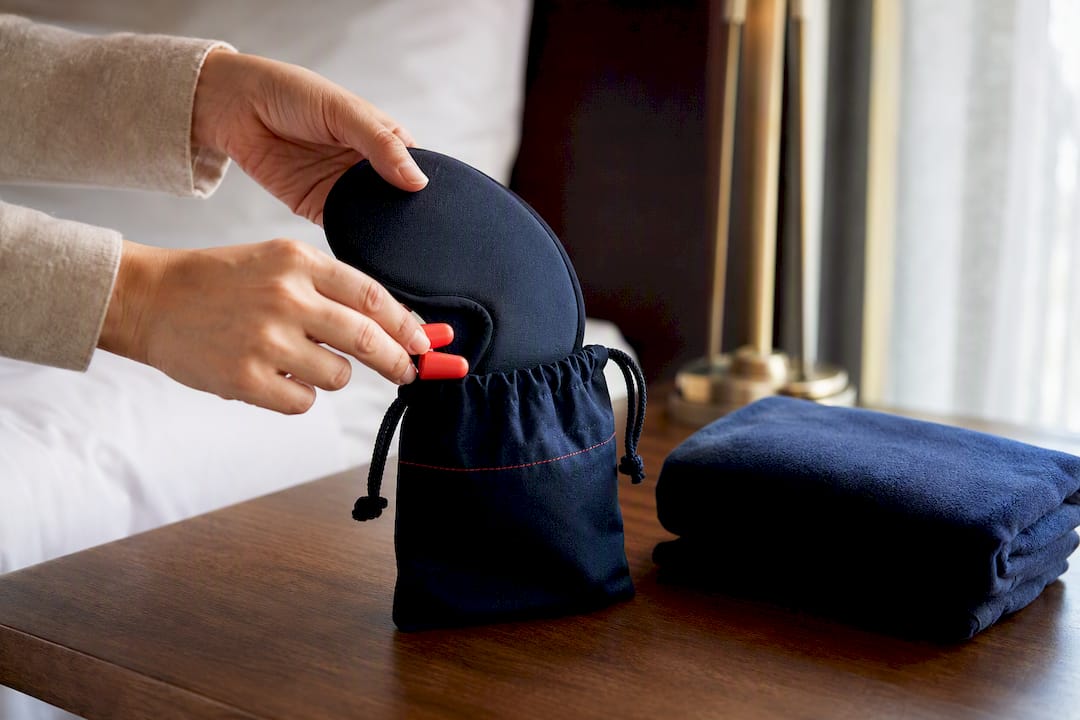
Compact wins here. A microfiber travel towel, a contoured eye mask, foam earplugs, and single-serve electrolyte sachets all pack flat and solve a real discomfort instead of just occupying space in a bag.
Pairing items works better than distributing them loose: an eye mask bundled with earplugs reads as a “sleep kit,” while a travel pillow paired with a compact blanket reads as a deliberate long-haul set rather than two random freebies. Package both pairings in a small drawstring pouch rather than shrink wrap, it survives a suitcase better and looks intentional at unboxing.
One flag worth building into your procurement process: any consumable inclusion, electrolyte packets especially, needs an ingredient and allergen label visible on the item itself, not just on the outer packaging that gets thrown away before the attendee ever eats or drinks it.
How Much Should You Budget, and What’s the Timeline?
Price signals value, whether you intend that or not. A $2 to $5 per-item giveaway reads as a nice-to-have; a $15 to $30 kit reads as a genuine gift; anything built around a prize trip reads as a real incentive program, which is exactly why the travel incentive cost breakdown HR teams use for budgeting treats trips as a separate line item from standard swag.
Lead times deserve equal attention. Most promotional suppliers need a proofing window before full production even starts, and quantity buffers of 10 to 15% above your registration count protect against last-minute sign-ups and damaged units.
One number worth planning around: nearly 80% of people keep a promotional product for over a year when it’s genuinely useful, according to industry data cited by Quality Imprint’s guide to branded travel kits. That retention rate is the whole argument for spending more on fewer, better items instead of spreading a flat budget across everyone equally.
Distribution model matters as much as the item itself:
- On-site handout works for lightweight, low-cost items at registration
- Pre-ship to home or office works for bulky prizes that would be a pain to carry on a flight
- Hotel room drop works for VIP kits tied to an overnight stay
- Digital redemption works best for prize trips and higher-value items, avoiding luggage friction entirely, per swag distribution guidance from Chilli Promotions
How Do You Choose the Right Prize for Your Attendees?
- Match the prize to the event goal. A brand-awareness giveaway calls for cheap, high-volume items; a retention or loyalty award calls for something with real weight, up to and including a prize trip.
- Check logistics fit before you commit. An audience flying in from across the country needs lighter, shippable items rather than bulky handouts they’ll have to check as luggage.
- Confirm compliance up front. Review your sweepstakes and prize rules for legal requirements, build a fulfillment plan with a documented fallback, and decide how you’ll measure whether the prize actually moved the needle on attendance, leads, or retention.
The Case for Trips Over T-Shirts
Physical swag has a shelf life measured in months before it lands in a donation bin. A trip has a shelf life measured in the stories people tell about it for years, which is exactly why it outperforms almost anything you can put a logo on when the goal is genuine engagement or top-tier recognition.
That doesn’t make kits obsolete. A well-built travel kit still earns its spot for mass distribution, speaker gifting, or budget-constrained programs where a trip simply isn’t in reach. The mistake I see most often is planners treating these as competing choices instead of complementary tools, one for everyone in the room, one for the handful of people you actually need to remember your brand.
— Donovan
A Simpler Way to Fulfill Conference Travel Prizes
Booking a prize trip yourself means juggling airline availability, blackout dates, and a winner who might not love the destination you picked for them. Some services remove that friction with digital travel certificates that let the winner choose their own resort, cruise, or vacation package, while your organization handles one simple purchase instead of a multi-vendor booking headache.
The mechanics are straightforward: taxes and resort fees may be included in the certificate value, blackout dates can be minimal, and delivery often happens digitally, so there might be no shipping delay and no physical item for a winner to lose in transit. That makes it a practical fit for sweepstakes prizes, sales incentives, employee recognition, and even charitable auction items, anywhere you need a flexible, high-perceived-value prize without managing the travel logistics yourself.
For event teams ordering at scale, the corporate gifting program covers custom trip selection sites, airfare vouchers in multiple denominations, and custom-branded gift box delivery for bulk orders. If you want winners to pick their own adventure, browse the Flex Trip Collections and get a corporate quote before your next conference date locks in.
Sources
For deeper budgeting numbers, see the travel prize ideas for sales contests breakdown, and this look at business travel convenience on what attendees value most.
- Prize trips: The marketer’s guide to travel prizes for your next promotion
- How to build branded travel kits for conferences
- 25 Best Event & Conference Swag Ideas for 2026 | Merchpath
FAQ
What Are Some Good Ideas for Conference Giveaways?
Insulated drinkware, power banks, and compact comfort items like sleep masks top most retention lists for 2026 events, largely because they solve problems attendees already have. For a bigger swing, a flexible prize trip or travel certificate works well as a grand-prize giveaway rather than a mass handout.
What Are Some Unique Travel Gift Ideas?
A branded travel kit built around one hero item, like a packable duffel, paired with three to five supporting pieces, tends to feel more thoughtful than a bag of random branded items. Digital travel certificates also stand out as a gift, since the recipient chooses their own destination instead of receiving a fixed itinerary.
What Are Some Ideas for Travel Giveaways?
Luggage tags, TSA-friendly locks, and cable organizers work well for frequent flyers, while electrolyte packets and eye masks appeal to a broader audience regardless of travel frequency. For higher-value giveaways, a per-day stipend built into a short prize trip, often around three nights and four days, gives winners a defined, usable experience.
What Are Some Good Conference Giveaways for 2026?
Tech accessories and drinkware remain the top-performing categories going into 2026, since both address needs attendees have every single day at an event. For a standout prize beyond standard swag, corporate teams increasingly turn to travel certificates that cover taxes and resort fees upfront, avoiding the usual booking friction of a traditional prize trip.