Jump to Section:
TL;DR:
- Travel gift certificates can boost charity auction success by generating competitive bidding and memorable experiences. Proper planning involves strategic item sourcing, meticulous documentation, strategic pricing, appealing presentation, and efficient digital fulfillment. Organizations that follow this comprehensive framework build donor trust, maximize revenue, and ensure smooth post-auction delivery.
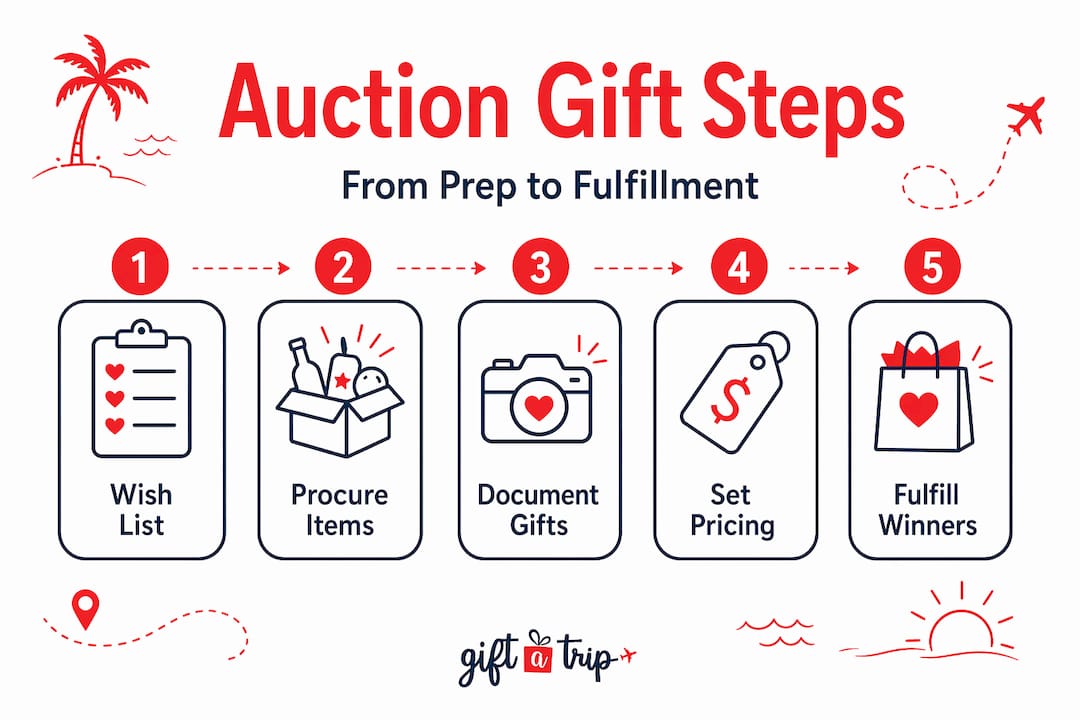
Travel gift certificates can be the difference between a charity auction that limps to its revenue goal and one that generates a bidding war in the final minutes. Yet most fundraising organizers approach the step-by-step charity auction gift certificates process reactively, procuring items late, documenting them poorly, and pricing them in ways that kill momentum before the paddles even go up. This guide changes that. What follows is a proven framework, built specifically for nonprofit event professionals, covering every phase from wish list to winner fulfillment so you can walk into your next auction with confidence and walk out with real results.
Table of Contents
- Understanding the preparation phase: item wish lists and sourcing strategies
- Executing procurement and documentation: securing and tracking travel gift certificates
- Pricing and presenting travel gift certificates for maximum bidding excitement
- Digitally fulfilling travel gift certificates efficiently after auction events
- Operational tips and compliance for smooth charity auction execution
- Why the auction item category matters more than the auction format
- Elevate your next charity auction with Gift A Trip travel certificates
- Frequently asked questions
Key Takeaways
| Point | Details |
|---|---|
| Thorough preparation | Start with a detailed wish list and sourcing plan to target travel gift certificates that fit your audience. |
| Precise documentation | Use procurement packets and in-kind forms to capture all gift certificate details and donor information to avoid confusion. |
| Smart pricing | Set auction starting bids at 30%-40% of retail value to drive competitive donor engagement and maximize revenue. |
| Streamlined fulfillment | Employ digital voucher systems to automate certificate delivery and provide instant clear redemption instructions. |
| Legal compliance | Provide required disclosure statements and IRS-compliant acknowledgments to donors and winning bidders above set thresholds. |
Understanding the preparation phase: item wish lists and sourcing strategies
The single biggest mistake organizers make is treating item procurement as a last-minute task. The best charity auction ideas start months before the event with a structured preparation phase. This is where a thoughtful wish list becomes your most important document.
Building a wish list that actually works
Your wish list should not be a vague collection of “nice to haves.” It should reflect your donor audience’s actual aspirations. Are your attendees young professionals who dream of European city breaks? Retirees who want resort escapes? Families who would bid aggressively on an all-inclusive Caribbean package? Align your travel certificate targets with those profiles. Organizers who procure items with wish lists and structured donation requests consistently secure better items with less scrambling.
Sourcing strategies that reduce dependency on cash purchases
Once the wish list is built, divide sourcing responsibility across your team based on connections. A board member with hotel industry ties handles resort outreach. A volunteer with airline contacts pursues flight upgrades. Prioritize in-kind donations first, then consignment packages. Consignment travel options, like those offered through fundraising travel packages, allow you to offer premium vacation experiences without paying upfront, only settling costs after auction proceeds come in.
Here is a simple framework for structuring your sourcing strategy:
- Assign one team member per category (resort stays, cruise packages, adventure experiences, spa retreats)
- Set a procurement deadline at least six weeks before the event
- Create procurement packets that include a wish list, a donor request letter, and an in-kind donation form
- Follow up within one week of sending any donation request
| Item category | Best sourcing method | Typical lead time |
|---|---|---|
| Resort stays | Consignment platforms | 4 to 6 weeks |
| Cruise packages | Direct corporate outreach | 6 to 8 weeks |
| City hotel nights | In-kind donation request | 2 to 4 weeks |
| Adventure experiences | Local business partnerships | 3 to 5 weeks |
Pro Tip: Review past auction data before finalizing your wish list. Items that generated the most bids or highest final prices tell you exactly what your audience values. Let the data guide your sourcing priorities, not assumptions.
Now that you understand the importance of thoughtful preparation, let’s move on to the practical execution of procuring and documenting your travel gift certificates for the auction.
Executing procurement and documentation: securing and tracking travel gift certificates
Procurement without documentation is just collecting. The real work is capturing every detail in a way that protects your organization legally, supports your catalog creation, and gives your accounting team what they need after the event.
The documentation checklist for every travel gift certificate
When a donor hands over a hotel gift certificate or a resort stay package, you need to record more than “nice vacation, thanks.” Use in-kind donation forms that capture the following for each item. According to procurement best practices, capturing restrictions, values, and donor signatures upfront prevents redemption headaches that surface weeks after the event.
- Item name and detailed description
- Estimated fair market value (provided by donor, not estimated by your team)
- Expiration date and blackout dates
- All usage restrictions (minimum night stays, geographic limits, party size)
- Donor name, organization, and contact information
- Donor signature authorizing use for auction purposes
- Your organization’s receipt of the donation (signed by authorized staff)
Tracking systems that keep your team aligned
A shared spreadsheet works for smaller events. For auctions featuring more than 30 items, consider event management software with built-in catalog functions. Either way, your tracking system should connect item details directly to your catalog descriptions and acknowledgment letters. This eliminates duplicate data entry and reduces the risk of misrepresenting an item on your bid sheet.
| Documentation element | Purpose | Who is responsible |
|---|---|---|
| In-kind donation form | Captures item details and donor signature | Procurement lead |
| Tracking spreadsheet | Links items to catalog and acknowledgments | Event coordinator |
| IRS disclosure language | Protects bidders’ tax deduction accuracy | Finance/legal staff |
| Written acknowledgment | Confirms donor’s tax-deductible contribution | Executive director |
IRS compliance you cannot ignore
The quid pro quo disclosure rules require your organization to provide written statements to winning bidders when their payment exceeds $75, clearly stating that the deductible portion is limited to what they paid above the item’s fair market value. Pre-write this disclosure language before your event and include it on bid sheets, winner receipts, and any post-event communications. Review your hotel gift certificates compliance practices to make sure your processes hold up under scrutiny.
Pro Tip: Create a single master document template that combines the in-kind form, IRS disclosure, and acknowledgment letter fields. One form, filled out once, feeds every downstream process automatically.
With reliable procurement and documentation practices in place, the next step is to focus on pricing and auction presentation strategies to maximize bidding.
Pricing and presenting travel gift certificates for maximum bidding excitement
Pricing is where most charity auction strategies quietly fail. Either the starting bid is too high and the item sits untouched, or it is too low and you leave money on the table. Neither result serves your mission.
The 30 to 40 percent rule
Starting silent auction bids at 30% to 40% of the item’s estimated retail value creates the perception of a genuine deal while leaving enough room for bidders to compete. A $2,000 resort stay package should open at $600 to $800. That price signals real value without intimidating bidders who might otherwise walk past.
Bundling to amplify perceived value
A single night at a hotel feels ordinary. That same night bundled with a spa credit, a restaurant gift card, and a travel tote from a local boutique becomes an experience. Bundle smaller donations or certificates into themed travel packages to justify higher starting bids and create emotional appeal. Vacation gift package best practices consistently show that themed presentation outperforms single-item listings in both bid volume and final price.
Travel’s dominance in charity auctions is not an accident. Travel packages account for over 50% of bids and 66% of total auction revenue in live auctions. No other category comes close. The emotional pull of a vacation, the shared fantasy of sitting on a beach or exploring a foreign city, converts casual browsers into serious bidders.
Presentation tactics that build bidder confidence
- Display estimated retail value prominently on every bid sheet
- Include a short description of the experience, not just the logistics (say “five nights in a beachfront suite with complimentary breakfast” not just “hotel stay”)
- Add a photo of the destination or property to the display
- Note minimal blackout dates and transferability to reduce hesitation
- Consider luxury positioning by exploring elevated travel options that give high-value feel without the full price tag
| Starting bid range | Bidding behavior | Revenue outcome |
|---|---|---|
| Under 30% of retail value | Strong early competition, quick saturation | Moderate revenue, fast close |
| 30% to 40% of retail value | Steady competitive bidding, multiple rounds | Strong revenue, high engagement |
| Over 50% of retail value | Slow opening, fewer initial bids | Risk of unsold item |
Pro Tip: If you want travel experiences to inspire genuine excitement, give your auctioneer a story to tell. Brief them on one compelling detail about each travel package: the view from the room, the signature dish at the resort restaurant, the activity that makes the destination unique. Specificity sells.
Now that pricing strategy and presentation are set, let’s explore the digital fulfillment process that ensures smooth delivery to winners post-auction.
Digitally fulfilling travel gift certificates efficiently after auction events
Winning a bid should feel like a celebration, not the start of a confusing paper chase. Digital fulfillment systems turn what used to be a manual, error-prone process into an experience that reinforces donor satisfaction and organizational credibility.

Building a voucher pool for controlled distribution
A voucher pool is essentially a secured inventory of unique redemption codes tied to specific travel certificates. Each code specifies value, expiration date, and redemption rules. This structure gives you control over your certificate supply while making it easy to allocate specific certificates to specific winners. A digital voucher fulfillment process reduces manual effort and bidder hesitation by automating both delivery and instructions.
Here is how to set up your fulfillment system before the event:
- Create your voucher pool with all certificate details loaded and verified
- Add each travel certificate as a distinct item in your auction management or store system
- Set the system to trigger voucher issuance automatically upon a confirmed winning bid
- Write transactional email templates that include the unique voucher code, step-by-step redemption instructions, expiration date, and a support contact
- Test the system with a dummy transaction at least two weeks before the event
Pro Tip: Send a secondary fulfillment email 48 hours after the auction as a follow-up. Many winners are caught up in the event excitement and do not act on the first email. A friendly reminder with the certificate details re-attached converts more winners into actual travelers, which reflects well on your organization and encourages repeat attendance.
For nonprofits with recurring auction events, corporate travel certificate solutions that support bulk digital delivery can dramatically reduce the administrative burden of fulfillment across multiple events per year.
Having covered fulfillment, the final practical considerations focus on maximizing operational efficiency and legal compliance at your event.
Operational tips and compliance for smooth charity auction execution
The best-planned auction can still stall at check-out if the operational side is not thought through. This section covers the details that separate a smooth event from a frustrating one.
Matching items to your audience
Selecting items aligned with audience interests directly reduces unsold inventory and boosts competitive bidding. A gala for a children’s hospital in the Midwest calls for family-friendly domestic resorts. A black-tie benefit in a coastal city skews toward international travel and luxury hotel stays. Do not offer a ski package to an audience where no one skis. Geographic relevance matters too: certificates redeemable in destinations within a few hours of your attendees’ homes tend to outperform exotic locations that feel logistically complicated.
- Survey attendees or past bidders before finalizing your item list
- Offer a mix of domestic and international options to cover different comfort levels with travel
- Include at least one “bucket list” item to generate buzz and anchor the room’s energy
Streamlining check-in and check-out
Long check-out lines are the enemy of goodwill. Assign dedicated staff to handle travel certificate winners specifically, since those transactions often require more explanation than a simple gift basket pickup. Pre-package winner envelopes with all relevant certificate information before the event begins. Use tablet-based payment systems to eliminate cash handling delays.
Legal disclosures you need at your event
Your organization is required to provide written disclosure when a winning bid exceeds $75, stating clearly that the tax-deductible amount is limited to the bid amount minus the item’s fair market value. This is not optional, and it applies to every travel certificate that sells above that threshold.
Pre-print this disclosure on your bid sheets and winner receipts. The IRS quid pro quo requirements also mean you should never assign a value to an item on a donor acknowledgment letter. Instead, describe the item and note that the donor is responsible for establishing fair market value. Your travel certificate business solutions provider should be able to supply documentation that supports donor valuation.
Pro Tip: Brief all event-night staff on the disclosure requirements before doors open. A volunteer who accidentally tells a winner that their full bid amount is tax-deductible creates a compliance problem your organization will spend months correcting.
Why the auction item category matters more than the auction format
Here is an opinion that may not be popular in every fundraising circle: the format of your auction, live versus silent versus online, matters far less than what you are actually selling. We have seen silent auctions outperform live ones because the items were genuinely desirable. We have seen online-only events generate record revenue because the travel certificates on offer were aspirational, flexible, and easy to understand.
The fundraising community spends enormous energy debating auction formats and bid sheet layouts and mobile bidding platforms. Those conversations are worth having. But they are downstream of the more fundamental question: are you giving your donors something they actually want?
Travel gift certificates answer that question more reliably than almost any other category. They carry universal emotional appeal. They are memorable. They produce stories that donors tell for years, which is exactly the kind of association that builds long-term relationships between supporters and organizations. The organizations that consistently outperform their fundraising goals do not just pick better platforms. They pick better items, document them carefully, price them strategically, and fulfill them in ways that make winners feel like VIPs.
That is the whole game. Everything in this guide is in service of that outcome.
Elevate your next charity auction with Gift A Trip travel certificates
Putting this framework into practice is dramatically easier when your travel certificates are designed specifically for gifting and redemption in high-stakes settings like charity auctions.
Gift A Trip provides digital travel gift certificates redeemable at major resorts, hotels, and cruise lines, with taxes and resort fees covered and minimal blackout dates. For fundraising organizers, that means you get auction items that are easy to document, straightforward to fulfill, and genuinely exciting to win. Whether you need a single premium package or bulk certificates for a recurring auction program, explore our charitable gifting options to find travel experiences your bidders will compete for. You can also browse our vacation raffle fundraiser guide for additional strategies to pair with your auction planning.
Frequently asked questions
What are the key steps to procure travel gift certificates for charity auctions?
Start by creating a detailed wish list, then approach potential donors with structured procurement packets containing donation request letters and in-kind forms. Step-by-step procurement that begins with wish lists and formal requests consistently produces better item quality and smoother documentation than informal outreach.
How should starting bids be set for travel gift certificates in silent auctions?
Set opening bids at 30% to 40% of the item’s estimated retail value to encourage early competition without leaving revenue on the table. Starting bids at this range create genuine perceived value while leaving room for multiple bidding rounds.
What legal disclosures are required for charity auctions involving gift certificates?
Your organization must provide written disclosure to any winning bidder whose payment exceeds $75, clarifying that their deductible contribution equals only the amount paid above the item’s fair market value. The IRS quid pro quo rules make this a firm legal requirement, not a best practice.
How can I efficiently fulfill digital travel gift certificates after the auction?
Build a voucher pool before the event, then set your system to automatically issue unique codes and send redemption instructions by email the moment a winning bid is confirmed. This automated voucher workflow eliminates manual fulfillment errors and delivers a better experience for your winners.