
TL;DR:
- Adding a personal message transforms a travel certificate into a meaningful, emotionally resonant gift that signifies thoughtfulness and genuine engagement. Specific, sincere messages, especially those linked to shared experiences or achievements, increase perceived value and emotional impact, whether in personal or corporate contexts.
A travel certificate becomes a meaningful, emotionally resonant gift the moment a personal message is added to it. Without one, even a luxury resort stay or cruise package reads as transactional. With one, it signals that the giver invested thought, recognized the recipient specifically, and cared enough to say something real. The question of why add personal messages to travel certificates has a clear answer rooted in psychology, organizational research, and the simple human need to feel seen. This article draws on 2026 findings from O.C. Tanner, Workhuman, and MDPI to show exactly how and why personalization transforms a travel gift from a voucher into a memory.
Why personal messages on travel certificates matter more than you think
Personalized messages improve perceived value because they signal specificity and genuine engagement, two factors the brain processes as proof of real human attention. A 2026 MDPI study of 400 e-commerce customers found that perceived specificity had a notably stronger effect on recipient engagement and psychological well-being than general relevance alone. That distinction matters. A message that says “Enjoy your trip” is relevant but not specific. A message that says “You finally get to see the Amalfi Coast you’ve been talking about for three years” is both, and the difference in emotional impact is significant.

Generic personalization, the kind that inserts a name into a template, often backfires. Research from Spokenote highlights that the brain’s trust response reacts to human presence and genuine engagement signals, not data-driven substitutions. When a recipient senses automation, trust drops rather than rises. This is why a handwritten-style note on a Giftatrip travel certificate outperforms a pre-filled template every time.
The practical implication is straightforward. The importance of personal messages lies not in length or eloquence but in specificity. One sentence that names what the recipient did, or references a shared experience, carries more weight than a paragraph of generic praise. That specificity is the mechanism through which a travel certificate with a personal touch becomes something the recipient remembers and talks about.
Pro Tip: Write the message as if you are speaking directly to the person in a quiet moment, not performing for an audience. That shift in mental framing produces more authentic language instantly.
How personal messages influence employee recognition and trust
Personalized recognition in a corporate context produces measurable outcomes that generic awards cannot replicate. The 2026 O.C. Tanner report found that intentional, value-aligned recognition makes employees 21x more likely to invest personally in their work and 8x more likely to trust their organization. Those are not marginal improvements. They represent the difference between a workforce that completes tasks and one that genuinely cares about outcomes.
Workhuman’s 2026 research adds another dimension. Employees recognized specifically for contributing to company goals are 5x more personally invested in company initiatives than those who receive generic recognition. This means the message on a corporate travel certificate is not just a courtesy. It is a strategic communication tool that connects the reward to the reason, reinforcing the behavior the organization wants to see repeated.
The benefits of custom travel certificates in employee recognition programs include:
- Higher trust scores: Employees who receive specific, value-aligned messages report significantly greater organizational trust.
- Stronger personal investment: Recognition tied to a named achievement motivates continued effort far more than a general “thank you.”
- Improved team culture: Visible, specific recognition sets a standard that peers notice and aspire to.
- Reduced disengagement risk: Generic awards can actually lower morale when employees perceive them as performative or automated.
- Alignment with company priorities: Messages that reference goals or values turn a travel reward into a cultural signal, not just a perk.
Organizations using corporate travel reward programs should treat the message field as seriously as the certificate value itself. A $500 resort stay with a specific, sincere note delivers more engagement return than a $1,000 certificate with a blank or template message.
What are best practices for crafting effective personal messages?
Effective personal messages follow a short, specific, and sincere structure. The 2026 O.C. Tanner report emphasizes that 1-2 true specifics outperform longer template-filled notes every time. Authenticity is the goal, and authenticity requires concrete detail, not volume.
For personal occasions, a 2026 CNBC feature on effective short messages advises linking trips to memories or clear intentions rather than stating the occasion generically. “Happy Anniversary” is forgettable. “The trip to Tuscany you planned in 2019 and never got to take” is not. That specificity emotionally anchors the gift and removes the transactional feel entirely.
Here is a practical step-by-step process for writing messages that land:
- Start with the recipient’s name. It signals the message was written for one person, not copied from a template.
- Name the specific achievement or occasion. Reference what they did, reached, or celebrated, not just the category of event.
- Connect the trip to their world. Mention a destination they have mentioned, a goal they have reached, or an experience they have described wanting.
- State your intention clearly. “I wanted you to have this” is more powerful than “Hope you enjoy.”
- Keep it under five sentences. Longer messages dilute impact. Specificity matters more than length.
A note from the Atlanta Journal-Constitution’s 2026 coverage of personal communication reinforces this: short, named messages that include a concrete reason consistently outperform longer autopilot notes in emotional impact. The goal of enhancing travel certificates with personalization is not to write more. It is to write precisely.
How does personalization differ for personal gifts versus corporate awards?
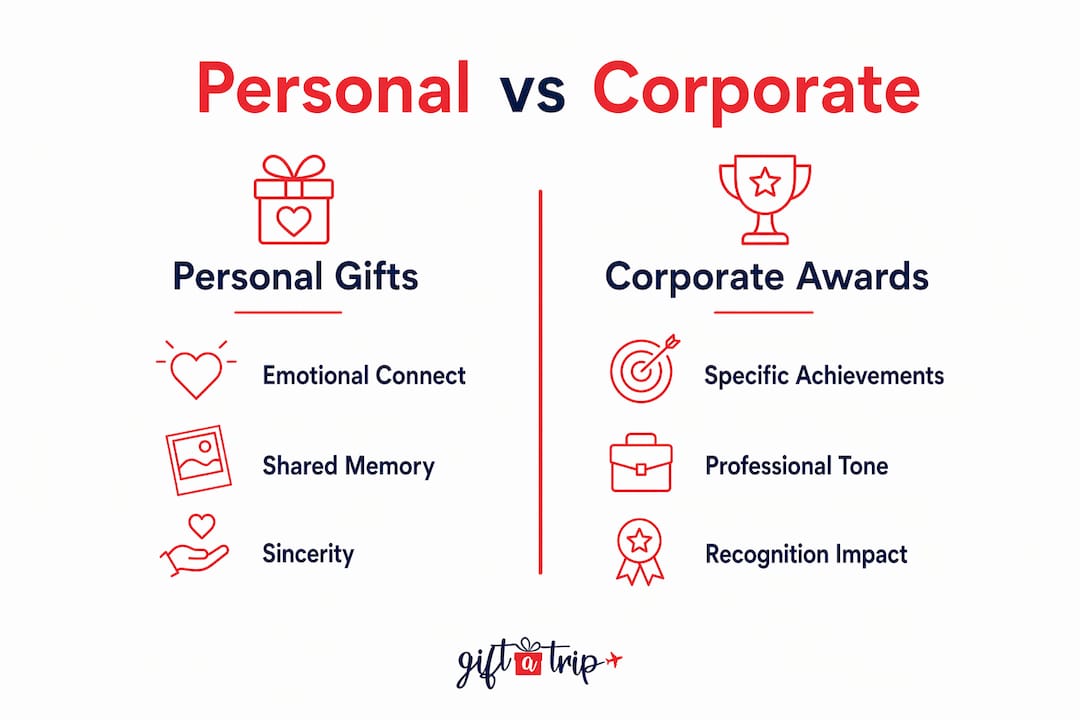
The goal of personalization shifts depending on context, and the message strategy should shift with it. For personal gifts, the priority is emotional connection. For corporate awards, the priority is alignment and recognition of contribution. Both require specificity, but the content, tone, and risks differ meaningfully.
A 2026 MDPI meta-analysis of gratitude letter responses found that some recipients experience discomfort when messages feel overly performative or disproportionate to the relationship. This applies in both personal and corporate contexts. A message that oversells the recipient’s qualities or sounds like a public speech can create awkwardness rather than warmth. Balance and sincerity are the guardrails.
The table below summarizes the key differences between personal and corporate message approaches for travel certificates:
| Dimension | Personal gift messages | Corporate award messages |
|---|---|---|
| Primary goal | Emotional connection and shared memory | Recognition of achievement and value alignment |
| Tone | Warm, intimate, conversational | Sincere, professional, specific to contribution |
| Content focus | Shared experiences, life milestones, personal intentions | Named achievement, company goal, team impact |
| Optimal length | 2-4 sentences | 3-5 sentences with one specific achievement named |
| Key risk | Sounding generic or occasion-only | Sounding automated, templated, or performative |
| Example anchor phrase | “The trip you’ve talked about since our wedding” | “Your work on the Q1 launch made this possible” |
Organizations deploying travel incentive programs at scale should build a message framework that allows managers to customize within a structure, rather than choosing between full templates and blank fields. That middle path produces the specificity that drives engagement without requiring every manager to write from scratch.
Key takeaways
Personal messages transform travel certificates from transactional vouchers into emotionally resonant gifts by signaling specificity, genuine engagement, and recognition that recipients recognize as real.
| Point | Details |
|---|---|
| Specificity drives impact | Messages naming a concrete achievement or shared memory outperform generic notes in emotional response. |
| Corporate recognition multiplies | O.C. Tanner data shows intentional recognition produces 21x higher personal investment and 8x greater trust. |
| Tone and sincerity matter | Overly performative messages can cause discomfort; 1-2 true specifics are more effective than lengthy praise. |
| Personal vs. corporate differ | Personal gifts prioritize emotional connection; corporate awards prioritize achievement alignment and cultural reinforcement. |
| Short and named wins | Messages that include the recipient’s name and a clear, concrete reason consistently outperform longer autopilot notes. |
The message is the gift, not the footnote
I have reviewed hundreds of travel certificate programs over the years, and the pattern is consistent. The certificates people remember are not the most expensive ones. They are the ones where someone took 90 seconds to write something real.
What surprises most organizations is how low the bar actually is. You do not need a copywriter. You need one sentence that names what the person did and one sentence that connects the trip to their world. That is it. The Workhuman and O.C. Tanner data from 2026 confirms what most of us already know intuitively: people want to feel seen, not just rewarded.
The mistake I see most often, especially in corporate programs, is treating the message field as optional or administrative. It is neither. It is the moment where a travel certificate either becomes a meaningful recognition or a branded transaction. The certificate pays for the trip. The message is why the recipient remembers who gave it to them.
For personal occasions, the same principle applies with even less pressure. You already know the person. You already know the trip they have been dreaming about. Write that down. That is the whole job.
— Donovan
How Giftatrip makes personalized travel certificates easy
Giftatrip offers travel certificates designed for exactly this kind of thoughtful gifting, whether you are recognizing a top performer, celebrating an anniversary, or rewarding a loyal customer.
Every certificate on the platform supports custom messaging at checkout, so you can add the specific, sincere note that makes the difference between a voucher and a gift. Certificates are redeemable at resorts, hotels, and cruise lines including Virgin Voyages cruise certificates, with taxes and resort fees covered and minimal blackout dates. Corporate clients can order in bulk with customizable gift boxes and message options built in. Browse the full range of travel gift certificates and find the right fit for your occasion or recognition program today.
FAQ
Why do personal messages increase the value of travel certificates?
Personal messages signal genuine engagement and specificity, which the brain processes as proof of real human attention. A 2026 MDPI study found that perceived specificity has a stronger effect on recipient well-being than general relevance alone.
How long should a personal message on a travel certificate be?
Two to five sentences is the optimal range. The 2026 O.C. Tanner report confirms that 1-2 true specifics outperform longer template-filled notes, and shorter messages with a named reason consistently land better than lengthy generic praise.
What is the difference between personal and corporate travel certificate messages?
Personal messages prioritize emotional connection and shared memories, while corporate messages should name a specific achievement and connect it to company values or goals. Both require sincerity and specificity to avoid feeling automated or performative.
Can a generic message on a travel certificate hurt engagement?
Yes. Research from O.C. Tanner shows that generic recognition reduces thriving odds and can lower trust rather than build it. Employees and recipients who sense a template message often feel less valued than those who receive no message at all.
What should I include in a personal message for a travel gift?
Include the recipient’s name, a specific reason for the gift, and a reference to the trip or destination that connects to their life. A 2026 CNBC feature confirms that linking the gift to a shared memory or stated intention removes the transactional feel and creates lasting emotional impact.