Jump to Section:
TL;DR:
- Employee recognition gifting involves giving thoughtful, tangible gifts at meaningful moments to foster emotional connections. Structured programs, aligned with specific occasions and personalized models, outperform ad hoc approaches in driving engagement and retention. Effective programs measure success through engagement, retention, and redemption rates, emphasizing consistency and personalization.
Employee recognition gifting is the intentional practice of giving thoughtful, tangible gifts to employees at meaningful moments, such as onboarding, work anniversaries, project completions, and holidays, to create lasting emotional connections and reinforce appreciation. Unlike verbal praise or performance bonuses, gifting produces a physical, memorable experience that employees associate with genuine acknowledgment. Platforms like Snappy and Kudos have formalized this practice into what the industry now calls “gift-led recognition,” a structured approach embedded across the entire employee lifecycle. In 2026, HR professionals and business managers are moving beyond ad hoc gift-giving toward scalable programs that tie directly to engagement, retention, and culture outcomes.
What is employee recognition gifting and why does it matter?
Employee recognition gifting is one distinct form within the broader recognition toolkit, and gifting creates lasting memories that verbal praise alone cannot replicate. The industry term for this practice is “gift-led recognition,” which signals that the gift itself is the primary vehicle for communicating appreciation, not a secondary add-on to a verbal acknowledgment or a cash reward.

The distinction matters because different recognition methods serve different psychological needs. A public shout-out in a team meeting satisfies the need for social visibility. A year-end bonus addresses financial motivation. A well-chosen gift, delivered at the right moment, creates an emotional anchor. Employees remember how a gift made them feel, and that memory reinforces their connection to the organization long after the moment has passed.
For HR professionals, understanding this distinction is the foundation for building programs that actually move the needle on morale and retention. Gifting is not a replacement for compensation or career development. It is a complementary layer that signals, “We see you as a person, not just a resource.” That signal, delivered consistently and thoughtfully, compounds over time into measurable cultural outcomes.
What occasions and moments are ideal for employee recognition gifting?
Timing is the single most important variable in gift-led recognition. A gift delivered at the right moment amplifies its emotional impact significantly. The most effective programs define a clear set of recognition occasions in advance, so managers are never improvising and employees receive consistent treatment across the organization.
The most common and highest-impact occasions include:
- Onboarding: A welcome gift on day one sets the tone for the employee relationship and signals that the company invests in people from the start.
- Work anniversaries: Marking one, three, five, and ten-year milestones reinforces loyalty and communicates that tenure is valued.
- Project completions: Recognizing the end of a demanding project, especially one that required extra effort, prevents burnout and motivates future performance.
- Holidays and seasonal moments: Year-end gifts are the most common, but summer or back-to-school moments also work well for teams with families.
- Birthdays: A personal touch that costs little but signals individual awareness.
- Spot recognition: Unscheduled gifts for exceptional contributions in the moment. These carry high emotional weight precisely because they are unexpected.
Inclusivity matters when selecting occasions. Not every employee celebrates the same holidays, and a program that defaults to Christmas-only gifting excludes a meaningful portion of most workforces. Building a calendar that includes secular milestones, such as work anniversaries and project completions, creates a more equitable foundation.
Pro Tip: Align your gifting calendar with your company values. If innovation is a core value, create a specific recognition moment for employees who pitch and implement new ideas. The occasion itself becomes a cultural signal.
The difference between routine rewards and strategic recognition is intentionality. A gift given because “it’s that time of year” carries far less weight than one tied to a specific, named achievement. Gifting programs that integrate recognition moments with clear value limits and approved formats consistently outperform ad hoc approaches.
How does employee recognition gifting differ from other types of recognition?
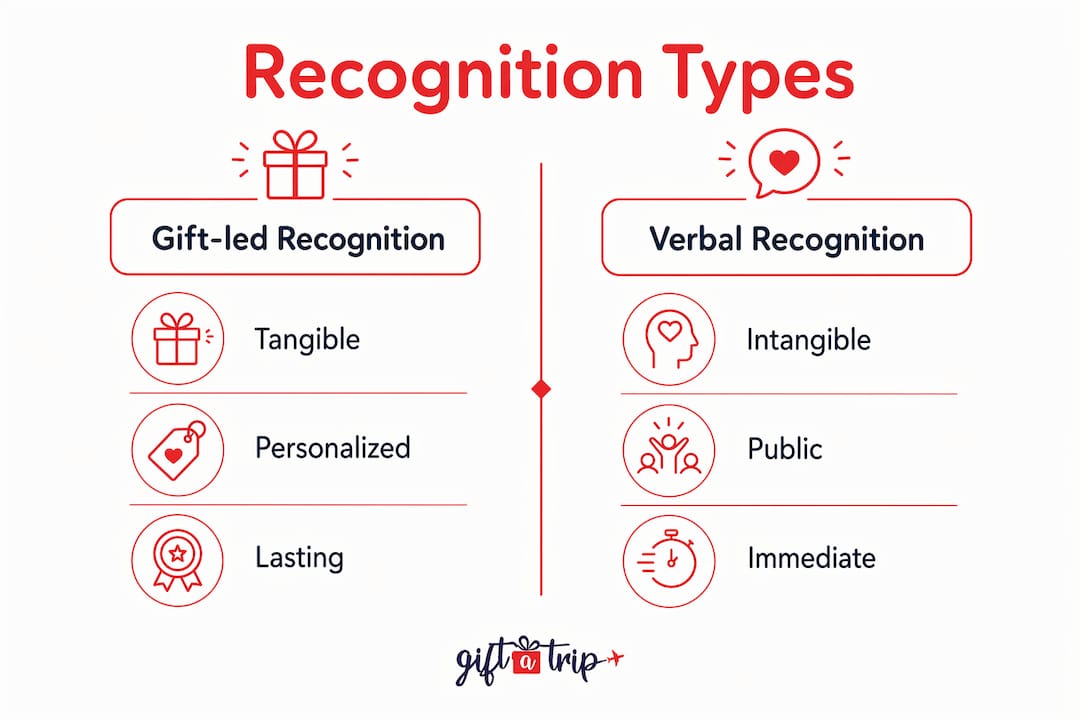
Gift-led recognition occupies a unique position in the recognition spectrum because it combines tangibility, personalization, and emotional resonance in a way that other methods cannot replicate on their own. The table below maps the key differences:
| Recognition type | Tangible | Personalized | Lasting impact | Best use case |
|---|---|---|---|---|
| Verbal praise | No | Moderate | Low | Daily reinforcement |
| Public acknowledgment | No | Low | Moderate | Team visibility |
| Performance bonus | No | Low | Moderate | Financial motivation |
| Award or trophy | Yes | Low | Moderate | Formal milestones |
| Employee gift | Yes | High | High | Emotional connection |
| Peer recognition | No | Moderate | Low | Culture building |
The table reveals a clear pattern. Gifts are the only recognition method that scores high on both tangibility and personalization simultaneously. A meaningful gift feels personal and relevant to the individual employee, which is what separates it from a generic award or a cash equivalent.
Verbal recognition and gifting are most powerful when used together. A manager who presents a gift while articulating exactly why the employee earned it creates a multi-sensory recognition moment that is far more memorable than either element alone. The gift becomes a physical reminder of the words spoken.
Pro Tip: Never send a gift without a personalized note. The note is what transforms a transaction into a recognition moment. Even two sentences explaining the specific reason for the gift doubles its emotional impact.
The behavioral influence of gifting extends beyond the recipient. When employees see colleagues receive thoughtful gifts for specific contributions, it signals to the entire team what behaviors the organization values. That visibility makes gifting a culture-shaping tool, not just a morale booster.
How to build an effective employee recognition gifting program
Building a gift-led recognition program that scales across a distributed workforce requires structure, not just good intentions. The most effective programs follow a defined architecture that covers occasions, budgets, formats, and execution guidelines.
Step 1: Define your recognition moments
Map the employee lifecycle and identify every natural gifting occasion. Onboarding, six-month check-ins, annual anniversaries, project completions, and departures are the baseline. Add company-specific moments that reflect your culture and values.
Step 2: Set budget guardrails
Establish per-occasion gift value ranges. Consistency prevents the perception of favoritism. Clear guidelines for gifting occasions and approved gift values minimize unfairness and improve program integrity across departments.
Step 3: Choose a gifting model
Two primary models exist. The curated model means HR selects specific gifts for each occasion. The recipient-choice model means employees select from a curated collection. Recipient-choice gifting balances personalization and operational ease, and it is especially effective for distributed and hybrid teams where shipping logistics vary by location.
Step 4: Address tax and compliance requirements
Tax treatment of employee gifts varies by jurisdiction. In the UK, the trivial benefits allowance permits tax-exempt gifts under £50, provided the gift is not cash, not a cash voucher, and not linked to performance. Mixing gifts with compensation or tying them to performance targets can jeopardize tax-exempt status under frameworks like the UK trivial benefits allowance, creating unintended tax liabilities. US-based programs should consult IRS de minimis fringe benefit rules for equivalent guidance.
Step 5: Empower managers with tools and training
Managers are the execution layer of any gifting program. Provide them with a simple platform, a clear occasion calendar, and pre-approved gift options. Platforms like Snappy and Huggg automate delivery and tracking, reducing administrative burden while maintaining a personal touch. For a practical framework on program setup, the gifting program guide for HR from Giftatrip covers the operational details in depth.
What are popular and effective employee gifts in 2026?
Gift trends in 2026 reflect a clear shift away from generic branded merchandise toward personalized, experience-driven rewards. Popular employee gifts in 2026 include curated baskets, tech accessories, wellness items, experiential rewards, and travel-related gift certificates. Each category serves a different recognition context.
- Experiential gifts and travel certificates: The highest-impact category for milestone recognition. A travel certificate from a platform like Giftatrip gives employees the freedom to choose their own experience, which dramatically increases perceived value compared to a physical item of equivalent cost.
- Tech accessories: Wireless chargers, noise-canceling earbuds, and ergonomic desk tools resonate strongly with remote and hybrid employees who spend significant time at home workstations.
- Wellness items: Subscriptions to meditation apps, fitness gear, or spa vouchers align with growing employee expectations around mental health support.
- Curated gift baskets: High-quality, unbranded items in a themed basket outperform cheap company swag. The quality over branding principle is one of the most consistent findings in employee gifting research.
- Gift certificates for hospitality experiences: Options like wine tours or curated dining experiences, such as those available through partners like Monticello Wine Tour, work well for teams in hospitality-adjacent industries.
For hybrid and remote teams, digital delivery is non-negotiable. Physical gifts that require office delivery exclude remote employees by default. Recipient-choice programs for distributed teams solve this by letting employees select and receive gifts on their own schedule, regardless of location.
The rise of travel vouchers as premium recognition gifts reflects a broader shift in what employees value. Experiences generate stronger memories and emotional associations than objects, which makes them particularly effective for high-stakes recognition moments like five-year anniversaries or exceptional performance awards.
How to measure the ROI of your employee gifting program
Gifting as a strategic recognition method produces measurable business outcomes tied to engagement, retention, and workplace culture. Measuring those outcomes requires a combination of quantitative metrics and qualitative feedback.
The most reliable indicators of program effectiveness include:
- Employee engagement scores: Track changes in engagement survey results before and after program implementation. Segment by department or tenure to identify where gifting has the greatest impact.
- Retention rates: Compare voluntary turnover rates for employees who received consistent recognition gifts versus those who did not. Even a one or two percentage point improvement in retention represents significant cost savings given average replacement costs.
- Morale and satisfaction surveys: Pulse surveys conducted within two weeks of a gifting moment capture immediate emotional response and provide qualitative data on gift relevance.
- Manager participation rates: A program that managers ignore is a program that fails. Track the percentage of eligible recognition moments that result in a gift being sent.
- Gift redemption rates: For recipient-choice programs, redemption rates indicate whether employees find the gift options appealing and relevant.
The qualitative layer matters as much as the numbers. Anecdotal feedback from employees who describe a specific gift as meaningful provides the kind of narrative evidence that justifies continued investment to leadership. Collect these stories systematically through exit interviews, engagement surveys, and manager one-on-ones. For deeper insight into how gifting connects to motivation metrics, the gifting and employee motivation guide from Giftatrip provides a practical framework for 2026.
Key takeaways
Gift-led recognition is a measurable, scalable strategy that drives engagement and retention when built on defined occasions, consistent budgets, and recipient-centered personalization.
| Point | Details |
|---|---|
| Define recognition moments | Map the employee lifecycle and set specific gifting occasions to prevent ad hoc, inconsistent recognition. |
| Use recipient-choice models | Let employees select from curated options to increase personalization and reduce logistics complexity for hybrid teams. |
| Prioritize experience over swag | Travel certificates, wellness items, and experiential gifts outperform generic branded merchandise in emotional impact. |
| Set budget guardrails | Consistent gift value ranges prevent perceptions of favoritism and support tax compliance in relevant jurisdictions. |
| Measure what matters | Track engagement scores, retention rates, and redemption rates to quantify program ROI and refine over time. |
Why gifting programs fail more often than HR admits
I have reviewed dozens of employee recognition programs over the years, and the most common failure mode is not a lack of budget. It is a lack of structure. Companies launch gifting initiatives with genuine enthusiasm, buy a batch of branded mugs or generic gift cards, and then wonder why engagement scores barely move.
The uncomfortable truth is that most gifting programs fail because they treat gifts as transactions rather than communications. A gift is a message. It says, “I noticed what you did, I know who you are, and I want you to feel that.” When the gift is generic, the message is generic. When the message is generic, the emotional impact is zero.
The second mistake I see consistently is tying gifts to performance metrics. This collapses the distinction between a bonus and a gift, and it creates exactly the wrong dynamic. Gifts should feel like appreciation, not compensation. The moment an employee starts calculating whether their output “earned” a gift, you have lost the recognition effect entirely.
The programs that work are the ones where a manager can send a thoughtful gift in under five minutes, because the platform, the occasion, and the budget are already defined. Operational friction is the silent killer of recognition culture. Remove it, and managers will actually use the program.
My recommendation for 2026: start with three occasions, one budget tier, and a recipient-choice model. Measure for six months. Then expand. Complexity is the enemy of consistency, and consistency is what builds culture.
— Donovan
Reward your team with travel they will never forget
Travel certificates are among the most memorable and flexible employee recognition gifts available in 2026, and Giftatrip makes them easy to deploy at scale. Whether you are recognizing a five-year anniversary, rewarding a high-performing team, or building out a structured gifting program, Giftatrip’s digital travel certificates cover resorts, hotels, and cruise lines from major brands, with taxes and resort fees included. Employees choose their own experience, which means the gift feels personal every time. For a premium recognition moment, explore Virgin Voyages cruise certificates or browse the full range of travel vouchers for corporate rewards to find the right fit for your team.
FAQ
What is employee recognition gifting?
Employee recognition gifting is the practice of giving thoughtful, tangible gifts to employees at meaningful moments, such as onboarding, anniversaries, and project completions, to reinforce appreciation and build emotional connection. The industry term for structured programs is “gift-led recognition.”
How is gifting different from a performance bonus?
A performance bonus is compensation tied to output. A recognition gift is an appreciation signal tied to a moment or behavior, and it works best when it feels personal rather than transactional. Mixing gifts with performance targets can also create tax compliance issues in some jurisdictions.
What are the most popular employee gifts in 2026?
The top categories in 2026 are experiential gifts and travel certificates, tech accessories, wellness items, and curated gift baskets. Experiences and recipient-choice options consistently outperform generic branded merchandise in employee satisfaction.
How do you measure the success of a gifting program?
Track employee engagement scores, voluntary retention rates, manager participation rates, and gift redemption rates. Supplement quantitative data with pulse surveys and qualitative feedback collected within two weeks of each gifting moment.
How much should companies spend on employee recognition gifts?
Budget ranges vary by occasion and company size, but consistency across the organization matters more than the specific amount. Clear per-occasion value guidelines prevent favoritism and support tax compliance, particularly under frameworks like the UK trivial benefits allowance.