
Jump to Section:
Most cruise gift cards cannot pay taxes, port fees, gratuities, or casino charges, and many require redemption before a set pre-sail deadline to count as onboard credit instead of just fare payment. Before you buy one, verify exactly what your recipient’s cruise line allows the card to cover and how far in advance it needs to be activated.
That single check prevents the most common gift-card complaint: a recipient who boards expecting a spending balance, only to find the card only applied toward the fare, or worse, sat unactivated because it arrived too close to sail date.
Here’s what to confirm before you check out:
- Currency: Nearly all cruise gift cards are sold in U.S. dollars only, with no foreign-currency versions.
- Activation window: Some lines require the card be applied to a booking roughly 10 business days before departure to function as onboard credit.
- Refund policy: Cruise gift cards are typically nonrefundable and cannot be exchanged for cash.
- Blocked charges: Expect exclusions on government taxes, port fees, gratuities, and casino play on most lines.
- Residency limits: Several lines restrict purchase and shipping to U.S. and Canadian addresses.
- Reload rules: Most cards are one-time use and cannot be topped up once the balance runs out.
Key Takeaways
Cruise gift card restrictions center on three things: what charges are excluded, how far ahead the card must be activated, and whether the purchase is refundable once bought.
| Point | Details |
|---|---|
| Blocked charges are standard | Most cards exclude taxes, port fees, gratuities, and casino play across major lines. |
| Timing determines usability | Some lines require redemption roughly 10 business days pre-sail to count as onboard credit. |
| Line policies vary widely | Carnival, Princess, and Royal Caribbean each apply different residency, refund, and redemption rules. |
| Purchases are usually final | Cruise gift cards are typically nonrefundable and not reloadable once bought. |
| Certificates reduce friction | Giftatrip’s travel certificates skip pre-sail activation deadlines and often include taxes and fees upfront. |
Table of Contents
- What Are the Most Common Cruise Gift Card Restrictions?
- How Do Gift Cards Turn Into Onboard Credit?
- Do Carnival, Princess, and Royal Caribbean Handle Gift Cards Differently?
- What Purchase and Payment Limits Should You Expect?
- What Should You Verify Before You Buy a Cruise Gift Card?
- Cruise Gift Card Restrictions: What Gift Givers Must Check
- A Simpler Way to Gift a Cruise Without the Fine Print
- Where to Verify Cruise Gift Card Policies
- Sources
- FAQ
What Are the Most Common Cruise Gift Card Restrictions?
Every major line treats gift cards a little differently, but the pattern repeats often enough to call it standard practice. Cards generally cover cruise fare, some onboard purchases, and prepaid extras like drink packages or Wi-Fi. They usually stop short of covering government taxes and port fees, gratuities, and casino chips, according to aggregated reporting from The Points Guy.
A few other patterns show up across nearly every line’s fine print:
- Gift cards are rarely issued with the recipient’s name printed on them, which makes them easy to hand off as a gift but also easy to lose track of if misplaced.
- Transferability exists in a loose sense (anyone holding the card number can typically redeem it), but the cruise line’s own terms govern whether that’s officially allowed.
- Denominations are usually fixed or sold in set increments rather than any custom dollar amount.
- Casino credit and spa treatments are the two categories most likely to get flagged as ineligible, even when the rest of the card works fine.
Pro Tip: If your recipient’s sail date is under two weeks away, call the cruise line’s gift services line before buying. Many lines enforce a roughly 10-business-day pre-apply rule to convert a gift card into usable onboard credit, and missing that window means the card may only apply to future bookings, not the trip your recipient already has planned.
How Do Gift Cards Turn Into Onboard Credit?
There are two ways a gift card gets used, and mixing them up is where most problems start. The first is redeeming the card before final payment, applying its value directly to the cruise fare or a prepaid package like a drink plan or excursion. The second is walking up to guest services once onboard and adding the card’s value to a ship account.

Carnival’s Sail & Sign account is the clearest example of the second path. It functions as the ship’s cashless payment system for the entire voyage, and Carnival explains that personalized Sail & Sign cards work immediately upon boarding. Guests can fund the account with Visa, MasterCard, Discover, American Express, and select gift-card products, though Carnival maintains a list of card types it won’t accept and warns that bank authorization holds can delay when funds actually post.
That timing gap trips people up more than any actual policy restriction. A gift card that works fine at checkout can still sit in limbo for a day or two while a bank hold clears, which matters if your recipient is trying to use it the morning they board.
- Redeeming before final payment: applies the value toward fare or prepaid extras, subject to the line’s pre-sail deadline.
- Redeeming onboard: adds funds to the ship account via guest services or a kiosk, generally usable right away once the hold clears.
- Some gift-card brands and prepaid travel-fund cards get flagged as unacceptable, so a card that works everywhere else might not open a ship account.
Pro Tip: To sidestep authorization holds entirely, activate the gift card and load it onto the booking at least a few days before sailing rather than waiting until embarkation morning. A hold that would only cost you an hour at home can eat into your first day at sea.
Do Carnival, Princess, and Royal Caribbean Handle Gift Cards Differently?
Yes, and the differences are specific enough to matter if you already know which line your recipient sails.
Carnival runs everything through Sail & Sign, and its accepted-payment list covers most major gift-card brands alongside standard credit cards. One quirk worth knowing: Carnival sometimes issues refunds, for a canceled excursion or an onboard credit balance, as a new Carnival Gift Card rather than a cash refund to the original payment method.
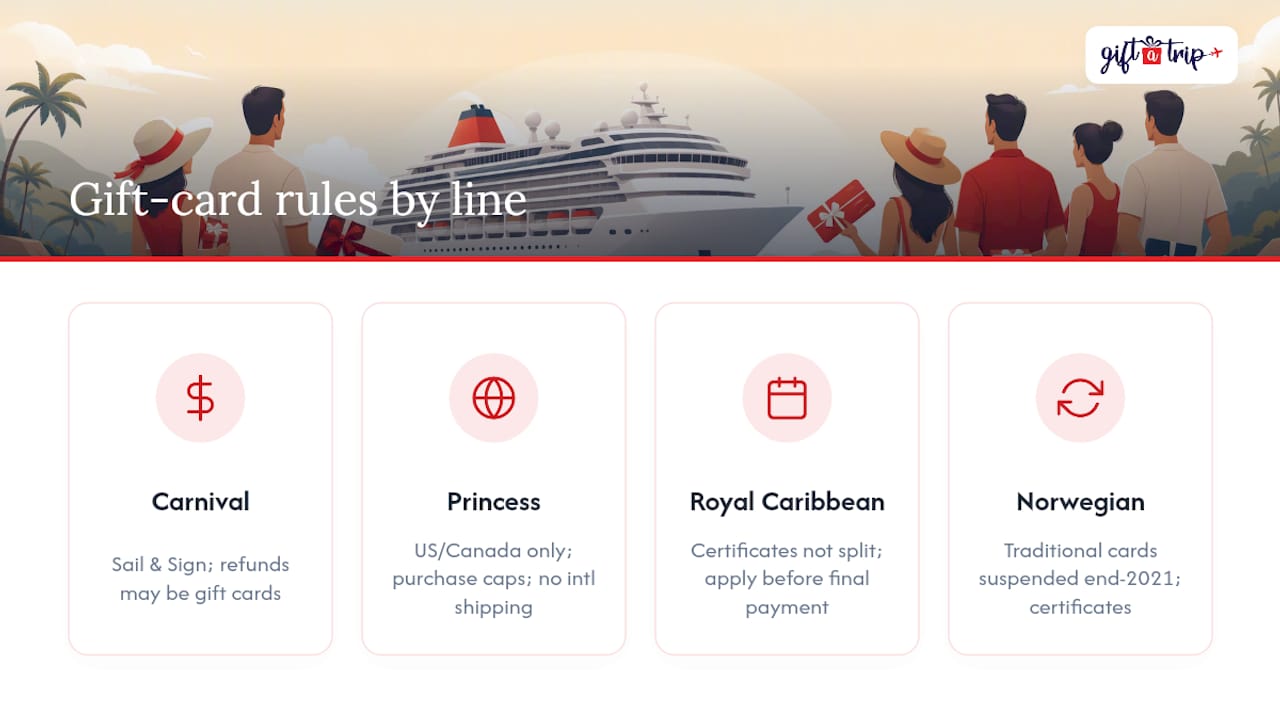
Princess Cruises limits gift card purchase and shipping to U.S. and Canada residents in most cases, and enforces purchase caps along with restrictions on shipping physical cards internationally. If your recipient lives outside those two countries, a Princess gift card may not be the right pick at all.
Royal Caribbean treats its certificates more like fare vouchers than flexible spending cards. Certificates redeem toward new reservations quoted in USD, generally can’t be split across multiple bookings or partially redeemed, and often must be applied before the final payment deadline to function as onboard credit rather than just a fare discount, according to Royal Caribbean’s own gift card program page. Miss that window and the certificate may only reduce what’s owed on the cruise fare, with no leftover balance to spend once aboard.
Norwegian Cruise Line suspended its traditional gift-card program at the end of 2021. NCL’s current gift card terms describe dormancy fees after periods of inactivity, replacement fees for lost cards, and confirm funds aren’t redeemable for cash, but new purchases now generally route through onboard credit or certificate alternatives instead of the old card format.
The variation across these four lines is exactly why checking the specific line’s official policy page beats relying on general gift-card assumptions. What’s true for Carnival often isn’t true for Royal Caribbean, and a Princess residency limit won’t show up anywhere in Carnival’s terms.
What Purchase and Payment Limits Should You Expect?
Buying the card comes with its own set of rules, separate from how the recipient eventually uses it.
Coverage from Cruise notes that several lines cap online gift-card purchases at an aggregate limit around $10,000, alongside per-transaction restrictions and denomination increments rather than open custom amounts. That ceiling rarely affects an individual buying a single card for a birthday or anniversary, but it matters for corporate buyers purchasing in bulk for an incentive program.
Payment method acceptance varies more than people expect. Visa and MasterCard-branded gift cards are frequently accepted as a funding source, while some travel-fund products and certain American Express gift card formats get rejected outright, per Carnival’s own list of acceptable card types. Shipping adds another layer: physical cards are often limited to U.S. and Canadian addresses, and residency restrictions can block purchase entirely for international buyers.
Refund policy is the least forgiving part of the whole system. Once purchased, cruise gift cards are typically nonrefundable and cannot be reloaded, so a card bought for a trip that later gets canceled usually can’t be converted back to cash.
Many cruise lines cap online gift-card purchases at roughly $10,000 in aggregate value, a limit that rarely touches individual gift buyers but matters for anyone purchasing in volume.
What Should You Verify Before You Buy a Cruise Gift Card?
Run through this list before checkout, ideally with the cruise line’s gift-card page or customer service line open in another tab.
- Confirm accepted uses. Ask directly whether the card covers fare only, or fare plus onboard spending, gratuities, and excursions.
- Check the activation timing. Find out if the card needs to be applied a set number of business days before sailing, or if it can be added once onboard.
- Verify acceptable payment types. If you’re funding the purchase with another gift card, confirm the cruise line’s system will accept that specific brand.
- Check residency and shipping limits. Confirm the recipient’s address qualifies if you’re sending a physical card rather than a digital one.
- Review refund and expiration policy. Ask what happens if the trip gets canceled or rescheduled, and whether dormancy fees apply after a period of inactivity.
- Confirm transferability rules. Most cards aren’t tied to a name, but some lines restrict resale or third-party redemption in their terms.
- Know how to check the balance. Save the balance-check phone number or online portal link somewhere the recipient will actually find it.
When policy language is vague or contradictory across a line’s own pages, two questions are worth a phone call rather than a guess: exactly when the card needs to be activated relative to the sail date, and how refunds get processed if the cruise itself is canceled or rescheduled.
Pro Tip: Buying in bulk for a corporate incentive program or group gift? Confirm the daily purchase cap with the line directly, and ask whether recipient names or booking numbers need to be submitted at purchase, some corporate orders require that information upfront to avoid processing delays.
If timing rules and pre-sail deadlines feel like too much to manage on someone else’s behalf, a cruise certificate built without those activation windows solves the problem before it starts.
Cruise Gift Card Restrictions: What Gift Givers Must Check
Most advice on this topic treats cruise gift cards like generic retail gift cards, buy one, hand it over, done. That framing misses the actual failure point. The restrictions themselves (blocked taxes, blocked casino play, USD-only pricing) are annoying but predictable. The real risk is timing: a card bought two weeks before sailing that needed 10 business days to activate, or a Royal Caribbean certificate that missed the final payment deadline and became fare credit instead of spending money.
Conventional gift-buying wisdom says “check the balance and the expiration date.” That’s necessary but not sufficient here. The bigger question is whether the card can even function the way the recipient expects it to, given when they’re sailing and which line they booked. A card that’s perfectly valid on paper can still disappoint someone if it arrives too late to activate properly.
If there’s one thing gift givers should prioritize first, it’s calling or checking the specific line’s policy page before purchase, not after. Every line writes its own rules, and the assumption that “gift cards all work about the same” is exactly the assumption that leads to a recipient standing at guest services confused about why their card only covers fare.
A Simpler Way to Gift a Cruise Without the Fine Print
Giftatrip sidesteps most of what makes cruise gift cards frustrating to give. Instead of a card with a pre-sail activation deadline and a list of blocked charges, Giftatrip’s travel certificates are delivered securely and digitally, priced in U.S. dollars, and built to cover more of the trip upfront, including taxes and resort fees on many packages, so your recipient isn’t stuck figuring out what’s excluded after they’ve already booked.

That matters most for the exact pain points covered above: no 10-business-day countdown to worry about, no guessing whether a certificate needs to be redeemed before final payment, and no residency restriction blocking a physical card from shipping. Corporate buyers get the same benefit at scale, with customizable gift boxes and bulk ordering for employee rewards or client gifts. If a cruise is the plan, browse Virgin Voyages cruise certificates and see how a certificate compares to a standard gift card for the recipient you have in mind.
Where to Verify Cruise Gift Card Policies
Check these official pages directly before buying, since policy details change and vary by line:
- Royal Caribbean’s gift card program page explains certificate redemption and pre-sail requirements.
- Norwegian Cruise Line’s gift card terms detail the suspended program and current fee schedule.
- For an alternative that skips card-specific restrictions altogether, see how cruise certificates compare to Royal Caribbean gift cards.
- Readers coordinating pre-cruise transportation may also find planning transportation for cruise departures useful for the logistics side of a gifted trip.
Sources
- Cruise line gift cards: what you can and can’t buy with them | The Points Guy
- Norwegian Cruise Line Gift Card Terms & Conditions | NCL
- Royal Caribbean Gift Card Program | Royal Caribbean Incentives
- Cruise
FAQ
Can a cruise gift card pay for gratuities or casino play?
Usually not. Most lines exclude gratuities, casino chips, and government taxes or fees from what a gift card can cover, according to aggregated cruise-line reporting.
How far in advance do I need to activate a cruise gift card?
It depends on the line, but a common rule requires redemption roughly 10 business days before sailing for the card to function as onboard credit rather than just fare payment.
Are cruise gift cards refundable if the trip is canceled?
No. Cruise gift cards are typically nonrefundable and have no cash value once purchased.
What happened to Norwegian Cruise Line’s gift card program?
Norwegian suspended its traditional gift-card program at the end of 2021 and now points buyers toward onboard credit or certificate alternatives, per NCL’s own terms.
Is there a gifting option that avoids cruise gift card restrictions entirely?
Travel certificates from platforms like Giftatrip often include taxes and fees upfront and don’t require a pre-sail activation deadline, which sidesteps the timing issues common with standard cruise gift cards.
How do I check the balance on a cruise gift card?
Most lines provide a phone number or online portal for balance checks, and lost or stolen cards typically require contacting that same customer service line for replacement, which may carry a fee.