Jump to Section:
Travel gift certificates typically cover a range of face values from modest to premium levels, with total program cost shaped by two drivers: the face value you choose (variable) and administrative overhead like platform fees and internal labor (fixed). Under IRS Publication 15-B (2026), employer-provided travel certificates are generally taxable to recipients, and their fair market value must be included in wages.
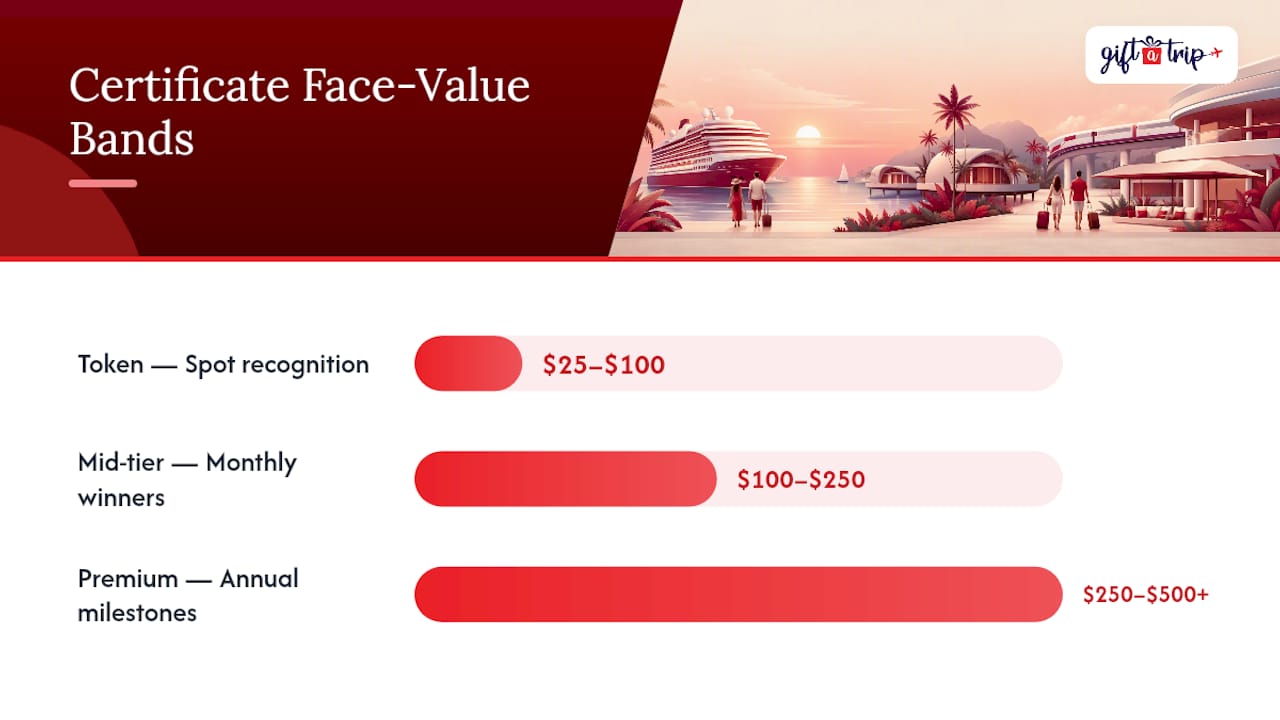
Typical face-value bands:
- Token ($25–$100): Spot recognition, peer nominations, contest prizes
- Mid-tier ($100–$250): Monthly winners, quarterly performance awards
- Premium ($250–$500+): Annual milestones, executive-level recognition, and sales club awards
The two top cost drivers: face value per certificate (scales with headcount and award frequency) and fixed administrative overhead (platform fees, internal HR time, fulfillment setup).
Key Takeaways
Budgeting travel gift certificates accurately requires combining face-value bands, fixed overhead, fulfillment fees, and a gross-up decision before you finalize any program cost.
| Point | Details |
|---|---|
| Face-value bands | Token ($25–$100), mid-tier ($100–$250), and premium ($250–$500+) cover most program tiers. |
| Total cost formula | Add face value + service fees + gross-up + annual fixed overhead for the true all-in figure. |
| IRS 2026 tax treatment | Travel certificates are generally taxable wages; include FMV in Box 1 of Form W-2. |
| Gross-up budget impact | A 28% flat gross-up adds $28 per $100 of taxable FMV to your program cost. |
| Giftatrip for bulk orders | Giftatrip provides FMV documentation, included taxes/resort fees, and bulk customization to simplify HR reporting. |
Table of Contents
- What does travel incentive cost actually include?
- Which price band fits your program goals?
- How do you calculate the total cost of a travel certificate program?
- What does IRS 2026 guidance say about taxing travel certificates?
- How does grossing up affect your program budget?
- How do bulk orders and delivery choices change your unit cost?
- What should you ask vendors before you buy?
- Why travel certificates often deliver different ROI than cash
- Giftatrip makes travel certificate programs easier to run
- Sources
- FAQ
What does travel incentive cost actually include?
Every travel certificate program carries two distinct cost layers, and conflating them is the most common budgeting mistake.
Fixed costs stay roughly constant regardless of how many certificates you issue: platform or account setup fees, campaign design, annual program planning, and internal administration time. Recognition platform fees for analytics and peer-to-peer features commonly run $2–$8 per employee per month for full-featured solutions, on top of your awards spend.
Variable costs scale directly with volume: the face value of each certificate, shipping or digital delivery, customization (branded gift boxes, personalized messaging), and any taxes or resort fees not already included in the certificate price.
A reliable way to model fixed overhead is the administrative formula practitioners use:
“Loaded” means fully burdened: salary plus benefits, payroll taxes, and a share of overhead. A People Ops coordinator at a $35/hour loaded rate spending 10 hours per month on the program adds $4,200 annually to your fixed cost line, before a single certificate ships.
| Fixed Cost Line Item | Budgeting Note | Spreadsheet Column |
|---|---|---|
| Platform/account setup fee | One-time or annual; confirm renewal terms | Setup Fees |
| Campaign design and creative | Flat project fee or internal hours | Design Costs |
| Internal HR/admin labor | Use loaded hourly rate × hours × 12 | Admin Overhead |
| Reporting and payroll prep | Especially relevant when certificates are taxable | Compliance Labor |
Pro Tip: Nomination review and winner communications are the two most underestimated labor sinks. Log those hours for one quarter, then annualize. Most HR teams are surprised by the result.
Which price band fits your program goals?
Choosing the right face value is less about budget and more about the signal you want to send. A $50 certificate handed out monthly reads differently than a $400 certificate presented at an annual gala, even if the annual spend per winner is identical.
| Band | Face-Value Range | Typical Use Case | Perceived Impact | Sample Budget per Winner |
|---|---|---|---|---|
| Token | $25–$100 | Spot recognition, peer awards, contest prizes | Acknowledgment | $25–$100 |
| Mid-tier | $100–$250 | Monthly/quarterly performance winners | Meaningful reward | $100–$250 |
| Premium | $250–$500+ | Annual milestones, sales club, executive awards | High-value recognition | $250–$500+ |
Mid-tier certificates hit the sweet spot for most corporate incentive programs: meaningful enough to generate genuine excitement, frequent enough to keep engagement high year-round. Premium certificates work best when they are rare, which is exactly what makes them feel special.
Pro Tip: High-frequency, low-value awards build habit; low-frequency, high-value awards build aspiration. Most programs need both. Budget for a mix rather than picking one band and applying it everywhere. See how travel certificates influence employee motivation for a deeper look at frequency and perceived value.
How do you calculate the total cost of a travel certificate program?
The formula is straightforward once you separate its components:
Total program cost = Total face value + Total service/fulfillment fees + Total tax gross-ups + Annual fixed overhead
Spreadsheet inputs you need
- Number of winners (headcount)
- Face value per certificate (by band)
- Unit service or processing fee (per certificate)
- Shipping or digital delivery cost per unit
- Platform or monthly subscription fees, annualized
- Estimated internal admin hours per month
- Loaded hourly rate for admin staff
- Gross-up rate (if covering employees’ taxes)
Worked example: 50-winner mixed-band program
That $400.40 all-in figure is what belongs in your budget request, not the $230 average face value.
What does IRS 2026 guidance say about taxing travel certificates?
The short answer: travel certificates are taxable. IRS Publication 15-B (2026) explicitly states that vacations, lodging, and similar items do not qualify as excludable “tangible personal property” under achievement award rules. The fair market value of a travel certificate must be included in the employee’s gross income and reported on Form W-2.
An IRS written determination (0437030) reinforces this: gift coupons with a readily ascertainable face value are treated as cash equivalents and cannot be excluded as de minimis fringe benefits, because they are not administratively impracticable to account for.
Payroll actions required:
- Determine the FMV of each certificate (typically the face value)
- Include FMV in Box 1 (wages) and typically Boxes 3 and 5 of Form W-2
- Withhold federal income tax, Social Security, and Medicare as applicable
- Keep vendor documentation showing FMV separately from any non-taxable service components
Statistic callout: Under IRS Publication 15-B (2026), travel certificates are generally taxable as wages — there is no de minimis exclusion available for certificates with a stated face value.
Pro Tip: Ask your vendor for an invoice that lists FMV and any separately stated service or fulfillment fees. That separation speeds up W-2 preparation and gives your payroll team a clean audit trail. A corporate travel certificate HR guide can help you build the right internal policy around this.
How does grossing up affect your program budget?
Grossing up means the employer covers the employee’s tax liability on the award, so the recipient keeps the full face value as net benefit. It protects perceived value but adds real cost.
Two common approaches:
- Flat-rate gross-up: Add a fixed percentage (often 25–30%) to the taxable FMV. Simple to calculate, slightly over- or under-covers depending on the employee’s bracket.
- Tax-equalized gross-up: Calculate the exact additional gross income needed so the employee nets the full face value after all applicable taxes. More precise, more complex.
Gross-up worked example
A $250 certificate is taxable.
Gross-up amount = $250 × 0.28 = $70
Total employer cost for this award = $250 + $70 = $320
| Tax Bracket (Approximate) | Suggested Gross-Up Rate | Budget Add per $100 FMV |
|---|---|---|
| 22% federal | 28–30% (federal + FICA) | $28–$30 |
| 24% federal | 30–32% (federal + FICA) | $30–$32 |
| 32% federal | 38–40% (federal + FICA) | $38–$40 |
Pro Tip: Cover federal income tax only (partial gross-up) when budget is tight. A full gross-up covering federal plus FICA is the cleaner policy for executive-level awards, where the optics of a tax bill on a recognition gift matter more.
How do bulk orders and delivery choices change your unit cost?
Volume is your best lever for reducing per-unit cost. Most certificate vendors offer tiered pricing where the per-unit price drops as order quantity rises. Customization adds back cost, but usually less than the discount saves.
Common extra fees to budget for:
- Processing or service fees (per certificate)
- Branded gift box or physical packaging (per unit or flat setup)
- Expedited fulfillment surcharge
- Shipping for physical certificates
- Customization setup fee for logo or messaging
| Order Quantity | Typical Unit Service Fee | Customization Setup | Effective Per-Unit Add-On |
|---|---|---|---|
| 1–24 units | Higher per-unit | Often not available | Higher |
| 25–99 units | Moderate per-unit | Flat fee spread across units | Moderate |
| 100+ units | Lower per-unit | Flat fee, minimal per-unit impact | Lower |
Digital delivery eliminates shipping cost entirely and cuts fulfillment time. For time-sensitive programs, that alone can justify choosing digital over physical. Giftatrip’s digital travel certificates guide walks through delivery options and typical timelines.

Pro Tip: On multi-year or high-volume agreements, processing fees and shipping are often negotiable. Ask specifically about fee waivers rather than discounts on face value — vendors have more flexibility there.
What should you ask vendors before you buy?
A short checklist prevents expensive surprises. Before signing any bulk order or program agreement, confirm every item below.
Vendor documentation checklist:
- FMV documentation provided per certificate (for W-2 reporting)
- Reporting export compatible with your payroll system
- Digital delivery option with confirmed turnaround time
- Taxes and resort fees included in face value (or clearly excluded)
- Redemption support for recipients (phone, chat, or email)
- Expiration policy stated in writing
- Blackout date policy and percentage of dates affected
- Customization options (logo, messaging, gift box)
RFP questions to ask:
- What are your payment terms for bulk orders?
- What is the standard turnaround for orders of [your quantity]?
- Can you provide a sample certificate and sample reporting export?
- How do you document FMV for employer tax reporting?
KPIs to track post-launch:
- Redemption rate (certificates redeemed ÷ certificates issued)
- Time to redeem (days from issue to booking)
- Cost per redeemed experience (total program cost ÷ redeemed certificates)
- Employee satisfaction score tied to the recognition event
For a full rollout framework, the travel certificate distribution guide for HR and events covers sequencing, lead times, and recipient communications.
Why travel certificates often deliver different ROI than cash
Cash bonuses disappear into a checking account. Travel certificates create something cash cannot replicate: an anticipation cycle. The moment a recipient receives a travel certificate, they start planning, imagining, and talking about the trip. That mental engagement stretches the recognition moment across weeks or months, not a single paycheck.
The Incentive Research Foundation makes a specific point about this dynamic: when executive leadership actively participates as hosts in incentive travel experiences, the networking and recognition value increases in ways a cash equivalent simply cannot match. A VP who joins a recognition trip signals organizational investment in a way that a bonus line item never does. For executive-hosted travel programs, that visibility is often the most memorable part of the experience.
O.C. Tanner recommends budgeting $200–$350 per employee per year for a comprehensive recognition strategy. Travel certificates fit naturally into that range at the mid-tier and premium bands, and they carry a perceived value that often exceeds their face value because recipients associate them with a specific, anticipated experience rather than a generic dollar amount.
Giftatrip makes travel certificate programs easier to run
Skip the spreadsheet guesswork on fulfillment. Giftatrip offers digital and physical travel certificates redeemable at resorts, hotels, cruise lines, and vacation packages from major brands, with taxes and resort fees included in many options. That inclusion matters: it removes the ambiguity around FMV and simplifies payroll documentation for your team.

Bulk orders come with customizable gift boxes, personalized messaging, and secure digital delivery, with typical turnaround times that fit standard HR program calendars. For larger orders, Giftatrip supports the reporting exports your payroll team needs to handle W-2 reporting cleanly. Request a bulk quote or browse certificate options at Giftatrip to see current pricing across face-value bands.
Sources
- Publication 15-B (2026), Employer’s Tax Guide to Fringe Benefits | Internal Revenue Service
- How to Budget for Employee Recognition | O.C. Tanner Institute
- Anatomy of a Successful Incentive Travel Program | Incentive Research Foundation
This article is general information, not a substitute for advice from a qualified financial advisor. Consult a qualified financial professional about your own circumstances before acting on anything here.
FAQ
How much does a travel gift certificate cost per employee?
Face value typically runs $25–$500+ depending on the award tier. Add service fees, fulfillment, and a share of fixed overhead to get the true all-in per-winner cost, which is higher than face value alone and varies depending on program specifics.
Are travel gift certificates taxable to employees in 2026?
Yes. Under IRS Publication 15-B (2026), travel certificates are generally taxable wages. Their fair market value must be included in Box 1 of Form W-2, with standard income tax, Social Security, and Medicare withholding applied.
What is a gross-up and do I need one for travel certificates?
A gross-up is an additional payment the employer makes to cover the employee’s tax liability on a taxable award. It is optional but protects the recipient’s net value.
How far in advance should I order bulk travel certificates?
Lead times vary by vendor and order size. Digital certificates typically process faster than physical ones. For bulk orders with custom branding, plan for at least two to three weeks. Giftatrip’s digital certificates guide outlines standard fulfillment timelines.
What is the recommended annual recognition budget per employee?
O.C. Tanner recommends $200–$350 per employee per year for a comprehensive recognition strategy, drawing on benchmarks from SHRM, Aon, and RPI. Travel certificates at the mid-tier band fit comfortably within that range.