
A travel gift is not like a sweater. Most travel certificates, vouchers and gift cards are built to be redeemed, not returned, so the question that matters is what happens if the plans change: can the balance be refunded, exchanged, extended or passed to someone else? The answer depends on three things: the type of gift, the terms printed on it, and the rules in the state where it was sold. This guide shows how to read all three before you give, and what to do if you are the one holding a gift that does not fit.
It is written for people who give travel gifts in volume or on purpose: HR and sales managers running reward programs, event planners, fundraising teams running auctions, retailers with promotional rewards, and individuals choosing a gift for a birthday, anniversary or honeymoon.
TL;DR
- Federal rules for gift cards set a floor: funds cannot expire for at least five years, and the expiration date or the fact that funds don’t expire must be disclosed.
- Federal law does not give you a right to a cash refund on an unused gift card. A few states require cash back on small balances, and New York and California have stricter rules than the federal floor.
- A travel certificate is often redeemed for a booking, so its terms (blackout dates, change rules, who can redeem) matter as much as the face value.
- Keep the receipt, the certificate number and the written terms. They are your proof if you ever need to resolve a problem.
- Gift A Trip certificates are designed around simple gifting: digital delivery, taxes and fees covered, minimal blackout dates and no minimum order.
Table of Contents
- Why there is no single travel gift return policy
- What federal law says about gift card returns, expiration and fees
- State rules can be stricter than the federal floor
- What to look for in the terms before you buy
- If you need to return or change a travel gift: step by step
- How to avoid needing a return at all
- Special cases for different givers
- Gift A Trip: certificates built for easy gifting
- Our view on travel gift returns
- FAQ
- Sources
Why there is no single travel gift return policy
“Travel gift” covers several different products, and each one has its own rules:
- Store-style gift cards and certificates sold to consumers fall under the federal gift card rule and your state’s gift card law.
- Travel vouchers and certificates for a specific stay or cruise are governed first by the terms of the certificate itself: what it includes, when it can be booked, what it costs to change.
- Airline or hotel credits issued after a cancellation are a different thing again. They are compensation for a canceled booking, not a gift you bought.
- Group and school travel vouchers can be explicitly written as non-cash. One education travel provider, for example, states in its help center that its future travel voucher is not a gift certificate and cannot be redeemed for cash unless noted.
So the first step with any travel gift is to identify which of these you hold. The wording on the certificate or the checkout page usually tells you.
What federal law says about gift card returns, expiration and fees
The federal rule that applies to most gift cards is the Electronic Fund Transfer rule, Regulation E, section 205.20. According to the current text on the eCFR, it applies to cards sold on or after August 22, 2010, and requires issuers to:
- give consumers a reasonable chance to buy a card with at least five years remaining before the funds expire;
- disclose the expiration date of the underlying funds, or that they do not expire;
- provide a toll-free number or website for getting a replacement after expiration;
- not charge a fee to replace an expired card or to provide the remaining balance before the funds expire, unless the card was lost or stolen.
The Georgia Attorney General’s consumer division describes the same framework in plain terms: money on a gift card cannot expire for at least five years from purchase or last load, an inactivity fee is allowed only after a year of no use and only once a month, and the card must disclose the expiration date and any fees.
What the rule does not do is give you a general right to turn a card back into cash. Attorney Amy Loftsgordon’s overview at Nolo confirms the same five-year floor and the one-fee-per-month limit, and it is where to look for the state-by-state exceptions described below.
For a deeper comparison, our guide to the five-year federal floor versus state rules walks through how the two layers fit together.
State rules can be stricter than the federal floor
The federal law is a minimum. According to the National Conference of State Legislatures, 38 states, Guam and Puerto Rico have their own expiration or fee statutes, and 14 states plus Puerto Rico authorize cash redemption of at least part of a card’s value (page updated May 20, 2026).
Two examples show how far the gap can go:
| State | What the rule says | Source |
|---|---|---|
| California | Store gift certificates and cards generally cannot carry expiration dates or dormancy fees, and balances under $10 can be redeemed for cash under Civil Code § 1749.5. | Nolo |
| New York | Most gift card fees are prohibited, expiration cannot come before nine years from issuance or last load, and balances under $5 must be redeemable for cash (open-loop and promotional certificates are excepted). The law took effect December 10, 2022. | Lexology |
The practical lesson: the state where the gift was purchased can change what the recipient is entitled to. If you are buying for a team spread across several states, the federal five-year floor is the number you can count on everywhere, and anything better is a bonus.
Note also that these rules are written for gift cards and gift certificates. A promotional certificate or a booking voucher tied to a particular trip may be treated differently, which is why the certificate’s own terms come first.
What to look for in the terms before you buy
Georgia’s Attorney General recommends checking the redemption policy, whether the card can be reloaded, any fee terms, and how lost or stolen cards are handled before you buy. For a travel gift, add the questions that decide whether the recipient can actually use it. Here is the checklist we use when we plan a travel gift.
1. What does it redeem for?
A certificate for a specific resort stay, a cruise, or a flexible choice of trips behaves differently. A flexible collection gives the recipient several destinations to choose from, which is the simplest way to avoid the mismatch that leads to a return request in the first place.
2. When does it expire, and how is that shown?
For gift cards, the expiration date or the statement that funds do not expire must be disclosed. For a trip certificate, look for two dates: the date by which it must be redeemed, and the date by which travel must be completed. These are not always the same.
3. Which costs are included?
Taxes, gratuities and resort fees are where a “free” trip becomes a surprise bill. A certificate with these covered is far easier to hand to someone as a finished gift. Our overview of which travel certificates include fees and taxes and the guide to travel gift card fees explain what to confirm.
4. How many blackout dates are there?
Blackout dates are the most common reason a recipient feels a gift is unusable. Fewer blackout dates means fewer reasons to ask for a return. Our piece on open date travel vouchers covers how booking windows work.
5. Can it be replaced if lost?
Digital delivery helps here, because the certificate is in an inbox, not a drawer. Still, know who to contact and what number or code identifies the gift.
6. Who can redeem it?
If a recipient cannot travel, can someone else use the gift? Terms differ, so read the transfer language before giving the certificate to a person whose plans are uncertain.
If you need to return or change a travel gift: step by step
There is no universal procedure, but this sequence works for most situations.
- Find the terms that apply. Look at the certificate itself, the confirmation email and the issuer’s terms page. The return policy of a store that sold you a card is not the same as the terms of the cruise line or resort that honors it.
- Check the date. Confirm the expiration or redemption deadline first. Under federal rules, an expired card still has a path to replacement: the issuer must provide a contact for a replacement, and cannot charge a fee to replace it or give you the remaining balance, unless it was lost or stolen (12 CFR 205.20).
- Gather proof. Georgia’s Attorney General advises keeping the receipt while money remains on a card. For a travel certificate, also keep the order confirmation, the certificate number and a copy of the terms as they read on the day of purchase.
- Ask for the right remedy. Cash is rarely available, but exchange, extension, a different travel date or a transfer to another person may be. Ask for what the terms allow, in writing.
- Check state law for small balances. If a balance is small, your state may require a cash payout. California and New York are examples, as shown above.
- Escalate in writing. If the issuer does not respond, send a short written request that cites the terms and your proof. A state attorney general’s consumer protection office handles complaints about gift card practices.
What about a trip booked with a certificate?
Once a certificate is turned into a booking, the booking’s change and cancellation rules apply. Read them at the moment you book, and note the final date for changes without penalty. Our travel certificate redemption guide shows how the booking stage typically works.
What happens to funds nobody claims?
When gift card funds go unclaimed, states treat them as unclaimed property. A Federal Reserve Bank of Philadelphia discussion paper explains that states either return such property to the original purchaser or owner or use it for the public’s benefit. It also describes Federal Trade Commission enforcement requiring clear fee disclosure and refund mechanisms for fees that were assessed. The takeaway for you as a giver is simple: a forgotten gift is rarely worth nothing, but it is much easier to use before it gets that far.
How to avoid needing a return at all
Most return requests come from a mismatch, not from a defect. A few habits keep a gift from landing in that position.
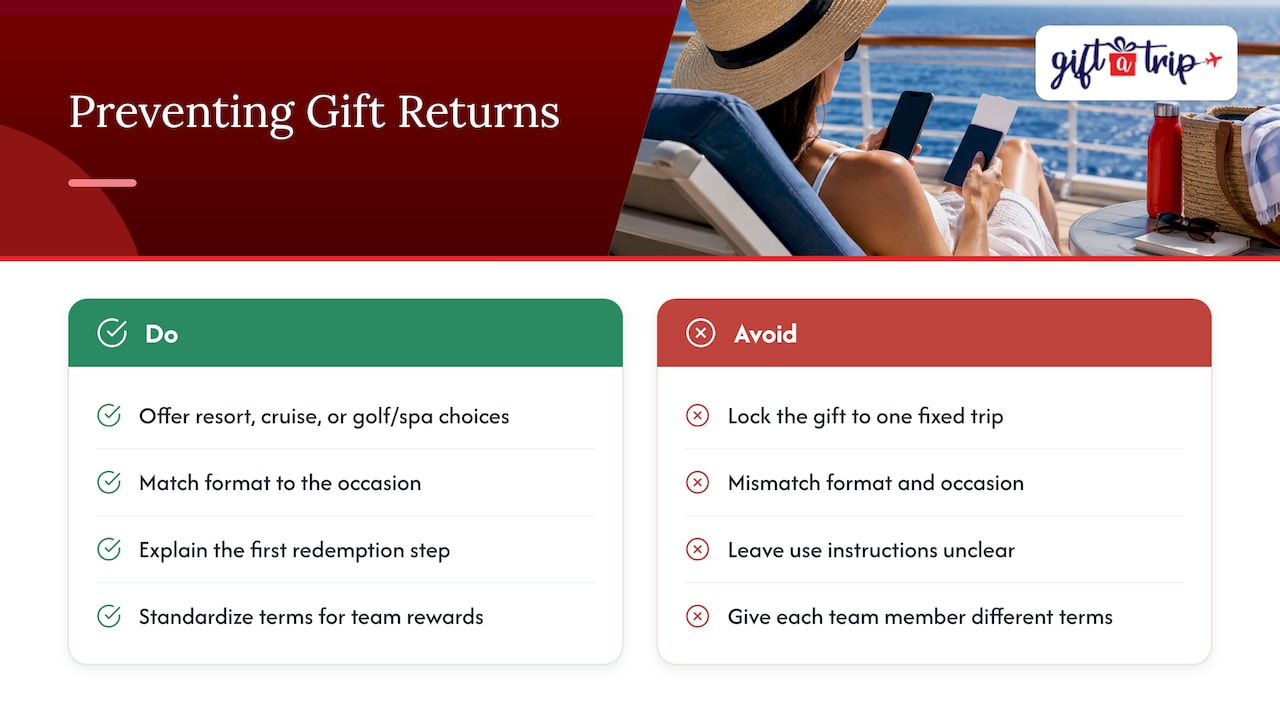
Choose flexibility over a single fixed trip. A recipient who can choose among resorts, cruises or golf and spa stays is far less likely to find that the gift doesn’t fit. Experience-based gift cards work on the same principle, and a guide on experience cards for travel shows how choice makes them popular.
Pick the gift’s format to match the occasion. A digital certificate can arrive the same day, which suits last-minute birthdays and employee milestones. A physical presentation suits an anniversary or an awards dinner.
Write a note that explains how to use it. A short message with the first step (where to go, what code to enter) cuts down on confusion more than any policy.
For teams, standardize. HR and sales managers who reward many people at once are better off with one set of terms for everyone than a different voucher for each person. That also makes the administration simpler: one policy to read, one set of dates to track. Our guides on turnkey travel rewards and corporate rewards with travel certificates cover the program side.
For auctions and promotions, confirm the dates. Charity auctions and retail promotions often hand a certificate to a winner weeks after the event. Make sure the winner receives the redemption window in writing so the prize is used, not forgotten.
Special cases for different givers
HR and sales managers
You are buying for people you may not know well, so the risk is a certificate that does not suit someone’s life. Give a choice of destinations and a long redemption window. Keep the program’s terms in one document that employees can read. For tax questions about reward certificates, speak to your company’s tax adviser or accountant, since the treatment of employee rewards depends on your situation.
Event planners and milestone celebrations
A group of recipients means a group of different calendars. A certificate with minimal blackout dates and a long window is better than one tied to a season. Our guide to digital travel certificates explains how delivery and redemption work.
Charities running auctions
Bidders want to know exactly what they are buying. Publish the certificate terms in the auction listing, including expiration, what is included and how it is redeemed. Clear terms support higher bids and fewer follow-up questions.
Individual gift givers
For birthdays, anniversaries and honeymoons, pick the destination category the recipient already loves: a cruise, a resort stay or a golf and spa break. Add a personal message. Our piece on why travel vouchers make a great gift lists the reasons they work.
Gift A Trip: certificates built for easy gifting
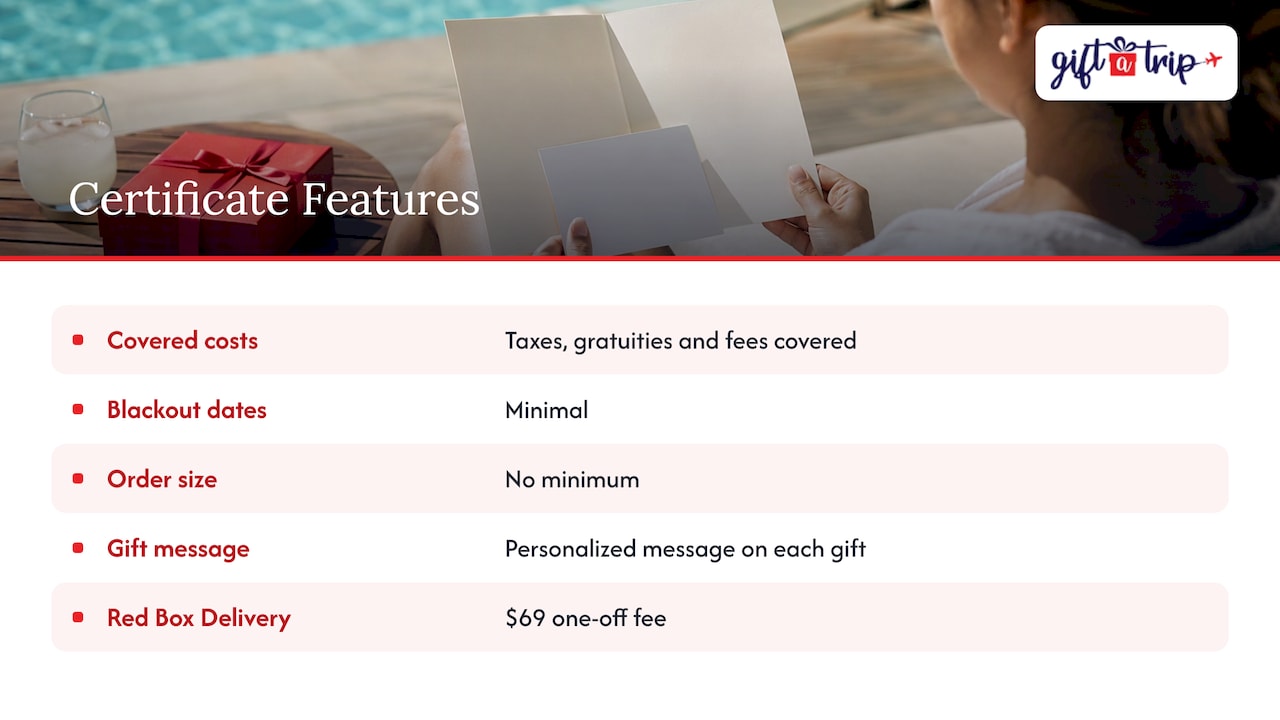
Gift A Trip sells digital and physical travel certificates redeemable for resort, hotel, cruise and vacation packages from major travel brands, to individuals and organizations. Our certificates are designed with taxes, gratuities and fees covered, minimal blackout dates and no minimum order, and you can add a personalized message to each gift.
If you are choosing for one person, browse cruises, resorts and hotels, and golf and spa getaways, or the Flex Trip Collections when the recipient should pick the destination.

For teams, our corporate gifting page covers Custom Trip Selection Sites, airfare vouchers in all denominations, Custom Flex Trip Collections and custom, branded gift box delivery. If you want a physical presentation, Red Box Delivery is a $69 one-off fee.
Our view on travel gift returns
Most people who ask about a return policy are really asking a different question: will this gift be easy to use? We think that is the right question, and it is best answered before the purchase, not after.
A gift certificate that is simple to read, with fees covered and few blackout dates, rarely needs a return. That is why we build our certificates around flexibility: a choice of brands, secure digital delivery, no minimum order and the option to personalize the message. When taxes and resort fees are already covered, the recipient is not left to solve a problem the giver created.
For organizations, the same idea scales. One clear set of terms, delivered the same way to every recipient, makes a reward program easier to run and easier for employees to trust. We would rather you spend your time choosing a thoughtful gift than managing exceptions.
Donovan
FAQ
Can I get a cash refund on a travel gift card?
Federal law does not give a general right to cash back on an unused gift card. Some states do, usually for small balances: California allows cash redemption of balances under $10, and New York requires it for balances under $5, according to Nolo and Lexology. Check the law in the state where the card was bought.
How long is a travel gift card valid?
For gift cards covered by the federal rule, funds cannot expire for at least five years, and the expiration date or the absence of one must be disclosed (12 CFR 205.20). A travel certificate for a specific trip can also carry a travel-by date, so read both dates.
What proof should I keep if there is a dispute?
Keep the receipt or order confirmation, the certificate number and a copy of the terms. Georgia’s Attorney General advises keeping the receipt while money remains on the card. Save emails in a folder so you can find them quickly.
What if the gift card expires before it is used?
The issuer must provide a toll-free number or website for requesting a replacement, and cannot charge a fee to replace an expired card or provide the remaining balance, unless the card was lost or stolen. This comes from the federal rule. Contact the issuer in writing and keep a copy.
Do state laws override a store’s no-refund policy?
Where a state requires cash redemption or bars expiration, the state law applies. The NCSL tracks which states have such statutes. If you think an issuer is not following your state’s rule, your state attorney general’s consumer protection office is the place to ask.
Sources
- eCFR: 12 CFR 205.20, Requirements for gift cards
- Georgia Attorney General: Gift Cards
- Nolo: Gift Certificate and Gift Card Laws
- NCSL: Gift Cards and Gift Certificates Statutes and Legislation
- Lexology: New York extends minimum term for gift cards
- Federal Reserve Bank of Philadelphia: Gift card laws, regulations and industry practices