
Bulk gift code management comes down to one idea: every code you buy is money, so it needs an owner, a record and a reconciliation, from the day the order is paid to the day the recipient redeems it. Teams that treat a batch of 200 codes like a spreadsheet of party favors usually discover the problem at year-end, when finance cannot match what was bought to what was handed out. Teams that set the routine up first rarely do. If you give travel as a reward, we built Gift A Trip to keep that routine light: digital certificates delivered securely, taxes and fees covered, and no minimum order.
This guide walks through the seven steps in order, with the payment questions to settle before you buy and the U.S. rules that shape how long a code must stay valid.
TL;DR
- Decide who receives what, at which value and by when before you buy. That sets quantity, cadence and budget.
- Pick the payment method early. Bank transfers and checks take days to clear, so a send date can slip if you pay late.
- Keep one ledger: code ID, recipient, value, delivery status, redemption status. Reconcile against it at least monthly.
- Verify recipient email addresses before sending. A code sent to a wrong address may not be recoverable.
- Federal rules set a five-year floor on most paid gift cards, but promotional cards and state laws differ, so check both.
Table of Contents
- What bulk gift code management actually covers
- Step 1: Plan the program before you order
- Step 2: Choose how you will pay
- Step 3: Receive and secure the codes
- Step 4: Deliver without errors
- Step 5: Track every code
- Step 6: Reconcile on a schedule
- Step 7: Know the rules on expiration, fees and tax
- A quick pre-order checklist
- Put it into practice with Gift A Trip
- FAQ
- Sources
What bulk gift code management actually covers
A gift code is a string that stands in for value. Whoever holds it can redeem it. That is why management matters more than the purchase itself. The work falls into seven jobs:
- Plan the program
- Pay for the order
- Receive and secure the codes
- Deliver them to recipients
- Track delivery and redemption
- Reconcile against finance records
- Stay inside the legal rules
Small programs can run all seven in one shared spreadsheet. Larger ones, such as a quarterly sales incentive for several hundred people, need clear owners for each job. The steps below show where each one tends to go wrong.
Step 1: Plan the program before you order
Start with five decisions: who receives codes, why they receive them, when they go out, what value tiers you will use, and how often you will reorder. Those five answers set your quantity and your cadence. Write them down in one page that finance, HR and whoever ships the codes can all read.
A practical example: a sales director wants to reward 40 reps at the end of each quarter. Three tiers make sense: a base reward for everyone who hits quota, a mid tier for the top ten, and one top prize. That is three denominations, four orders a year and a budget finance can forecast. Without the tiers, every quarter becomes a fresh negotiation.
Then pick the reward type. Cash-like cards get spent on groceries and gas and are forgotten. A travel certificate is a different kind of reward because the recipient plans a trip around it, which is the reason many HR teams use travel for milestones and top performers. Our step-by-step employee reward gifting guide walks through matching the reward to the occasion, and the bulk order gifting guide for corporate planners covers the planning side in more depth.
Run a pilot first
Before committing a full budget, send a small batch of 10 to 50 codes. You are testing three things: whether the emails arrive, whether the branding and message look right, and whether recipients can redeem without help. A pilot costs little and catches the mistakes that are expensive at scale. We lay out how to structure one in our pilot guide for HR and finance.
Step 2: Choose how you will pay
Payment is the step most teams leave to the last minute, and it is the one that can push back a send date. Businesses typically see four funding routes across bulk gift programs: bank transfer by ACH, wire transfer, company check and corporate credit card. They differ in three ways you should compare before you place an order:
| What to check | Why it matters |
|---|---|
| Speed | Cards usually clear fastest. ACH and checks can take several business days to clear, and codes are often released only after the funds arrive. |
| Cost | Some sellers add a convenience fee on card payments. On a large order a percentage fee adds up quickly, so compare it with the cost of paying by bank transfer. |
| Limits | Sellers can set minimum and maximum order sizes and daily caps. Confirm yours before you plan a large send. |
Two practical rules follow. First, work backward from the send date. If your event or holiday send is fixed, start a bank transfer early enough to clear, and keep a card as the fallback for last-minute top-ups. Second, check your own internal limits. Public institutions often route large purchases through formal procurement. The University of Utah’s procedures, for example, require a procurement process for electronic gift card orders over $10,000 unless an agreement is already in place, and they send the eCards only after payment is received. Private companies have their own approval thresholds. Learn yours first.
Fees, minimums and processing times change from seller to seller and from year to year, so get them in writing from whoever you buy from before you plan around them. With Gift A Trip there is no minimum order, and the certificate price includes taxes and fees, which keeps the budget line simple. Our guide to buying gift cards in bulk for corporate programs covers the ordering process.
Step 3: Receive and secure the codes
Once the order is fulfilled, you hold a file of live codes. Treat it like a stack of cash. A single leaked spreadsheet can expose every code in the batch at once, so access control matters more than any fancy tool.
A short security routine for any program:
- Limit who can see the file. Give access by role: finance sees totals, HR sees recipient assignments, and only the person sending sees the codes.
- Use a second approver for large sends. Two sets of eyes on a batch of any real value catches typos and misdirected lists.
- Store the file in one controlled location. Not in email threads, chat messages or personal drives.
- Keep an audit trail. Record who approved each batch and when it went out.
- Know how to freeze a code. If a code is reported lost or leaked, you need a way to void it and reissue it fast. Ask your seller how that works before the order, not after.
Digital delivery helps here. With a platform that sends each recipient their own certificate by secure link, there is no master file of raw codes to leak. That is the design behind our digital certificates, and our overview of secure digital travel certificates explains the five-year validity, the fees and the HR tax questions.
Step 4: Deliver without errors
Most “redemption problems” are really delivery problems. The email went to spam, the address was stale, or a forwarding rule swallowed it. Those are different from a recipient who got the code and simply did not use it, and you fix them differently.
The habits that prevent errors:
- Validate addresses before sending. The University of Utah’s procedures put responsibility on the department to submit accurate emails, and they warn that a code sent to a wrong address may not be recoverable, with no refunds or returns on sent codes.
- Send from a recognizable sender name, and tell recipients in advance to expect it.
- Isolate failures. If a send bounces, pull that recipient out of the batch, note the reason, and resend separately so nobody gets two codes.
- Personalize the message. A named note from a manager makes it clear the email is real and not a phishing attempt.
If you want a physical presentation for a milestone or an awards night, our Red Box Delivery is a one-off $69 fee. For employee programs where branding matters, see our guide to corporate gift card customization.
Step 5: Track every code
Your ledger should answer four questions at a glance: what was purchased, who received it, what was redeemed and what is still outstanding. A workable set of columns:
| Column | Example |
|---|---|
| Order or PO number | PO-2026-114 |
| Code ID (not the code itself) | Batch 3, item 27 |
| Denomination | $250 |
| Recipient and department | A. Rivera, Sales |
| Delivery method and date | Email, with timestamp |
| Delivery status | Delivered, bounced, resent |
| Redemption status | Redeemed, not redeemed |
| Expiration date | As stated on the certificate |
Store the code ID, not the live code, wherever many people can see the sheet. And split the statuses: “issued but not delivered” and “delivered but not redeemed” need separate columns, because the first is a technical fix and the second is a communication nudge.
Assign owners. A split that works for many organizations: finance owns purchasing and reconciliation, HR owns recipient assignment, and whoever handles operations owns delivery and exceptions. When everyone owns it, nobody does.
Step 6: Reconcile on a schedule
Reconciliation means proving that what you bought equals what you gave out plus what is left. Public institutions set a clear example. The University of Colorado’s finance procedures say each card’s purchase and issuance should be traceable in a log, with reconciliation whenever cards are purchased or at least quarterly, so that cards purchased minus cards disbursed matches what is on hand. The University of Utah goes further for eCards: departments keep the recipient spreadsheet and reconcile the vendor’s distribution detail to it at least monthly, checking card count, total value and recipient emails.
A good routine for a company:
- When a batch arrives, check the count, denomination, total value and fees against the invoice.
- After each send, attach a delivery confirmation to every code.
- Monthly, compare the ledger to the seller’s distribution report.
- At quarter-end, hand finance a summary: purchased, issued, redeemed, outstanding.
Ask for exportable, transaction-level reports when you choose a seller, with recipient, amount, brand and status. Rebuilding that by hand at year-end is the most common reason programs get painful.
Step 7: Know the rules on expiration, fees and tax
Expiration and fees
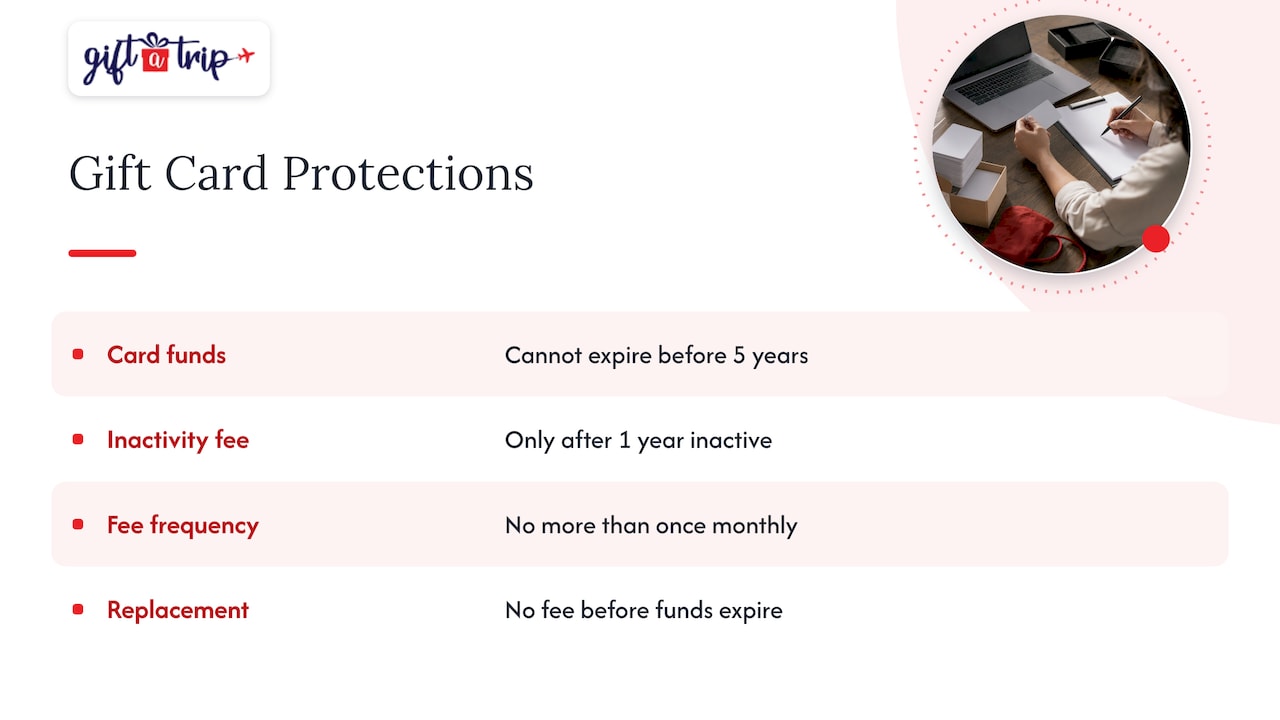
The federal rule for most paid gift cards is Regulation E, 12 CFR 1005.20. In plain terms, the funds on a card may not expire sooner than five years after issue (or after funds were last loaded), and an inactivity or service fee is allowed only after a full year with no activity, with the terms clearly disclosed and no more than one such fee a month. An issuer also may not charge to replace an expired card or to give back a remaining balance before the funds expire, unless the card was lost or stolen.
Two things to keep in mind. Cards issued through loyalty, award or promotional programs can fall into a separate category with its own disclosure rules, so a reward program is not automatically treated like a retail gift card. And states can add their own rules on top. For a real-world look at how a state’s expiration rules play out for a local business, see this note on Colorado gift card expiration rules. Our own comparison of the federal floor and state rules is in U.S. gift card expiration laws.
For your program, the practical step is simple: put the expiration date in your ledger for every code, and send a reminder well before it, so value does not lapse unused.
Tax
Rewards given to employees can have payroll and tax consequences, and the treatment depends on the program and the amount. Ask your tax adviser or payroll provider how your reward program should be reported, and make sure your records show recipient, denomination and date so they can do it. Our page on secure digital travel certificates touches on the HR tax side for travel rewards.
A quick pre-order checklist
Before you pay for any bulk order, confirm:
- Recipients, purposes, value tiers and send dates are written down
- The payment method fits your timeline and internal approval limits
- You know who can access the codes and who approves a send
- Recipient addresses have been checked
- The ledger exists and has owners
- Expiration dates are recorded and reminders scheduled
- Payroll or tax treatment is cleared with the right person
Our view: manage the reward, not just the code
Most bulk code advice treats the code as the product. We see it the other way around. The code is the delivery vehicle, and the reward is what the recipient remembers. A pile of small gift cards creates a pile of small things to administer: more codes to track, more balances to reconcile, more chances for something to go to the wrong inbox.
That is why we built Gift A Trip around travel certificates that go out digitally and securely, with taxes and fees covered, minimal blackout dates, and no minimum order. One certificate for a resort stay or a cruise is one line in your ledger, and it carries more weight with the person who gets it than a stack of small-value cards. For corporate programs we also offer custom trip selection sites, custom Flex Trip Collections and branded gift box delivery, so a team of ten and a team of a thousand are handled the same way.
Our advice: start with a small pilot, keep the ledger honest, and choose a reward people will actually use.
Donovan
Put it into practice with Gift A Trip
If your program rewards sales teams, milestones, customers or auction winners, our corporate gifting page shows the options: custom trip selection sites, airfare vouchers in all denominations, custom Flex Trip Collections and custom, branded gift box delivery. Individual buyers can browse resorts, cruises and golf and spa getaways and send a certificate with a personal message.

For flexible rewards where the recipient picks the destination, take a look at our Flex Trip Collections.
FAQ
How do I manage a large batch of gift codes without errors?
Keep one ledger with a code ID, recipient, value, delivery status, redemption status and expiration date for every code. Limit access to the live codes, validate email addresses before sending, and reconcile at least monthly. Assign finance, HR and operations separate roles so each step has an owner.
What payment methods do businesses use for bulk gift cards?
The usual options are ACH, wire transfer, company check and corporate credit card. Cards tend to clear fastest and may carry a fee, while bank transfers and checks can take several business days. Confirm fees, limits and release conditions with your seller, and check your own approval thresholds first.
How long must a paid gift card stay valid in the U.S.?
Under Regulation E, the funds on most paid gift cards cannot expire sooner than five years after issue or the last load. Promotional and loyalty cards can be treated differently, and some states add stricter rules, so record the expiration date for every code.
Can a code sent to the wrong email be recovered?
Not always. Institutional purchasing rules, such as the University of Utah’s eCard procedures, note that sent codes may not be refundable or recoverable. Verify addresses before every send and send a small pilot batch first.
Sources
- eCFR: 12 CFR 1005.20, Requirements for gift cards and gift certificates
- University of Colorado: Finance Procedural Statement on Gift Cards
- University of Utah: Electronic Gift Card (eCard) Purchasing Procedures