Jump to Section:
Group gifting travel means buying travel gift certificates in bulk, redeemable for resorts, hotels, cruises, or vacation packages, for corporate rewards, event prizes, or client appreciation. It has nothing to do with crowdfunding a friend’s honeymoon. The right move for any planner: pick a provider that handles bulk digital delivery, custom messaging, and included fees, so recipients redeem without friction.
TL;DR:
- Bulk travel certificates are ideal for employee recognition, sales incentives, and client appreciation, with budgets typically ranging from $150 to over $1,000 per certificate.
- Digital delivery simplifies distribution across remote teams, but physical packaging is available for milestone or executive gifts at additional cost.
- Planning should focus on clear objectives, recipient segmentation, budget per person, and early support preparations or pilot testing to prevent overspending and redemption issues.
- Tax and legal considerations require early consultation with payroll and finance teams, as employee certificates are usually taxable income, and gift limits apply for client rewards.
- Most programs should prioritize fewer, higher-value rewards over spreading budgets thin, with careful setup to ensure smooth delivery and accurate value communication.
Table of Contents
- What Is Group Gifting Travel and When Should You Use It?
- Why Do Travel Certificates Outperform Cash or Merchandise?
- How Do You Plan and Distribute Bulk Travel Certificates?
- What Should You Budget, and How Do You Prove ROI?
- How Does Delivery and Redemption Actually Work?
- Which Certificate Format Fits Your Program Size?
- What Are the Legal and Tax Rules for Bulk Travel Gifting?
- A Planner’s Take: What Actually Moves the Needle
- How Gift A Trip Supports Group Gifting Travel Programs
- Sources
- FAQ
What Is Group Gifting Travel and When Should You Use It?
Group gifting travel refers to purchasing multiple travel gift certificates at once, typically redeemable for stays at resorts, hotels, cruise lines, or bundled vacation packages from established travel brands. It is a bulk-purchasing model built for organizations, not a peer-to-peer contribution pool. That second meaning, friends chipping in toward one person’s trip, is a completely different product with a completely different buyer.
Corporate and event use cases dominate this category:
- Employee recognition programs rewarding tenure, performance, or referrals
- Sales incentive trips tied to quarterly or annual targets
- Event prizes for conferences, galas, and trade shows
- Client appreciation gifts for top accounts
- Charitable auction items that raise more than a gift basket ever could
Each use case has a different budget ceiling and a different tolerance for personalization, which is exactly why the planning steps below matter before you place an order.
Why Do Travel Certificates Outperform Cash or Merchandise?
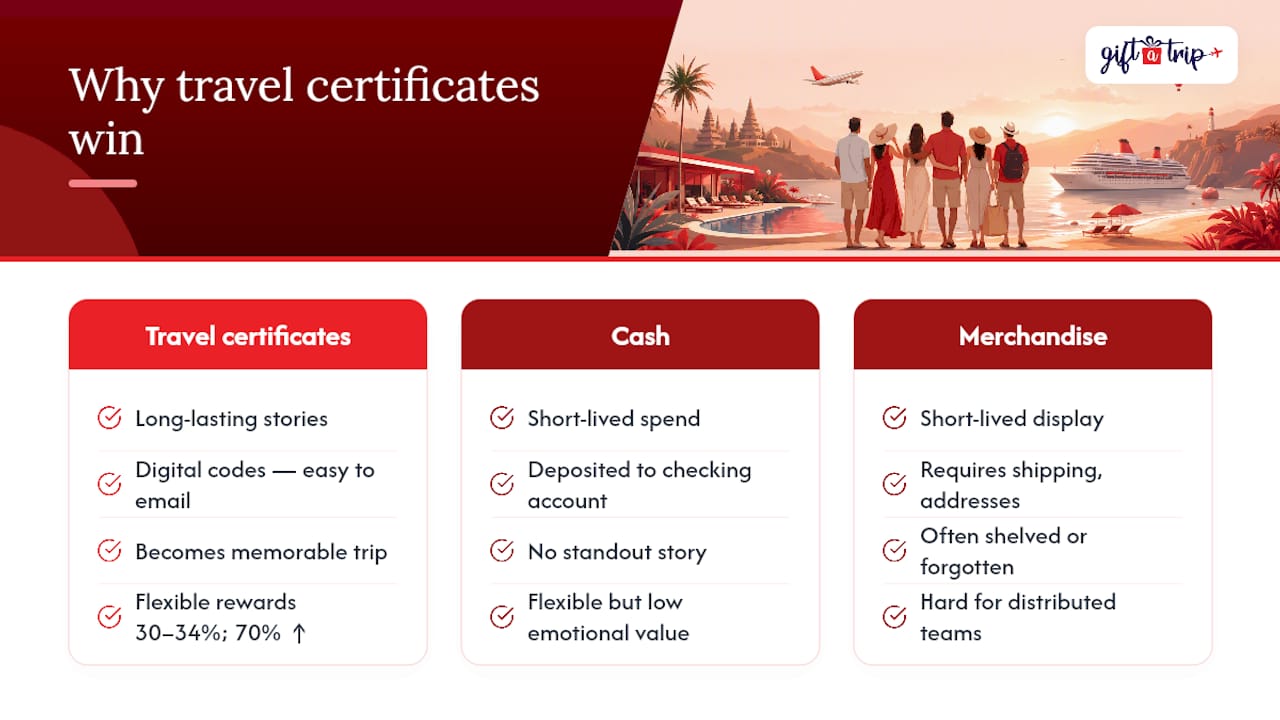
A travel certificate creates an experience a recipient remembers years later. Cash gets absorbed into a checking account within days; a branded mug gets shelved. A trip to a resort or a cruise cabin becomes a story someone tells coworkers on Monday morning, and that emotional residue is precisely what recognition programs are trying to buy.
Digital delivery also solves the distributed-workforce problem that merchandise never could. You cannot ship a crate of gifts to a hundred remote employees across a dozen time zones without shipping delays and address-collection headaches, but you can email a redemption code to every one of them in an afternoon.
The market is also moving toward fewer, richer rewards rather than more, cheaper ones. Gift cards and flexible rewards now account for roughly 30 to 34% of program allocations in North America and Europe, and nearly 70% of North American organizations expect to increase gift card use through 2026. That shift toward flexible, high-perceived-value rewards is exactly the lane travel certificates occupy, and it is why smart planners are consolidating budgets into fewer, better gifts instead of spreading them thin.
How Do You Plan and Distribute Bulk Travel Certificates?
Ordering fifty or five hundred certificates without a plan is how programs blow their budget on rush shipping or send the wrong denomination to the wrong tier of employee. Work through these steps in order:
- Define the objective first. Decide whether you are rewarding a one-time spot bonus, a milestone anniversary, or a top-performer incentive trip. Program design should start with the audience and the behavior you want to reinforce, not the destination you like best.
- Segment recipients by tier. A five-year anniversary gift and a President’s Club trip should never carry the same certificate value.
- Set a per-person budget band that includes taxes and fees. A certificate advertised at $500 that adds $80 in resort fees at redemption creates a bad surprise for the recipient, not you.
- Build in lead time. Bulk digital orders can move fast, but custom-branded packaging and physical delivery need more runway, especially around Q4 holiday volume.
- Choose personalization and packaging. Decide whether recipients get a plain email or a branded box with a handwritten-style message.
- Collect recipient data cleanly. Names, emails, and shipping addresses (if physical delivery applies) should be gathered once, through one form, not scattered across spreadsheets.
- Plan for support. Someone on your team, or your vendor’s support line, needs to be reachable when a recipient has trouble redeeming.
Pro Tip: Order a small pilot batch of five to ten certificates before committing to your full program. It surfaces data-collection gaps and redemption confusion while the stakes are still low.
What Should You Budget, and How Do You Prove ROI?
Per-instance budgets vary widely by tier. A spot-recognition certificate might run $150 to $300. A milestone anniversary gift often lands between $300 and $750. Top-performer incentive trips, especially flex collections with concierge-level service, commonly exceed $1,000 per person, particularly as buyers shift toward smaller, more curated groups with 54% planning to increase per-trip spending in 2026.
Your real cost has four line items, not one:
- Certificate face value
- Taxes and resort fees (ask upfront whether these are included)
- Fulfillment and delivery costs, digital or physical
- Internal administration time
On the measurement side, skip vanity metrics. Track retention among recipients versus non-recipients, post-trip satisfaction surveys, and any measurable lift in the behavior you incentivized, whether that’s sales output or referral volume. Budget guides for 2026 recommend allocating 5 to 10% of total program spend toward gifting and personalization touches, since small customization details drive outsized perceived value relative to their cost.
How Does Delivery and Redemption Actually Work?
Digital delivery is the default for most bulk programs, and for good reason. The recipient gets a unique code by email, manages their own redemption timeline, and never has to give you a home address. That single feature eliminates most of the logistics headaches that come with a hundred-plus recipient list.
Physical delivery still has its place for milestone moments and executive gifts. Branded box options like Red Box Delivery let you present a certificate with the kind of unboxing moment a plain email cannot replicate, which matters for retirement gifts or top-tier award ceremonies.
A few operational notes worth knowing before you order:
- Included taxes, resort fees, and minimal blackout dates reduce the friction recipients hit when they finally try to book.
- Redemption windows typically run months, not days, so recipients aren’t rushed into a bad travel date.
- The most common pitfall is a mismatch between promised value and what shows up at checkout. Fees tacked on later erode trust fast.
Pro Tip: Tell recipients exactly what’s included, taxes, gratuities, resort fees, before they redeem. A surprise charge undoes the goodwill the gift was supposed to create.
Which Certificate Format Fits Your Program Size?
Not every program needs the same product. Matching format to scale saves both budget and administrative time.
- Spot recognition: Small-value digital certificates with instant delivery work best here. Low cost, fast turnaround, no packaging needed.
- Top-performer incentives: Flex trip collections or higher-value packages with concierge-style support fit programs rewarding a smaller group at a much higher per-person spend.
- Event prizes and auctions: Themed packages with physical, branded presentation perform better on stage or at a gala than a plain email code ever will.
- Small-group curated trips: Pairing a certificate with local programming, a destination partner activity or dinner, adds a layer DMCs and DMOs are well positioned to help with, since these partners can offer access to unique local experiences and sometimes subsidize costs.
What Are the Legal and Tax Rules for Bulk Travel Gifting?
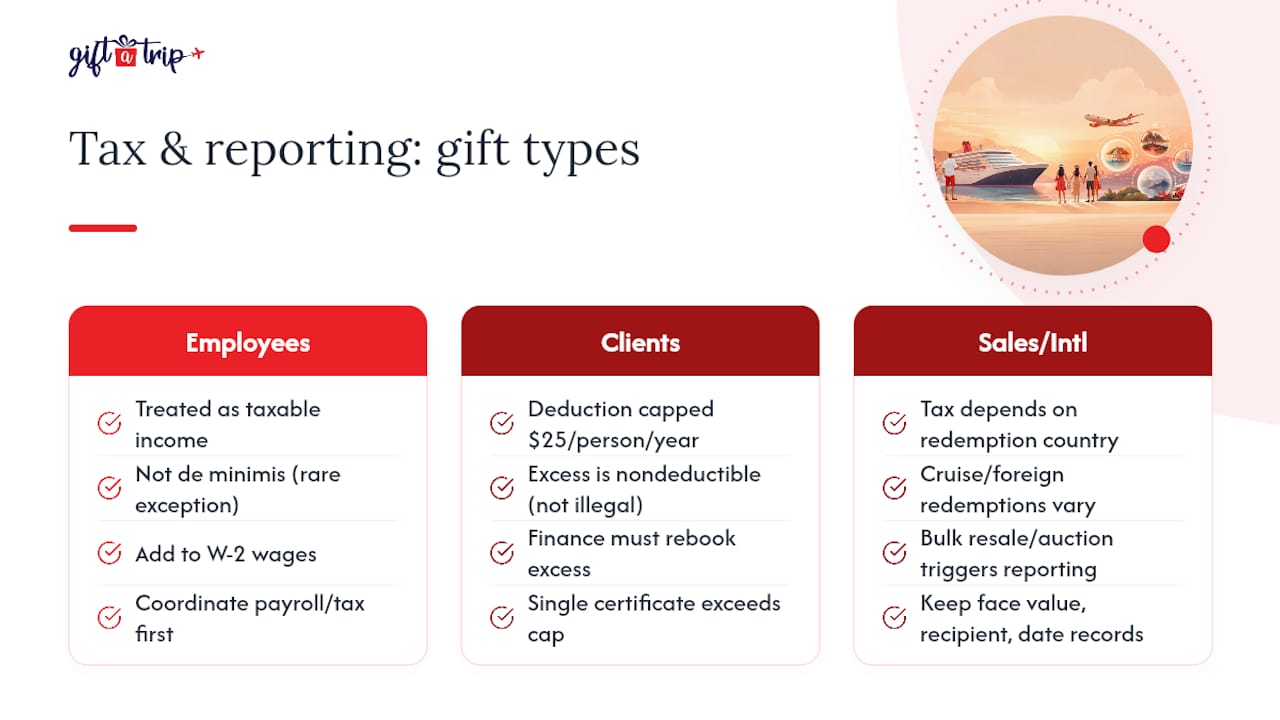
Travel certificates given through a business are generally treated as taxable income to the employee under IRS rules on fringe benefits, unless they qualify as a minimal “de minimis” benefit, a narrow exception that rarely covers something as valuable as a trip. That means most employee travel awards need to be reported, typically added to W2 wages, and HR teams should coordinate with payroll or a tax advisor before rolling out a large program rather than after certificates have already gone out.
Client gifts follow a different, and stricter, rule. The IRS caps deductible business gifts to any one person at $25 per year, a limit that has not moved in decades and that a single travel certificate blows past instantly. That doesn’t make the gift illegal. It just means the excess amount typically isn’t a deductible business expense, which changes how your finance team should book it.
Sales tax and international considerations add another layer. A certificate redeemable across multiple countries or cruise lines may carry different tax treatment depending on where redemption happens, and bulk purchases for resale or auction (as in charitable events) can trigger separate reporting requirements. None of this should scare you off the format. It should just push you to loop in your tax and payroll teams early, get their sign-off on reporting treatment before the first certificate goes out, and keep clean records of face value, recipient names, and redemption dates for every certificate issued. A five-minute conversation before launch beats a messy correction during tax season.
A Planner’s Take: What Actually Moves the Needle
The IRF data confirms what smart planners already suspected: fewer, richer rewards beat spreading a budget thin across everyone. Before you order anything, lock down three decisions: who exactly you’re rewarding, what per-person budget band that tier deserves, and whether digital or physical delivery fits your timeline. Skip that order, and you’ll be fixing mistakes after certificates are already in inboxes.
— Donovan
How Gift A Trip Supports Group Gifting Travel Programs
Some providers handle the operational headaches this guide just walked through: secure digital delivery, customizable bulk packaging, and pricing that includes taxes and fees so recipients don’t hit a surprise charge at checkout. Minimal blackout dates mean fewer support tickets when someone tries to book their trip.
For higher-value incentive tiers, the Flex Trip Collections give recipients flexibility across resorts, hotels, and cruise lines instead of locking them into one property. If you want the branded unboxing moment for an executive gift or milestone award, Red Box Delivery handles that physical presentation piece without you managing packaging vendors yourself. Corporate buyers running larger programs can also explore custom trip selection sites and airfare vouchers built specifically for bulk HR and event orders.
Start small: request a quote for a pilot batch of ten to twenty certificates, and pull the Travel Certificate Distribution Guide for HR and Events before you finalize your recipient list. It walks through the data-collection and fulfillment steps this article covered, in more operational detail.
Sources
This guide draws on the IRF 2026 Trends Report, 2025 Incentive Travel Index findings, and Gift A Trip’s own distribution guides for corporate clients.
- THE IRF 2026 TRENDS REPORT
- Corporate Incentive Travel Is Now a $180 Billion Business Case – Here Is What That Means for 2026 Planning
- The Ultimate 2026 Incentive Travel Budget Guide: Costs, Strategy & ROI Planning
FAQ
How Long Does Redemption Typically Take?
Redemption windows generally run several months rather than days, giving recipients time to plan travel dates without pressure. Exact timelines depend on the certificate and provider, so confirm the window before distributing certificates in bulk.
Are Travel Gift Certificates Taxable Income?
Yes, for employee recognition, travel certificates are generally treated as taxable compensation under IRS fringe benefit rules and typically need to be reported through payroll. Client gifts face a separate $25 annual deductibility cap per recipient, so check both rules with your tax advisor before launching a large program.
Does Giftatrip Charge for Physical Delivery?
Giftatrip’s Red Box Delivery option costs $69 as a one-time fee for branded physical packaging. Digital delivery pricing and certificate values vary by product, so check current pricing directly on the site.
Can I Personalize Bulk Orders With Messaging or Branding?
Yes. Bulk orders can include personalized messaging and custom branded packaging, which is one of the reasons planners lean toward this format over generic gift cards. Options like custom, branded gift box delivery are built specifically for this kind of bulk customization.
What’s the Minimum Order Size for a Corporate Program?
There is often no fixed minimum order requirement for some corporate gifting programs, which makes it practical to run a small pilot batch before committing to a full rollout. Starting with ten to twenty certificates is a reasonable way to test recipient experience before scaling up.