
Jump to Section:
“Cruise gift card policies” refers to the rules governing Gift A Trip’s cruise travel certificates: what they cover, what they exclude, and how long they last. The single most important action for any buyer, individual or corporate, is to verify eligible uses, expiration or transfer rules, and fulfillment timelines before purchase. Skip that step and you risk handing someone a gift that comes with more friction than joy.
TL;DR:
- Many cruise gift certificates exclude government taxes, port fees, gratuities, and casino play from the redeemable balance, which can significantly increase overall costs.
- Certificates typically last one to three years, with some requiring advance booking within specific windows, making timely planning essential.
- Transferability varies by issuer; some allow name changes or transfers for fees, while others are strictly personal, so verify rules before gifting.
- Blackout dates, minimum sail lengths, and advance purchase requirements may restrict when and how certificates can be redeemed.
- Corporate bulk orders involve additional considerations such as customization, secure distribution, fulfillment timelines, and potential tax implications.
Table of Contents
- What Cruise Gift Certificate Policies Usually Cover
- Common Restrictions and Exclusions to Expect
- Corporate and Bulk-Order Policy Considerations
- How to Buy, Send, and Manage Cruise Travel Certificates Safely
- Buyer Checklist: 10 Things to Check Before You Buy
- Author’s Perspective and Practical Takeaways
- Buying Cruise Certificates Through Gift A Trip
- Sources
- FAQ
What Cruise Gift Certificate Policies Usually Cover
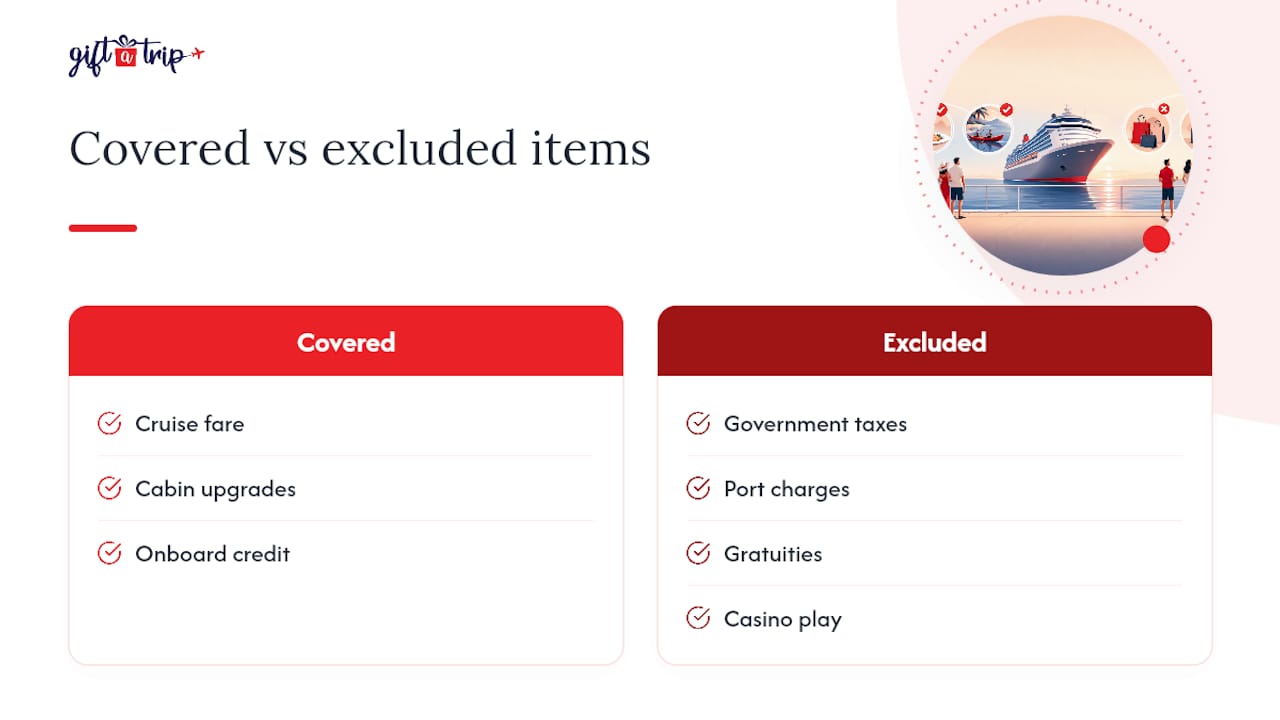
A cruise travel certificate typically pays toward the cruise fare itself, and often extends to cabin upgrades or onboard credit, depending on the certificate type and issuer. What it almost never covers is the full cost of a voyage once you factor in the extras. Government taxes, port charges, and gratuities usually sit outside the redeemable balance, and casino play is a common exclusion in cruise-related certificate products.
Denominations vary by product. Some certificates apply as a flat credit toward any qualifying sailing, while others set minimum or maximum values that determine whether the certificate covers a full booking or just offsets part of one. Ask whether the certificate functions as a partial payment or a standalone voucher. That distinction changes how a recipient plans their trip.
Expiration terms deserve close attention. Many certificates carry a window of one to three years, and some advance-purchase vouchers must be applied to a new booking made a set number of days out. One documented example requires booking at least 120 days ahead and expires within three years of purchase.
Transferability rules also differ widely. Some certificates allow a name change or transfer to another traveler, sometimes for a fee, while others lock the certificate to the original purchaser. Gift A Trip’s Royal Caribbean cruise certificates page lays out these terms clearly so buyers know what they are giving before checkout.
Common Restrictions and Exclusions to Expect
Every cruise certificate has boundaries. Knowing them in advance prevents an awkward conversation between the gift giver and the recipient later.
- Onboard charges are often excluded. Specialty dining, spa services, and Wi-Fi packages frequently fall outside the redeemable balance.
- Government taxes and port fees rarely count toward the certificate. These charges are billed separately in most cases.
- Gratuities and casino play are standard exclusions. Nearly every cruise-related certificate structure excludes casino wagering from redemption.
- Blackout dates and minimum sail lengths can apply. A three-day sailing might not qualify if the certificate requires a five-night minimum.
- Advance-purchase windows limit spontaneity. Some vouchers only apply to bookings made well ahead of the sail date, so last-minute redemptions may not work.
- Per-sailing caps and single-use rules are common. A certificate might only apply once, with no rollover for unused value.
Discounted voucher-style certificates illustrate the tradeoff well. Some sell below face value, such as paying $150 for a $300 certificate, but the savings come with tighter booking rules. That is a fair trade for a flexible traveler, but a frustrating one for a recipient who wants to book quickly.
Corporate and Bulk-Order Policy Considerations
Corporate buyers face a different set of questions than individual shoppers, mostly around scale, customization, and compliance. Order minimums and maximums vary by provider, and lead times for physical fulfillment tend to run longer than digital delivery, so build in buffer time before an event or recognition deadline.
- Customization and branding options let HR teams and event planners align certificates with a company’s visual identity.
- Fulfillment format matters for security. Bulk digital codes need controlled distribution so unredeemed certificates don’t circulate before the intended recipient gets them.
- Tax treatment requires early planning. Incentive trip winners often owe tax on the imputed value of the prize, and mature incentive programs commonly build in a gross-up payment so the winner isn’t stuck with a surprise bill.
- Redemption logistics need clear documentation. Booking windows, substitution rules, and the recipient information required at redemption should be spelled out before certificates go out the door.
Larger incentive travel programs also carry contractual weight that a single gift certificate never does. Group hotel contracts, deposit schedules, and cancellation clauses become relevant once you’re moving dozens of winners through a program, and that’s a different planning exercise than sending one certificate to a retiring employee.
Pro Tip: Loop in your finance or tax advisor before you finalize a bulk order, not after. A gross-up decision made post-distribution is far messier than one baked into the budget from the start.
Gift A Trip’s distribution guide for HR and events walks through fulfillment formats in more detail for teams planning their first bulk order.
How to Buy, Send, and Manage Cruise Travel Certificates Safely
Getting a cruise certificate policy right isn’t complicated, but skipping a step is where most gifting mistakes happen.
- Verify the terms first. Read the exclusions, expiration date, and transferability rules before you commit to a purchase.
- Choose the certificate type and value that matches the occasion, whether that’s a fixed-value gift or a percentage-off voucher.
- Select a delivery method. Digital delivery works for speed; physical packaging suits milestone gifts like retirements or anniversaries.
- Prepare recipient instructions. Include the redemption deadline, any booking requirements, and who to contact with questions.
- Track distributed certificates. For bulk orders, keep a record of which code went to which recipient in case of a replacement claim.
- Escalate promptly if something goes wrong. Contact customer service quickly if a code fails or a certificate needs reissuing, and keep the original purchase confirmation on hand.
Buyer Checklist: 10 Things to Check Before You Buy
Before you complete any purchase, run through this list:
- Eligible uses (fare, upgrades, onboard credit)
- Expiration date and any dormancy rules
- Transferability or name-change permissions
- Blackout dates or minimum sail-length requirements
- Minimum and maximum redemption values
- Exact redemption steps the recipient must follow
- Any fees tied to transfers or booking changes
- Refund and cancellation policy
- Tax implications for corporate or high-value awards
- Fulfillment timeline for digital or physical delivery
Ambiguity is the most common failure point in incentive programs, and publishing clear qualification rules and timelines upfront is what separates a smooth program from a frustrating one. Gift A Trip’s own page on cruise gift card restrictions covers several of these checks in more depth if you want specifics before buying.
Author’s Perspective and Practical Takeaways
Certificates make sense when the recipient values flexibility over a fixed itinerary. A managed incentive trip or straight cash works better when the goal is a guaranteed, uniform experience for a large group. The two most avoidable mistakes I see: buyers skipping the expiration date because it feels like fine print, and corporate teams forgetting the tax conversation until a winner asks about it. Both are fixed with five minutes of reading the terms before checkout.
— Donovan
Buying Cruise Certificates Through Gift A Trip
Some providers remove the guesswork that trips up most gift givers by stating policy terms plainly on every certificate page, rather than burying restrictions in fine print you find out about after checkout. Secure digital delivery, customizable gift boxes, and bulk-order support give both individual buyers and corporate teams a way to gift a cruise without chasing down redemption rules after the fact.

For corporate orders, Gift A Trip’s bulk order gifting guide walks through customization, distribution controls, and fulfillment timelines so your program launches on schedule. If you’re buying a single certificate for a birthday, anniversary, or retirement, browse Virgin Voyages cruise certificates to see current terms and pricing before you check out.
Sources
- Cruise line gift cards: how they work and common exclusions
- Corporate Incentive Trips: The 2027 Operator’s Guide
- Incentive travel planning: a strategic guide
FAQ
Are cruise gift cards refundable?
Most cruise travel certificates are non-refundable once purchased, though some providers allow reissuing if a code fails or is lost, so always check the cancellation policy before buying.
How long are cruise gift certificates valid?
Validity windows commonly range from one to three years, and some advance-purchase vouchers require booking a set number of days ahead of sail date, so check the specific expiration terms on your certificate.
Can you transfer a cruise gift certificate to someone else?
It depends on the issuer. Some certificates allow a name change or transfer, sometimes for a fee, while others are locked to the original purchaser, so confirm this before gifting.
Do cruise gift certificates cover taxes and gratuities?
Generally no. Government taxes, port fees, gratuities, and casino play are commonly excluded from the redeemable balance on cruise certificates.
What should corporate buyers check before a bulk cruise certificate order?
Corporate buyers should confirm order minimums, customization options, fulfillment lead times, and tax treatment, since incentive trip winners often owe tax on the trip’s value unless the program includes a gross-up payment.