
The five most damaging auction travel mistakes are picking a destination without checking donor preferences, writing vague listings, scattering fulfillment across too many vendors, sequencing travel lots poorly, and skipping a real redemption plan. Every one of these is preventable with a short checklist and one designated fulfillment owner, whether you source a donated package or issue a certificate through a provider like Gift A Trip.
TL;DR:
- Matching travel prizes to donor preferences and clearly describing inclusions increases bidding confidence and prevents undervaluation.
- Using fixed-value travel certificates instead of donated packages reduces fulfillment complexity and minimizes scope ambiguities.
- Setting strict booking deadlines, documenting responsibilities, and including detailed restrictions on the lot sheet cut down on post-auction complaints.
- Limiting the number of travel lots to three to five and sequencing the most attractive trip mid-event maintains bidder engagement.
- Assigning a single fulfillment owner and providing a straightforward redemption process ensures smoother delivery and better participant experience.
Table of Contents
- What Are the Most Common Auction Travel Mistakes?
- How Do You Build a Travel Auction Checklist That Prevents These Errors?
- What Fulfillment and Compliance Steps Get Overlooked?
- How Should You Present and Sequence Travel Lots for Bigger Bids?
- What Happens After the Gavel Falls?
- How Do Travel Certificates Solve Most of These Problems?
- Why Simplicity Beats Ambition in Travel Auction Lots
- Sources
- FAQ
What Are the Most Common Auction Travel Mistakes?
Most travel-lot failures trace back to a handful of decisions made weeks before the event, not the night itself. Here’s where planners consistently go wrong.
- Chasing organizer taste over donor data. A committee member loves Tuscany, so Tuscany goes on the block, even though last year’s bidding data shows your donors go crazy for beach resorts and golf packages. Vague package descriptions and ignoring audience preferences are among the top reasons travel lots underperform.
- Vague listings that leave bidders guessing. “Weekend getaway for two” tells nobody anything. Missing traveler counts, blackout dates, and exact inclusions makes bidders nervous, and nervous bidders bid low.
- Sourcing through commission-heavy brokers. Third-party travel brokers often take a cut that could have gone straight to your cause. Sourcing travel in-house rather than through commission-based brokers keeps more value with the charity and gives you cleaner control over redemption terms.
- Bad timing kills bidding energy. Put your marquee trip up too early and the room hasn’t warmed up. Put it up too late and people are checking their coats.
- Diffused fulfillment with no single owner. When the hotel, the airline credit, and the transfer voucher all come from different sources with nobody coordinating them, winners end up making four phone calls to book one trip.
- Reimbursement traps and hidden costs. Resort fees, baggage charges, and seat upgrades that weren’t disclosed at auction time turn a generous prize into a customer-service headache.
None of these mistakes are exotic. They’re the same five errors, repeated year after year, at galas from small-town PTA fundraisers to corporate incentive dinners.
How Do You Build a Travel Auction Checklist That Prevents These Errors?
Fixing these problems starts weeks before the gavel, not the week of.
- Check the audience, not your gut. Pull last year’s bid sheets or send a two-question donor poll. If beach resorts outbid European tours by two to one last year, don’t gamble on a repeat of your personal travel wish list.
- Pick your sourcing route deliberately. A donated package from a board member’s timeshare is free but comes with restrictions you can’t control. A travel certificate gives you fixed inclusions and predictable value. Consignment travel gives flexibility but usually carries a commission. Weigh cost against control before you commit.
- Document inclusions exactly, then set the numbers. Write out what’s covered, what isn’t, and the blackout window in plain language. Set opening bids at or above your nonprofit cost so the trip can’t sell for less than what it cost the organization to offer it.
- Name one fulfillment owner and write a one-page redemption sheet. Winners should get a single document explaining exactly how to book, who to contact, and by what date.
- Set hard deadlines for booking, reimbursement, and backup plans. If a winner hasn’t booked within 90 days, what happens? Decide that now, not after the complaint email arrives.
Pro Tip: Print your redemption terms on the actual bid sheet, not just a follow-up email. Bidders who see “must book by June 2026, blackout dates apply during holidays” before they raise a paddle bid with fewer surprises later.
A step-by-step charitable auction travel workflow helps you turn this checklist into a repeatable process instead of a one-time scramble.
What Fulfillment and Compliance Steps Get Overlooked?
The gap between an exciting auction moment and a happy winner three months later is almost entirely operational. Prize travel failures usually stem from misaligned logistics, compliance mismatches with official rules, and poor coordination among multiple vendors, not from bad luck.
- Match your Official Rules to the actual prize. If your printed rules promise “airfare included” but the certificate only covers lodging, you have a legal problem, not just an awkward conversation.
- Decide who books, in writing. Is it the organizer, the donor, the supplier, or the winner? Document who pays what and when, before the auction, not after a confused winner calls three different numbers.
- Coordinate every vendor touching the trip. Flights, hotel, and transfers need to line up on arrival day. Give the winner one contact, not a folder of vendor emails.
- Plan for cancellations upfront. Weather, health issues, and scheduling conflicts happen. Decide your reimbursement and rebooking policy before you need it, not while a winner is upset on the phone.
- Disclose the extras. Baggage fees, resort fees, and seat assignments are the surprise costs that generate the angriest emails. Say so in the fine print now.
A reliable dining itinerary built around local guides can round out a travel lot nicely, but only after the core logistics are locked down. Coordination failures, not bad weather or unlucky timing, cause most of the complaints that land in a nonprofit’s inbox after the event.
How Should You Present and Sequence Travel Lots for Bigger Bids?
Describe the experience, not the destination. Bidders buy the feeling of a private plunge pool or a sunset dinner on the water, not a line item that just says “Cancun.” A short sample itinerary, paired with real photos, does more to raise bids than any amount of adjective-stacking in the catalog copy.
- Write experiential copy that names specific moments: a couples’ massage, a chef’s table dinner, a champagne toast at check-in.
- Keep travel lots to a tight set of three to five. Limiting travel lots to a small, curated group keeps bidder attention focused instead of splitting it across too many similar options.
- Sequence your best trip when the room is warmed up but not worn out. Travel lots perform best mid-event, after the energy has built but before fatigue sets in.
- Put redemption steps right on the lot sheet, not buried in a follow-up email nobody reads until it’s too late.
Pro Tip: If you’re stuck on ideas beyond the standard beach week, a list of travel reward ideas for fundraising can help you diversify without overwhelming the catalog.
What Happens After the Gavel Falls?
Winning a trip and actually taking it are two different experiences, and the gap between them is where goodwill gets won or lost.
- Contact the winner within 48 hours. Send a short, warm message with the redemption sheet attached and a clear next step.
- Confirm whether it’s a booked trip or a stipend model, and set a realistic settlement timeline, typically 60 to 90 days for booking confirmation.
- Name one escalation contact for changes, questions, or problems, so the winner never has to guess who to call.
- Keep records of every certificate, restriction, and blackout date communicated, both for compliance and for next year’s donor relationship.
- Restate any blackout windows or restrictions in writing at the moment of redemption, not just at the moment of the win.
Fundraisers routinely underestimate how much coordination a “won” trip still needs. A single point of contact for fulfillment, kept consistent from the gavel to the final thank-you note, is what actually protects the winner’s experience and your organization’s reputation.
How Do Travel Certificates Solve Most of These Problems?
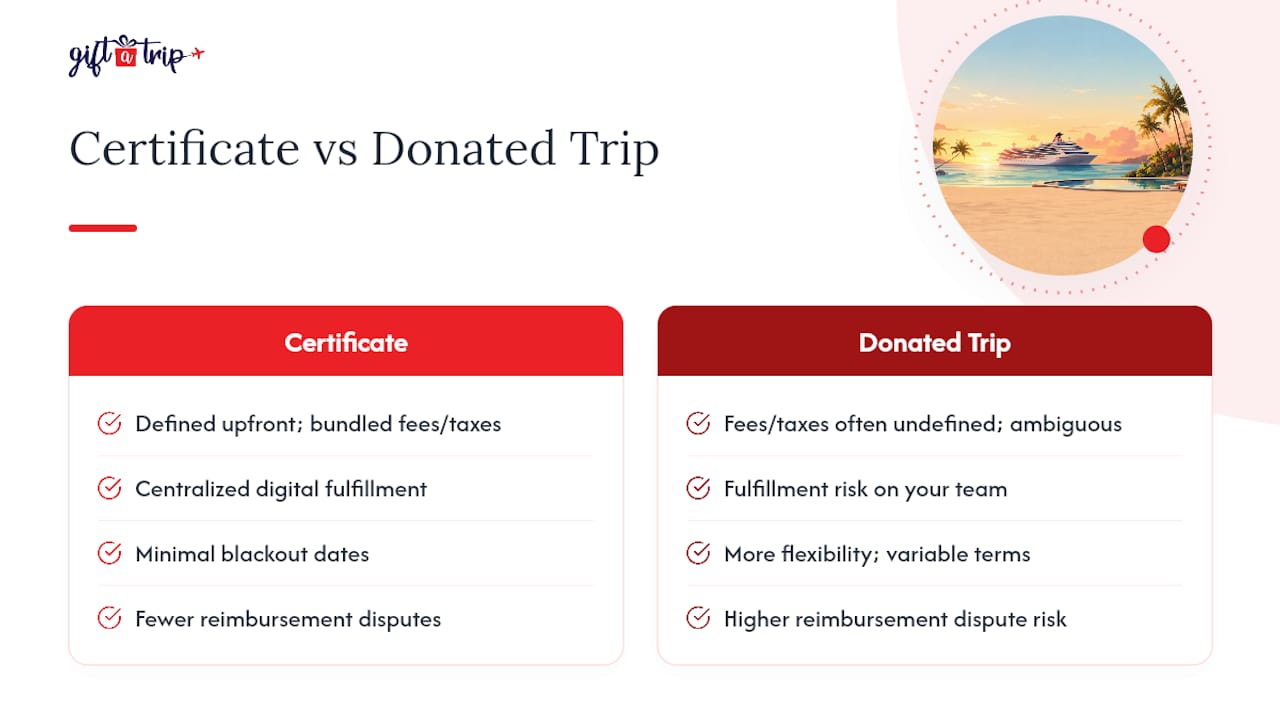
Certificate-based travel prizes sidestep most of the mistakes above by design. Because the inclusions, taxes, and fees are defined upfront, there’s no ambiguity for winners to get frustrated over later. Digital travel certificates centralize fulfillment and clarify inclusions, which cuts down the reimbursement disputes that plague loosely defined donated packages.
Some certificate programs offer secure digital delivery, customizable bulk gift boxes for corporate or event orders, and certificates that bundle in fees and taxes with minimal blackout dates. That structure works especially well when your committee doesn’t have a donor willing to arrange a full custom package, or when you want predictable value instead of negotiating with a hotel property directly. If you’re weighing a certificate against a donated trip, the deciding factor is usually control: a certificate gives you fixed terms; a donated package gives you flexibility but shifts fulfillment risk onto your team. Either way, a step-by-step charity auction gift certificate guide walks through how to fold either option into an existing auction workflow.
Why Simplicity Beats Ambition in Travel Auction Lots
The biggest misconception fundraisers carry into travel auctions is that a more exotic destination automatically means a higher bid. It usually doesn’t. Donors bid confidently on what they can picture and trust, not on what sounds impressive on a gala program. A clearly defined weekend package with airtight terms will consistently outbid a vague “luxury European adventure” that nobody can picture booking.
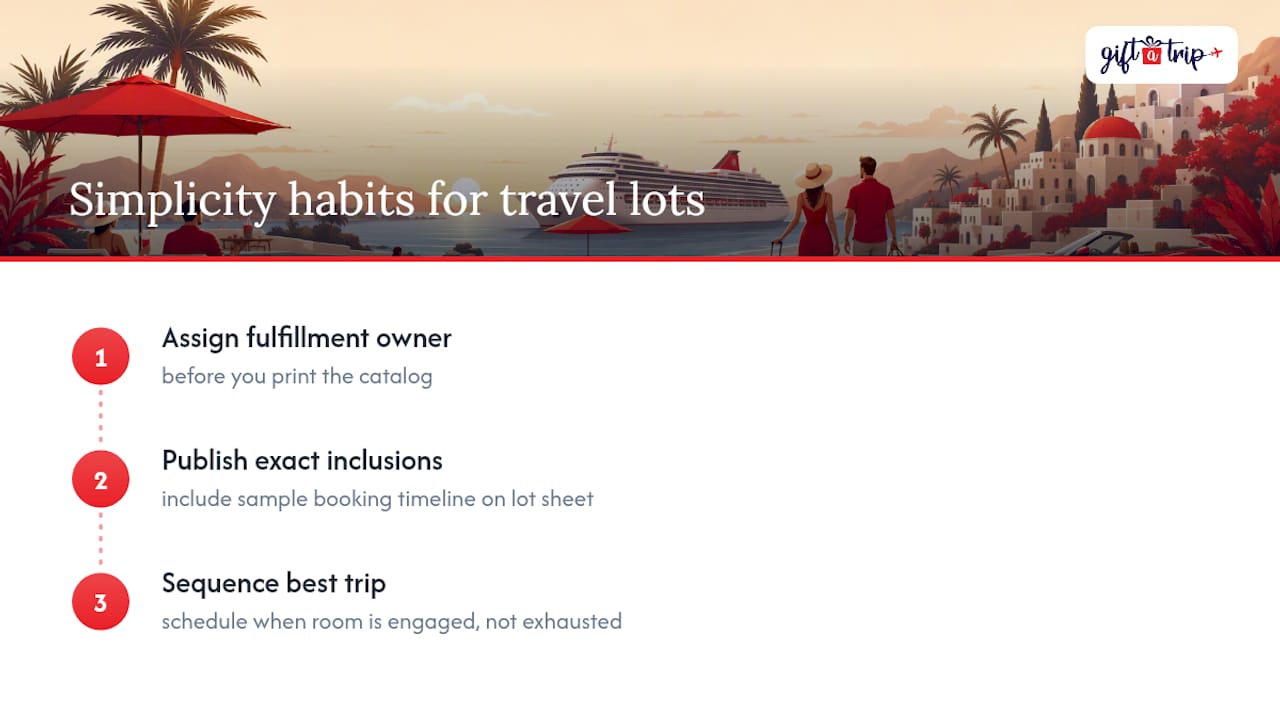
Assign one fulfillment owner per lot before you ever print the catalog. Publish exact inclusions and a sample booking timeline on the lot sheet itself, not in a follow-up email. And sequence your best trip for the moment the room is engaged, not exhausted. Those three habits fix nearly every recurring complaint that shows up in post-auction surveys, and none of them require a bigger budget, just better sequencing of decisions you were already going to make.
— Donovan
Sources
- Travel and Vacation Nightmares: Managing Compliance and Winner Experience in Prize Fulfillment | ESG
- Charity Auction Travel Packages: Boost Fundraising Donations – Charity Safaris
- Charity vacation auctions: sourcing and selling travel lots
- Charity Auction Travel Packages | CharityAuctions
FAQ
What is the biggest mistake fundraisers make with travel auction items?
Picking a destination based on committee preference instead of what donor bidding history actually shows people want is the single most common and most costly mistake.
Should nonprofits source travel packages in-house or through a broker?
Sourcing in-house or through a certificate provider typically keeps more value with the nonprofit than commission-based brokers, and it gives clearer control over redemption terms.
How many travel lots should a single auction include?
Keep travel lots to a curated group of three to five so bidder attention and energy stay focused on marquee items instead of splitting across too many similar options.
Who should be responsible for booking a winner’s trip?
Document one fulfillment owner, whether that’s the organizer, donor, or supplier, before the auction happens, and give winners a single point of contact for booking and any changes.
What should be disclosed in a travel auction listing to avoid complaints?
List exact inclusions, blackout dates, traveler count, and any extra costs like resort fees or baggage charges directly on the lot sheet, not just in a follow-up email.