Jump to Section:
TL;DR:
- Experiences create lasting emotional bonds and become part of personal identity, unlike fleeting physical products. Personalization enhances their effectiveness, boosting loyalty and engagement by matching recipients’ preferences. Using experiences for rewards and gifts fosters anticipation, reduces clutter, and generates memorable stories that extend emotional impact.
Offering experiences over products means choosing gifts and rewards that create lasting emotional memories rather than transferring physical ownership. 59% of Millennials and Gen Z prefer experiential gifts over physical products as of 2026, and corporate gifting data shows 92% of C-level recipients remember personalized experience gifts for over six months. Physical goods lose their emotional charge quickly as people adapt to owning them. Experiences, by contrast, become part of a person’s identity and story. Whether you are selecting a birthday gift or designing an employee rewards program, the case for experience-based giving has never been stronger.
Why offer experiences over products: the emotional science
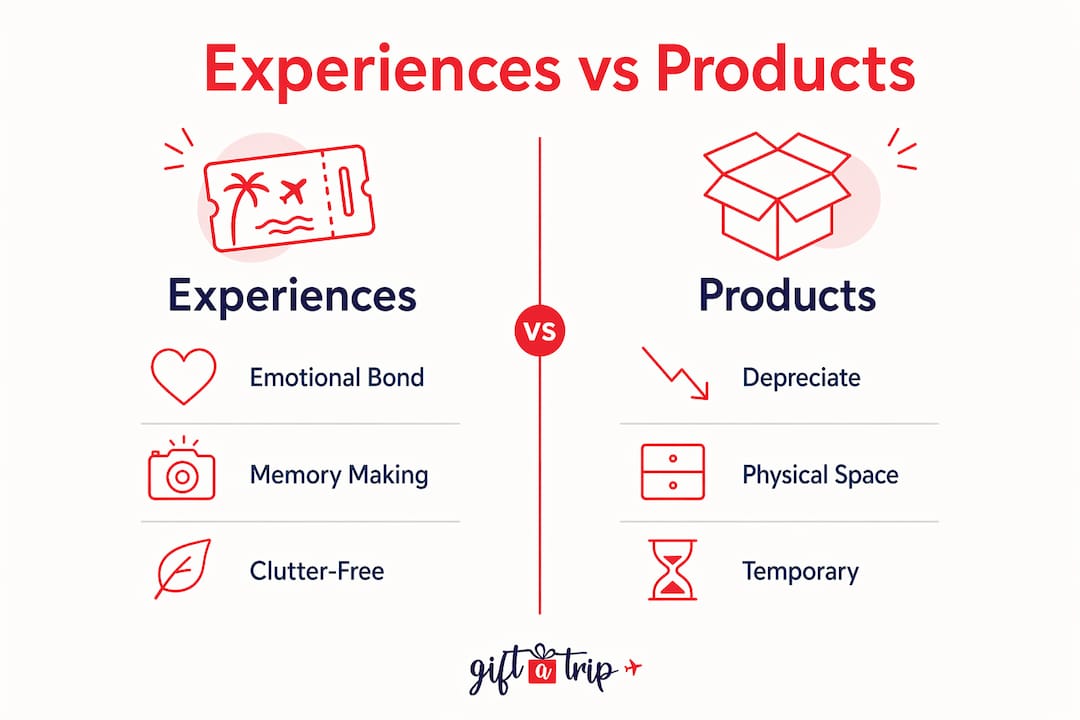
Experiences create stronger emotional bonds than products because of what happens during consumption, not at the moment of unwrapping. Research by Chan and Mogilner with 1,788 participants found that emotional intensity during use is the primary factor that makes experiential gifts strengthen relationships more than physical ones. A product may impress on day one, but that impression fades as it becomes part of the furniture.
Dr. Thomas Gilovich at Cornell University demonstrated that experiences become part of personal identity and life stories in a way that physical goods simply do not. A new watch becomes background noise within weeks. A weekend in the mountains stays in conversation for years. That difference is not sentimental. It is psychological.
Experiences also build social bonds in ways products rarely do. Harvard Business Review analysis confirms that experiential gifts create stronger social sharing compared to material gifts, which tend to generate isolated appreciation. When someone returns from a trip or a cooking class, they tell the story. That storytelling extends the emotional value of the gift far beyond the event itself.
The best physical gifts can blur this line. A high-quality espresso machine, for example, creates an emotional ritual every morning. These “material gifts with experiential souls” work because they generate repeated emotional moments during use. The principle is the same: it is the feeling during engagement, not the object itself, that drives lasting satisfaction.
- Emotional intensity during use, not unwrapping, is the key bonding mechanism
- Experiences integrate into personal identity and remain part of life stories
- Social sharing amplifies the value of experiential gifts over time
- Physical goods that create repeated emotional rituals can mimic experiential benefits
Pro Tip: When selecting a gift, ask yourself: “Will this create a memorable moment during use?” If the answer is yes, you are on the right track regardless of whether the gift is physical or experiential.
How does personalization make experience gifts more effective?
Personalization is the factor that separates a meaningful experience gift from an awkward obligation. 61% of marketers say personalization drives improved customer retention in 2026. That number reflects a shift in how organizations think about gifting: generic is no longer good enough.
A poorly matched experience gift can feel like homework. Sending a skydiving voucher to someone with a fear of heights, or a wine tasting to a non-drinker, signals that the giver did not pay attention. That failure undermines the entire purpose of the gift. The emotional damage from a mismatched experience gift is often worse than giving nothing at all.
Personalized experiential gifts boost client loyalty by up to 35% in competitive corporate gifting markets. That figure reflects real business value. When a recipient feels seen and understood, the gift reinforces the relationship rather than just acknowledging it. This is why the most effective corporate reward programs invest in understanding recipient preferences before selecting an experience.
Personalization applies to physical gifts too, but experiences allow a deeper level of customization. You can tailor the destination, the activity, the timing, and the companions. That flexibility makes experience-based gifts uniquely suited to modern consumer expectations, where one-size-fits-all rewards are increasingly ignored. Understanding personalized gifting’s role in engagement helps both individuals and organizations make smarter choices.
- Research the recipient’s hobbies, travel preferences, and lifestyle before choosing an experience
- Avoid generic “spa day” or “adventure package” defaults without confirming they fit the person
- In corporate settings, survey employees or clients on preferred experience categories annually
- Pair the experience with a personal note that explains why you chose it for them specifically
Pro Tip: For corporate programs, build a simple preference profile for key recipients. Even three data points, such as preferred travel style, dietary needs, and activity level, can transform a generic reward into a genuinely memorable one.
What are the practical benefits of choosing experiences over products?
Anticipatory happiness is one of the most underrated advantages of experience-based gifts. Psychology research shows that pre-experience anticipation can exceed the happiness from the experience itself. A product arrives and the excitement peaks immediately. An experience gift, delivered weeks in advance, generates sustained positive emotion from the moment of receipt through the event and into the memories that follow.

Experiences also solve a problem that physical gifts create: clutter. A physical product competes for space, requires maintenance, and eventually gets discarded. An experience leaves no residue except memory. For recipients who value minimalism or already have everything they need, an experience is the only gift that adds value without adding weight.
The shareability of experiences amplifies their worth in ways products cannot match. When someone posts about a resort stay or a cooking class, the gift reaches an audience far beyond the recipient. That organic storytelling creates brand association for corporate gifters and deepens personal relationships for individual givers. The gift keeps working long after the event ends.
Here are the core practical advantages that make experiences the stronger choice:
- Anticipatory happiness generates positive emotion from the moment of receipt, not just during the event itself.
- Memory durability means recipients recall experiential gifts far longer than physical ones, with 92% of C-level recipients remembering personalized experience gifts for over six months.
- Zero clutter makes experiences ideal for recipients who are hard to shop for or who already own what they need.
- Social amplification through storytelling and sharing extends the emotional reach of the gift beyond the recipient.
- Flexible price points allow experiences to fit any budget, from a local cooking class to a luxury cruise certificate.
- Sustainability reduces waste associated with packaging, shipping, and eventual disposal of physical goods.
Physical products depreciate. A $200 gadget is worth less the moment it leaves the store. A $200 experience, by contrast, appreciates in memory. That asymmetry is the core financial and emotional argument for choosing experiences. Understanding how guest experience drives satisfaction in hospitality reinforces why this principle applies across both personal and professional gifting contexts.
How to successfully deliver experience-based gifts and rewards
Presentation shapes how an experience gift lands. A digital certificate sent without context feels transactional. The same certificate delivered with a handwritten note, a personal message explaining the choice, and a hint of what to expect creates anticipation before the experience even begins. Storytelling is not decoration. It is part of the gift.
Include a tangible element when possible. A small physical item that hints at the experience, such as a travel guide, a branded luggage tag, or a custom itinerary card, gives the recipient something to hold while they wait. This bridges the gap between the moment of receipt and the experience itself, sustaining the emotional engagement that makes experiential gifts so effective.
Deliver the notification early. Advance notification of an experience gift creates anticipatory happiness that enhances overall satisfaction. This is a psychological benefit unavailable from most physical products. A gift announced six weeks before the event generates six weeks of positive emotion. A product delivered to the door generates one afternoon of excitement.
Offering choice between experience and physical gifts improves satisfaction and retention. SHRM research and the O.C. Tanner Global Culture Report both confirm that top reward programs blend both intelligently, respecting individual preferences. Not every recipient wants the same thing, and forcing an experience on someone who would prefer a practical tool defeats the purpose.
- Lead with a personal message that explains why you chose this specific experience for this specific person
- Add a tangible teaser item to create physical anticipation before the event
- Deliver experience gifts early to maximize the anticipatory happiness window
- In corporate contexts, use experiences for milestone recognition and physical gifts for practical day-to-day needs
- Offer recipients a choice when budget allows, and track preferences for future gifting cycles
- Use digital travel certificates for flexible, instantly deliverable experiential gifts that recipients can redeem on their own schedule
Key Takeaways
Experiences outperform products as gifts because they generate intense emotions during use, become part of personal identity, and create lasting memories that physical goods cannot replicate.
| Point | Details |
|---|---|
| Emotional intensity drives bonding | The feeling during an experience, not the unwrapping, is what strengthens relationships and builds loyalty. |
| Personalization is non-negotiable | Matching the experience to the recipient’s interests boosts loyalty by up to 35% and prevents the gift from feeling like an obligation. |
| Anticipation multiplies value | Delivering experience gifts early creates weeks of positive emotion before the event even occurs. |
| Social sharing extends reach | Experiences generate storytelling that amplifies the gift’s value far beyond the recipient and the event. |
| Choice improves outcomes | Blending experience and physical gift options in reward programs respects preferences and increases satisfaction. |
The case for experiences is stronger than most people realize
I have watched organizations spend significant budgets on branded merchandise that ends up in a drawer by February. The intent is genuine, but the impact is close to zero. The shift I have seen work, consistently, is when a company replaces a generic gift basket with a travel certificate or a curated local experience tied to something the recipient actually cares about.
The mistake most givers make is treating the gift as the gesture. The gift is not the gesture. The memory is the gesture. A product says “I thought of you.” An experience says “I know you.” That distinction sounds small, but recipients feel it immediately, and they remember it for years.
The 2026 data on experiential gifting is not surprising to anyone who has paid attention. What surprises me is how slowly organizations are acting on it. The research has been clear for nearly a decade. Experiences create stronger bonds, generate better recall, and produce measurable loyalty gains. The only reason to keep defaulting to physical products is habit.
My advice is direct: stop defaulting to what is easy to order and start asking what will create a story worth telling. That question alone will improve your gifting outcomes more than any budget increase. Intentionality is the ingredient most gifting programs are missing, and it costs nothing extra.
— Donovan
Travel experiences that make gifting effortless
Giftatrip offers digital travel certificates redeemable at resorts, hotels, cruise lines, and vacation packages from major brands. Each certificate delivers instantly, includes taxes and resort fees, and carries minimal blackout dates, making it one of the most flexible experiential gifts available for both personal and corporate use.
For organizations running employee recognition or client loyalty programs, Giftatrip’s bulk ordering and personalized messaging options make it straightforward to deliver meaningful travel experiences at scale. If you are ready to give a gift that creates a genuine memory, Virgin Voyages cruise certificates and resort stays are a strong place to start.
FAQ
Why do experiences create stronger memories than products?
Experiences generate intense emotions during consumption, which is the primary mechanism that encodes strong memories. Research shows 92% of C-level recipients remember personalized experience gifts for over six months.
How important is personalization for experience gifts?
Personalization is critical. A mismatched experience gift can feel like an obligation rather than a reward. Matching the experience to the recipient’s interests drives retention and loyalty gains of up to 35%.
What is anticipatory happiness in experiential gifting?
Anticipatory happiness is the pleasure a recipient feels while looking forward to an upcoming experience. Psychology research shows this pre-event enjoyment can exceed the happiness felt during the experience itself, a benefit physical products cannot replicate.
Should organizations offer experiences or physical gifts for employee rewards?
Top reward programs blend both, but use experiences for milestone recognition and physical gifts for practical needs. SHRM research confirms that offering choice between the two improves satisfaction and retention outcomes.
What makes digital travel certificates effective as experience gifts?
Digital travel certificates combine the flexibility of a physical gift with the emotional impact of an experience. They deliver instantly, allow recipients to choose their own timing, and create anticipation that sustains positive emotion from receipt through redemption.