Jump to Section:
TL;DR:
- Travel incentives in 2026 are shifting towards higher per-person spending on fewer, more meaningful experiences. Smaller groups, wellness integration, and slower itineraries drive deeper engagement and stronger loyalty. Technology such as AI and automated approval frameworks support but do not replace personalized, human-centered program design.
Travel incentive trends 2026 are defined by one clear shift: companies are spending more per person and doing less per day. The Incentive Research Foundation and Maritz research confirm this move toward purposeful, slower programs. Average spend per participant reached $4,900 in 2025, a 54% increase, and 45% of organizations plan to grow their budgets further in 2026. For corporate managers and incentive coordinators, this signals a fundamental rethinking of what travel rewards are supposed to accomplish. The goal is no longer to impress with volume. It is to motivate with meaning.
What are the defining characteristics of travel incentive trends 2026?
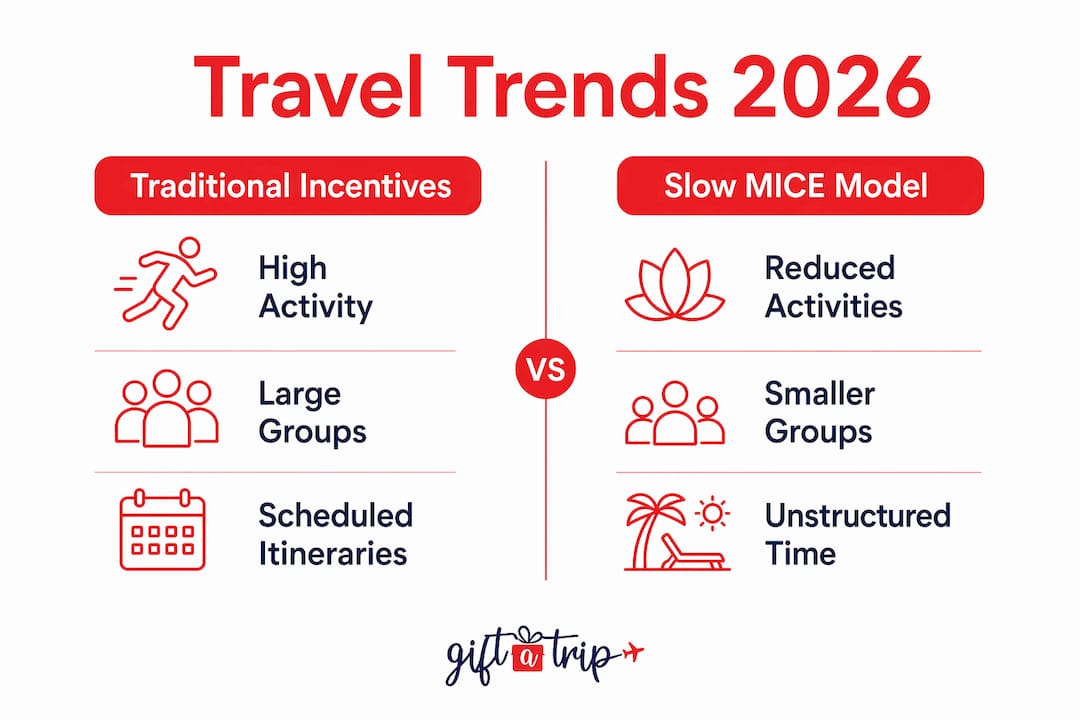
The dominant model reshaping 2026 travel incentives is called “Slow MICE.” MICE stands for Meetings, Incentives, Conferences, and Exhibitions. The “slow” version borrows from the slow travel movement: fewer activities, more breathing room, and deeper engagement with each experience. Programs built on this model replace packed schedules with two or three high-quality moments per day, giving participants time to absorb and connect.
Wellness integration is now standard, not optional. Wellness appears in at least 81% of incentive programs, and programs that include it report stronger post-trip motivation than those relying on traditional luxury perks alone. Spa access, guided meditation, and nature-based activities are replacing cocktail receptions as the default evening offering.
Group size is shrinking by design. The preferred cohort is now 20–60 participants, small enough that every winner gets recognized individually. Larger groups dilute that recognition. A room of 300 people applauding a winner feels very different from a dinner of 40 where the CEO knows everyone’s name.
Key characteristics shaping programs right now:
- Slower itineraries with deliberate downtime built into every day
- Wellness as a core element, not an add-on spa credit
- Smaller, exclusive groups for deeper personalization and recognition
- Quality over quantity in activities, favoring cultural depth over tourist checklists
- Higher per-person investment even as total group sizes shrink
Pro Tip: When designing your 2026 program, cut one activity from each day and replace it with unstructured time. Participants consistently rate free time as one of the most memorable parts of a well-designed incentive trip.
How do generational and workforce changes impact travel incentive design?
The workforce earning travel rewards in 2026 looks very different from a decade ago. 60% of top-performing incentive qualifiers now work in operations or technology roles, not sales. That single statistic rewrites the eligibility rules for most programs. If your qualification criteria still filter for quota-carrying salespeople only, you are excluding the majority of your highest performers.
Motivation data from Maritz and SITE Global reinforces why this matters. 61% of employees rate individual travel as “extremely motivating,” and 89% report greater loyalty to their employer after winning a travel incentive. That loyalty effect does not stop at the sales floor.
Generational preferences add another layer of complexity. Gen Z qualifiers prioritize novelty and authenticity over prestige destinations. They want to go somewhere they cannot easily book themselves, and they want the experience to feel real rather than staged. Millennial winners still respond strongly to wellness and family-friendly flexibility. Older cohorts often value comfort, exclusivity, and recognition ceremonies.
The practical implication is that a single itinerary no longer serves everyone well. Programs that offer guest flexibility, such as a choice between a cooking class and a hiking excursion on the same afternoon, consistently outperform rigid schedules on post-trip satisfaction scores.
- Expand eligibility beyond sales to include operations, technology, and support roles
- Offer experience choices within the itinerary to accommodate generational preferences
- Build in recognition moments that feel personal, not ceremonial
- Select destinations that feel exclusive and hard to replicate independently
- Design for guests, since many winners bring a partner and that person’s experience shapes the winner’s memory
What technology and strategy innovations support 2026 travel incentives?
Strategic Meeting Management, known as SMM, is the framework most large organizations now use to govern incentive travel alongside their broader meeting portfolios. SMM treats every incentive trip as a managed spend category with defined approval workflows, compliance checkpoints, and ROI benchmarks. The practical tool that makes SMM work at scale is the Meeting Request Form, or MRF.
SMM frameworks and automated MRFs reduce cost per attendee by an average of 15% while supporting compliance. That reduction comes from consolidating supplier negotiations, eliminating duplicate bookings, and catching budget overruns before they happen rather than after.
ROI measurement has grown more precise. The most credible method compares sales pipeline closed by incentive winners against non-winners over the same period. This approach produces a number that finance teams accept, which matters when you are defending a $4,900 per-person budget to a CFO focused on cost controls.
AI tools are changing administrative workflows without replacing human judgment. ChatGPT and Microsoft Copilot now handle tasks like RFP drafting, itinerary formatting, and attendee communication templates. That frees planners to focus on the decisions that actually require human insight: supplier relationships, on-site problem solving, and the emotional arc of the program.
The four technology priorities for 2026 programs:
- Implement MRFs to automate approval workflows and capture spend data from the first planning request
- Use AI for administrative tasks such as drafting communications, formatting budgets, and building comparison matrices
- Track ROI by comparing winners to non-winners on revenue metrics over a defined post-trip window
- Score destinations on sustainability and duty-of-care criteria before shortlisting, not after contracts are signed
Pro Tip: Build your ROI tracking framework before the program launches, not after. Retroactively matching winner data to sales outcomes is possible but messy. A pre-defined tracking window of 90–180 days post-trip produces the cleanest results.
One risk that technology cannot solve is hidden costs. Clear communication about inclusions and exclusions is critical to maintaining the perceived value of the reward. A winner who arrives expecting a fully covered experience and then receives a resort fee bill at checkout does not feel rewarded. That perception damage is hard to undo.
How are destination and itinerary choices evolving in 2026?
Destination selection in 2026 is driven by three forces: travel time, sustainability, and the demand for experiences that feel genuinely exclusive. 40% of planners now prioritize destinations with lower carbon footprints, which in practice means favoring short-haul options that maximize program time while reducing environmental impact.
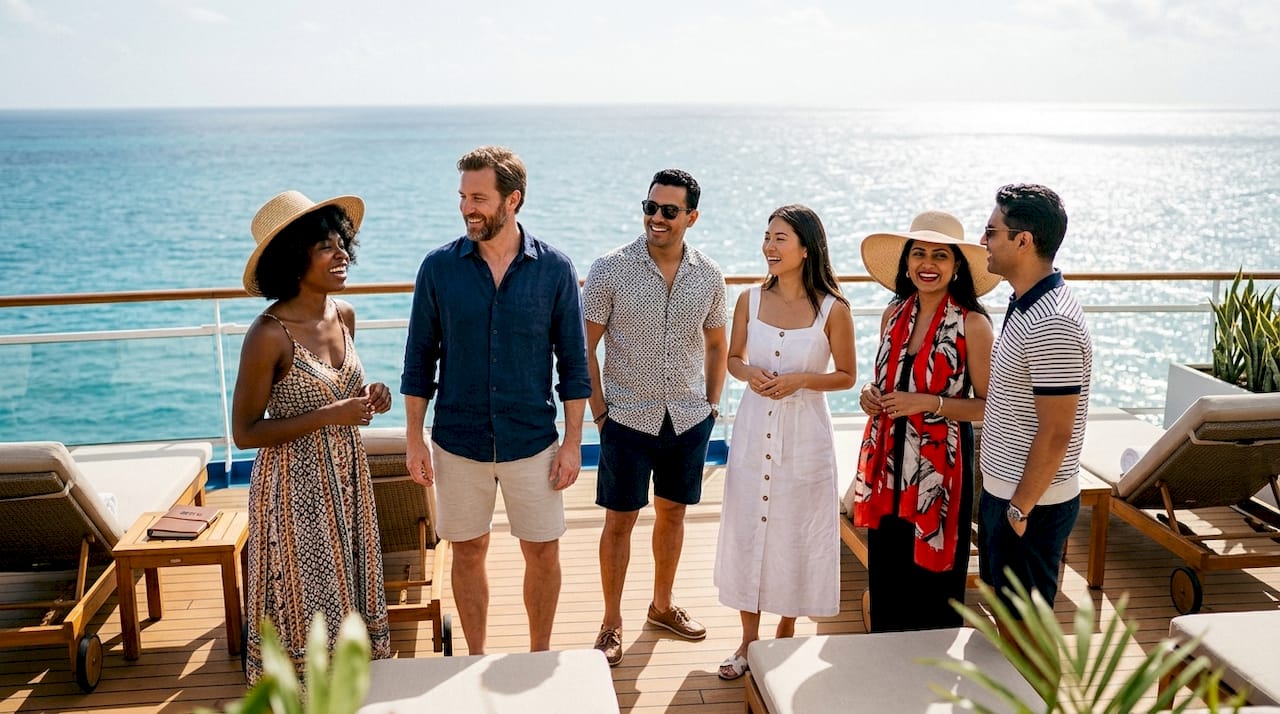
Short-haul luxury destinations win on multiple fronts. A four-night program in a destination reachable in two hours leaves four full days for experiences. The same four nights with a ten-hour travel day on each end leaves two. That math is reshaping destination shortlists across North America and Europe.
Less-visited locations are gaining ground fast. Destinations that feel undiscovered carry a prestige that Paris or Cancun no longer can. Emerging European cities, boutique island properties, and culturally rich secondary markets offer the novelty that Gen Z and Millennial winners specifically seek. Boutique venues in these locations also book out further in advance, which is pushing lead times from the traditional six months to twelve months or more.
| Itinerary approach | Traditional model | 2026 model |
|---|---|---|
| Daily activity density | 4–6 scheduled events | 2–3 curated experiences |
| Group size | 100–300 participants | 20–60 participants |
| Destination type | Major tourist hubs | Emerging or boutique locations |
| Sustainability scoring | Rarely applied | Standard pre-selection criterion |
| Booking lead time | 4–6 months | 10–14 months |
Cultural immersion has replaced sightseeing as the itinerary standard. Participants cooking with a local chef, visiting a family-owned winery, or joining a community project remember those moments years later. A bus tour of the same city’s landmarks does not produce the same recall or the same loyalty effect.
The guest experience design at boutique properties also tends to be more attentive than at large resort hotels, which reinforces the exclusivity feeling that makes travel incentives work as motivators. That feeling is the product. The destination is just the setting.
Key Takeaways
The most effective 2026 travel incentive programs combine smaller groups, slower itineraries, and expanded eligibility to produce measurable loyalty gains and clear ROI.
| Point | Details |
|---|---|
| Spend is rising with purpose | Average per-person investment reached $4,900, reflecting a shift to quality over volume. |
| Slow MICE outperforms packed schedules | Programs with fewer, deeper activities drive stronger post-trip motivation and loyalty. |
| Eligibility must expand | 60% of top qualifiers work in operations or technology, not sales. |
| Technology supports but does not replace humans | AI handles admin tasks; human judgment drives emotional program design. |
| Destination choice is now a sustainability decision | 40% of planners prioritize lower-carbon destinations, favoring short-haul luxury options. |
Why the “less is more” principle is the real trend to watch
I have reviewed incentive program designs across industries for years, and the pattern I keep seeing is this: the programs that fail are the ones that try to justify their budget by filling every hour. Coordinators feel pressure to show value through activity count. That instinct is understandable and almost always wrong.
The data from Maritz and the Incentive Research Foundation backs what I have observed directly. Participants do not remember the third excursion of the day. They remember the dinner where the CEO sat at their table. They remember the morning they had nothing scheduled and ended up exploring a market with a colleague they barely knew. Those unplanned moments are not accidents. They are what happens when you design space into a program.
The other mistake I see repeatedly is treating the workforce as a monolith. A program designed for a 45-year-old sales director will not motivate a 27-year-old operations analyst the same way. The travel incentives guide from Giftatrip covers this well: personalization is not a luxury feature of modern incentive programs. It is the baseline expectation of a multi-generational workforce.
My recommendation for 2026 is to start planning earlier than feels necessary, cut your activity list by 30%, and spend the savings on one extraordinary moment that participants will describe to their families. That is the return on investment that does not show up in a pipeline report but keeps people working toward the next qualifier.
— Donovan
How Giftatrip fits into your 2026 incentive program
Corporate managers who want the flexibility of travel rewards without the complexity of group trip logistics have a direct option worth knowing.
Giftatrip offers digital travel certificates redeemable at major resorts, hotels, and cruise lines, with taxes and resort fees covered and minimal blackout dates. Certificates ship digitally, which means distribution to a team of 20 or 200 takes minutes, not weeks. For coordinators managing diverse teams with different travel preferences, the flexibility of a certificate lets each winner choose the experience that motivates them most. Giftatrip’s corporate gifting program supports bulk orders with personalized messaging, making it straightforward to align travel rewards with your 2026 incentive strategy.
FAQ
What is the average spend per participant in 2026 incentive travel?
Average incentive travel spend per participant reached $4,900, a 54% increase from prior years, as organizations shift toward fewer but more meaningful experiences.
What does “Slow MICE” mean for corporate incentive programs?
Slow MICE refers to incentive programs with fewer scheduled activities, more downtime, and a focus on cultural depth and wellness rather than high-density sightseeing.
How do 2026 travel incentives affect employee loyalty?
Research from Maritz and SITE Global shows 89% of employees report greater loyalty after winning a travel incentive, and 93% say they want to win again.
Who qualifies for incentive travel programs in 2026?
60% of top incentive qualifiers now work in operations or technology roles, meaning programs that limit eligibility to sales teams miss the majority of high performers.
How far in advance should you book a 2026 incentive trip?
Boutique and emerging-destination venues are booking out 10–14 months in advance, making early planning critical to securing the properties that deliver the exclusivity participants expect.