
Jump to Section:
TL;DR:
- Travel rewards are earned through credit card spending, loyalty programs, and partner networks, and become valuable when redeemed wisely. Transferring points to airline or hotel partners offers the highest value, while avoiding unnecessary transfers or poor redemptions maximizes returns. Staying disciplined with cards, monitoring points expiry, and using fixed travel certificates can optimize your travel rewards strategy.
Travel rewards are defined as points or miles earned through credit card spending, airline programs, and hotel loyalty memberships that you redeem for flights, hotel stays, and other travel experiences. Understanding how travel rewards work is the difference between leaving thousands of dollars in free travel on the table and actually using them. The system rewards everyday spending by converting purchases into currency you spend on travel. Welcome bonuses, category multipliers, and partner transfers are the three levers that determine how much value you extract.
How do you earn travel rewards?
Travel rewards accumulate through three primary channels: credit card spending, loyalty program enrollment, and partner networks. Each channel compounds the others when used together.

Credit card spending is the fastest way to build points. Most travel rewards cards assign a base rate of 1 point per dollar spent, with higher multipliers for specific categories. A card might award 3x points on dining and travel, 2x on groceries, and 1x on everything else. Choosing a card whose bonus categories match where you already spend money is the single most effective earning decision you can make.

Welcome bonuses represent the largest single source of travel rewards value. Sign-up bonuses typically offer between 60,000 and 80,000 points after spending $4,000 in the first three months. A 60,000-point bonus can be worth $750 to $1,200 depending on how you redeem it. That is more value than most people earn from a full year of regular card spending.
Loyalty programs from airlines and hotels add another layer. Enrolling in programs like frequent flyer accounts or hotel loyalty tiers earns you points directly on stays and flights, separate from any credit card rewards. Shopping portals and dining rewards networks extend earning even further by awarding bonus points when you buy from participating retailers or restaurants.
Here is a quick breakdown of the main earning methods:
- Credit card base spending: 1x–3x points per dollar, depending on category
- Welcome bonuses: 60,000–80,000 points after meeting a minimum spend
- Airline and hotel loyalty programs: Points earned directly on travel purchases
- Shopping portals: Bonus points for buying through a card’s online shopping hub
- Dining rewards networks: Extra points at enrolled restaurants
Pro Tip: Link your loyalty program accounts to your credit card wherever possible. Stacking credit card points with airline or hotel points on the same purchase doubles your earning rate at no extra cost.
What determines the value of travel rewards points and miles?
Point value is not fixed. The same 10,000 points can be worth $50 or $500 depending entirely on how you redeem them. This is the concept most travelers miss, and it is where real money is either made or lost.
Redemption methods dictate point value across a clear spectrum. Statement credits return roughly 0.5–1 cent per point. Travel portal bookings push that to 1–1.5 cents. Transferring points to airline or hotel partners regularly unlocks 2–5 cents per point. That difference means 50,000 points is worth either $250 as a statement credit or up to $2,500 on a premium flight redemption.
| Redemption method | Typical value per point |
|---|---|
| Statement credit | 0.5–1 cent |
| Travel portal booking | 1–1.5 cents |
| Transfer to airline partner | 2–5 cents |
| Transfer to hotel partner | 1.5–3 cents |
Always compare the cash price of a booking to its point cost before redeeming. Divide the cash price by the number of points required to get your cents-per-point value. If the result is below 1 cent, you are better off paying cash and saving your points for a higher-value redemption. Redeeming high-value points for low-cost bookings is one of the most common and costly mistakes in travel rewards.
Points expiration is another factor that quietly erodes value. Points typically expire after 12–36 months of account inactivity. A single qualifying purchase, such as a small purchase on your card, resets the expiration clock. Set a calendar reminder every six months to make at least one transaction on each rewards account you hold.
Pro Tip: Before you transfer points to an airline or hotel partner, confirm that award space is available for your dates. Transfers are permanent and cannot be reversed once completed.
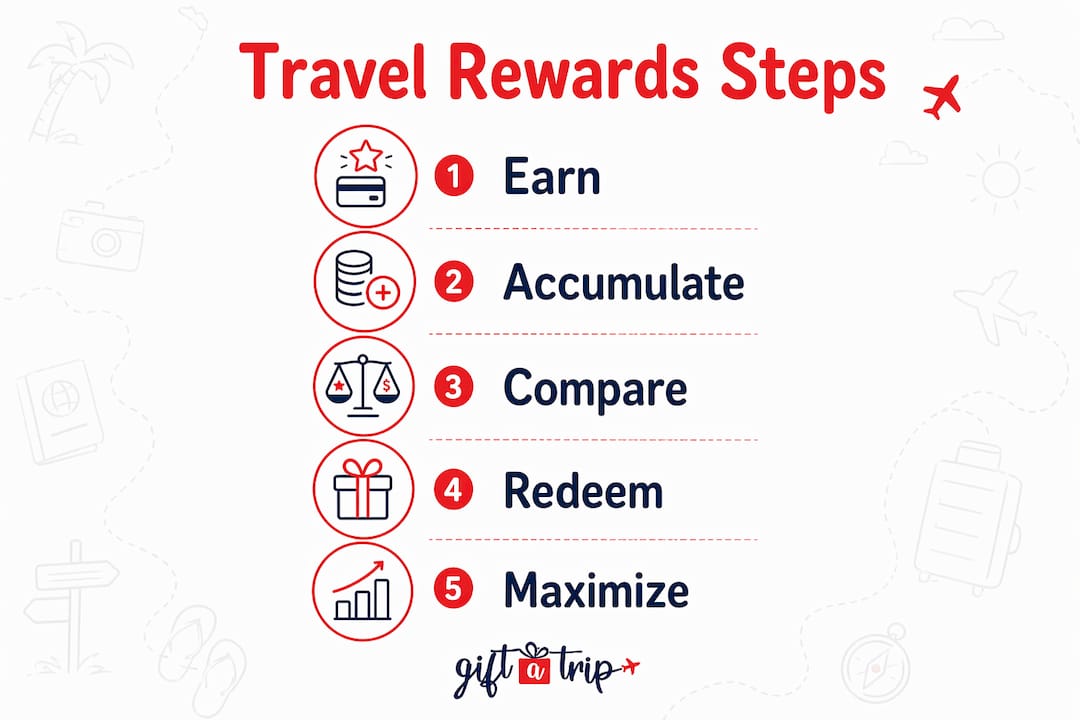
What are smart strategies to maximize travel rewards?
Maximizing travel rewards comes down to discipline, not complexity. The travelers who get the most value follow a simple, repeatable system rather than chasing every new card or promotion.
-
Hold no more than two primary cards. Holding two cards matched to your top spending categories avoids complexity and keeps earning focused. More cards mean more annual fees, more minimum spends, and more accounts to track.
-
Meet welcome bonus requirements with planned spending only. Never overspend to hit a minimum spend threshold. Use the card for purchases you were already going to make, such as groceries, utilities, and recurring subscriptions. Carrying a balance at roughly 22% APR wipes out every point you earned.
-
Prioritize transferable points programs. Flexible programs that transfer to multiple airline and hotel partners consistently outperform cards locked to a single airline. Transferable points let you shop for the best redemption across programs rather than being stuck with one option.
-
Confirm award availability before transferring. This is non-negotiable. Transferred points cannot be returned. Check that your target flight or hotel has award space available before you move a single point.
-
Audit premium card fees annually. Premium cards only justify high annual fees when you fully use perks like travel credits and lounge access. If you are not using those benefits, downgrade to a no-fee card and keep the rewards without the cost.
For travelers interested in how flexible travel rewards compare to fixed-program options, the core principle is the same: flexibility in redemption always produces higher average value.
Pro Tip: Pay your credit card balance in full every month. Interest charges at 22% APR negate all earned rewards within weeks. Travel rewards only work in your favor when you carry no balance.
How do travel rewards apply for different travelers and events?
Travel rewards programs are not one-size-fits-all. The right approach depends on how often you travel, what you spend money on, and whether you are using rewards personally or for a group.
Occasional travelers benefit most from a single flexible rewards card with a strong welcome bonus. The bonus alone often covers a round-trip flight or a hotel stay. Category multipliers on dining and groceries keep points accumulating between trips without requiring any extra effort.
Frequent flyers can justify holding both a premium travel card and a co-branded airline or hotel card. The combination earns elite-qualifying miles on flights while stacking transferable points on everyday spending. Knowing how to book a hotel stay at the right time also affects how many points you need for a given redemption.
Corporate and incentive travel is a different use case entirely. Companies use travel rewards in two main ways:
- Loyalty programs for employees: Rewarding top performers with points or travel credits tied to company spending
- Travel certificates and gift vouchers for events: Distributing fixed-value travel experiences as prizes, recognition awards, or event incentives
Travel certificates work particularly well for corporate events because they remove the complexity of points management. The recipient gets a defined travel experience without needing to understand redemption rules or transfer mechanics. Giftatrip specializes in exactly this format, offering travel gift certificates for loyalty rewards that HR teams and event planners can distribute at scale.
Tailoring your approach means matching your card and program choices to your actual travel patterns. A traveler who flies one airline exclusively benefits from a co-branded card. A traveler who books across multiple airlines and hotels gets more value from a transferable points program. Neither approach is wrong. The mistake is using the wrong one for your habits.
Key Takeaways
Travel rewards deliver the most value when you earn through welcome bonuses and category spending, then redeem by transferring points to airline or hotel partners rather than using statement credits.
| Point | Details |
|---|---|
| Welcome bonuses are the biggest value source | A 60,000-point bonus can be worth $750 to $1,200 depending on redemption method. |
| Redemption method determines point value | Transfers to partners yield 2–5 cents per point versus 0.5–1 cent for statement credits. |
| Two cards beat ten | Holding two well-matched cards maximizes earning without fee or complexity overload. |
| Never transfer before confirming award space | Point transfers to partners are permanent and cannot be reversed once completed. |
| Travel certificates simplify group rewards | For corporate events and gifting, fixed-value travel certificates remove points complexity entirely. |
The part of travel rewards nobody talks about enough
Most travel rewards content focuses on earning. The real skill is in knowing when not to redeem. I have watched people burn 80,000 points on a $400 economy ticket because they wanted to “use up” their points before they expired. That is a redemption rate of 0.5 cents per point. Those same points could have covered a business-class seat worth $3,000 or more.
The discipline that separates good rewards travelers from great ones is patience. You hold points until the right redemption appears, not until you feel like traveling. That means keeping accounts active with small periodic transactions so points do not expire while you wait.
The other thing I would push back on is the obsession with premium cards. A mid-tier card with no annual fee and a solid transferable points program beats a $695-per-year card where you only use one or two of the included perks. Run the math every year. If the perks you actually use do not exceed the annual fee, downgrade without guilt.
The simplest framework: earn on two cards, transfer to partners for premium redemptions, pay your balance in full every month, and audit your fees once a year. That is it. Everything else is noise.
— Donovan
Travel certificates as a flexible rewards alternative
Not every travel reward needs to come from a credit card. Giftatrip offers digital travel certificates redeemable at resorts, hotels, and cruise lines, with taxes and resort fees included and minimal blackout dates.

For HR teams, event planners, and anyone rewarding a group, travel certificates for corporate rewards cut through the complexity of points programs entirely. There is no minimum spend, no transfer mechanics, and no expiration anxiety. Recipients get a real travel experience, and organizers get a clean, scalable gifting solution. Giftatrip also offers Virgin Voyages cruise certificates for those who want to deliver a premium, memorable reward that stands apart from a standard gift card.
FAQ
How do travel rewards work for beginners?
Travel rewards work by earning points or miles on purchases made with a rewards credit card or through a loyalty program, then redeeming those points for flights, hotel stays, or other travel. The value you get depends on which redemption method you choose, with partner transfers typically offering the highest return.
What is the best way to redeem travel rewards points?
Transferring points to airline or hotel partners delivers the highest value, typically 2–5 cents per point, compared to 0.5–1 cent for statement credits. Always confirm award availability before transferring, since the transfer cannot be reversed.
Do travel rewards points expire?
Most travel rewards points expire after 12–36 months of account inactivity. Making a small qualifying purchase on your card or loyalty account resets the expiration clock and keeps your points valid.
Are travel rewards credit cards worth it?
Travel rewards cards are worth it when you pay your balance in full every month and use the card’s benefits. Carrying a balance at roughly 22% APR eliminates all rewards value, making the card a net financial loss.
Can travel rewards be used for corporate events or gifting?
Travel rewards work well in corporate contexts through two formats: loyalty points distributed to employees via company spending programs, and travel certificates or gift vouchers given as fixed-value rewards. Travel certificates are the simpler option for group events because they require no points management from the recipient.