
TL;DR:
- Travel promotions increase bookings by creating urgency and converting customers before inventory becomes perishable. They drive local economic benefits, improve campaign ROI during shoulder seasons, and reinforce brand value through bundling and integrated marketing. Measuring success with collaborative attribution models and timely targeting enhances promotion effectiveness and supports long-term growth.
Travel promotions are targeted marketing efforts designed to increase traveler bookings, deepen brand engagement, and drive measurable economic returns for businesses and destinations. If you are asking why invest in travel promotions, the answer is grounded in hard data: 90% of consumers booked vacations last year, with promotions cited as a primary catalyst for their final decision. That figure means your audience is already primed to buy. The question is whether your brand shows up at the right moment with the right offer. This guide breaks down the economic rationale, the most effective promotion types, and the measurement practices that separate high-performing travel marketing teams from the rest.
Why invest in travel promotions for economic and marketing growth
Travel promotions do far more than fill seats and beds. They compress customer decision windows, smooth seasonal demand, and generate local economic activity that justifies marketing spend at the executive level. Understanding the full scope of these benefits is what separates tactical discounters from teams that build lasting brand value.

Sales promotions shift customers from “maybe later” to “book today” by creating urgency around perishable inventory. A hotel room unsold tonight is revenue gone forever. A flight seat that departs empty cannot be recovered. Promotions solve this problem by accelerating decisions before the window closes.
The economic ripple effect is real. Travelers who book through promotional campaigns spend on dining, transportation, and local attractions. That spending generates tax revenue and supports jobs in destination communities. Marketing teams that quantify this downstream impact gain credibility with finance and leadership, which directly supports budget approvals.
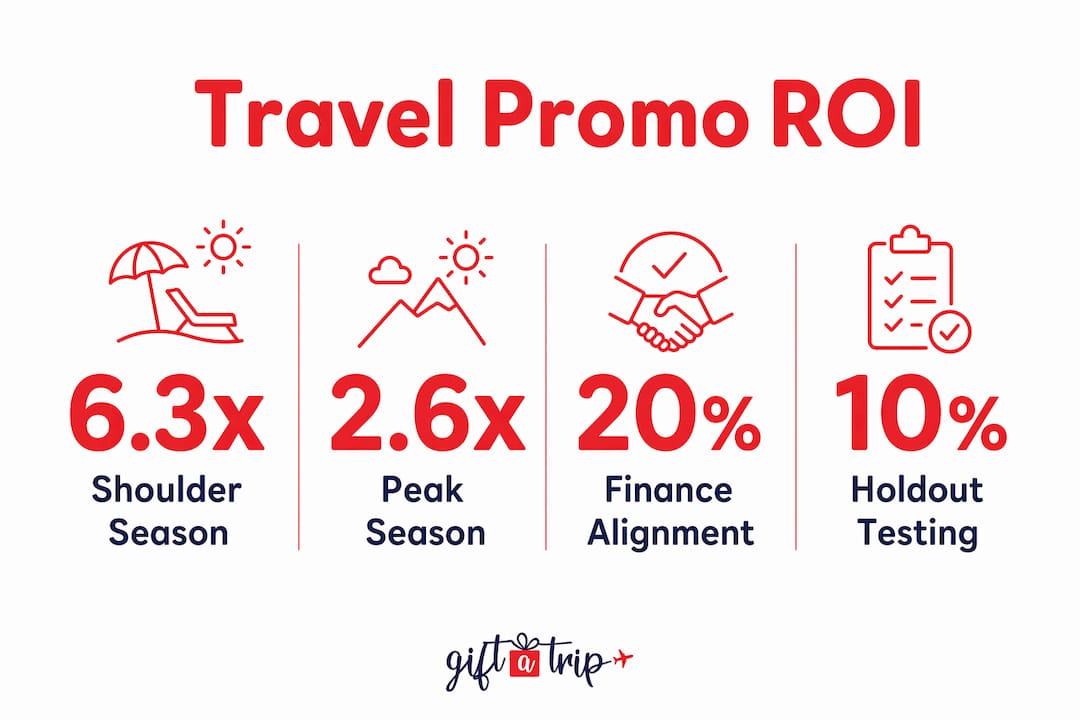
Timing amplifies every dollar you spend. Shoulder-season campaigns deliver 6.3x ROAS compared to 2.6x during peak periods. That is more than double the return for the same media investment. Shifting budget toward off-peak windows is one of the highest-leverage moves a travel marketing team can make.
Pro Tip: Before planning your next campaign calendar, map your occupancy data by month. The months sitting at 60–70% occupancy are your highest-ROI promotion windows, not the months already running at 95%.
Teams aligned with finance also report stronger outcomes. Marketing and finance alignment produces 20% higher confidence in incrementality measurement and delivers ROI gains above 20%. That alignment turns promotion spending from a cost center into a defensible growth investment.
What types of travel promotions are most effective?
Not all promotion formats deliver equal results. The best choice depends on your audience, your inventory situation, and where you are in the customer relationship. The table below maps the most common promotion types to their primary use cases.
| Promotion type | Best use case | Key benefit |
|---|---|---|
| Limited-time offers | Filling distressed inventory fast | Creates urgency, accelerates bookings |
| Early-bird discounts | Smoothing demand ahead of peak season | Locks in revenue, improves forecasting |
| Loyalty rewards | Retaining high-value repeat customers | Increases lifetime value, reduces churn |
| Bundled experiences | Protecting brand value while adding perceived worth | Avoids pure price competition |
| Contests and giveaways | Building awareness and email lists | Low cost per lead, high social reach |
Bundling stands out as the most brand-safe approach. When you pair a hotel stay with a cooking class, a spa credit, or a curated local tour, you shift the conversation from price to value. Customers compare the bundle against alternatives, not just the room rate. This protects your pricing power over time.
Integrated marketing communications drive higher conversion than promotions running in isolation. A limited-time offer supported by paid social, email, PR coverage, and a direct sales follow-up outperforms the same offer running on a single channel. The promotion becomes the call to action within a broader brand story, not a standalone discount announcement.
Top travel brands invest in brand equity and audience relationships upstream before executing lower-funnel promotions. That upstream investment is what makes the promotion land. Customers who already trust your brand convert at higher rates and at better price points when the offer arrives.
Channel timing matters as much as channel selection. Email performs best for loyalty offers sent to existing customers. Paid search captures high-intent travelers already researching destinations. Social media works for awareness-stage contests and giveaways. Matching the promotion type to the right channel at the right moment is what produces results worth reporting.
How to measure and optimize travel promotion ROI
Most marketing teams measure promotion performance with last-click attribution. That model systematically undercounts the contribution of upper-funnel activity and overstates the value of the final touchpoint. It leads to budget cuts in brand-building and overinvestment in bottom-funnel retargeting.
The fix is a custom attribution model built in partnership with your finance team. Advanced attribution models increase measurement accuracy and deliver ROI improvements above 20%. Finance brings rigor to incrementality testing. Marketing brings channel expertise. Together, they produce a measurement framework that leadership trusts.
| Measurement approach | What it captures | Limitation |
|---|---|---|
| Last-click ROAS | Final conversion touchpoint | Ignores upper-funnel influence |
| Multi-touch attribution | All touchpoints in the journey | Requires clean data integration |
| Incrementality testing | True lift from the promotion | Needs control groups and time |
| Finance-integrated model | Full ROI including downstream spend | Requires cross-team collaboration |
AI-powered tools now make real-time budget reallocation practical. AI agents targeting distressed inventory improve marketing ROI by identifying underperforming segments and shifting spend before the opportunity closes. This is not a future capability. Travel marketing teams are deploying it now to respond to booking pace data within hours, not weeks.
Pro Tip: Run a holdout test on your next promotion. Withhold the offer from 10% of your eligible audience and compare booking rates. That gap is your true incrementality, and it is the number your CFO will actually believe.
Avoid measuring promotions in isolation. A flash sale that drives 500 bookings looks great on a dashboard. But if those bookings cannibalize full-rate reservations or train customers to wait for discounts, the net effect is negative. Measure net revenue per available room or net revenue per seat alongside raw booking volume.
Practical strategies for timing and targeting travel promotions
Timing is the variable most marketing teams underweight. The same offer, delivered at the wrong moment, produces a fraction of the results. These strategies give you a framework for getting the timing right.
- Target shoulder seasons first. Shoulder-season travelers spend within 5% of peak-period travelers but cost significantly less to acquire. That gap in acquisition cost is pure margin. Shift at least 30% of your campaign budget to shoulder-season windows and track the ROAS difference directly.
- Deploy midweek specials to smooth weekly demand. Hotels and resorts consistently see occupancy dips on Tuesday and Wednesday nights. A midweek rate or added-value package targeted at drive-market customers fills those gaps without discounting weekend inventory.
- Segment your audience before you set your offer. Price-sensitive customers respond to percentage discounts and flash sales. Loyalty customers respond to exclusive access, upgrades, and early booking windows. Sending the same offer to both groups wastes budget and dilutes brand perception.
- Use short booking windows to create urgency. Offers that expire in 48–72 hours produce higher conversion rates than open-ended promotions. The deadline forces a decision. Without it, customers bookmark the page and forget it.
- Coordinate with revenue management. Your promotion should target dates with low booking pace, not dates already trending toward sellout. Real-time collaboration with revenue teams prevents promotions from discounting inventory that would have sold at full rate anyway.
A well-run travel giveaway can also serve as a low-cost demand generator. Contests build email lists, generate social engagement, and create earned media coverage, all while positioning your brand around the aspiration of travel rather than the mechanics of discounting.
Key takeaways
Travel promotions deliver the highest ROI when they are timed to shoulder seasons, integrated across channels, and measured with finance-aligned attribution models rather than last-click metrics.
| Point | Details |
|---|---|
| Shoulder seasons outperform peak | Shoulder-season campaigns deliver 6.3x ROAS versus 2.6x during peak periods. |
| Integration multiplies results | Promotions paired with advertising, PR, and personal selling convert at higher rates than standalone discounts. |
| Finance alignment boosts ROI | Teams that build attribution models with finance report 20%+ ROI gains and stronger measurement confidence. |
| Segmentation protects margins | Price-sensitive and loyal customers require different offers to avoid training buyers to wait for discounts. |
| Bundling preserves brand value | Pairing travel with experiences shifts competition from price to perceived value. |
The uncomfortable truth about travel promotions most teams ignore
Travel promotions are precision tools, not blunt instruments. I have watched marketing teams run back-to-back flash sales and call it a promotion strategy. What they actually built was a customer base conditioned to never pay full price. That is not growth. That is a slow erosion of brand equity disguised as booking volume.
The teams that get this right treat promotions as solutions to specific business problems. Low occupancy in october? Build a shoulder-season campaign with a bundled experience and a 72-hour booking window. New market segment you want to acquire? Run a contest that collects first-party data and introduces your brand without leading with a discount.
The measurement piece is where most teams leave money on the table. Relying on last-click ROAS feels safe because the numbers are easy to pull. But that model rewards the last ad a customer saw, not the brand campaign that made them want to travel with you in the first place. Partnering with finance to build an incrementality framework is uncomfortable work. It takes longer and requires sharing data across teams. The payoff is a budget conversation where you can prove what your promotions actually caused, not just what happened nearby.
Promotions work best when they sit inside a brand-building strategy, not outside it. The brands with the most pricing power are the ones that invest in travel advertising upstream and use promotions to close demand, not to generate it from scratch. That sequence matters more than any individual offer.
— Donovan
How Giftatrip supports your travel promotion strategy
Marketing and sales teams need promotion tools that deliver real perceived value without eroding brand equity. Giftatrip’s digital travel certificates give you exactly that. They are redeemable at major resorts, hotels, and cruise lines, including Virgin Voyages and Crystal Cruises, and they cover taxes and resort fees so recipients experience the full value of the reward.
Corporate clients use Giftatrip to power sales incentive programs that motivate teams, reward top performers, and create memorable client experiences. Bulk ordering with customizable gift boxes and personalized messaging makes it practical for large-scale campaigns. Whether you are running a loyalty program, a client appreciation initiative, or a contest prize, Giftatrip’s travel certificates add genuine aspirational value to your promotion without the complexity of managing travel logistics in-house.
FAQ
Why do travel promotions outperform standard discounts?
Travel promotions tied to experiences create perceived value that pure price cuts cannot match. Bundled offers and exclusive access shift the customer’s comparison from price to overall worth.
What is the best season to run travel promotions?
Shoulder seasons deliver the strongest return. Shoulder-season campaigns generate 6.3x ROAS compared to 2.6x during peak periods, with travelers spending within 5% of peak-season levels.
How do you measure travel promotion ROI accurately?
Custom attribution models built with finance teams outperform last-click ROAS. Incrementality testing with control groups gives the clearest picture of what a promotion actually caused.
How do travel certificates work as a promotion tool?
Travel certificates are prepaid, digitally delivered vouchers redeemable for hotel stays, resort packages, or cruises. They function as high-value incentives in loyalty programs, sales contests, and corporate gifting without requiring the issuer to manage travel logistics.
How does timing affect travel promotion performance?
Promotions targeting low-demand periods fill perishable inventory at lower acquisition costs. Midweek specials, last-minute deals, and shoulder-season campaigns all smooth demand curves and improve net revenue per available unit.