
TL;DR:
- Value-based gifting focuses on choosing meaningful gifts aligned with the recipient’s core values and emotional needs rather than on price or presentation. This approach fosters stronger relationships, lasting memories, and reduces waste by prioritizing authenticity and personalization. It emphasizes thoughtful selection over expenditure, enhancing impact in personal and corporate contexts alike.
Most people think a better gift means a more expensive gift. That logic feels intuitive, but it’s wrong more often than not. What is value-based gifting, then? It’s the practice of choosing gifts based on alignment with the recipient’s values, personality, and emotional needs rather than price tag or presentation. This approach produces stronger relationships, less waste, and a deeper sense of generosity that both giver and recipient actually feel. Whether you’re planning a corporate recognition program, an anniversary surprise, or a holiday exchange, this guide breaks down what value-based gifting means and how to do it well.
Table of Contents
- Key takeaways
- What value-based gifting actually means
- The real benefits of value-based gifting
- Value-centric gift ideas and examples
- How to choose and give value-based gifts
- My take on why this changes everything
- Give a gift worth remembering with Giftatrip
- FAQ
Key takeaways
| Point | Details |
|---|---|
| Meaning over money | Value-based gifting prioritizes emotional impact and personal alignment, not cost or quantity. |
| Emotional ROI is real | Gifts that build memories or habits create stronger bonds than expensive, generic items. |
| Experiences outperform objects | Behavioral science consistently shows people value shared experiences over material things. |
| Presentation shapes perception | Context, timing, and storytelling raise the perceived value of any gift, regardless of price. |
| Applies to corporate gifting too | Companies that shift to value-driven gifting report stronger employee loyalty and retention. |
What value-based gifting actually means
At its core, values-based giving is about choosing gifts that reflect the giver’s and recipient’s core beliefs rather than performing generosity through dollar amount. The goal is not a transaction. It’s a statement: “I see who you are, and this gift reflects that.”
Traditional gifting often defaults to what’s impressive on the surface. A big box, a recognizable brand, a high price point. The logic is that visible effort signals care. But recipients almost universally report that the gifts they remember most are the ones that showed someone was actually paying attention to them.
Value-based gifting flips the entire decision-making process. Instead of asking “What can I afford to spend?” or “What looks generous?”, you ask “What does this person care about?” and “What will genuinely add to their life?” That shift in framing is where everything changes.
Here’s what distinguishes value-based gifting from conventional approaches:
- Alignment with recipient’s values: A gift for someone who prioritizes sustainability should reflect that. A reusable, ethically sourced item communicates more care than an expensive product wrapped in single-use plastic.
- Emotional return on investment: Successful gift-givers focus on the strength of memory or habit the gift helps build, not the sticker price.
- Sustainability and longevity: Value-based gifts are often repairable, reusable, or refillable. They signal long-term thinking.
- Relationship significance: The gift should feel like it comes from someone who knows the recipient, not from someone who ran a search for “popular gifts under $50.”
- Ethical sourcing: Who made it and how matters. Gifts from brands with clear values add a layer of meaning most mass-produced items can’t match.
This framework applies equally to personal celebrators choosing birthday gifts and to corporate gift managers building employee recognition programs. The scale changes. The principle doesn’t.
The real benefits of value-based gifting
Switching to a value-driven gifting mindset isn’t just philosophically satisfying. It produces concrete, measurable benefits for everyone involved.
-
Stronger emotional connections. When a gift accurately reflects someone’s personality or values, it communicates genuine attentiveness. That attentiveness builds trust and deepens relationships over time, whether you’re a spouse, a manager, or an event planner.
-
Lasting memories over clutter. Mindful gifting shifts the question from “What is impressive?” to “What will truly matter?” The result is gifts that get used, displayed, or remembered rather than stored in a closet.
-
Support for ethical makers. Choosing artisan or independently crafted gifts directs money toward people and processes aligned with care and quality. That’s a benefit that extends beyond the recipient.
-
Reduced waste. Generic, low-relevance gifts are discarded at a staggering rate. Value-based gifts, because they align with what someone actually uses or values, stay in circulation longer. Repairable and multi-use gifts reduce waste and signal long-term care simultaneously.
-
Higher perceived generosity at any price point. This is one of the most counterintuitive findings in gifting research. A thoughtful $40 gift consistently outperforms a generic $150 gift in recipient satisfaction. You don’t need a bigger budget. You need a more intentional process.
Pro Tip: Before purchasing, write down three things you know to be true about the recipient’s daily life, values, or goals. If your gift doesn’t connect to at least one of them, reconsider the choice.
The importance of thoughtful gifting becomes especially clear in corporate settings. Companies that recognize employees with personalized, experience-based rewards consistently see higher engagement than those relying on gift cards or branded merchandise alone.
Value-centric gift ideas and examples
Understanding the concept is one thing. Seeing it applied is another. Here are the main categories of value-based gifts, with the characteristics that make each one work.
Artisan and handmade gifts
These work because they carry a story. When origin stories build trust, the gifting experience deepens. Knowing a ceramic mug was made by a specific artisan using reclaimed clay changes how the recipient holds it. That context adds emotional value without adding cost.

Look for sewn seams, replaceable parts, natural materials, and items with clear aftercare support. These details signal durability and intentionality.
Experience gifts
Behavioral science is consistent here. People value emotional connection, shared memories, and meaningful rituals more than a gift’s price or novelty. A cooking class, a spa day, a weekend getaway. These gifts don’t sit on a shelf. They live in someone’s memory.
Travel gifts are a standout example of this category. The gift of travel creates lasting memories in a way most physical gifts simply can’t match. For corporate clients, experience-based rewards consistently outperform merchandise in motivation and loyalty impact.
Repairable, refillable, or reusable products
A leather journal that can be resoled. A quality pen with replaceable cartridges. A premium water bottle built to last a decade. These items signal that you thought about the recipient’s future, not just the moment of unwrapping.
Hybrid gifts combining object and experience
This is where value-based gifting gets genuinely creative. A small token paired with an experience amplifies both. A locally sourced candle alongside a spa certificate. A book about a destination alongside a travel voucher. The combination creates a narrative the recipient can follow.
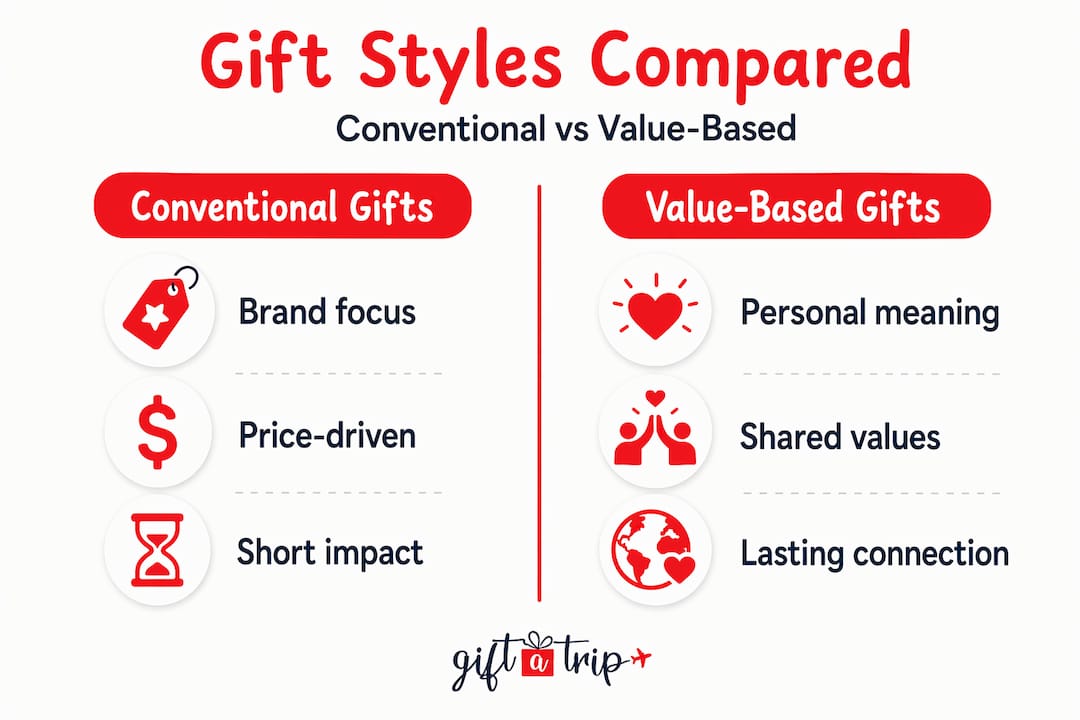
Here’s a quick comparison of conventional versus value-based gifting approaches:
| Approach | Focus | Outcome |
|---|---|---|
| Conventional gifting | Price, brand recognition, volume | Short-term impression, low retention |
| Value-based gifting | Alignment, meaning, emotional impact | Lasting memory, stronger relationship |
| Experience gifting | Shared time, memorable events | High emotional ROI, zero clutter |
Pro Tip: When budget is limited, invest in presentation and storytelling. Low-cost gifts with thoughtful presentation consistently feel more generous than expensive items with no context or personalization.
You can also find regionally specific, value-aligned options through curated guides like local gift ideas that prioritize meaningful, place-connected products over generic retail selections.
How to choose and give value-based gifts
Knowing what value-based gifting is and actually doing it well are two different things. Here’s how to close that gap.
Start with the recipient, not the store. Before you browse anything, spend five minutes thinking about the person. What do they talk about most? What frustrates them daily? What have they mentioned wanting to try? Gifts are social signals communicating regard, closeness, and care. The signal only lands when it’s accurate.
Prioritize quality and ethical sourcing. One well-made item from a maker with clear values outperforms three average items every time. This is the core principle of value-based gifting and it applies whether you’re spending $30 or $300.
Think about presentation and ritual. The perceived value of a gift is shaped by context, timing, and presentation, not just the object itself. A handwritten note explaining why you chose the gift adds more emotional weight than any ribbon or box upgrade.
Here are common pitfalls to avoid:
- Generic last-minute gifts. These signal that the recipient wasn’t worth the time it takes to think. Even a small, well-chosen gift beats a rushed, expensive one.
- Projection gifting. Buying what you would want, not what the recipient values. This is the most common mistake in both personal and corporate gifting.
- Overloading with volume. More items don’t mean more care. They often mean less of it. A single meaningful gift almost always lands better than a collection of filler items.
- Ignoring the post-gift experience. Value-based gifting extends beyond the unwrapping. Does the gift have aftercare? Does it come with instructions, a follow-up experience, or a story to return to?
For corporate gift-givers and event planners, these principles translate directly into program design. Impactful recognition programs built around meaningful experiences rather than branded swag produce measurably better outcomes in employee engagement and client retention.
My take on why this changes everything
I’ve spent years watching people agonize over gift budgets while completely ignoring the one variable that actually matters: relevance. I’ve seen $200 wine sets go untouched because the recipient doesn’t drink. I’ve watched a $35 travel journal become someone’s most treasured possession because it matched exactly what they were going through at that moment in their life.
The uncomfortable truth about conventional gifting culture is that it’s mostly about the giver’s anxiety, not the recipient’s needs. We default to expensive because it feels safer. We choose recognizable brands because they reduce our risk of judgment. Value-based gifting requires something harder: actually paying attention.
What I’ve learned is that the emotional ROI framework is the most useful lens you can apply to any gifting decision. Not “How much did I spend?” but “How much will this matter six months from now?” Experience gifts, especially travel, score consistently high on that measure. A weekend at a resort is a story someone tells for years. A branded mug is forgotten in a cabinet.
I’d also push back on the idea that value-based gifting is only for people with generous budgets. The shift isn’t about spending more. It’s about spending smarter and with more intention. A $50 gift chosen with real care beats a $200 gift chosen with none.
— Donovan
Give a gift worth remembering with Giftatrip
If value-based gifting is about creating lasting memories and honoring the recipient’s experiences, travel certificates are one of the most direct expressions of that principle.

Giftatrip specializes in digital travel certificates redeemable at top resorts, hotels, and cruise lines. Whether you’re recognizing a top-performing employee, celebrating a personal milestone, or building a corporate rewards program, these certificates offer the flexibility and personalization that make gifts genuinely meaningful. Every certificate covers taxes and resort fees, includes minimal blackout dates, and can be customized with personal messaging. Explore vacation voucher options for corporate gifting or browse experiential rewards designed to inspire and retain your team.
FAQ
What is value-based gifting in simple terms?
Value-based gifting means choosing gifts based on what matters to the recipient, including their values, habits, and emotional needs, rather than focusing primarily on price or appearance. The goal is emotional relevance, not visual impressiveness.
What makes a gift valuable beyond its price?
Context, personalization, timing, and presentation all shape perceived gift value more than cost. A low-cost gift with a meaningful story and thoughtful delivery consistently outperforms an expensive generic item.
What are the best value-based gift examples?
Strong examples include artisan handmade goods, experience gifts like travel or classes, reusable and repairable products, and hybrid gifts pairing a token item with an experience. Travel certificates are a particularly high-impact option because they create lasting memories.
How does value-based gifting apply to corporate settings?
Corporate value-based gifting shifts the focus from branded merchandise to personalized, experience-driven rewards. Research shows that meaningful gifts tied to individual preferences build stronger loyalty and engagement than generic incentives.
Does value-based gifting require a larger budget?
No. Value-based gifting is about reallocating attention, not increasing spend. A smaller, thoughtfully chosen gift aligned with someone’s actual values typically delivers stronger emotional impact than a larger, generic one.