
TL;DR:
- Personalized travel gift certificates create lasting memories and boost employee motivation more than cash.
- Digital delivery enables instant, scalable recognition for remote and hybrid teams worldwide.
- Effective programs require ongoing management, personalization, and celebration to build loyalty and engagement.
Most HR leaders and sales managers operate under a common assumption: cash is king when it comes to employee rewards. Give someone money, and they’ll appreciate it most. It’s logical, measurable, and feels fair. But research consistently tells a different story. Flexible, personalized rewards like gift certificates consistently outperform cash in driving motivation, loyalty, and perceived value. Travel certificates, in particular, create experiences that employees actually remember and talk about. This article walks you through why that happens, how digital delivery is changing the game, and how to build a program that gets real results.
Table of Contents
- Why gift certificates outperform cash in employee rewards
- The shift to digital and travel gift certificates
- Designing a high-impact gift certificate program
- Pitfalls, compliance, and optimization: expert insights
- What most companies miss when using gift certificates
- Enhance your employee rewards program with travel certificates
- Frequently asked questions
Key Takeaways
| Point | Details |
|---|---|
| Experiences beat cash | Travel gift certificates offer more motivating and memorable rewards than cash or generic items. |
| Digital delivery matters | Instant, scalable distribution of digital certificates simplifies rewarding remote and hybrid teams. |
| Personalization increases impact | Tailoring certificate options and seeking feedback maximize program effectiveness and engagement. |
| Stay compliant | Global tax and reporting rules for rewards require careful program planning and documentation. |
| Continual optimization required | Track redemption, adjust offerings, and share stories to keep recognition efforts meaningful. |
Why gift certificates outperform cash in employee rewards
Here’s the problem with cash rewards: they disappear. An employee receives a $200 bonus, it hits their bank account, and within two weeks it’s absorbed into rent, groceries, or a credit card payment. The emotional connection to the reward fades almost immediately. There’s nothing tangible to remember, no story to tell, and no moment that stands out.
Travel gift certificates work differently. They don’t get lost in a paycheck. They sit in someone’s inbox or wallet as a promise of something exciting to come. That anticipation is motivational on its own. When the employee actually takes the trip, they create a memory tied directly to their employer’s recognition. That’s a fundamentally different dynamic.
Personalization plays a huge role here too. When you give someone a travel gift and recognition option with real choices, whether that’s a beach resort, a city hotel, or a cruise, you signal that you see them as an individual with preferences. Generic gifts don’t do that. A branded coffee mug or a standard gift basket communicates effort, but rarely inspires.
“The most effective recognition strategies prioritize meaningful experiences over impersonal or purely financial rewards, because the emotional impact of an experience outlasts the practical value of cash.” This distinction matters enormously when you’re designing a program meant to retain high performers.
Here’s a side-by-side look at how the three most common reward types stack up:
| Reward type | Perceived value | Memorability | Flexibility | Emotional impact |
|---|---|---|---|---|
| Cash bonus | Moderate | Low | High | Low |
| Generic gift | Low | Low | Low | Low |
| Travel certificate | High | Very high | High | Very high |
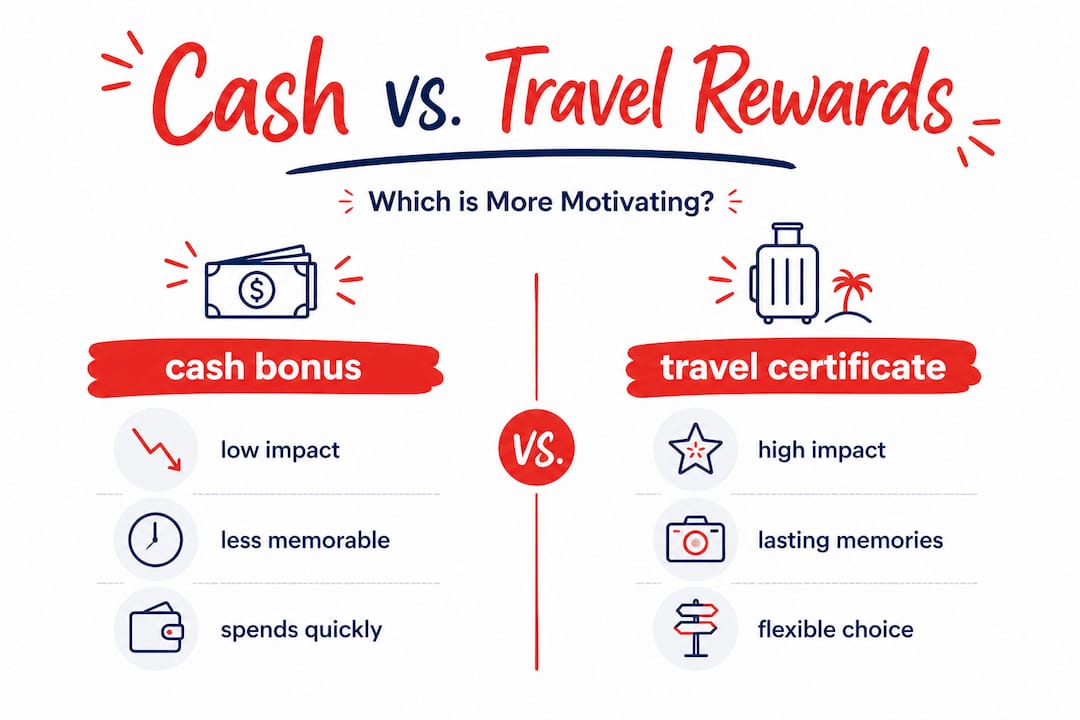
The data speaks clearly. When you think about enhancing rewards with travel packages, you’re not just offering a perk. You’re offering an experience that builds loyalty and reinforces your company’s culture of recognition. That’s the kind of reward that keeps top performers from updating their resumes.
Key advantages of travel certificates over other rewards include:
- Choice and autonomy: Employees select destinations and timing that suits their lives
- Aspirational value: Travel feels like a luxury, increasing perceived generosity
- Lasting memories: Experiences outlast physical gifts in emotional recall
- Social proof: Employees share their trips, becoming internal brand ambassadors
- No financial absorption: Unlike cash, certificates stay earmarked for something special
The shift to digital and travel gift certificates
The modern workforce is distributed, diverse, and often spread across time zones. Traditional reward methods, like mailing physical gift cards or hosting in-person award ceremonies, simply don’t scale for remote or hybrid teams. This is exactly where digital travel gift certificates have become essential.
Digital certificates enable instant distribution through HR platforms, email, or direct messaging. A manager in New York can recognize a teammate in Manila in real time, with no shipping delays, no lost mail, and no administrative overhead. That immediacy matters. Recognition that arrives weeks after the achievement loses much of its motivational power.
The industry data on digital adoption is telling. Full choice now accounts for 41% of all sends, meaning nearly half of all digital certificate programs now allow employees to select their own reward entirely. Non-expiring certificates are also on the rise, removing the anxiety of expiration dates that often cause employees to either rush redemptions or forget about rewards entirely.
| Certificate format | Flexibility | Delivery speed | Best use case |
|---|---|---|---|
| Physical gift card | Low | Days to weeks | In-person events |
| Digital gift card (restricted) | Moderate | Instant | Specific retailer rewards |
| Digital travel certificate (open choice) | High | Instant | Remote/hybrid recognition |
| Non-expiring travel certificate | Very high | Instant | Long-term motivation programs |
For individual travel incentives specifically, the digital format removes every logistical barrier. Employees can receive their certificate, browse destinations, and start planning within the same hour.
Pro Tip: Always choose fully digital, non-expiring travel certificates for your core rewards program. The flexibility dramatically increases redemption rates, which means more employees actually experience the reward you intended to give them.
There’s one critical area HR teams often overlook when launching these programs: tax compliance. The tax treatment of employee rewards varies significantly by country, and even by state in some cases. What qualifies as a non-taxable de minimis benefit in one jurisdiction may be fully taxable income in another. Before scaling your program internationally, consult with your tax team or a compliance advisor.
Strong corporate gifting strategies always account for these variables upfront. Building compliance into your program design saves significant headaches later. Your corporate travel incentives guide should include a compliance checklist as a standard document, not an afterthought.
Benefits of going digital for reward delivery include:
- Zero geographic barriers for global or remote teams
- Instant delivery that connects recognition with the achievement in real time
- Automated distribution through HR platforms, reducing administrative burden
- Full audit trail for tracking who received what and when
- Scalability from five employees to five thousand without additional complexity
Designing a high-impact gift certificate program
A travel gift certificate is only as powerful as the program surrounding it. Handing someone a certificate without context or intention produces far less impact than delivering it within a well-designed recognition experience. Here’s how to build a program that actually moves the needle.

1. Define your goals clearly. Are you trying to reduce turnover, boost quarterly sales performance, improve peer recognition, or reward tenure milestones? Your goal determines the structure. A sales incentive program looks very different from an anniversary recognition program. Get specific before you select any certificates or set any budgets.
2. Survey your employees before you choose rewards. This step is skipped more often than you’d think, and it’s a costly mistake. Employees have wildly different preferences. Some dream of beach getaways; others want city breaks or family-friendly resort options. Surveying preferences and tracking redemption dramatically improves satisfaction and perceived value. A quick anonymous poll takes twenty minutes to set up and can completely reshape your program for the better.
3. Select the right certificate types. Match the certificate to the reward level. Entry-level recognition might be a hotel night or a dining experience. Major milestones, like a five-year anniversary or a record-breaking sales quarter, warrant something bigger: a cruise, a resort stay, or a full vacation package. Consider hotel gift certificate strategies as your baseline, then layer in higher-value options for top performers.
4. Communicate the reward meaningfully. Delivery matters as much as the certificate itself. A personalized note explaining why the employee is being recognized elevates the moment significantly. Don’t just send a code in a generic email. Take sixty seconds to write something specific, authentic, and human. Look at real-world gifting examples to see how leading companies do this well.
5. Measure redemption and collect feedback. Track which certificates get redeemed, how quickly, and what employees say about the experience. This data tells you what’s working and what needs adjustment. Programs that don’t measure outcomes become stale and eventually ineffective.
Pro Tip: Pair your certificate delivery with a small physical element, like a handwritten card or a branded travel accessory, to strengthen the emotional impact of the moment. The combination of digital convenience and physical warmth creates a recognition experience that feels genuinely special.
One metric worth monitoring carefully is breakage: the percentage of certificates that are never redeemed. Some breakage is inevitable, but high breakage is a warning sign. It usually means the certificates don’t feel accessible, the redemption process is too complicated, or employees simply forgot. Tracking breakage and sending timely reminders keeps your program performing at its best, and unredeemed value can often be reintegrated into future recognition cycles.
Pitfalls, compliance, and optimization: expert insights
Even well-intentioned programs fail when they fall into predictable traps. The most common one is what we call “set-and-forget” syndrome. A company launches a gift certificate program with enthusiasm, then lets it run untouched for two or three years. Destination options become outdated, certificate values don’t keep pace with inflation, and employees quietly stop caring. Recognition programs require active management, not passive administration.
“Compliance and thoughtful program design maximize both motivation and organizational ROI. A well-structured program that accounts for tax, equity, and redemption experience consistently outperforms one built purely on budget.”
Watch for these specific pitfalls:
- Over-reliance on certificates alone: Certificates amplify recognition, but they don’t replace it. Personal acknowledgment from a manager still matters enormously
- Ignoring global tax rules: The global tax implications of employee rewards are complex. Non-compliance creates liability and erodes trust with employees when unexpected tax bills arrive
- Poor redemption UX: If claiming a certificate requires multiple logins, phone calls, or confusing steps, employees give up. Simplicity is not optional
- No feedback loop: Programs without feedback mechanisms can’t improve. Regular pulse surveys after redemption provide gold-standard data
- Ignoring breakage strategically: Unused certificates represent both a risk and an opportunity. Track them and build a reactivation process into your program calendar
Travel vouchers best practices consistently emphasize simplicity and communication as the two most powerful levers for improving redemption. Make it easy to redeem and remind people it exists. Those two steps alone can increase utilization rates by a meaningful margin.
Optimization is an ongoing process. The best programs run quarterly reviews, incorporate employee suggestions, refresh the certificate catalog annually, and monitor whether the reward level still feels aspirational to the workforce. What motivated a team in 2022 may feel routine by 2026.
What most companies miss when using gift certificates
Here’s the honest truth after watching hundreds of corporate reward programs in action: most companies treat gift certificates as a transaction, not a relationship. They set a budget, pick a vendor, distribute certificates on autopilot, and check the box. The result is a program that technically exists but doesn’t actually build loyalty or drive engagement.
The biggest missed opportunity is personalization at scale. Many HR teams assume personalization is only possible for small teams. That’s simply not accurate anymore. Modern platforms allow you to segment your workforce by role, tenure, or preference and deliver tailored travel options to each group automatically. A junior sales rep and a senior account director don’t want the same reward, and treating them identically communicates that you’re not really paying attention.
The second major gap is the failure to celebrate redemption publicly. When an employee comes back from a trip that your company sponsored, that story has enormous internal value. Ask for a photo, a short testimonial, or even just a sentence about the experience. Share it on your internal channel. That public moment does something a certificate alone cannot: it makes the reward real and aspirational for every other employee watching.
Corporate travel reward programs that build in this storytelling component consistently report higher engagement than those that don’t. It costs nothing extra. It just requires intention.
The long-term lesson is this: gift certificates are a tool, not a strategy. The strategy is meaningful, consistent recognition built around what your people actually value. Certificates are powerful when they’re the delivery mechanism for genuine appreciation. They fall flat when they’re used as a shortcut for it.
Always close the loop. Ask employees what they loved about their experience. Celebrate the stories publicly. Use that feedback to make the next round even better. That cycle of recognition, experience, and storytelling is what separates good reward programs from great ones.
Enhance your employee rewards program with travel certificates
If the ideas in this article have you rethinking your current approach to recognition, the next step is finding a platform that makes implementation straightforward and impactful. Gift A Trip provides HR teams and sales managers with a curated selection of travel certificates covering resorts, hotels, cruise lines, and full vacation packages, all designed for instant digital delivery.
Whether you’re building your first structured recognition program or refreshing an existing one, Gift A Trip’s strategic gifting guide offers a practical roadmap for choosing the right certificates at every level. You can shop travel certificates directly through the platform, with options for bulk orders, personalized messaging, and customizable packaging. For broader inspiration on what works across industries, the collection of top travel gift ideas highlights the most popular and effective options for rewarding and retaining talent.
Frequently asked questions
What makes travel gift certificates more motivating than cash for employees?
Travel gift certificates create lasting memories and allow employees genuine choice, making the reward feel far more personal and valuable than a cash deposit that quickly disappears into everyday expenses. Flexible, personalized certificates consistently outperform cash in boosting motivation and perceived recognition value.
How do digital gift certificates help remote or hybrid teams?
Digital certificates can be delivered instantly to anyone, anywhere in the world, eliminating shipping delays and geographic barriers entirely. Instant, scalable distribution through HR platforms makes digital travel certificates the ideal solution for distributed teams.
Are there tax considerations when giving employees gift certificates?
Yes, and they vary more than most HR teams expect. The tax treatment of employee rewards differs by country, and sometimes by region within a country, so consulting a compliance expert before scaling your program is essential.
What if an employee doesn’t redeem their gift certificate?
Unredeemed certificates, sometimes called breakage, can be tracked and reintegrated into future recognition cycles rather than written off as waste. Breakage from unused cards is a recoverable asset when your program includes a systematic tracking and reactivation process.
How do you keep gift certificate programs from feeling impersonal?
The most effective approach is to survey employee preferences before selecting certificates, personalize the delivery message, and celebrate successful redemptions publicly within the organization. Surveying preferences and tracking feedback transforms a generic program into one that genuinely resonates with your workforce.