Jump to Section:
TL;DR:
- Immersive travel experiences deepen donor emotional connections and increase long-term support.
- Well-designed donor trips outperform traditional fundraising methods in engagement, retention, and advocacy.
- Successful programs require careful planning, segmentation, authentic storytelling, and qualified logistics partners.
Most fundraising teams spend years refining the perfect direct mail piece, the right gala format, or the most compelling email subject line. Yet one of the most powerful donor engagement tools sits largely untapped: immersive travel experiences. Experiential philanthropy trips deepen emotional connections by letting donors witness nonprofit work firsthand, generating engagement levels that standard gifts rarely match. For CSR managers looking to move donors from passive supporters to passionate advocates, this guide breaks down the emotional, financial, and strategic case for making travel a cornerstone of your donor incentive program.
Table of Contents
- The emotional impact of travel experiences on donors
- How travel experiences drive fundraising results
- Common pitfalls and how to avoid them
- Strategies for designing impactful donor travel programs
- A fresh perspective: Travel as advocacy, not just incentive
- How to take the next step with travel experiences for donors
- Frequently asked questions
Key Takeaways
| Point | Details |
|---|---|
| Emotional connection | Travel experiences foster lasting emotional bonds that boost donor loyalty. |
| Fundraising ROI | Immersive donor trips often outperform traditional incentives by increasing engagement and revenue. |
| Execution matters | Avoid common pitfalls by balancing mission impact with comfort and expert logistics. |
| Long-term advocacy | The real value of travel is turning donors into passionate year-round advocates. |
The emotional impact of travel experiences on donors
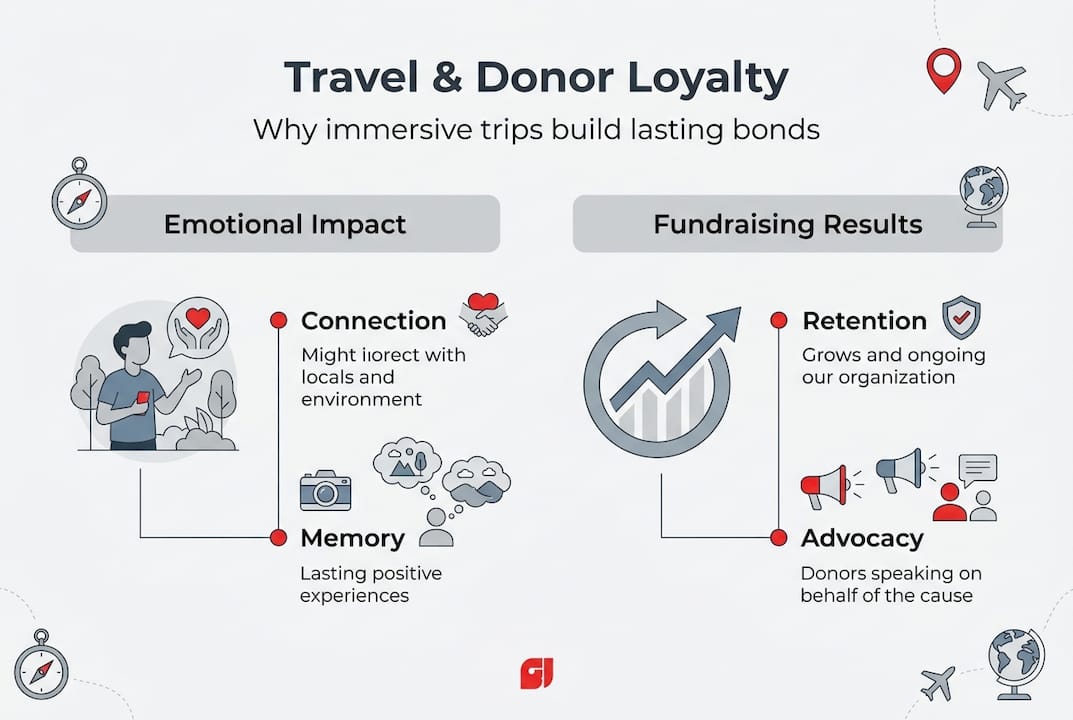
Travel rewires how donors think about your mission. When someone boards a plane to see your work in action, they stop being a line item on a ledger and start becoming a stakeholder. That shift is profound, and it’s nearly impossible to replicate with a thank-you letter or a branded gift basket.
What makes travel so uniquely powerful? The experience engages multiple senses, places donors in unfamiliar contexts, and connects abstract organizational goals to real human faces and stories. A donor who visits a community school your organization built remembers that trip for life. They tell their friends, their family, their colleagues. They become unpaid ambassadors carrying your mission into networks you would never reach through traditional outreach.
“Donor travel programs don’t just raise money in the moment. They build a pipeline of deeply committed supporters who give more, give longer, and recruit others to do the same.”
Here’s what that emotional transformation typically looks like in practice:
- Direct observation: Donors see firsthand where their money goes, removing any skepticism about organizational impact.
- Personal connection: Meeting the beneficiaries of your programs creates bonds that outlast the trip itself.
- Shared experience: Traveling alongside other donors and staff builds community and peer accountability.
- Authentic storytelling: Donors return home with personal narratives that amplify your message organically.
- Elevated commitment: The investment of time and travel signals a deeper personal stake in your mission.
This is exactly why experience-based rewards consistently outperform material gifts in long-term donor retention metrics. Transactional giving—where a donor writes a check in exchange for a tote bag—creates a buyer relationship. Experiential giving creates a believer relationship. That difference compounds over years of fundraising.
The practical takeaway for CSR managers is this: if your goal is to boost donor engagement and extend the average donor lifespan in your portfolio, travel is not a luxury add-on. It is a strategic investment in relationship capital that pays dividends for years.
How travel experiences drive fundraising results
Emotional impact is compelling, but CSR managers also need hard numbers to justify program investment. The good news is that the evidence, while still emerging, points consistently in one direction: travel programs deliver outsized fundraising results.
Consider a real-world example that illustrates the ceiling of what is possible. The Atlas Daughters Samoa trip raised $1.5 million by immersing women and daughters directly in mission work. That figure represents not just donations collected during the trip but a sustained surge in giving from participants who returned home transformed by what they witnessed. One experience, one cohort of travelers, and a seven-figure fundraising outcome.
Zoom out to the broader nonprofit fundraising landscape and the underlying numbers reinforce why travel belongs in your strategy. The median fundraising ROI across nonprofit campaigns is $4.50 returned per $1 invested, with well-run campaigns boosting results by 38% above baseline. Travel programs, when executed well, tend to outperform these benchmarks significantly because they generate downstream giving that extends far beyond the trip itself.
| Fundraising approach | Typical emotional engagement | Long-term donor retention | Advocacy potential |
|---|---|---|---|
| Direct mail | Low | Moderate | Low |
| Gala events | Moderate | Moderate | Moderate |
| Donor travel programs | Very high | High | Very high |
| Digital campaigns | Low to moderate | Low | Low to moderate |
The long-term pipeline value is where travel programs truly separate themselves. A donor who travels with your organization is significantly more likely to upgrade their giving tier, include your organization in estate planning, and introduce major gift prospects from their own network.

Pro Tip: Track post-trip giving separately from your general donor pool for at least 24 months. The trajectory of travel program alumni compared to non-participants will make the ROI case for you with zero additional analysis needed.
Thinking about enhancing donor incentives at scale? The key is structuring travel opportunities so they feel exclusive and mission-aligned, not like a vacation perk. That positioning is what separates programs that build loyal pipelines from those that feel transactional. Creating unforgettable rewards requires intentionality at every stage of the experience design.
Common pitfalls and how to avoid them
Not every donor travel program delivers on its promise. Many organizations dive in with enthusiasm and come out with exhausted donors, logistical disasters, and a team that vows never to try it again. The mistakes are avoidable, but only if you know where to look.
The most common pitfalls in donor trip design follow a predictable pattern:
- Overpacking the itinerary. Filling every hour with programming feels productive during planning but causes donor exhaustion on the ground. Tired, overwhelmed donors do not become advocates. Build breathing room into every day.
- Avoiding hard conversations. Donors who travel to see your work deserve honest discussions about complexity, systemic inequity, and organizational challenges. Sanitizing the experience for comfort destroys authenticity and trust.
- Centering donor comfort over mission truth. Five-star accommodations paired with surface-level community visits signal that the experience is a reward vacation, not a mission immersion. Balance matters.
- Tying the trip too directly to fundraising asks. Soliciting major gifts mid-trip feels coercive and cheapens the experience. Let the trip do the emotional work; follow up with asks afterward.
- Managing logistics in-house. Travel coordination, vendor management, health and safety protocols, and contingency planning require expertise that most nonprofit teams do not have. In-house management increases risk without reducing cost.
Pro Tip: Partner with an organization that specializes in fundraising event success and donor experience design. The cost of professional support is almost always recovered through better outcomes and fewer crises.
The biggest hidden cost of a poorly executed donor trip is not the wasted budget. It is the donor relationship you damage. A supporter who leaves your trip feeling manipulated, exhausted, or disappointed may never upgrade their giving level and may actively discourage peers from engaging with your organization. Get the fundamentals right before scaling.
Strategies for designing impactful donor travel programs
With the common mistakes in clear view, building a program that actually works becomes much more straightforward. The best donor travel experiences share a consistent set of design principles.
First, partner with specialists for logistics and safety. This frees your team to focus on the mission content and relationship-building that only you can provide. Specialists bring vendor networks, insurance frameworks, and emergency protocols that protect both your donors and your organization.
Second, integrate structured reflection time into every day of the trip. Unprocessed experiences fade quickly. A 45-minute facilitated debrief each evening turns raw observations into lasting commitments. Donors who articulate what they witnessed are far more likely to act on it when they return home.
Third, segment your travel experiences to match specific donor demographics. A single trip format does not serve everyone equally well.
| Donor segment | Ideal trip format | Key design consideration |
|---|---|---|
| Major donors | Small group, high immersion | Personalized access to leadership and beneficiaries |
| Mid-level donors | Structured group, educational focus | Balance of mission content and community building |
| Families with children | Shorter micro-trips, age-appropriate programming | Safety, accessibility, and shared family reflection |
| Next-gen supporters | Peer-led, socially focused experiences | Collaboration opportunities and digital storytelling |
Think carefully about how engagement strategies for donors apply differently across these segments. What converts a mid-level donor into a major gift prospect looks very different from what energizes a 25-year-old next-gen supporter. Tailoring the experience is not optional; it is what separates programs that plateau from those that grow.
Finally, review your recognition tips post-trip. Sending a personalized travel certificate or curated memory package after the experience reinforces the emotional bond and gives donors something tangible to share with their networks.
A fresh perspective: Travel as advocacy, not just incentive
Most conversations about donor travel focus on the fundraising math: what did we spend, what did we raise, and what is the net return? That framing misses the larger opportunity entirely.
The real value of a well-designed travel program is not the check a donor writes at the end of the trip. It is the next ten years of behavior that check represents. Donors who travel with your organization become year-round advocates. They post on social media, host dinner conversations, introduce your mission to their networks, and make your case in rooms you will never enter.
Conventional wisdom treats travel as a high-cost line item to be justified by immediate revenue. We think that undersells it dramatically. When you invest in travel for long-term advocacy, you are essentially paying to develop a distributed marketing and major-gift development team made up of your most passionate supporters.
Authentic experiences turn participants into storytellers. Storytellers recruit donors. That compounding effect is why the most sophisticated nonprofit development teams treat donor travel as infrastructure, not programming.
How to take the next step with travel experiences for donors
You now have a clear picture of why donor travel works, what to avoid, and how to design experiences that convert supporters into lifelong advocates. The next question is practical: how do you source the right travel experiences at scale without creating a full-time logistics operation?

Gift A Trip makes it straightforward. Our corporate travel gifting solutions give CSR managers access to flexible, high-quality travel certificates redeemable at resorts, hotels, cruise lines, and vacation packages from major brands. Whether you want to reward top donors, create impactful travel gifts for milestone contributors, or build a charitable auction around a premium experience, our certificates cover taxes and resort fees with minimal blackout dates. Explore travel certificate solutions and see how easy it is to add travel to your donor engagement strategy today.
Frequently asked questions
What types of donors respond best to travel experiences?
Major and mid-level donors, as well as families and next-gen supporters, are highly responsive to immersive travel opportunities tied to mission impact. Long-term pipeline building through emotional bonds and advocacy makes travel especially effective for CSR programs focused on showcasing real organizational impact.
How do travel experiences for donors compare to traditional fundraising gifts?
Travel experiences create deeper emotional engagement and typically deliver higher donor retention than standard gifts or recognition items. Experiential philanthropy trips let donors witness nonprofit work firsthand, a level of connection no branded merchandise can replicate.
What are the biggest risks in donor travel programs?
The most common risks include over-scheduled itineraries, lack of authenticity, logistical failures, and misaligned donor expectations. Reviewing identified trip pitfalls before you launch any program dramatically reduces the chance of a costly misstep.
How is ROI measured for donor travel initiatives?
ROI is measured by new revenue, donor retention rates, advocacy activity, and downstream fundraising impact, not just immediate participation costs. The median nonprofit ROI of $4.50 per $1 invested provides a useful baseline, though well-run travel programs frequently exceed that figure over a multi-year horizon.