Jump to Section:
TL;DR:
- Experiential auction items, such as trips and exclusive access, yield higher fundraising returns than physical goods. They stimulate emotional bidding through anticipatory emotion and social currency, leading to more competitive bids and increased revenue. Limiting the auction to 8-12 curated high-value experiences and using multi-sell strategies further boosts overall results.
Experiential auction items are defined as prizes that deliver a live event, trip, or exclusive access rather than a physical object. They are the single most effective category in charitable fundraising auctions today. Organizers who understand why choose experiential auction items over traditional goods consistently raise more money, generate more competitive bidding, and leave donors with a stronger connection to the cause. Travel packages, VIP event access, and resort stays routinely sell for 200–300% of their procurement cost. That performance gap is not accidental. It is rooted in psychology, pricing dynamics, and the way human beings assign value to memory over material goods.
Why choose experiential auction items over physical goods?
The answer starts with how donors make bidding decisions. Donors do not bid rationally at charity auctions. They bid emotionally. Physical items carry a visible retail price that acts as a ceiling. A bidder who knows a wine basket retails for $150 will rarely push past $180. Experiences carry no such anchor. A weekend at a luxury resort or a private cooking class with a celebrated chef has no price tag on the shelf. Bids rise because the perceived value is personal, not market-driven.
The psychological term for this is anticipatory emotion. Anticipatory emotion drives bidding because donors are not buying an object. They are buying the feeling of looking forward to something. That mental state is far more powerful than the satisfaction of owning a new item.
Experiences also carry social currency. Winning a trip to a Caribbean resort or courtside seats to a playoff game gives the winner a story to tell. Social currency increases bidding because donors compete not just for the prize but for the bragging rights attached to it. This is why two bidders who can both afford the same item will push each other far beyond a rational stopping point.
“Donors bid not simply for items but for memories, creating emotional investment that drives competitive bidding. The experience taps into anticipatory emotion and social currency in ways that no physical product can replicate.”
The atmosphere at auctions featuring high-quality experiences is measurably more energetic. Guests lean in, conversations pick up, and even silent auction tables draw longer lines. That energy translates directly into higher final bids across every lot in the room, not just the experiential ones.
Financial advantages of experiential items in fundraising events
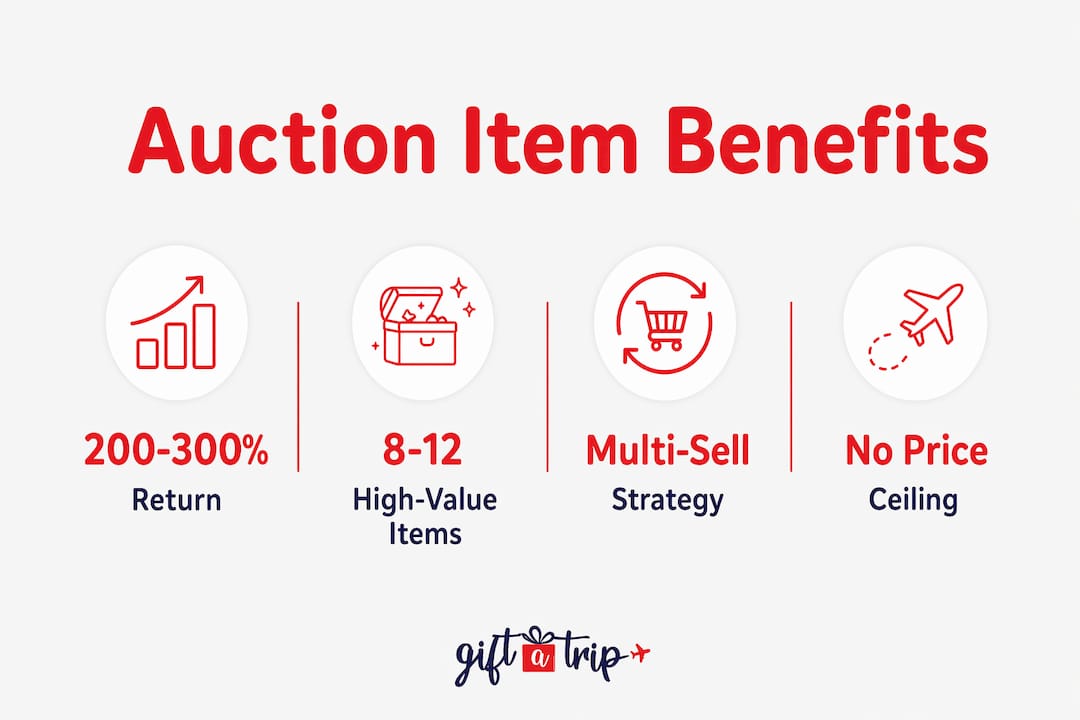
The revenue case for experiential items is concrete. Experience and travel packages frequently return 200–300% of their procurement cost. A resort certificate acquired at $500 can realistically sell for $1,000 to $1,500 at a well-run charity auction. No physical item category comes close to that margin on a consistent basis.

One reason is the absence of a retail price ceiling. Physical items are capped by visible retail prices, while experiences have no fixed ceiling. Bidders cannot look up the “correct” price for a private yacht charter or a behind-the-scenes stadium tour. That uncertainty works in the auctioneer’s favor every time.
Curation also matters. Experts recommend keeping live auction catalogs to only 8–12 high-value items to generate maximum competition. Fewer lots mean fewer distractions and more bidder focus on each prize. A tightly curated list of eight experiential items will consistently outperform a sprawling catalog of thirty mixed goods.
The table below shows how common experiential categories compare in terms of bidder appeal and revenue potential.
| Experience category | Bidder appeal | Revenue potential vs. cost |
|---|---|---|
| Luxury resort stays | Very high | 200–300% |
| Cruise packages | Very high | 200–300% |
| VIP event access | High | 150–250% |
| Private dining experiences | High | 150–200% |
| Adventure travel packages | High | 175–250% |
Multi-sell strategies add another layer of revenue. Selling the same experience to multiple bidders can triple revenue without adding a single new item to your inventory. If three guests all want the same resort package, sell it three times. Each buyer gets an identical certificate, and your organization collects three winning bids instead of one.
Pro Tip: Open your live auction with your strongest experiential item. Starting with the top lot builds immediate momentum and sets a high-energy tone that carries through every subsequent bid.
How to curate and present experiential auction items effectively
Great experiential items fail when they are presented poorly. The description is the first place organizers lose money. Donors respond to stories, not logistics. A description that reads “Four-night stay at a beachfront resort, subject to availability, blackout dates may apply” kills enthusiasm. A description that reads “Wake up to the sound of the ocean in a private suite on the Gulf Coast, with dinner for two included on arrival night” creates desire.
Simplified emotional storytelling consistently outperforms logistical detail in driving bidder enthusiasm. Save the fine print for after the auction closes. During the event, sell the feeling, not the terms.
Practical presentation steps that raise final bids:
- Use professional photography or vivid destination imagery in your printed catalog and digital displays.
- Write descriptions in second person. “You will” and “your suite” create personal ownership before the bidding even starts.
- Place your top experiential item first in the live auction sequence to anchor the room’s energy.
- Highlight exclusivity and scarcity. Scarcity drives urgency and pushes competitive bidders to act before someone else does.
- Train your auctioneer or emcee to tell a 30-second story about each experience before opening the bidding.
Travel packages are the most reliable category across donor demographics. Travel and adventure packages attract wider bidder interest than narrow-interest physical items because almost everyone values a vacation. A golf weekend appeals to golfers. A resort stay appeals to nearly everyone in the room.
Pro Tip: Pair a travel certificate with a small physical add-on, such as a luggage tag set or a travel journal, to make the package feel tangible and gift-ready at the moment of winning. This small touch increases perceived value without adding significant cost.
For organizers building their first experiential catalog, Giftatrip offers travel rewards for fundraising that are specifically designed for charity auction use, with flexible redemption and no-risk consignment options.
Common misconceptions about experiential auction items
The most persistent myth is that physical items are safer. Organizers assume that a tangible product is easier to sell because donors can see and touch it. The data says otherwise. Physical items underperform experiences on revenue margin, bidder enthusiasm, and donor satisfaction in the weeks after the event.
A second misconception is that experiences are logistically complicated. Organizers worry about redemption windows, travel restrictions, and donor complaints. These concerns are manageable with the right supplier. Well-structured travel certificates from reputable providers cover taxes and resort fees, carry minimal blackout dates, and come with clear redemption instructions that donors receive after the auction closes.
Key concerns organizers raise, and the honest answers:
- “What if donors don’t redeem the experience?” Unredeemed certificates still generate full auction revenue. The cause keeps the winning bid regardless of whether the winner travels.
- “What if the experience feels too exclusive for our donor base?” Broader demographic appeal is actually an advantage of travel and experience packages. They work across income levels when priced and presented correctly.
- “Should we include any physical items at all?” A small number of physical lots can anchor the silent auction and give lower-budget donors a way to participate. The live auction, however, should be dominated by experiences.
- “What about donors who can’t travel?” Offer a mix of local experiences, such as private dinners, spa days, or event tickets, alongside travel packages to give every bidder a relevant option.
The myth that physical items are necessary for silent auctions has been disproven repeatedly. High-quality experiences energize silent auction tables just as effectively as live auction floors. The key is presentation and starting bid placement.
Key Takeaways
Experiential auction items outperform physical goods in every measurable fundraising metric because they remove price ceilings, trigger emotional bidding, and generate revenue at 200–300% of procurement cost.
| Point | Details |
|---|---|
| Revenue performance | Experiences return 200–300% of procurement cost, far exceeding physical items. |
| No price ceiling | Experiences carry no retail reference price, allowing bids to rise without a cap. |
| Emotional bidding | Anticipatory emotion and social currency push donors to bid beyond rational limits. |
| Curate tightly | Limit live auctions to 8–12 items to maximize competition and focus. |
| Multi-sell strategy | Sell the same experience to multiple bidders to multiply revenue without extra inventory. |
What I’ve learned from watching auctions transform with experiences
I have watched fundraising events change completely when organizers make the shift from physical goods to experiential items. The room feels different. Bidders who were passive during the silent auction suddenly compete hard when a resort package or a private charter goes on the block.
The part that surprises most organizers is how little the specific destination matters compared to the feeling of exclusivity. A weekend at a well-presented regional resort can outbid a poorly described international trip every time. The story wins, not the geography.
What I find underused is the multi-sell strategy. Most auctioneers still treat each lot as a single sale. Selling three certificates for the same resort package to the three top bidders is one of the cleanest revenue multipliers in fundraising, and it leaves every competitive bidder feeling like a winner. That goodwill carries into the next event.
The organizations that consistently raise the most money are not the ones with the biggest budgets. They are the ones that understand donor loyalty through travel and build their auction strategy around emotional connection rather than retail value. That shift in thinking is available to any event, at any scale.
— Donovan
Giftatrip’s travel certificates for your next auction
Giftatrip provides travel certificates built specifically for fundraising auctions, with options spanning resort stays, hotel packages, and cruise lines including Virgin Voyages cruise certificates that consistently draw competitive bids at charity events. Every certificate covers taxes and resort fees, carries minimal blackout dates, and arrives via secure digital delivery, so your team handles zero physical fulfillment.

Organizers can browse the full auction-ready catalog to find packages that match their donor demographics and event budget. Giftatrip’s no-risk consignment model means your organization pays only when an item sells, removing the financial risk of unsold inventory entirely. For event planners ready to move beyond retail items, Giftatrip is the direct path to experiential auction packages that perform.
FAQ
What are experiential auction items?
Experiential auction items are prizes that deliver a live event, trip, or exclusive access rather than a physical product. Common examples include resort stays, cruise packages, VIP event tickets, and private dining experiences.
Why do experiential items raise more money than physical goods?
Physical items carry a visible retail price that caps bidding, while experiences have no fixed market price. Experiences also trigger anticipatory emotion and social currency, which push donors to bid competitively beyond rational limits.
How many experiential items should a live auction include?
Experts recommend 8–12 high-value items for a live auction. A tightly curated list generates more competition per item and keeps bidder energy focused throughout the event.
Can the same experience be sold to more than one bidder?
Yes. Multi-sell strategies allow organizers to sell identical experience certificates to multiple winning bidders. This approach can multiply revenue from a single popular package without adding inventory.
Are experiential items suitable for silent auctions?
Experiential items work well in silent auctions. High-quality experience packages energize guest engagement and drive competitive bidding at silent auction tables just as effectively as in live auction formats.