
Jump to Section:
Travel rewards beat merchandise for high-stakes recognition almost every time, because experiences create memories that last while objects sit in a drawer. Merchandise still wins for frequent, low-ceremony moments where speed and simplicity matter more than sentiment. The right call depends less on the reward category and more on how much choice, personalization, and administrative ease you build into the program.
TL;DR:
- Travel rewards create lasting memories and social stories, making them more effective for milestone and rare recognitions than merchandise.
- Merchandise stays visible daily and can be more practical, but it often lacks the emotional impact and long-term recall of travel experiences.
- Combining both reward types in a hybrid approach generally yields better results than choosing one category exclusively, especially when giving recipients a choice.
- Efficiently managing travel certificates requires understanding costs like taxes, fees, and logistics, which digital providers can streamline better than physical merchandise.
- Proper structuring of travel certificates, including fee transparency and minimal blackout dates, is essential to prevent surprises and ensure high redemption rates.
Table of Contents
- Travel Rewards vs Merchandise: What Changes Psychologically
- When Should You Choose Travel Rewards Over Merchandise?
- What Should You Budget and Plan for Operationally?
- How Do Travel Certificates Work in Practice?
- Donovan’s Perspective: Why the Either/Or Debate Misses the Point
- Ready to Add Travel Certificates to Your Reward Program?
- Sources
- FAQ
Travel Rewards vs Merchandise: What Changes Psychologically
The gap between these two reward categories isn’t really about price. It’s about what happens in the recipient’s head months later. Behavioral research on experiential versus material purchases consistently finds that experiences generate greater lasting happiness and get retold socially far more than physical items of equal value. A weekend at a resort becomes a story told at dinner parties for years. A branded fleece jacket becomes background noise in a closet within a month.
That durability comes down to hedonic adaptation, a key aspect explained in the role of customer service in hospitality which enhances guest experience and satisfaction. People get used to owning things fast. Novelty wears off, and the dopamine hit from unwrapping a nice gift fades within weeks. Experiences resist that fade because they’re tied to identity and memory rather than possession, and they generate a social multiplier: retelling a trip to coworkers extends the recognition well past the recipient, amplifying the message an award was meant to send in the first place.
None of that means merchandise is a weak choice across the board. Tangible perks that solve a real, visible problem can outperform expectations. One empirical study of workplace benefits found that certain non-monetary perks like company cars correlated with measurably higher work effort, suggesting category and utility matter as much as sentiment. A useful, visible object can serve as a daily reminder of recognition, offering a kind of ongoing presence that a one-time trip may not provide.
Here’s how the two categories tend to stack up on the traits that matter most to HR teams:
- Memorability: Travel rewards score higher on long-term recall; merchandise fades faster from memory.
- Social signaling: Trips generate spontaneous stories and photos; branded items rarely prompt unsolicited sharing.
- Daily visibility: Merchandise (bags, tech, apparel) stays in view longer as a recurring reminder.
- Perceived appreciation: Experiential rewards read as recognition; merchandise can read as transactional if not personalized.
- Practical utility: Functional merchandise solves an immediate need travel certificates don’t address.
Quick stat: Programs that combine both reward types report stronger results than single-category approaches, according to industry research on top-performing incentive programs, which points to hybrid strategies rather than picking one lane permanently.
When Should You Choose Travel Rewards Over Merchandise?
Instead of debating the categories in the abstract, run the decision through five variables: how often the reward happens, how much ceremony it deserves, your per-person budget, how many people you’re rewarding, and how much choice you can realistically offer.
- Annual or milestone awards (five-year anniversaries, top-performer recognition): choose travel rewards. The rarity of the occasion justifies the higher perceived value and the story it creates.
- High-volume spot recognition (weekly shoutouts, small wins): choose merchandise or gift cards. Speed and low administrative load matter more than ceremony here.
- Charitable auctions or event prizes: choose travel certificates. Industry guidance on experiential rewards versus gift cards recommends reserving experiences for rare, high-impact moments precisely because auction bidders respond to aspirational value.
- Large-scale programs with tight per-person budgets: choose merchandise, unless you can source travel certificates at a price point that still covers taxes and fees without breaking the budget.
- Programs where recipient preference is unknown or varies widely: choose a hybrid model, letting recipients pick between a certificate and a merchandise catalog.
Pro Tip: If you’re unsure which category will land better with a specific group, offer both and let the recipient choose. Programs that give people a choice consistently report higher satisfaction than programs that lock everyone into one preset reward.
The hybrid approach isn’t a compromise, it’s often the smarter default. Reserve travel rewards for the handful of moments each year that deserve a real story, and use merchandise or gift cards to keep frequent recognition moving without bogging down your team in logistics.
What Should You Budget and Plan for Operationally?
The reward category matters less than whether your team has planned for the paperwork behind it. Most program breakdowns aren’t about picking the wrong reward category. They’re about underestimating what it takes to deliver either one at scale.
Before you commit to a reward type, map out the full cost and timeline picture:
- Base cost: certificate face value or merchandise unit price before any add-ons.
- Taxes and resort fees: these can add 15 to 30% to a travel certificate’s real redemption cost if not built into the package upfront.
- Shipping and fulfillment: physical merchandise carries freight, warehousing, and damage-replacement costs that digital certificates avoid entirely.
- Personalization and messaging: custom branding or a handwritten note takes staff time regardless of category.
- Admin and reporting hours: tracking redemptions, resending lost codes, and reconciling budgets against finance.
Procurement timelines differ sharply between the two categories, and that difference should shape your ordering calendar.
| Factor | Travel certificates | Merchandise |
|---|---|---|
| Typical lead time for bulk orders | Days (digital delivery) | Weeks (manufacturing, shipping) |
| Fee transparency risk | Resort fees can surprise if not included upfront | Shipping and customs fees can surprise on international orders |
| Redemption support needed | Yes, recipients need booking guidance | Minimal, item ships directly |
| Storage/inventory required | None | Yes, for physical stock |
Digital delivery removes most of the friction on the travel side. A provider that bundles taxes and resort fees into the certificate price, and handles bulk order distribution with tracking and redemption support, cuts the administrative burden that usually pushes planners toward merchandise by default.
How Do Travel Certificates Work in Practice?
A travel certificate isn’t a vague promise of “a trip someday.” It’s a redeemable code or voucher tied to a specific brand, resort chain, or cruise line, with defined inclusions and a redemption window. Recipients typically log in to a booking portal, select dates within available inventory, and confirm a stay. The certificate’s fine print determines what’s covered and what isn’t, which is exactly where most administrative headaches start.
The two details that make or break a program are fee inclusion and blackout policy. A certificate that quietly excludes taxes and resort fees can leave a recipient facing a surprise bill at checkin, which turns a goodwill gesture into a complaint. A certificate with heavy blackout dates can sit unused until it expires.
Gift A Trip addresses both issues directly in how it structures certificates for HR and event use:
- Secure digital delivery, so bulk orders reach recipients instantly without shipping delays.
- Customizable gift boxes for large corporate or event orders.
- Personalized messaging options for milestone recognition.
- Taxes and resort fees built into the certificate price, removing the redemption-time surprise that erodes goodwill.
- Minimal blackout dates, so recipients can actually book the trip they were promised.
For planners choosing between a certificate provider and a general merchandise procurement channel, the deciding factor usually comes down to this: merchandise vendors are built for physical goods logistics, while a dedicated travel certificate provider is built for redemption support and fee transparency, the two things that make travel rewards succeed or fail after the gift is given.
Donovan’s Perspective: Why the Either/Or Debate Misses the Point
After years of watching incentive programs get designed from a spreadsheet instead of from the recipient’s perspective, I’ve noticed the same mistake repeat itself: treating “travel rewards vs merchandise” as a permanent policy decision instead of a per-occasion judgment call.
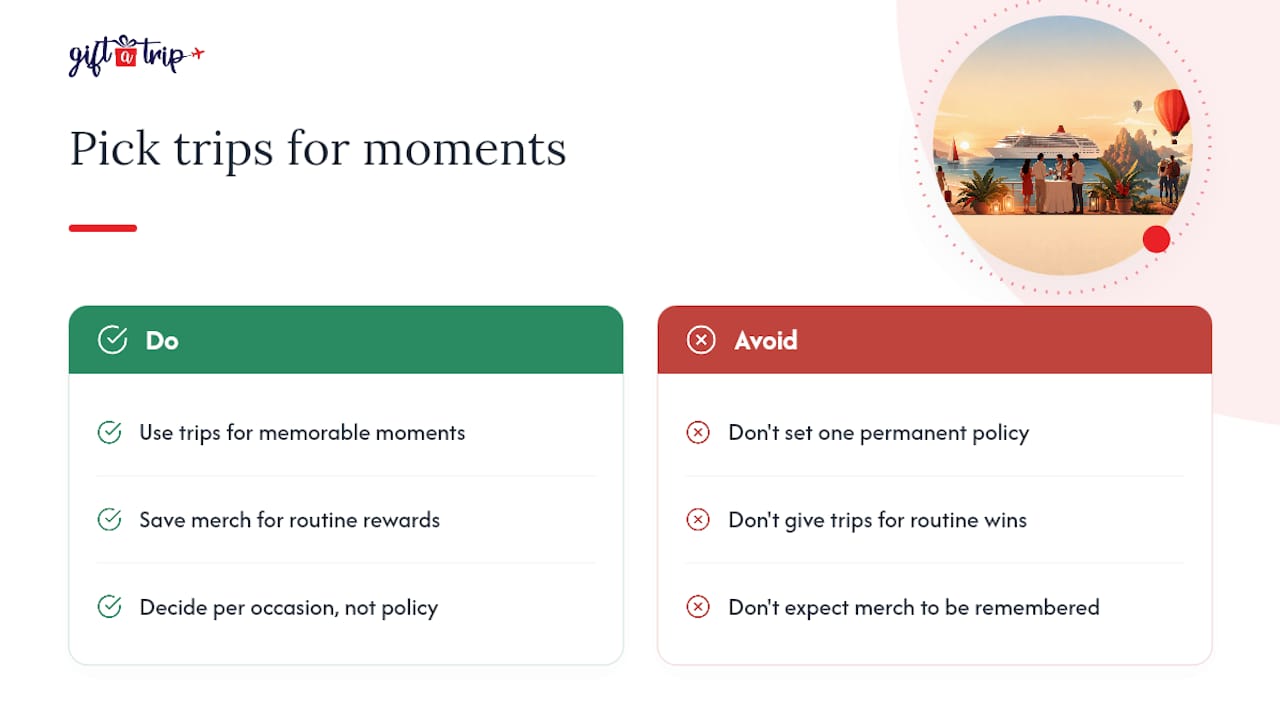
The strongest programs I’ve seen described in industry case studies don’t pick a lane. They reserve travel certificates for the five or six moments a year that actually deserve a story, and use merchandise or gift cards for the fifty other moments that just need to happen on time. One incentive-program story worth remembering: a sales team that received a resort certificate for hitting an annual target still mentioned the trip in meetings a year later. Nobody mentions the branded tumbler.
If you’re building a program from scratch, don’t ask which category is better. Ask which moments deserve to be remembered, and reward those with a trip.
— Donovan
Ready to Add Travel Certificates to Your Reward Program?
If you’ve been defaulting to merchandise because travel rewards seemed too complicated to administer at scale, there are services built to solve that problem. Bulk orders ship through secure digital delivery, gift boxes are customizable for corporate branding, and every certificate price already includes taxes and resort fees, so there’s no surprise bill waiting for the recipient at checkin.
Planners running annual awards, service anniversaries, or charitable auctions can browse ready-made options like the Virgin Voyages cruise certificates or work from the full travel certificate distribution guide to plan a bulk order for your next recognition cycle. Request a sample certificate or a bulk-order quote today to see how quickly a program like this can go from decision to delivery.
Sources
- Study on benefits and work effort (Springer article)
- Experience Gifts vs Physical Rewards: What Research Shows | Teambonder
- Experiential rewards vs gift cards: When to use which one | Empuls/Xoxoday
FAQ
Are Travel Rewards Better Than Merchandise for Retention?
Travel rewards tend to produce stronger long-term retention effects for milestone recognition because experiences create memories and social stories that outlast the novelty of a physical item.
Can Merchandise Ever Outperform Travel Rewards?
Yes. Functional, visible items tied to daily work tasks can produce measurable increases in effort and engagement, particularly when the item solves a real, recurring problem for the recipient.
Should a Program Choose One Reward Category or Mix Both?
Most top-performing programs mix both, using travel certificates for rare high-ceremony moments and merchandise or gift cards for frequent, high-volume recognition.
How Does Gift A Trip Simplify Bulk Travel Certificate Orders?
Gift A Trip provides secure digital delivery, customizable gift boxes, personalized messaging, and certificates that already include taxes and resort fees, which removes most of the administrative friction HR teams face with bulk travel rewards.