Jump to Section:
TL;DR:
- Planning and compliance are crucial to ensure travel certificates arrive on time and meet regulatory standards.
- Using a trusted provider with broad inventory and transparent pricing simplifies distribution and enhances participant satisfaction.
How does the step-by-step bulk travel certificate ordering process work?
Getting bulk travel certificates from idea to inbox follows a clear sequence. Nail each phase and you avoid the two most common failures: certificates that arrive late and programs that nobody redeems.
Here is the core process at a glance:
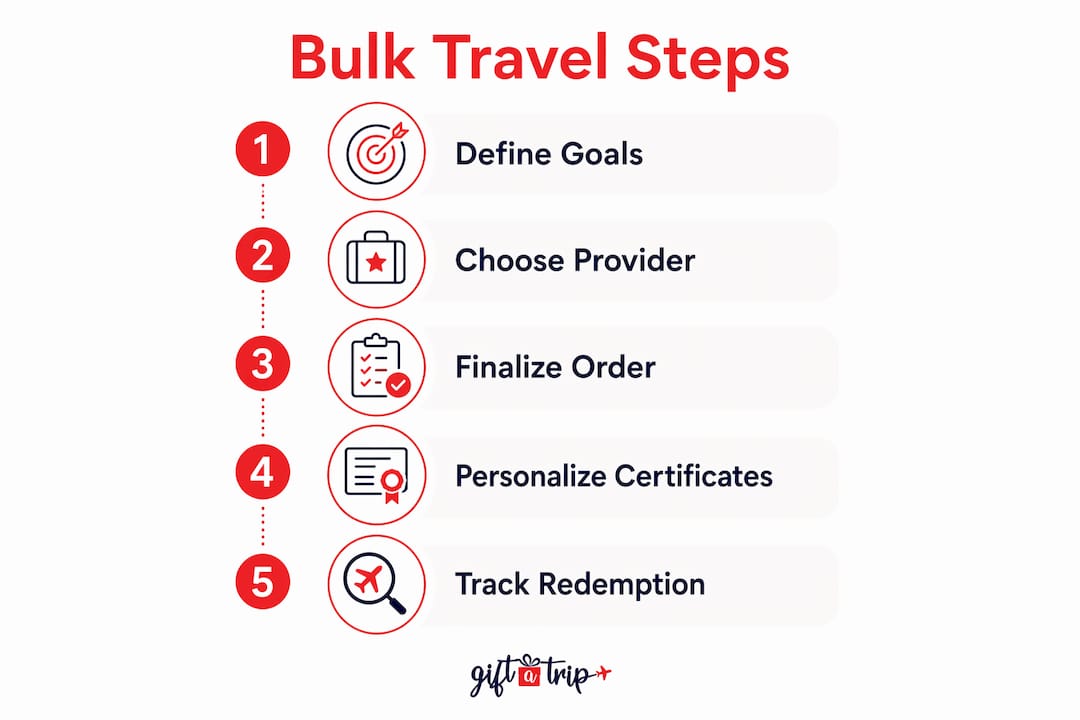
- Define program goals and recipient criteria before touching any order form
- Select a provider with a wide travel network and transparent, all-in pricing
- Finalize order volume, customization options, and delivery schedule
- Review legal and compliance requirements, including cancellation terms and tax treatment
- Distribute certificates with personalized messaging and a tracking system in place
- Monitor redemption and outcomes against your original program goals
Each step builds on the last. Skip the goal-setting phase and you will likely choose the wrong certificate type. Skip compliance review and you may face tax reporting headaches after the fact. The travel certificate ordering process rewards preparation more than speed.
How to order travel certificates in bulk: a detailed 2026 walkthrough
Step 1: Define your objectives and qualifying criteria
Start with a single question: what behavior or outcome are you rewarding? Common goals include hitting a sales target, completing a training milestone, or recognizing tenure. Once the goal is clear, set the qualifying criteria, whether that is a revenue threshold, a performance ranking, or a points total. The Incentive Research Foundation’s research on successful incentive programs identifies clearly tied earning criteria as one of five core elements that determine whether a program actually works.
Document your recipient list, estimated headcount, and any eligibility rules before you contact a provider. This saves significant back-and-forth later.
Step 2: Choose the right provider
Provider selection comes down to three factors: inventory depth, pricing transparency, and delivery infrastructure. A provider with a narrow hotel network will frustrate recipients who live in markets those properties do not serve. Wide travel inventory directly affects perceived value, so prioritize breadth of options across resorts, cruises, and vacation packages. Industry guidance from the IRF consistently recommends engaging a professional partner for buying power, risk mitigation, and up-front program design.

Ask every candidate provider three direct questions: Are taxes and resort fees included in the certificate price? What are the blackout date restrictions? What happens if a recipient needs to cancel or reschedule?
Step 3: Finalize volume, customization, and delivery schedule
Once you have chosen a provider, lock in your order volume and any branding requirements. Most corporate programs benefit from branded digital gift boxes that carry company logos and personalized messages. Customized digital delivery with company branding measurably increases the perceived value of the reward and reinforces employer brand at the moment of receipt.
Build your delivery schedule around the program calendar, not the provider’s convenience. If certificates are tied to a Q4 sales contest, recipients should receive them within days of the announcement, not weeks.
Timeline expectations:
- Planning and provider selection: 2–4 weeks
- Order processing and customization: 1–2 weeks
- Digital delivery to recipients: same day to 48 hours after processing
- Redemption window: typically 12–18 months from issuance
Step 4: Address legal and compliance requirements
This step gets skipped more often than any other, and it causes the most problems. Legal and compliance considerations must be addressed before you place the order, not after. Key areas to cover:
- Tax treatment: In the US, travel certificates issued as employee rewards are generally treated as taxable compensation. Confirm with your payroll or tax team how to report and gross up the value.
- Cancellation and refund policies: Understand what happens if a recipient cannot travel during the validity window.
- State-specific regulations: Some states have specific rules around gift certificate expiration and fees. Check the rules for your recipients’ states of residence.
- Data privacy: Bulk orders require collecting recipient names and email addresses. Confirm your provider handles that data in compliance with applicable privacy standards.
Step 5: Distribute, personalize, and track
Distribution is where programs either land or fall flat. A certificate that arrives with a generic subject line and no context gets ignored. Pair each certificate with a clear explanation of what it covers, how to redeem it, and who to contact for support. Platforms that make redemption feel effortless see meaningfully higher participation rates than those that leave recipients to figure it out themselves.
Set up tracking from day one. Monitor delivery confirmations, redemption rates, and support requests. That data tells you whether the program is working and where to adjust.
Pro Tip: Use branded digital gift boxes with a personalized note from a senior leader. Recipients who feel genuinely recognized, not just processed, redeem at higher rates and remember the experience longer.
What best practices actually move the needle on travel incentive programs?
The difference between a travel certificate program that drives results and one that collects dust usually comes down to execution, not budget.
- Communicate the program clearly and early. Recipients need to understand how to qualify, what the certificate covers, and exactly how to book. Ambiguity kills participation.
- Offer flexible travel options. A single resort destination excludes recipients who cannot travel to that location. Programs with broad inventory, including resorts, cruises, and vacation packages, serve diverse workforces far better.
- Track redemption rates actively. A low redemption rate is not proof that employees dislike travel. It usually signals a confusing booking process or limited options, both of which are fixable.
- Tie recognition to the moment. Certificates delivered weeks after a milestone lose emotional impact. Speed of recognition matters as much as the reward itself.
- Measure outcomes against your original goals. Did sales increase? Did retention improve? Without baseline data, you cannot prove ROI to leadership.
Travel rewards consistently outperform cash incentives on emotional resonance and long-term loyalty. Experiential rewards create lasting memories that cash simply cannot replicate, and that emotional connection translates into stronger engagement over time. For a deeper look at why travel outperforms bonuses, the travel certificates vs cash bonuses comparison lays out the evidence clearly.
Programs that combine transparent qualification criteria, flexible redemption, and consistent communication tend to see the strongest results. The IRF’s anatomy of a successful incentive travel program found that clear, consistent communication throughout the earning period, not just at the finish line, keeps participants motivated across the full program cycle.
How Giftatrip simplifies bulk travel certificate ordering for US companies
Giftatrip is built specifically for the use case this article covers: corporate HR teams, sales managers, and event planners who need to order travel certificates in volume without turning it into a full-time project.
- Extensive travel inventory: Giftatrip’s certificates are redeemable at resorts, hotels, cruise lines including Virgin Voyages and Crystal Cruises, and vacation packages from major brands, giving recipients genuine choice.
- All-inclusive pricing: Taxes and resort fees are covered in the certificate value, so recipients do not encounter surprise charges at checkout. Understanding resort fees and hidden costs upfront is one of the clearest advantages of working with a provider that builds them in.
- Minimal blackout dates: Flexible redemption windows mean recipients can book when it works for them, not just during narrow availability windows.
- Secure digital delivery with branded packaging: Certificates arrive via secure digital delivery in customizable gift boxes, complete with personalized messaging. That presentation matters, especially for employee recognition programs where the moment of receipt sets the tone.
- Reporting and tracking tools: Giftatrip’s platform gives program administrators visibility into order status and delivery confirmation, reducing the manual follow-up that typically burdens HR teams.
- Support for loyalty programs and charitable gifting: Beyond employee rewards, Giftatrip certificates work for corporate gifting programs, sales incentives, charitable auctions, and milestone celebrations.
Pro Tip: Giftatrip’s HR and events distribution guide walks through the full ordering and delivery workflow. Using it as a checklist before your first bulk order cuts setup time and prevents the most common administrative errors.
Ready to place your first bulk order? Giftatrip’s bulk order gifting guide for corporate planners covers every detail, from minimum quantities to branded delivery options.
How to efficiently order bulk travel certificates: a quick recap
Before you place an order, run through this checklist:
- Set clear program goals and define qualifying criteria in writing
- Choose a provider with broad travel inventory and all-in pricing that covers taxes and fees
- Follow a standardized process: define, select, finalize, comply, distribute, and track
- Communicate the program and redemption process clearly to every recipient
- Offer flexible travel options that work for a diverse group of recipients
- Use a trusted platform like Giftatrip to handle digital delivery, branding, and reporting without adding internal overhead
Key Takeaways
Bulk travel certificate programs succeed when every phase, from goal-setting to redemption tracking, is planned before the first order is placed.
| Point | Details |
|---|---|
| Start with clear goals | Define qualifying criteria and program objectives before selecting a provider or placing any order. |
| Prioritize all-in pricing | Choose a provider that includes taxes and resort fees to prevent surprise charges for recipients. |
| Plan your timeline | Allow 2–4 weeks for planning, 1–2 weeks for processing, and up to 48 hours for digital delivery. |
| Address compliance early | Confirm US tax treatment, cancellation policies, and state-specific gift certificate rules before ordering. |
| Track redemption actively | Monitor redemption rates after distribution; a low rate usually signals a process or inventory problem, not disinterest. |
FAQ
What is a bulk travel certificate order?
A bulk travel certificate order is a single purchase of multiple travel certificates, typically made by a company for employee rewards, sales incentives, or event gifting, processed through a provider’s corporate ordering system.
How long does the bulk ordering process take from start to delivery?
Planning and provider selection typically takes 2–4 weeks, order processing and customization takes 1–2 weeks, and digital delivery to recipients can happen within 48 hours of processing.
Are taxes and resort fees included in travel certificate pricing?
Not always. Providers vary widely on this. Giftatrip includes taxes and resort fees in its certificate pricing, so recipients do not face unexpected charges when they book.
What compliance issues should HR teams address before ordering?
US employers must confirm the tax treatment of travel certificates as employee compensation, review cancellation and refund policies, check state-specific gift certificate regulations, and verify that recipient data is handled in line with applicable privacy standards.
How do you increase redemption rates in a travel certificate program?
Keep the redemption process simple, offer a wide range of travel options, and communicate program details clearly at the time of distribution. Confusing redemption processes are the leading cause of low participation, not lack of interest in travel.