Jump to Section:
Why experiential rewards outperform traditional incentives
Experiential rewards are non-cash incentives that give recipients a memorable, personal experience rather than a physical object or money. Think travel certificates, concert tickets, spa retreats, or cooking classes. Their core role is not simply to say “thank you” but to create an emotional bond between the giver and the recipient that a gift card or cash bonus rarely achieves.
The preference data is striking. A Retail Technology Show 2026 survey found that 54% of consumers prefer experiential perks over traditional discounts, rising to 66% among Millennials. That gap matters because Millennials now make up the largest share of the workforce and a dominant slice of consumer spending.
What makes experiential rewards especially powerful is their ability to reinforce desired behaviors while creating stories people want to share. A cash bonus gets deposited and forgotten. A weekend at a resort becomes a story told at dinner parties for years. Research published in the Journal of Retailing confirms that experiential rewards boost word of mouth, loyalty, and spending both during and after the reward pursuit, driven by stronger self-connection than material alternatives.

Giftatrip sits squarely in this space, offering digital travel certificates redeemable at resorts, hotels, cruise lines, and vacation packages from major brands. For loyalty managers and HR professionals designing programs in 2026, that kind of turnkey experiential option removes the logistical friction that often kills a good idea before it launches.
Key reasons experiential rewards outperform traditional incentives:
- They create emotional memories that outlast the reward itself
- They generate social sharing, extending brand reach organically
- They connect to personal identity, not just purchasing behavior
- They reduce hedonic adaptation, keeping satisfaction higher over time
- They drive measurable gains in retention, engagement, and spending
Why customers and employees prefer experiences over cash
People claim to prefer cash. Then they perform better when they receive experiences. That contradiction sits at the heart of reward program design in 2026, and understanding it changes how you build a program.
The behavioral economics explanation is hedonic adaptation: humans quickly return to their baseline happiness after acquiring a material object. A new laptop is exciting for a week. A trip to the Caribbean is still being talked about a year later. Experiences resist adaptation because they are tied to memory, identity, and social connection rather than ownership.

Research on emotional memory and experiences shows that experiences evoke longer-lasting emotions than material benefits precisely because of this mechanism. The anticipation before a trip, the experience itself, and the retelling afterward all extend the emotional return well beyond the moment of delivery.
Among employees, the preference shift is especially visible in burnout-prone environments. Experiential rewards reduce burnout and improve morale by providing meaningful breaks and genuine motivation, according to research on workplace well-being. For Millennials and Gen Z workers, recognition that feels personal and story-worthy carries far more weight than a line item on a paycheck.
What drives the preference for experiences:
- Anticipation creates a second wave of enjoyment before the experience even happens
- Experiences are harder to compare to a dollar amount, reducing the “was it worth it?” second-guessing
- Social sharing turns a personal reward into a public signal of recognition
- Personalization signals that the organization actually knows who you are
- Experiences connect to self-identity in ways that a cash deposit never can
How experiential rewards differ from traditional and material rewards
The difference between handing someone $500 and sending them a travel certificate is not just format. It is psychological architecture.
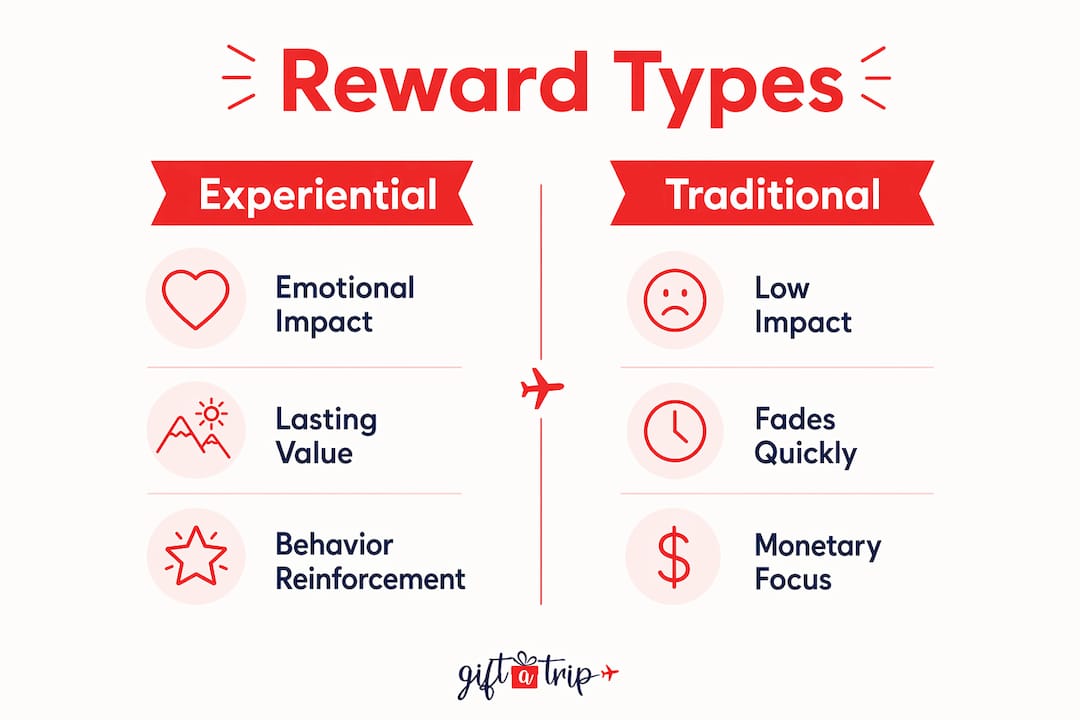
Cash gets mentally filed under “income” or “savings.” It blends into the household budget and loses its identity as a reward almost immediately. An experience, by contrast, stays categorized as a gift. That mental separation matters because it changes how the recipient feels about the giver, and how motivated they are to earn the reward again.
A BI Worldwide study found that employees rewarded with experiential incentives showed notably higher performance improvement during a competition compared to those receiving cash. That gap is not marginal. It reflects a fundamental difference in how the brain processes the two reward types.
Physical gifts occupy a middle ground. They are tangible, which some recipients appreciate, but they carry the risk of missing the mark entirely. A gift that does not fit someone’s taste can feel worse than nothing. Experiences, especially those with some degree of choice built in, sidestep that problem. Research from the O.C. Tanner Global Culture Report confirms that customization in rewards consistently increases satisfaction more than predetermined gifts.
The most effective programs in 2026 use hybrid structures: a curated menu of experiential options alongside a smaller selection of physical rewards. This approach respects individual preference while keeping the emotional weight of the experience at the center. Points-based structures that let recipients save toward a meaningful experience also sustain effort longer than one-time cash payouts, because the goal stays visible and personally meaningful throughout the earning period.
Experiential vs. traditional rewards at a glance:
| Factor | Experiential rewards | Cash or material rewards |
|---|---|---|
| Emotional impact | High and lasting | Low, fades quickly |
| Social shareability | Strong | Minimal |
| Personalization potential | High | Low to moderate |
| Hedonic adaptation resistance | Strong | Weak |
| Performance improvement | — | — |
| Identity connection | Strong | Weak |
Types of experiential rewards and real-world examples
Experiential rewards span a wide range of categories, and the right choice depends on your audience, your budget, and what behavior you are trying to reinforce.
Incentive travel is the category with the most consistent data behind it. According to the 2023 Incentive Travel Index, 90% of respondents cite travel as a retention driver, and 53% of senior leaders view it as a “need to have” rather than a nice extra. Giftatrip’s digital travel certificates make this category accessible without the logistical complexity of booking group trips. Recipients can redeem certificates for stays at resorts, hotels, or cruise lines from major brands, with taxes and resort fees covered and minimal blackout dates.
Wellness experiences include spa days, fitness retreats, meditation programs, and mental health days. These resonate particularly well in high-stress industries and with employees who are already showing signs of burnout. The connection between wellness rewards and reduced burnout is well-documented, and the signal they send about organizational values is hard to replicate with a cash bonus.
Learning and development experiences cover masterclasses, industry conferences, professional certifications, and skills workshops. For employees who are motivated by growth, these rewards double as career investment. They also carry a practical benefit for the employer: the skills come back to the organization.
Team and social experiences such as group dinners, escape rooms, cooking classes, or sporting events build culture and belonging. These work best as recognition for collective achievement rather than individual performance. The experience of doing something memorable together reinforces team identity in a way that individual rewards cannot.
Local and lifestyle experiences include concert tickets, wine tastings, art classes, and adventure activities. These are highly personalizable and work well for customer loyalty programs where the goal is to surprise and delight rather than simply transact.
Pro Tip: When designing a loyalty program, offer a tiered experience menu rather than a single reward. Letting recipients choose from three to five options at a given points level increases perceived value without increasing cost, and it dramatically reduces the chance of a reward missing the mark.
For HR professionals looking at employee rewards examples, travel certificates consistently rank among the highest-impact options because they combine aspiration, personalization, and lasting memory in a single, easy-to-deliver package.
Why value matters more than cost in experiential rewards programs
The instinct to evaluate a reward by its price tag is understandable but counterproductive. A $50 experience that connects to someone’s identity and creates a story they share with friends delivers more program ROI than a $200 cash bonus that disappears into a checking account.
The research on this is consistent. Experiential rewards have been shown to significantly improve employee retention compared to standard recognition programs. Retention is expensive to lose: replacing an employee typically costs a significant portion of their annual salary, so even a modest improvement in retention rates pays back the investment in rewards many times over.
Redemption architecture is where many programs quietly fail. A Deloitte survey found that 40% of consumers sometimes forget to redeem loyalty rewards. Unredeemed rewards are not neutral. They signal that the program is not compelling enough to stay top of mind, and they erode the emotional connection the program was designed to build. Frictionless, personalized redemption is not a design luxury. It is a retention mechanism.
The value-over-cost principle also applies to how you communicate rewards. Framing a travel certificate as “a weekend at a beachfront resort” lands differently than “a $300 reward.” The experience framing activates anticipation and imagination. The dollar framing invites comparison and skepticism. For program designers, the language around the reward is almost as important as the reward itself.
Business case for prioritizing value:
- Higher retention reduces replacement costs significantly
- Emotional connection to the brand drives repeat purchases and referrals
- Personalized experiences increase redemption rates, keeping the program active
- Stories shared by recipients extend brand reach at no additional cost
- Small experiential rewards can match the impact of much larger material ones
What the research reveals about emotional connection and program outcomes
The most counterintuitive finding in experiential rewards research is the preference paradox: people consistently say they would prefer cash, but they consistently perform better and report higher satisfaction when they receive experiences. This gap between stated preference and actual outcome is why program designers who rely on employee surveys to set reward structures often end up with underperforming programs.
Four lab studies and two field studies published in the Journal of Retailing in 2026 found that experiential rewards significantly boost word of mouth, loyalty, redemptions, and spending compared to material rewards. Critically, even small experiential rewards produced effects comparable to large material ones. That finding has direct implications for budget-constrained programs: you do not need to spend more, you need to spend differently.
The mechanism behind this is self-connection. Experiences align with how people see themselves and want to be seen. A travel reward says something about who you are. A cash deposit says nothing. When a reward connects to identity, the recipient associates that feeling with the brand or employer who gave it, and that association persists long after the experience ends.
Hybrid programs that combine curated experiential options with physical rewards yield the highest satisfaction and inclusiveness. Not everyone wants to travel. Some employees have caregiving responsibilities that make a weekend away impractical. A well-designed program acknowledges this without abandoning the experiential core. Offering a wellness retreat, a local dining experience, and a travel certificate at the same tier gives recipients genuine choice while keeping the emotional weight of the program intact.
Pro Tip: Do not design your reward program based solely on what employees say they want in a survey. Run a small pilot with experiential options alongside cash equivalents and measure actual redemption rates, performance changes, and post-reward engagement scores. Behavioral data will tell you more than stated preferences.
Understanding why experiences outperform products is the foundation for building programs that actually change behavior rather than simply checking a recognition box.
How to design an effective experiential rewards program
Effective program design starts with a clear answer to one question: what behavior are you trying to change or reinforce? Retention, referrals, sales performance, and wellness engagement each call for different reward structures and experience categories.
Segment your audience before you build the reward menu. A sales team motivated by competition and status responds well to aspirational travel rewards with public recognition attached. A customer service team dealing with daily stress responds better to wellness experiences and flexible time off. Treating all employees or customers as a single audience produces a program that resonates with no one in particular.
Build in choice at every tier. The research on customization is clear: choice increases satisfaction more than a single predetermined reward, even when the options are equivalent in cost. At each redemption level, offer three to five distinct experience categories so recipients can select what fits their life. Giftatrip’s digital travel certificates work well here because they give recipients flexibility in when and how they use the reward, rather than locking them into a specific date or destination.
Make redemption frictionless. Given that a significant portion of consumers sometimes forget to redeem loyalty rewards, the redemption process itself needs to be as simple as possible. Digital delivery, clear instructions, and reminder communications at key intervals all reduce the drop-off between earning a reward and actually using it.
Tie the reward to the achievement publicly. The recognition moment matters as much as the reward itself. Announcing a travel certificate award in a team meeting or company newsletter amplifies the emotional impact and signals to others what behaviors the organization values. The social visibility of the recognition is part of what makes experiential rewards generate stories.
Review and refresh the reward menu annually. Experience preferences shift. What felt aspirational in 2024 may feel routine by 2026. Keeping the menu current signals that the program is alive and that the organization is paying attention to what its people actually want.
How to measure the impact of experiential rewards on engagement and loyalty
Measuring experiential rewards requires a broader set of metrics than a simple cost-per-redemption calculation. The goal is to capture behavioral change, not just transaction volume.
Retention rate is the most direct measure for employee programs. Track turnover among employees who have received experiential rewards versus those who have not, controlling for tenure and role. A meaningful gap in retention rates is the clearest signal that the program is working. Given that experiential rewards can drive up to 6x higher retention compared to standard programs, even a modest improvement justifies the investment.
Net Promoter Score (NPS) and word-of-mouth referrals are the key metrics for customer loyalty programs. Experiential rewards are specifically designed to generate stories and sharing, so tracking whether rewarded customers refer others at higher rates than non-rewarded customers captures the program’s downstream value. The Journal of Retailing research found that experiential rewards significantly boost word of mouth compared to material alternatives, making referral tracking a natural fit.
Redemption rate tells you whether the reward is compelling enough to stay top of mind. A low redemption rate is a warning sign, not a cost saving. It means the program is not creating the emotional pull it needs to drive behavior. Target a redemption rate above 70% as a baseline for a healthy program.
Post-reward engagement scores measure whether the emotional lift from an experience translates into sustained behavior change. Survey participants 30 and 90 days after redemption to track changes in job satisfaction, brand affinity, or purchase frequency. The persistence of that lift is what separates a well-designed experiential program from a one-time feel-good moment.
Performance metrics tied to the rewarded behavior close the loop. If the program rewards sales performance, track whether rewarded employees maintain higher performance in the quarter after receiving the reward. If it rewards customer referrals, track whether referred customers have higher lifetime value than those acquired through other channels.
Challenges and best practices in implementing experiential rewards
The biggest implementation challenge is logistics. Sourcing, delivering, and tracking experiential rewards at scale is harder than issuing a gift card, which is why many programs default to cash or points despite the evidence favoring experiences. Digital travel certificates from platforms like Giftatrip solve a significant portion of this problem by handling fulfillment, personalization, and delivery in a single workflow.
Inclusivity is a real design constraint. Not every experience works for every person. Travel rewards exclude employees with mobility limitations, caregiving responsibilities, or anxiety about unfamiliar environments. A program that only offers travel risks signaling that certain employees are not the intended audience. The solution is a tiered menu that includes local, wellness, and learning experiences alongside travel, so every recipient can find something meaningful.
Budget allocation often underweights the communication layer. Organizations spend on the reward and almost nothing on the recognition moment surrounding it. A travel certificate handed over in a plain envelope during a routine one-on-one meeting delivers a fraction of the emotional impact of the same certificate presented publicly with a specific acknowledgment of what the recipient did to earn it. The ceremony around the reward is not optional.
Avoiding reward fatigue requires rotating the experience menu and introducing new categories over time. When the same options appear year after year, the anticipation that drives performance drops. Introducing a new experience category annually, such as adventure travel, culinary experiences, or wellness retreats, keeps the program feeling fresh.
Best practices for implementation:
- Partner with a platform that handles digital delivery and fulfillment at scale
- Build a tiered menu with at least three experience categories per level
- Invest in the recognition moment, not just the reward itself
- Track redemption rates monthly and investigate drops immediately
- Refresh the experience menu at least once a year
- Communicate the program clearly and repeatedly so it stays top of mind
For teams building or rebuilding a recognition program, the travel certificate distribution guide from Giftatrip covers the practical logistics of delivering experiential rewards at scale across HR and events contexts.
Hospitality professionals can also draw on how guest experience delivery works in hotel and resort settings, where experiential reward design has been refined over decades of direct customer interaction.
Giftatrip makes it straightforward to put travel experiences at the center of your rewards program. Digital travel certificates are redeemable at resorts, hotels, and cruise lines from major brands, with taxes and resort fees covered, minimal blackout dates, and secure digital delivery for bulk corporate orders. Whether you are rewarding a sales team, recognizing a top customer, or building a loyalty tier that actually drives behavior, the benefits of experiential gifting are built into every certificate.
Explore corporate travel gift ideas that inspire, reward, and retain the people who matter most to your organization.
Key Takeaways
Experiential rewards outperform cash and material incentives because they create lasting emotional connections, drive higher performance, and generate stories that reinforce brand loyalty long after the reward is received.
| Point | Details |
|---|---|
| Consumer preference is shifting | 54% of consumers prefer experiential perks over discounts, rising to 66% among Millennials. |
| Performance gap is measurable | Experiential incentives drove much higher performance improvement compared to cash in a direct comparison. |
| Retention impact is significant | Experiential rewards can drive up to 6x higher employee retention compared to standard recognition programs. |
| Redemption design matters | 40% of consumers sometimes forget to redeem loyalty rewards, making frictionless delivery a core program requirement. |
| Choice increases satisfaction | Customization and choice in rewards consistently increase satisfaction more than predetermined gifts. |
FAQ
What is an experiential reward?
An experiential reward is a non-cash incentive that gives the recipient a memorable activity or event rather than money or a physical object. Examples include travel certificates, spa visits, concert tickets, and cooking classes.
What are the four types of rewards?
Reward programs typically organize incentives into four categories: monetary rewards (cash, bonuses), material rewards (physical gifts, merchandise), experiential rewards (travel, events, activities), and recognition rewards (public acknowledgment, titles, awards). Experiential and recognition rewards tend to produce the strongest long-term engagement.
What are the three types of rewards?
A common framework groups rewards into intrinsic rewards (internal satisfaction from the work itself), extrinsic rewards (external incentives like pay or gifts), and social rewards (recognition, belonging, and status). Experiential rewards span both extrinsic and social categories, which is part of why they outperform pure cash incentives.
What are the five pillars of total rewards?
Total rewards frameworks typically cover compensation, benefits, work-life balance, performance and recognition, and development and career opportunities. Experiential rewards most directly strengthen the recognition and work-life balance pillars, though well-designed programs can also support development through learning experiences.
Why do experiential rewards outperform cash bonuses for motivation?
Experiences resist hedonic adaptation, meaning the satisfaction they create lasts longer than the satisfaction from a material purchase of equivalent value. Research also shows that people connect experiences to their identity more strongly than they connect cash, which drives higher performance and deeper loyalty to the organization that gave the reward.